
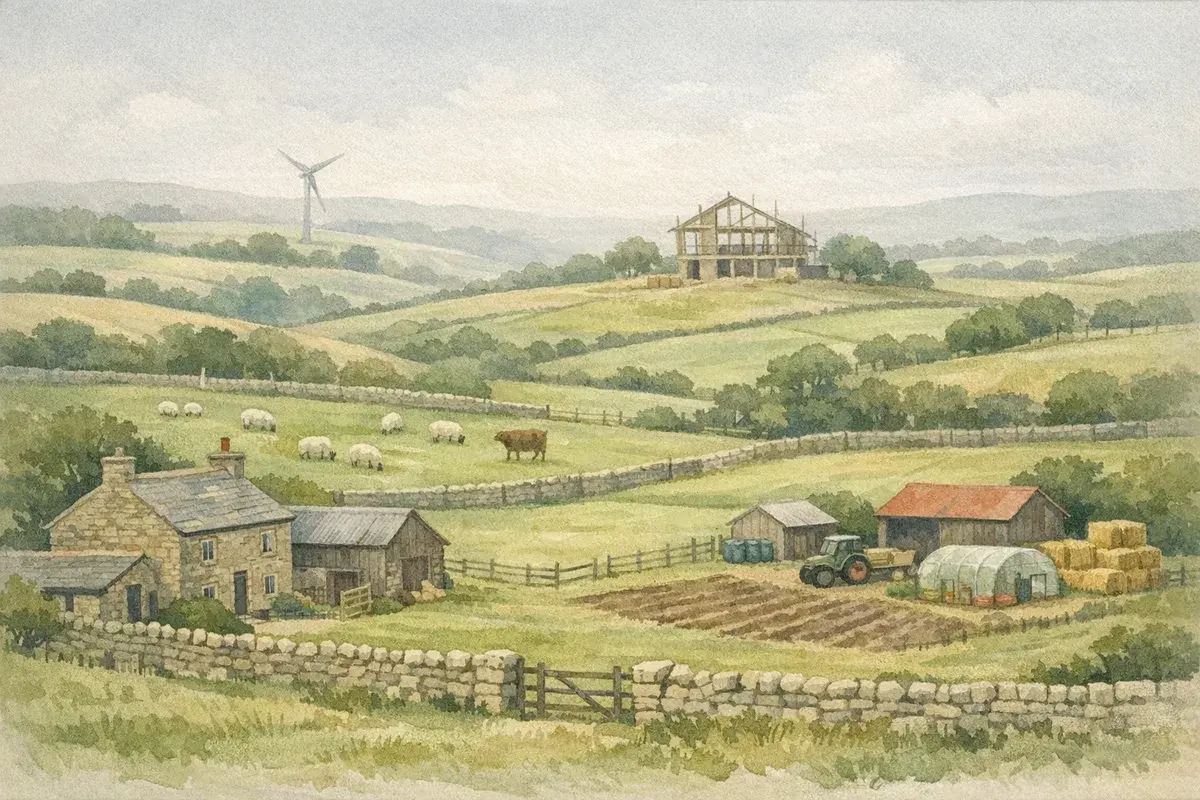
You can buy a field in the UK and still be surprised by how little you're actually allowed to do with it.
That's because "planning permission on agricultural land" isn't really one rule, it's a web of definitions (what counts as agriculture?), triggers (what's a material change of use?), and location-based constraints (Green Belt, highways access, flood risk, protected habitats). Add permitted development rights (which feel straightforward until they aren't), and it's easy to make a costly assumption.
This guide cuts through the confusion. You'll learn what tends to be possible without full planning, what almost always needs consent, why councils refuse rural proposals, and how to approach a planning strategy that stands up to scrutiny, whether you're farming, investing, or diversifying.
Start With The Basics: Agricultural Use, Planning Permission, And Material Change Of Use
Planning law jargon can feel like it's designed to trip you up. But once you understand three ideas, agricultural use, material change of use, and the difference between "agricultural" and "outside planning", the rest starts to make sense.
What Counts As Agricultural Land Use In Planning Terms
In planning terms, "agriculture" is broadly what you'd expect: using land for growing crops, grazing livestock, horticulture, and certain woodland uses connected to farming. It also covers things like intensive fruit/veg production, and it can include buildings and operations that are genuinely and reasonably necessary for that use.
Two practical points matter here:
- Agriculture is about primary production. Storing your own hay and machinery is a different proposition from running a commercial storage operation for third parties.
- The planning definition is not the same as the estate agent definition. A listing might say "agricultural land" because of its historic use, its current lawful use, its soil type, or simply because it's not residential. None of that automatically tells you what you can build.
If you're weighing up land quality because it influences long-term strategy (including what might be considered "best and most versatile" land in policy terms), it's worth understanding how agricultural land grades work in the UK, it can become relevant when applications are balanced against soil protection and food production.
When A Change Becomes "Material" (And Triggers Permission)
You don't need planning permission for every change. You need it when the change is "material", meaning it's significant enough to alter the planning impacts.
Common material triggers on agricultural land include:
- Agriculture → equestrian/livery (often material because of intensity, paraphernalia, traffic, lighting, muck management, and the character of the land)
- Agriculture → commercial storage (vehicle movements, hours of use, noise)
- Agriculture → residential (almost always material)
- New operational development (new buildings, hardstanding, access tracks) unless it falls within permitted development
A useful way to think about it: councils focus on outcomes, traffic, noise, visual impact, drainage, ecology, neighbour amenity, and precedent, not just your intentions.
Why "Agricultural" In A Listing Doesn't Automatically Mean "No Planning Needed"
People get caught out by the idea that agricultural land is a kind of planning-free zone. It isn't.
Even where permitted development rights exist, they're conditional. And where full planning is needed, policy still applies, Green Belt, landscape designations, highways safety, flood risk, and local plan strategy.
Before you commit (especially if you're buying with a plan in mind), it helps to approach the purchase like a planning project. Our guide on how to buy agricultural land without missing key red flags is written for exactly that moment when the viewing feels exciting but the paperwork hasn't caught up yet.
And a quick reality check: "agricultural" doesn't automatically mean you can live there, run a business there, or build what you like there. It means the lawful use is agriculture, everything else depends on the planning route you take.
Permitted Development Rights For Agriculture: What’s Possible Without Full Planning
Permitted development (PD) is where many rural projects start. Done properly, it can save time and reduce uncertainty. Done casually, it can trigger enforcement, redesign costs, and months of back-and-forth.
Part 6 GPDO In England: Key Routes For Buildings, Tracks, And Operations
In England, agricultural PD rights mainly sit in Part 6 of the General Permitted Development Order (GPDO). In plain terms, Part 6 can allow certain types of agricultural development, typically new farm buildings, extensions/alterations, private tracks, and excavation/engineering works, without submitting a full planning application.
But PD isn't a blank cheque. It's constrained by things like:
- Unit size (different routes apply depending on the hectares farmed)
- Building size, siting, and use (and whether it's reasonably necessary for agriculture)
- Proximity to protected areas and sensitive locations
If you're at the early "what can I realistically do here?" stage, it's often helpful to cross-check against a dedicated explainer on what you can build on agricultural land without planning permission in the UK so you're not relying on hearsay from the yard gate.
Prior Notification: When You Still Need The Council's Sign-Off
A common misunderstanding is: "It's PD, so I can crack on." In many Part 6 cases you still need prior notification/prior approval (wording varies), meaning you notify the local planning authority and wait for confirmation on certain matters.
What councils often look at under prior notification includes:
- Siting and design (is it where it should be, and does it look appropriate?)
- Highways and access impacts
- Potential effects on protected landscapes or habitats
In other words, it's not full planning, but it's also not "no planning". If you start building before the process is complete, you're taking on avoidable risk.
Common PD Pitfalls: Size Thresholds, Separate Units, And Non-Agricultural Uses
Most problems we see (often via agents we work with and planning consultants we speak to regularly) come down to three patterns:
- Getting the unit wrong: PD rights relate to the agricultural unit, what land forms the holding, how it's occupied, and how it's used. Fragmented arrangements and informal rental can complicate this.
- Designing a building for a non-agricultural purpose: A "farm building" that's clearly intended for commercial storage, a trade counter, or residential ancillary use is likely to attract scrutiny.
- Assuming PD covers tracks and hardstanding without limits: Tracks can be contentious, especially where they change the landscape character, enable new uses, or alter drainage.
One more subtle pitfall: creating a building that later becomes evidence of a different use. For example, a "general purpose barn" that immediately fills with caravans, pallet stacks for third parties, or unrelated vehicles can quickly unravel the original justification.
Bottom line: PD is powerful, but it's rule-bound. Treat it like a compliance exercise, not a shortcut.
What You’ll Need Full Planning Permission For (And Why It’s Commonly Refused)
Full planning permission is where rural proposals meet the sharp edge of policy. Some projects can be consented, plenty are, but refusals usually come down to predictable themes: unjustified residential use, harm to landscape character, highway safety, and "non-essential" development in the countryside.
Dwellings And New Residential Use (Including "Temporary" And Rural Worker Homes)
If you want to live on agricultural land, assume you'll need full planning permission.
Councils are cautious about new homes in open countryside because it can:
- create sporadic residential development
- lead to ribboning and precedent
- increase car dependency
- conflict with local plan settlement strategy
What about a "temporary" mobile home or caravan for a worker? That can sometimes be supported, but it's not automatic. You'll usually need to demonstrate:
- a functional need (the enterprise genuinely requires on-site presence)
- a financial test (the business is viable and can sustain the cost)
- a well-defined proposal with limits (time period, siting, landscaping)
And even when consent is granted, it may come with an agricultural occupancy condition (an "ag tie") restricting who can live there. Those conditions can affect resale value and mortgageability, so treat them as a long-term commitment, not a footnote.
Equestrian, Livery, And "Horses As Agriculture" Misconceptions
This one catches out otherwise savvy buyers.
- Keeping horses for leisure is not agriculture in planning terms.
- Some horse-related uses can look similar to grazing, but the planning impacts (stables, menage, jumps, lighting, vehicles, lessons, livery clients) often make it a different use.
If your plan includes stables, a riding arena, hardstanding, or a change towards livery/training, you're likely moving into full planning territory.
The most common reasons equestrian-related proposals get refused?
- visual harm (fencing, surfacing, floodlights)
- poor access/visibility for horseboxes
- intensification close to neighbours
- landscape and ecology impacts
Commercial, Storage, And Diversification Uses That Typically Need Consent
Diversification is a fact of rural life now. But many diversification ideas are a planning application, not a PD job.
Typically needing consent:
- commercial storage (especially third-party)
- vehicle-based businesses (plant hire yards, logistics, repairs)
- tourism uses (glamping, holiday cabins)
- processing and retail beyond genuinely ancillary farm sales
Barn conversions deserve a special mention. Converting an agricultural building to residential or commercial use can be possible, but it's technical and condition-heavy, and the building's history and construction really matter. If that's your direction, read our dedicated guide on how barn conversion planning permission works in practice before you assume "it's already there, so it'll be easy".
Why are these commonly refused? Because councils will look for:
- policy support for the use in that location
- evidence it won't undermine landscape character
- suitable access, parking, and manoeuvring
- safe drainage and no unacceptable flood risk
- acceptable amenity impacts (noise, lighting, hours)
If your proposal can't answer those points credibly, it's often dead on arrival, or it becomes a slow-motion redesign over many months.
Location Constraints That Change Everything: Designations, Access, And Environmental Rules
Two identical proposals can get two completely different outcomes based on location. This is where rural planning becomes less about what you want to do, and more about what the site can reasonably carry.
Green Belt, AONB, National Parks, SSSI, Flood Risk, And Heritage Constraints
Certain designations raise the bar immediately.
- Green Belt: new buildings are tightly controlled. Agricultural buildings may be possible, but you'll need to show genuine agricultural necessity and avoid anything that looks like a step towards residential.
- National Landscapes (formerly AONB) and National Parks: landscape impact is central. Siting, materials, and visibility matter. So does whether there are alternative sites with less harm.
- SSSI and other ecological designations: ecology constraints can affect timing, method, and sometimes feasibility.
- Flood risk: not just "is the field wet?", it's about mapped flood zones, safe access/egress, and whether development would increase risk elsewhere.
- Heritage constraints: listed buildings, scheduled monuments, and their settings can bring a heritage officer into the conversation early.
None of these automatically kills a project, but they change your strategy. You may need specialist reports, careful siting, or a different use altogether.
Highways, Visibility Splays, And New Access Points From Classified Roads
Highways is one of the fastest ways for an application to get knocked back.
If you're proposing a new access (or significantly intensifying an existing one), the highways authority may scrutinise:
- visibility splays (and whether you control the land needed)
- speed of traffic on the road
- turning space on-site (especially for HGVs, tractors, horseboxes)
- mud on the highway, drainage, and surfacing detail
A surprisingly common rural problem: the access looks fine for today's use, but your new use changes vehicle type, frequency, and hours. That's when "it's always been like that" stops being persuasive.
Nutrient Neutrality, Biodiversity Net Gain, And Ecology Surveys
Environmental policy has teeth now.
- Biodiversity Net Gain (BNG) is a legal requirement for most developments in England (with some exemptions). You may need a habitat survey and a plan showing measurable improvement.
- Nutrient neutrality requirements apply in certain catchments, affecting residential and other schemes that increase nutrient loads.
- Ecology surveys (bats, barn owls, newts, breeding birds) can be seasonal, miss the survey window and you can lose months.
If you're buying land with development hopes, your due diligence should include these constraints early, not after you've spent money on drawings.
And because planning systems are not uniform across the UK, even the basics differ by nation. If you're looking north of the border, start with the bigger picture on agricultural land in Scotland so you're not applying an England-only mindset to a Scottish site.
A Practical Step-By-Step Process To Secure Consent (Or Reduce The Risk)
You can't control planning outcomes completely. But you can control how much avoidable risk you carry, and how credible your proposal looks from day one.
Due Diligence Before You Buy: Title, Covenants, Rights Of Way, And Services
Before you exchange, treat planning as one strand of due diligence alongside legal and practical constraints.
Check (properly) for:
- title restrictions and covenants (limits on use, building, or business activity)
- rights of way (footpaths crossing your intended building site can be a headache)
- wayleaves and easements (overhead lines, pipes, third-party rights)
- services (water, power, broadband: and whether upgrades are realistic)
- what you actually own and occupy: boundaries on rural land can be "historic", optimistic, or both
Also: confirm the land's registration status and documentation. Getting that wrong can delay everything from finance to agreements with neighbours. Our explainer on agricultural land registration and what it means in practice is worth a read if your seller's paperwork feels thin.
Pre-App, Design And Access Thinking, And A Planning Statement That Fits Policy
A good pre-app isn't a formality, it's how you find out what the council is likely to resist before you spend heavily.
A strong pre-app package typically includes:
- clear description of the agricultural enterprise (or proposed enterprise)
- site plan showing context, neighbours, designations, and access
- an initial design that looks like it belongs (materials, roof form, siting against existing built form)
- early highways thinking (visibility, surfacing, turning)
Then you need a planning statement that doesn't just say "this is needed". It should show:
- which local plan policies you're relying on
- why the proposal is reasonably necessary
- what alternatives have been considered (especially in sensitive landscapes)
- how impacts are mitigated (landscaping, drainage, hours, lighting)
If you're in England, policy and practice can vary significantly by region and local authority. Even within England, the market and planning context can feel very different depending on where you are, so it helps to ground yourself in the regional landscape of agricultural land in England when you're comparing opportunities.
Submission, Determination, Conditions, And Discharge: What To Expect In Reality
Once submitted, "normal" timelines often stretch, especially if consultees raise issues.
Expect:
- requests for clarification (particularly around use, drainage, ecology)
- conditions that control materials, landscaping, external lighting, hours, drainage, and sometimes the exact use
- discharge of conditions before you can start (or before you can use the building)
One pragmatic tip: treat conditions as part of your programme and budget from the beginning. The cost of surveys, drawings, and discharge applications isn't just admin, it's often the difference between a smooth build and a stalled one.
And if your project is energy-led (solar in particular), plan for a different tier of scrutiny, grid connection, landscape, glint and glare, ecology, and sometimes community engagement. Our resource on solar panels on agricultural land and the planning realities goes deeper on what tends to be asked for.
Financial And Tax Considerations That Can Follow Planning Uplift
Planning uplift can be transformational. It can also create disputes, tax surprises, and messy title problems if you don't structure things carefully.
Overage, Options, Promotion Agreements, And How Value Uplift Is Shared
If you're buying land with development potential (or selling land where you suspect the buyer is chasing it), expect conversations about:
- overage/clawback: seller receives a share of uplift if permission is granted (or implemented) within a set period
- options: buyer pays for the right (not obligation) to buy later if planning is achieved
- promotion agreements: promoter funds and manages the planning process, then land is sold on the open market and proceeds shared
These structures can be fair and sensible. But the detail matters: triggers, definitions of "planning permission", deductions for costs, and anti-avoidance clauses. Get a specialist solicitor involved early, rural development paperwork is its own universe.
Tax Reliefs And Traps: APR/BPR, CGT, VAT, And When "Trading" Gets Questioned
Tax is heavily fact-dependent, and you should take bespoke advice. But you should be aware that planning and diversification can change the tax picture.
Areas that commonly come up:
- APR (Agricultural Property Relief) and BPR (Business Property Relief) for inheritance tax: changes in use, letting arrangements, and development activity can affect eligibility.
- Capital Gains Tax (CGT): uplift events, disposals of part, and complex ownership structures can change the calculation.
- VAT: opting to tax, new commercial uses, and mixed-use situations can create unexpected VAT positions.
- Trading vs investment: if HMRC views activity as trading (rather than investment), treatment may differ.
Planning uplift is exciting, but don't let excitement outrun the paperwork.
Splitting Titles, Ransom Strips, And Access Rights That Affect Developability
In rural deals, developability often hinges on access and control.
Watch for:
- ransom strips (a sliver of third-party land blocking access)
- uncertain rights (informal access used for years but not legally secured)
- title splits that separate the access from the development parcel
A land agent and a rural solicitor will usually spot these, but only if you bring them in early enough. By the time a planning officer asks "do you control the visibility splay?" it's too late to discover you don't.
England Vs Scotland Vs Wales: The Big Planning Differences To Watch
If you operate across borders (or you're investing beyond your home patch), don't assume the system is identical. It isn't. The principles rhyme, but the legal routes and terminology diverge.
Permitted Development And Prior Approval: Not The Same System Everywhere
England's GPDO Part 6 framework is often the reference point people talk about, but Scotland and Wales have their own permitted development frameworks, different thresholds, and different processes.
What this means in practice:
- a project that's straightforward PD in England may require a different consent route elsewhere
- the documents a council expects (and how they consult) can vary
- local policy can influence how "reasonably necessary" and landscape impact are interpreted
So, when you're researching "planning permission agricultural land", always add the nation to your question.
Rural Housing Tests, Agricultural Occupancy Conditions, And Local Policy Variations
Rural housing is one of the clearest areas where local policy and decision-making culture matters.
Across the UK you'll see versions of:
- functional and financial tests for rural worker dwellings
- conditions restricting occupancy (ag ties)
- stricter landscape policies in protected areas
But how strictly those tests are applied can vary by authority, and sometimes by specific designation. It's why pre-app and local plan familiarity are so valuable.
If you're buying, also remember: the market differs as much as the planning system. The right professional team (rural surveyor, planning consultant, agent) should be matched to the nation you're operating in, not just the asset class.
Enforcement, Retrospective Applications, And When To Get Professional Help
Most people don't set out to breach planning control. It usually happens because someone relied on a mate's advice, assumed "it's agricultural so it's fine", or tried to save time.
The problem is that enforcement doesn't care about intent, it cares about what's been built or how the land is being used.
Time Limits, Breaches Of Condition, And Enforcement Notices
Planning enforcement can involve:
- unauthorised operational development (buildings, hardstanding)
- unauthorised material change of use
- breach of condition (using a building differently, failing to carry out landscaping, ignoring drainage requirements)
There are limitation periods in some cases, but relying on "time running out" is risky and can backfire, especially if evidence shows ongoing breach, deliberate concealment, or if the issue is a breach of condition where different rules can apply.
If you've inherited a situation (common with older yards and ad-hoc diversification), get it reviewed calmly and professionally before it escalates.
Retrospective Permission: When It Works (And When It Backfires)
Retrospective applications can work when the development is fundamentally acceptable in policy terms but was implemented without the correct consent.
They tend to backfire when:
- the use is clearly inappropriate for the location (e.g., high-intensity commercial use down a single-track lane)
- the development is visually prominent in a protected landscape
- the access is demonstrably unsafe
- ecology impacts weren't assessed and harm has occurred
A retrospective submission is also a signal to the authority, so your paperwork needs to be stronger than average, not weaker.
Who To Involve: Land Agents, Planning Consultants, Surveyors, And Highways/Ecology Specialists
If your project affects value, time, or your ability to operate, it's rarely a DIY job.
Typically, the right team includes:
- a specialist land agent (market reality, rural comparables, negotiation)
- a planning consultant (strategy, policy fit, handling pre-app and objections)
- a chartered surveyor (site constraints, valuation, development appraisal)
- highways consultant where access is sensitive
- ecologist where habitats/species are likely
- a rural solicitor for title, covenants, access rights, overage, and agreements
We've seen strong outcomes when buyers and landowners treat planning as a managed process, built around evidence, rather than a roll of the dice.
Whichever side you're on. Buyers tell AgLand what they're looking for and hear the moment something fits. Owners advertise straight to the buyers who already match, for one flat fee and no commission. Register as a buyer or check your matches.
Conclusion
Planning permission on agricultural land in the UK is less about finding a loophole and more about building a case: clear agricultural justification (where relevant), policy fit, sensible design, and honest handling of constraints like access, landscape, and ecology.
If you take one practical lesson from this: don't treat "agricultural" as a planning outcome. Treat it as a starting point, then do the due diligence, pick the right consent route, and get specialist help early where the stakes are high.
Disclaimer: AgLand.co.uk is a UK agricultural land and rural property matching service, where buyers register what they are looking for and owners advertise directly to the buyers who match, and a rural resource hub. Nothing in this text is intended as legal, financial, tax, or investment advice. You should carry out your own due diligence and seek independent advice from appropriately qualified professionals (for example, a planning consultant, chartered surveyor, rural solicitor, tax adviser, and/or ecologist) before making decisions or taking action.