
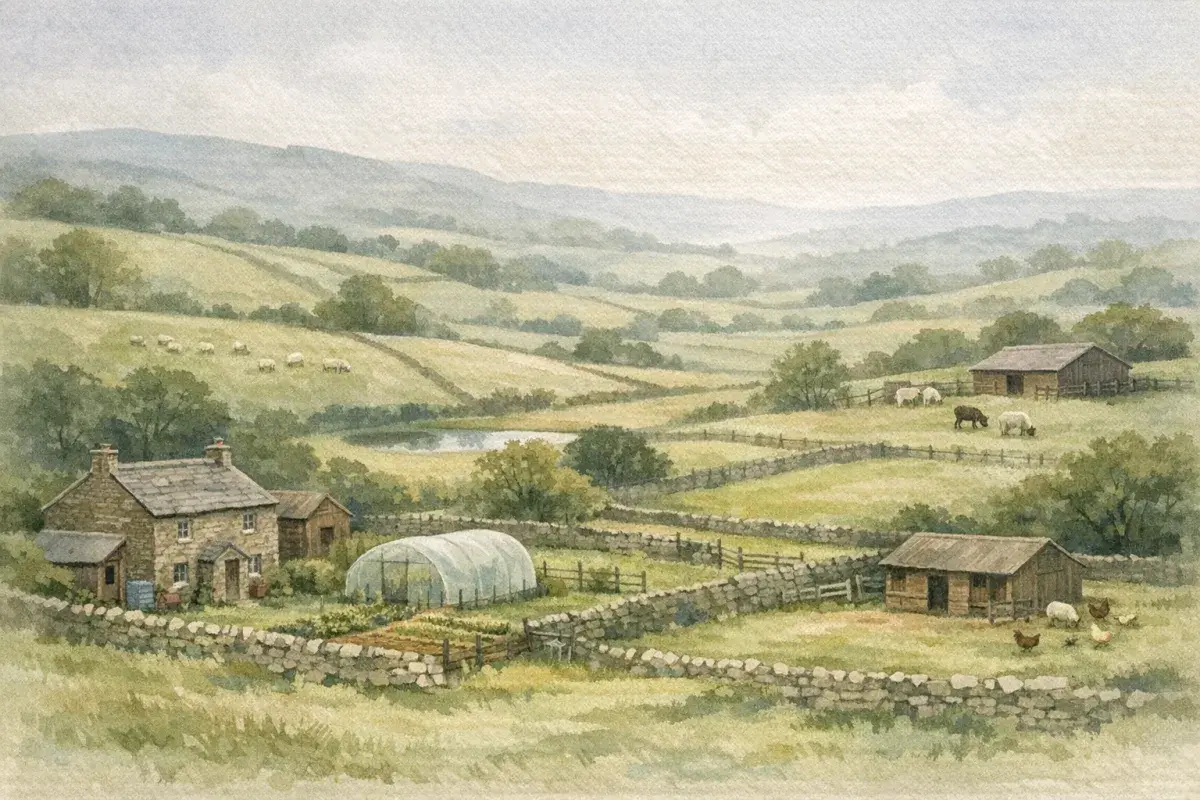
Smallholdings have a funny way of looking simple on paper and getting complicated the moment you try to "just put up a shed" or "pop a cabin on for a year." In the UK planning system, the label smallholding doesn't buy you any special freedoms, and it can sometimes raise eyebrows, because councils have seen plenty of hobby-farm set‑ups drift into quasi‑residential use.
If you're buying, running, or expanding a smallholding, the real game is understanding what your land is used for (in planning terms), what policies cover it, and how to present a proposal that looks credible, necessary, and policy‑aligned. This guide walks you through what tends to get approved, what tends to get refused, and the practical route to stack the odds in your favour, without sleepwalking into enforcement risk.
What “Smallholding” Means For Planning Purposes
The first thing to get straight: "smallholding" isn't a formal planning use class. It's a common description for a smaller rural unit, often a few acres up to, say, 20–30 acres, used for a mix of growing, livestock, horticulture, or equestrian activity.
Planning decisions don't really hinge on whether you call it a smallholding. They hinge on what the lawful use is right now, what you're proposing to build or change, and whether local and national policies support that development in the countryside.
Why Smallholdings Attract Extra Planning Scrutiny
Smallholdings often sit in the awkward middle ground:
- Too small to obviously justify a lot of "agricultural" development, in an officer's eyes.
- Big enough to tempt incremental residential creep (a container becomes a workshop, the workshop gains a bathroom, and suddenly it's a "need somewhere to stay while lambing"…).
- Highly visible locally, especially if you're near a village edge, parish councils tend to take an interest.
That doesn't mean you can't get permission. It means you need to make your proposal look like what it is: reasonably necessary for the land-based use, proportionate to the scale of the holding, and thoughtfully sited.
A phrase you'll see (or feel) a lot is: "Is this genuinely required for agriculture, or is it a back door to something else?" Your job is to answer that question before it's asked.
Agricultural Use Vs Equestrian And Mixed Use: The Common Pitfall
This is where many smallholding plans wobble.
- Agriculture (for planning purposes) includes livestock, arable, horticulture, fruit growing, seed growing, dairy farming, and similar land-based production.
- Equestrian use is typically treated differently. Keeping horses for leisure is usually not "agriculture" in planning terms (even though horses graze). It's often considered equestrian/recreational.
- Mixed use is common on smallholdings, say, a few sheep plus a couple of horses.
The pitfall: you apply for an "agricultural barn" but your set-up reads as stables and tack storage. Or you rely on agricultural permitted development rights when the council views the unit as predominantly equestrian.
If you're unsure where you sit, it's worth reading up on how councils typically interpret "agricultural land" and what you can do with it before you spend money on drawings. AgLand's guide on planning rules for agricultural land is a good starting point for the UK context and the usual tripwires.
The Planning Framework You’re Actually Dealing With
UK planning can feel like a single system, but in practice you're dealing with a hierarchy of policy and a layer cake of constraints.
At decision time, the question is usually: does your proposal align with the development plan, and is there anything in national policy that shifts the balance?
National Policy And The Development Plan: NPPF And Local Plans
In England, the National Planning Policy Framework (NPPF) sets the tone: support sustainable development, protect the countryside's character, and direct most new housing to appropriate locations.
But the heavy lifting is your Local Plan (plus any neighbourhood plan). This is where you'll find policies on:
- New buildings in the open countryside
- Reuse of rural buildings
- Agricultural diversification
- Landscape character
- Design expectations (materials, form, siting)
- Parking, access and highways
A pragmatic takeaway: a strong planning application reads like it was written with the Local Plan open on the desk. You don't just describe what you want, you show how it matches specific policies.
If what you're trying to do is fundamentally residential (or could be interpreted that way), you'll also want to understand the typical routes and obstacles. Our deeper piece on building a house on agricultural land explains the main planning pathways and where smallholders usually stumble.
Countryside Protection Policies: Green Belt, AONB, National Parks, SSSI, Flood Zones
Constraints don't always mean "no", but they do raise the standard of justification and design.
Common constraints that bite smallholdings:
- Green Belt: new buildings are tightly controlled: "essential facilities" for outdoor sport and agriculture can sometimes be supported, but residential is a steep hill.
- AONB / National Scenic Area (Scotland) / National Parks: landscape impact is scrutinised: siting, materials, and visibility matter hugely.
- SSSI and protected habitats: you may need ecological surveys and mitigation: timing matters (e.g., nesting season).
- Flood Zones: councils apply the sequential test: even "minor development" can trigger flood risk assessment expectations in some locations.
A smallholding application often wins or loses on the boring bits: visibility from public viewpoints, whether you're tucked against existing buildings, and whether you've avoided the "plonked in the middle of a field" look.
Permitted Development On A Smallholding: Useful, But Not A Free Pass
Permitted development (PD) can be incredibly helpful on a working smallholding, but it's not a magic cloak. PD is conditional, and councils are quick to argue it doesn't apply where the use is questionable or the proposal crosses a threshold.
If you're at the early stage of planning what's possible without a full application, AgLand's explainer on what you can build without planning permission on agricultural land is worth a read, especially because the devil is in the detail.
Part 6 Agricultural PD Rights: Who Qualifies And The Key Thresholds
In England, many agricultural PD rights sit under Part 6 of the General Permitted Development Order (GPDO). (Scotland, Wales and Northern Ireland have their own regimes and thresholds, so always check the rules that apply where your holding is.)
Two practical points smallholders often miss:
- You need to qualify as an agricultural unit for the relevant PD class. The council may look at the unit's use, not just the land title.
- The thresholds matter, particularly the size of the unit. Some PD rights are more generous above certain hectare levels, and more restricted below.
Even when you do qualify, PD is typically aimed at development reasonably necessary for the purposes of agriculture. That phrase ("reasonably necessary") is where arguments happen. A 200m² barn might be obviously necessary on a 150-acre arable unit. On a 5-acre mixed smallholding, you'll want to explain storage needs, animal welfare requirements, machinery dimensions, feed handling, and why existing buildings don't cut it.
Prior Approval, Siting, Design, And When PD Falls Away
Many agricultural PD proposals require prior notification / prior approval. That means the council gets to assess (depending on the class):
- Siting and design
- Transport and highways impacts
- Noise and odour
- Contamination risks
- Flooding
And PD can fall away or become risky if:
- The building is effectively for non-agricultural use (e.g., primarily equestrian leisure storage).
- The proposal is part of a wider pattern that looks like residential intensification.
- You're in a constrained location where additional controls apply, or the proposal triggers separate consents.
One practical tip: don't treat "prior approval" as a tick-box. Submit a tidy package, site plan, elevations, a short written justification, photos of existing buildings, and a clear explanation of the agricultural use. Officers are human: make it easy to say yes.
What You Can Usually Get Permission For (And What’s Hard)
Smallholding projects generally fall into two buckets:
- Operationally necessary stuff (storage, handling, welfare, access) that policy often supports.
- Lifestyle-led stuff (dwellings, "glamping," amenity buildings) that policy treats far more cautiously.
If you keep that distinction front and centre, your decisions become clearer.
Agricultural Buildings, Tracks, Hardstandings, And Fencing
What councils are often comfortable with, when well justified and sensibly designed:
- General-purpose agricultural buildings for feed, bedding, machinery, produce handling, lambing pens, etc.
- Small livestock shelters (especially when tied to welfare and rotational grazing).
- Field accesses, tracks, and gateways where they reduce mud on highways, improve safety, or support stock movement.
- Hardstandings for manure handling, loading areas, washdown (with proper drainage considerations), or to stop vehicles churning up land.
- Fencing and gates, particularly for stock management.
Where smallholdings get pushback:
- Buildings that look oversized compared to the holding.
- Proposals that are too prominent in the landscape.
- "Agricultural" barns that conveniently include domestic-style windows/doors, patios, or layouts that scream future conversion.
If you're putting up any kind of farm building, it's worth aligning with the practical expectations laid out in AgLand's guide to planning permission for farm buildings. It's not about gaming the system, it's about avoiding the common mistakes that cause refusals or (worse) enforcement.
Conversion And Change Of Use: Barns, Stables, And Rural Workshops
Conversions can be a smart route on a smallholding, because councils often prefer reuse over new build, but only if the building is genuinely capable of conversion and the use is policy-supported.
Typical scenarios:
- Barn to dwelling: sometimes possible, but tightly controlled (and not always via "easy" routes). Structural capability, location, design, and prior use all matter.
- Agricultural building to flexible commercial use: small rural workshops, storage, or low-impact business uses can be supported where they don't harm neighbours or highways.
- Stables and equestrian facilities: can be acceptable, but you may need a clearer equestrian planning case rather than dressing it up as "agriculture."
If your end goal is residential, be honest with yourself early. The rules and risks around shifting from agricultural to residential are nuanced, and the paperwork matters. AgLand's article on agricultural to residential planning routes is designed for exactly that moment when you're deciding whether a scheme is realistic.
New Dwellings, Temporary Accommodation, And Agricultural Workers’ Homes
This is the section that causes most smallholding heartache.
Planning policy is generally resistant to new isolated homes in the countryside unless strict tests are met. And because many smallholdings are part-time or lifestyle-driven (nothing wrong with that), councils often doubt whether a new dwelling is essential.
Proving Need: Functional And Financial Tests, And The Paperwork That Wins Cases
If you're pursuing an agricultural worker's dwelling (or tying a proposal to an essential need), you'll usually find yourself dealing with two broad ideas:
- Functional need: is there a clear, ongoing requirement for a worker to live on-site to care for animals/crops, respond to emergencies, or manage time-critical operations?
- Financial viability: can the enterprise sustain the costs associated with a dwelling? Is it a real business with a credible business plan?
What tends to strengthen your position:
- A proper business plan (not a one-pager) with enterprise budgets, realistic stocking numbers, cropping plans, and market assumptions.
- Evidence of animal welfare requirements: lambing/calving schedules, vet letters (where appropriate), mortality risks, biosecurity needs.
- A clear explanation of why existing nearby housing (including renting) won't meet the functional need.
- A realistic approach to scale: councils are sceptical of "dream farm" projections that jump from 2 acres to full-time income overnight.
There are also edge cases where a new dwelling is pursued via other rural planning routes, but the burden of proof remains high.
Caravans, Mobile Homes, And Temporary Permissions: The Real-World Rules
This is where people get caught out by internet folklore.
A caravan or mobile home on your land isn't automatically acceptable just because it has wheels. The key issue is usually whether its siting amounts to development and, more importantly, whether it introduces a residential use.
Sometimes councils will grant a temporary permission tied to:
- Establishing a new agricultural enterprise
- A defined time period
- Clear conditions (removal date, personal occupancy, welfare checks)
But plenty of smallholders end up in enforcement because they move onto land first and try to "regularise" later.
If temporary accommodation is on your mind, read AgLand's practical guide to mobile homes on agricultural land and planning risk. It's one of those areas where one wrong assumption can become expensive.
Utilities And Waste: Septic Tanks, Package Treatment Plants, Water, And Access
Even when the principle of development is fine, the scheme can fail on utilities, especially foul drainage and access.
On smallholdings, you're often off mains drainage, sometimes off mains water, and your access may be a track that's "always been fine" until you need planning permission.
Foul Drainage And Environment Agency Considerations
For foul drainage, you'll typically look at:
- Septic tanks or package treatment plants
- Discharge to ground (soakaway/drainage field) or surface water (more sensitive)
You may need to show:
- Ground conditions and percolation potential
- Separation distances from watercourses, boreholes, and boundaries
- That the system won't pollute groundwater or nearby habitats
In some areas (and depending on the discharge), you'll also need to consider the regulatory side, this is where getting the right professional advice early saves time.
Practical tip: when a planning officer asks for "drainage details," they don't want brand brochures. They want a short drainage statement with a plan, levels if relevant, and confirmation that what you propose is feasible on that site.
Highways, Visibility Splays, And "Intensification" Objections
Highways issues are a classic refusal reason, particularly where a smallholding access joins a fast rural road.
Common tripwires:
- Inadequate visibility splays
- Access width, passing places, or poor surfacing
- Mud and debris tracked onto the highway
- A proposal that looks like it will intensify use significantly (more vehicle movements, deliveries, visitors)
Even if you think traffic will be minimal, it's worth quantifying it. "A couple of trips a day" is vague. "One feed delivery every fortnight, vet visits as required, and one livestock trailer movement per month outside peak periods" reads as credible.
A Step-By-Step Route To Approval
Most smallholding planning successes aren't won by clever arguments. They're won by doing the basics unusually well.
Pre-Application, Surveys, And A Planning Statement That Matches Policy
A sensible route looks like this:
- Define the lawful use of the land and buildings (what you're actually allowed to do today).
- Map constraints: Green Belt, AONB, flood risk, heritage assets, public rights of way, ecology.
- Use pre-application advice where the council offers it and where the project value justifies it.
- Commission surveys early if they're likely to be requested:
- Ecology (especially if barns could host bats)
- Flood risk/drainage
- Transport/highways note for more complex schemes
- Heritage statement where listed buildings or settings are involved
- Prepare a planning statement that directly addresses the relevant Local Plan policies and the real-world impacts (landscape, neighbours, highways, noise).
If you're at the buying stage and trying to assess what's realistically achievable, it helps to understand how "no planning permission" should change your approach and offer strategy. AgLand's guide to buying land where planning isn't in place is written for that exact decision point.
Neighbour Relations, Parish Dynamics, And Handling Conditions
This part sounds soft, but it's often decisive.
- Talk to neighbours early if your proposal could affect views, traffic, or noise. You don't need permission from everyone, but surprises create objections.
- Expect parish councils to focus on countryside protection, precedent, and traffic. If you've already addressed those issues in your submission, their comments carry less sting.
- Be ready for conditions: landscaping, external materials, hours of operation, lighting controls, drainage details, and, in rural dwellings, occupancy restrictions.
Conditions aren't inherently bad. What matters is whether you can comply without crippling your operation. If a condition is unreasonable, you can sometimes negotiate wording before a decision is issued, or vary it later. But don't assume you'll "deal with it after." In rural planning, that's how people end up stuck.
Enforcement, Certificates, And Buying A Smallholding With Planning Risk
If you're buying or already operating a smallholding, planning risk isn't just "can I get permission?" It's also "what's lawful already, and what could trigger enforcement?"
Lawful Development Certificates, Existing Use Rights, And Agricultural Ties
Three concepts matter a lot:
- Lawful Development Certificate (LDC): a way to get formal confirmation that an existing use or building is lawful (often based on evidence of time and continuity). This can be hugely valuable when you're relying on what's already there.
- Existing use rights: not everything on rural land is automatically lawful. Uses can change over time without paperwork, but that doesn't mean they're immune from challenge.
- Agricultural ties / occupancy conditions: some rural dwellings are restricted to people working in agriculture (or forestry). That affects value, mortgageability, and your future options.
If you're buying a smallholding with a house, always check whether there's an occupancy restriction. If you're buying land with buildings, be clear on whether those buildings were erected under PD, under a permission, or… under optimism.
Red Flags In Listings: What To Check Before You Exchange
A few practical red flags we see again and again:
- "Potential" with no supporting planning history, no pre-app, and no clear policy route.
- A "barn" that looks recently kitted out with domestic details, but no consent.
- Tracks, hardstandings, fencing, lighting, gates, installed widely and recently, with no obvious permission basis.
- Confusion over what's included: does the sale include the access? any shared drive rights? any services wayleaves?
- Claims like "no planning needed" without documentary backup.
Before you exchange, you want a paper trail: decision notices, approved plans, conditions discharge, building control where applicable, and clear title information. If the plan is to apply after purchase, price that uncertainty in, and line up the right professionals early (planning consultant, surveyor, highways input, ecologist where needed).
Conclusion
Smallholding planning permission in the UK is rarely about clever loopholes. It's about credibility: a proposal that's proportionate to your holding, consistent with how the land is used, and designed to sit quietly in the countryside.
If you take one practical mindset into your next step, make it this: build the planning case before you build anything else. Clarify the lawful use, map constraints, pick the correct route (PD, prior approval, full planning, change of use), and put a policy-led story around the application. That's how you avoid the slow bleed of redesigns, refusals, and neighbour disputes.
Disclaimer: AgLand.co.uk is a UK agricultural land and rural property matching service, where buyers register what they are looking for and owners advertise directly to the buyers who match, and a rural resource hub. Nothing in this text is intended as legal, financial, tax, or investment advice. Planning outcomes depend on your site, local policy, and specific facts. You should carry out your own due diligence and seek advice from suitably qualified professionals (for example, a chartered town planner, surveyor, solicitor, ecologist, highways consultant, and tax adviser where relevant) before making decisions or taking action.