
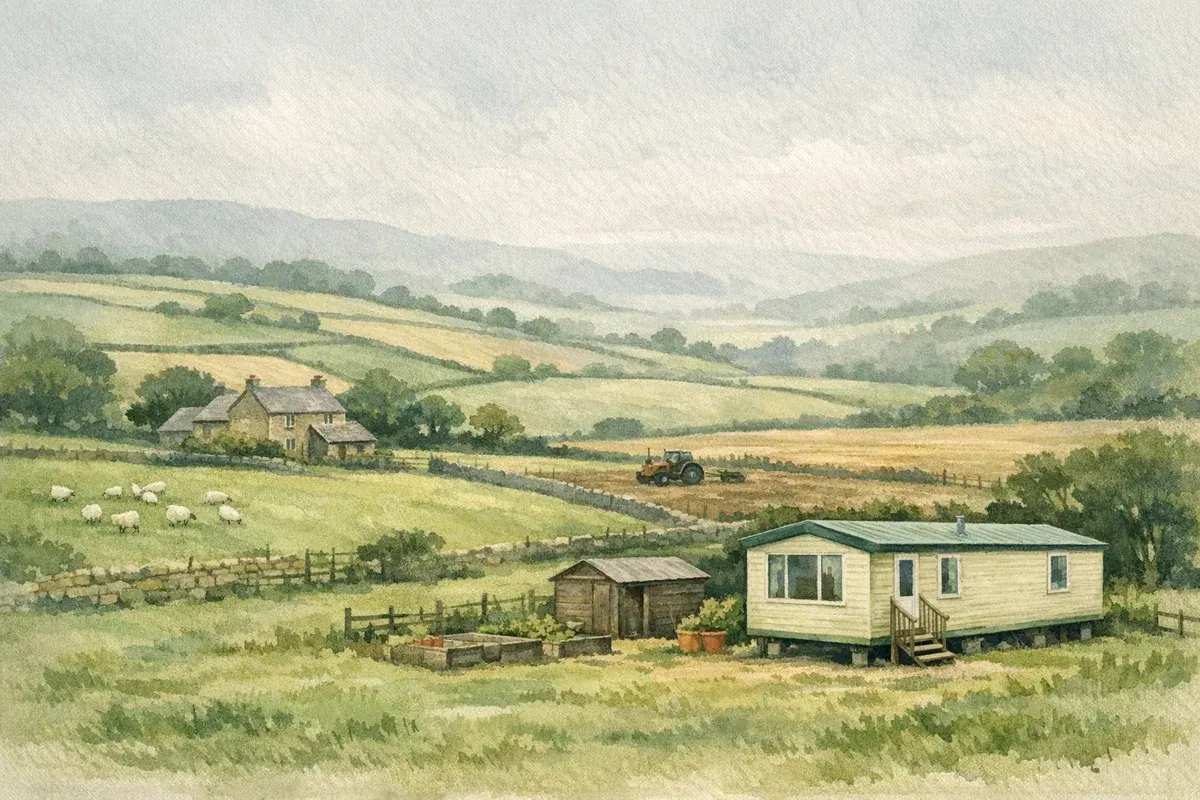
You've found a block of land. You've got a farm business to run (or you're buying into one). And a mobile home looks like the perfect, quick fix, somewhere to sleep during lambing, a base while you build, or even a lower‑cost way to live rurally.
Then reality bites: in UK planning, the issue usually isn't whether the unit has wheels. It's whether what you're doing on the land amounts to development, and, more often, whether you've created a residential use.
This guide cuts through the confusion around mobile home on agricultural land planning: what triggers permission, what evidence planners expect, where people get caught out, and the legitimate routes that can work if you approach it properly.
Start With The Big Question: What Are You Actually Trying To Do?
Most planning problems start because the goal is fuzzy. "Put a mobile home on the field" could mean three very different things in the eyes of a Local Planning Authority (LPA), and each has different risks, evidence, and outcomes.
Temporary Workers' Accommodation For A Farm Business
If you're trying to house someone on site to meet a genuine operational need (think: livestock welfare, security of high‑value kit, time‑critical husbandry), you're in the territory of a temporary agricultural dwelling. That can sometimes be justified, but it isn't automatic, and "it would be convenient" won't cut it.
A good starting point is being crystal‑clear about:
- Who needs to live on site (you, an employee, a family member, a contractor)
- When (seasonal peaks vs year‑round)
- Why on the unit, not just near the unit
- What happens if you can't (animal welfare impacts, business interruption, unacceptable travel times)
If your endgame is eventually a permanent house, planners will want to see you're not using a temporary unit as a back‑door route to a dwelling.
A Mobile Home As A Permanent Dwelling
If you want to live in the mobile home long‑term as your main home, assume you'll be treated as proposing a new dwelling in the countryside, which is heavily controlled in England, Wales and Scotland (with some policy differences by nation and by local plan).
Even if the structure itself meets the legal definition of a caravan, the use can still be residential, and that's usually where permission is needed.
Before you spend money, it's worth reading up on the wider rules around planning permission on agricultural land because the mobile home question sits inside that bigger framework.
Storage, Welfare, Or Ancillary Use (Not A Separate Home)
Sometimes you don't want a dwelling at all. You might want:
- a welfare cabin for staff during peak periods
- a rest space for night checks
- a unit used occasionally, ancillary to the farm office or yard
- secure storage (though "mobile home" is rarely the right tool for that)
This is where people accidentally drift into residential use, adding a shower, full kitchen, post delivered there, spending most nights on site, until the council views it as a home.
If what you need is genuinely temporary or ancillary, it helps to understand what counts as legitimate short‑term siting and what still triggers control. Our guide to temporary structures on agricultural land is useful here, because councils often look at the real‑world pattern of use, not the label you put on the unit.
The Planning Basics That Catch People Out
Planning law is full of traps for the well‑meaning. With mobile homes on farmland, the same few misunderstandings come up again and again.
Is A Mobile Home ‘Development' Or A ‘Caravan'? Why The Definition Matters
In plain English, a "mobile home" can fall under the legal concept of a caravan if it meets certain size and mobility criteria. That matters because some siting and use of caravans is treated differently from building a permanent structure.
But here's the catch: even if your unit is a caravan in law, you still have to consider whether placing it on land amounts to a change that requires permission.
Also, the moment you start needing associated works, hardstanding, access tracks, bunding, service trenches, septic tanks, electricity connections, those works can themselves be development.
Material Change Of Use: Residential Use Is Usually The Real Trigger
The most common trigger is not the caravan sitting there. It's the material change of use of the land to something residential.
Typical signs LPAs look for include:
- the unit is occupied as someone's main home
- domestic paraphernalia (garden furniture, toys, washing lines, bins)
- deliveries, post, registered address use
- separate curtilage (a "gardened" area fenced off)
- utility hookups that indicate permanence
If you're thinking, "But it's still agricultural land," that's the point: land can be agricultural in ownership yet have a different planning use. The planning system is interested in use in practice, day to day.
If you're unsure how your plan might be characterised, it's worth getting your head around change of use of agricultural land because mobile-home disputes often end up being argued as change‑of‑use cases.
Why ‘It Has Wheels' Does Not Make It Planning-Free
Wheels are not a magic cloak.
Even if a unit can theoretically be moved, councils will look at whether it's truly mobile in reality. A "caravan" that hasn't moved for years, sits on an engineered base, has fixed decking, is skirted, and is fully serviced will be treated as effectively established.
A useful way to think about it is this: planning officers aren't judging your intentions in the abstract. They're judging the planning harm and policy impact, new residential activity in open countryside, highway safety, landscape effects, drainage, ecology, neighbour amenity. Most refusals happen because the applicant assumed that being on farmland was enough, and what councils actually want evidenced before you pay for drawings is the cheapest thing you can read first.
So the question becomes: are you creating a new home (or something that functions like one) where policy normally resists it?
Routes That Can Work (And The Evidence You’ll Need)
If you approach this like a paperwork problem rather than a "see if we can get away with it" problem, you'll make better decisions and spend less money twice.
Below are routes we've seen work in the real world, usually when supported by solid evidence, a coherent agricultural case, and professional input.
Temporary Agricultural Dwelling: The Functional And Financial Tests
For a temporary rural worker dwelling (including in a caravan or mobile home), LPAs typically focus on two big questions:
- Functional need: Is there a genuine need for someone to live on site to run the enterprise? This usually hinges on livestock (welfare, security, time‑critical care) more than arable.
- Financial viability: Is the business real, active, and viable, capable of sustaining the cost of the dwelling and the worker?
What "good evidence" often looks like:
- a clear description of the enterprise (stock numbers, calving/lambing pattern, cropping, staffing)
- timetables showing frequency and timing of essential on‑site attendance
- animal welfare rationale (and why alternatives don't work)
- accounts (or a robust business plan for a new enterprise)
- details of existing buildings, and why they can't provide suitable accommodation
- a search area assessment showing why nearby rental/owner housing won't meet the need
The uncomfortable truth: many applications fail because the plan is actually "I want to live there, and I'd like to run a smallholding," rather than "the holding requires a worker on site." That difference matters.
If your longer‑term goal is a permanent home, read up on the realities of building a house on agricultural land, because temporary permission is often time‑limited and tied to strict conditions.
Permitted Development Rights: When They Help (And When They Don't)
Permitted Development (PD) rights on agricultural units can be incredibly helpful, for barns, tracks, certain changes of use, and other operational development.
But for residential occupation of a mobile home, PD is usually not the straightforward answer people hope it will be.
PD may still matter indirectly, because:
- you might be able to lawfully create or upgrade agricultural buildings that reduce the need for on‑site living (e.g., modern livestock handling, security measures)
- in some circumstances, existing lawful development can strengthen the overall case that the unit is an established, functioning enterprise
- PD can affect whether associated works (like certain hardstandings) are permitted, though details are fact‑specific and often hinge on thresholds, siting, and prior notification
If you want a practical overview of what can be done without full consent, see what you can build on agricultural land without planning permission. It's not a loophole for a dwelling, but it can shape how you plan the holding sensibly.
Lawful Development Certificate: Proving Existing Lawfulness
If a mobile home (or residential use) has existed for a long time, you may hear people mention the "four‑year rule." The principle is that, after certain time periods, enforcement may become time‑barred, but only if you can prove the facts with evidence, and the law and interpretation have nuances.
A Lawful Development Certificate (LDC) is the formal way to ask the LPA to confirm that an existing use or development is lawful.
Evidence you might need includes:
- dated photographs (over a consistent period)
- statutory declarations (carefully prepared)
- utility bills, council tax records, and delivery evidence
- electoral roll entries
- tenancy agreements
- site plans showing the extent of the use/curtilage over time
Be careful: submitting weak or inconsistent evidence can backfire, because it can prompt scrutiny and site visits. If you're even considering the LDC route, speak to a planning consultant first, ideally one who's handled rural enforcement and agricultural cases.
Siting And Design Factors Planners Will Scrutinise
Assuming you have a plausible planning route, the next battle is often practical: where it sits, how it's accessed, what services it needs, and what it looks like in the landscape.
Access, Highways Safety, And Visibility Splays
Highways is a common deal‑breaker, particularly on fast rural roads.
Expect questions like:
- Can you enter/exit in forward gear?
- Is there adequate visibility in both directions (visibility splays)?
- Will additional movements create conflict with existing farm traffic?
- Is the access suitable in winter and in wet conditions?
- Is there enough turning/parking space on hardstanding so vehicles don't reverse onto the highway?
Even if you're only housing one person, the unit often increases domestic‑style trips (deliveries, visitors, school runs). That change in trip type is something LPAs and highways officers notice.
Foul Drainage, Water, And Environmental Constraints
A mobile home that's lived in produces foul drainage. If you're outside mains sewer coverage (common in rural areas), you're into package treatment plants or septic systems, and those need proper assessment and siting.
Planners and environmental health often look at:
- proximity to watercourses and ditches
- flood risk (including surface water risk)
- ground conditions and percolation testing
- pollution risk to groundwater
- capacity and maintenance arrangements
And don't underestimate the "small" bits: new water connections, electric supply routes, and trenching can have their own impacts, especially in sensitive landscapes.
Landscape And Ecology: AONB, National Parks, SSSI, And Biodiversity Duties
If your land is within (or visible from) a protected landscape, National Parks, Areas of Outstanding Natural Beauty (AONB), or near heritage assets, expect much stricter scrutiny.
Ecology can also be a silent constraint, particularly if:
- you're near a Site of Special Scientific Interest (SSSI)
- the siting affects hedgerows, ponds, mature trees, or species habitat
- external lighting is proposed (bats are a frequent issue)
In England, biodiversity net gain expectations have tightened in recent years and many LPAs expect clear ecological thinking even for relatively small proposals.
A practical tip we see work: treat the siting like you're trying to hide it (politely). Use existing built form (yards, building clusters), avoid skylines, minimise engineered bases, control lighting, and keep domestic clutter out of view. The more it looks like an established working farm layout, and the less it reads as a new garden in a field, the stronger your position tends to be.
Occupancy Controls, Agricultural Ties, And How They Affect Value
If permission is granted for residential accommodation on agricultural land, it's often controlled tightly. Those controls can protect the planning balance, but they also affect resale value, mortgageability, and who can legally live there.
Agricultural Occupancy Conditions Explained (And Common Pitfalls)
An agricultural occupancy condition (often called an "agricultural tie") restricts who may occupy the dwelling, typically to someone employed (or last employed) in agriculture (sometimes forestry) in the locality.
Common pitfalls we see:
- Assuming it's a formality. It's not. Breaching an occupancy condition can trigger enforcement.
- Letting it out casually. Short lets, Airbnb‑style use, or housing friends can be risky if it conflicts with the condition.
- Treating the unit as an asset first, planning constraint second. Buyers, lenders, and insurers will want clarity.
If you're buying land with an existing dwelling (or consent for one), you should treat the tie as a headline issue in valuation and exit planning. If you're already tied and considering lifting it, the process is specialised and evidence‑heavy, see our guide to agricultural occupancy condition removal for how LPAs typically assess it.
What Happens If The Mobile Home Becomes A Second Dwelling
A big red line for LPAs is the creation of a second dwelling, for example, you already have a farmhouse on the holding and the mobile home starts operating as a separate home (different household, separate utilities, independent curtilage).
That can:
- undermine the agricultural justification used to obtain permission
- increase planning harm (more domestic activity, visual impact, highway trips)
- attract enforcement attention, especially if neighbours object
If your real plan is "farmhouse plus an additional unit for family," don't assume a mobile home is an easier route. You may be better off exploring formal options for conversion, replacement dwellings, or other policy‑compliant routes.
In some cases, people also look at changing existing agricultural buildings to residential use. That's a different route, with different tests and local policy considerations, our explainer on agricultural to residential planning permission will help you understand what tends to be possible, and what tends to be refused.
Enforcement Risk, Penalties, And How To Put Things Right
If there's one thing to take seriously in mobile home on agricultural land planning, it's enforcement. Councils don't need to "catch you in the act." They just need enough evidence to believe there's been a breach.
How Councils Investigate And What Evidence They Rely On
Most investigations begin with a complaint (often a neighbour, sometimes a parish council). After that, LPAs can use a mix of tools:
- site visits (announced or unannounced)
- planning contravention notices (formal questions you must answer truthfully)
- aerial imagery and historic mapping
- council tax and address data points
- photographs from public rights of way
- evidence of domestic activity (bins, vehicles, deliveries, fencing)
A misconception is that if the unit is "temporary," enforcement can't happen. In practice, temporary siting can still be a breach if it amounts to development or a material change of use.
Your Options If You're Already On Site
If you've already moved a mobile home onto land (or you're already living in it), you generally have four sensible moves, depending on your facts and your risk tolerance:
- Stop the residential use and revert to a clearly non‑residential/ancillary use (only if that use is lawful). This often means removing domestic markers and not staying overnight.
- Apply for planning permission proactively with a robust case (agricultural need, siting strategy, supporting reports).
- Seek a Lawful Development Certificate if you believe the use is already lawful due to passage of time (but only with strong evidence and professional advice).
- Relocate/remove the unit before the dispute escalates.
What you shouldn't do is half‑measure it, keeping the unit in place, living there "a bit," and hoping no one notices. That's when costs spiral: retrospective applications, consultant fees, potential appeals, and the stress of uncertainty.
If you're at the buying stage, the best de‑risking step is actually earlier than planning: buy (or rent) with your end use in mind. On AgLand, you can register that you're after holdings with established yards, existing residential elements, or planning history, features that can materially change your options, and be alerted when an owner advertises one. And if something looks promising, ask for the planning references early, not after you've fallen in love with the view.
Conclusion
A mobile home can be a legitimate part of a working farm setup, but the planning system will judge what you're doing, not what you call it. If the reality looks like a new home in open countryside, you should assume you'll need a policy‑compliant case, credible evidence, and a siting approach that reduces impact.
If you're serious about doing it lawfully, start by defining your objective, then stress‑test it against functional need, site constraints, and enforcement risk. Get the right advice early, especially where you're relying on agricultural justification, past use, or anything that could be read as an attempt to create a second dwelling.
Disclaimer: AgLand.co.uk is a UK agricultural land and rural property matching service, where buyers register what they are looking for and owners advertise directly to the buyers who match, and a rural resource hub. Nothing in this text is intended as legal, financial, tax, or investment advice. Planning and land matters are fact-specific and subject to change. You should carry out your own due diligence and take independent advice from appropriately qualified professionals (for example, a planning consultant, chartered surveyor, solicitor, tax adviser, ecologist, and/or highways/drainage specialist) before making decisions.