
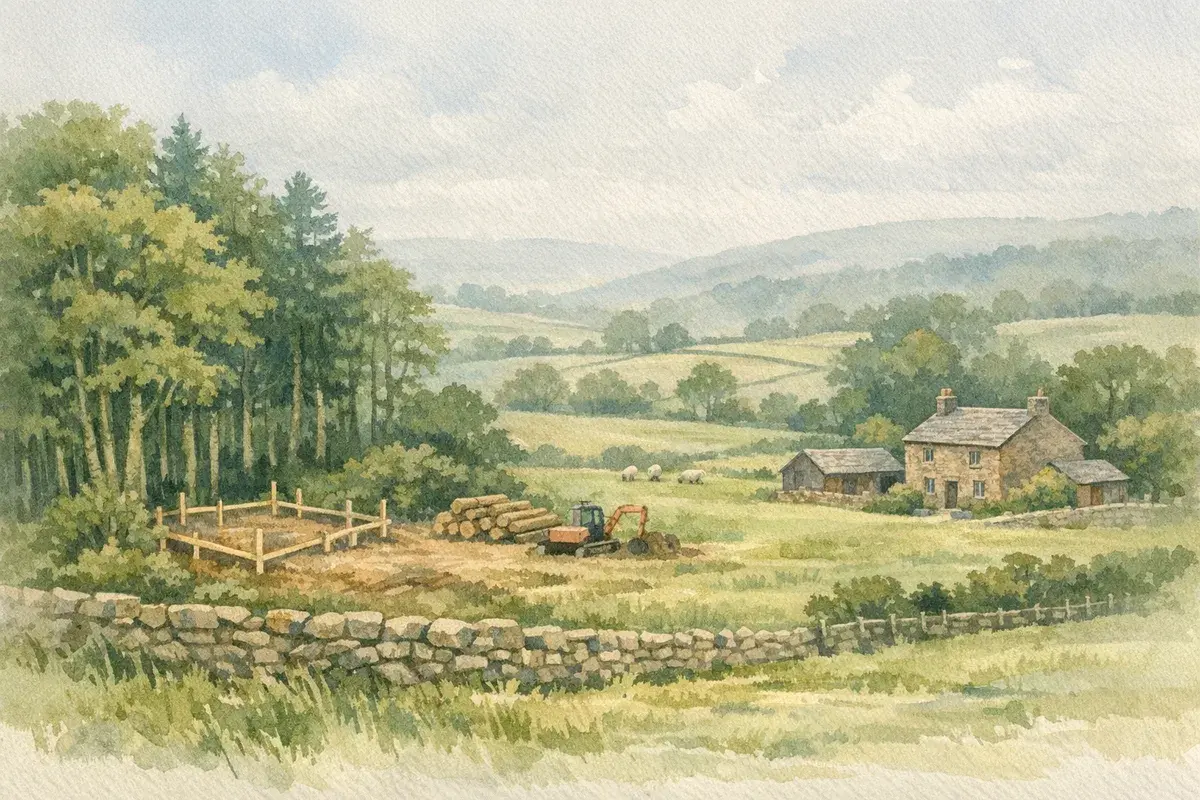
You've found a block of woodland with a cracking outlook and you're thinking: could I put a house here? A cabin? A barn? Or even just a proper track and a bit of hardstanding so the place actually works?
The honest answer to "can you build on woodland" in the UK is: sometimes, but rarely in the way most people imagine. Woodland is often tightly constrained by planning policy, protected habitats, tree controls, access limitations, and (increasingly) biodiversity rules. And if it's ancient woodland, the door can be close to bolted shut.
Still, there are lawful routes forward: building elsewhere on the holding, re-using existing structures, forestry buildings with the right consents, and carefully designed edge-of-woodland schemes that avoid the most sensitive areas.
This guide cuts through the confusion, in plain UK terms, and shows you how the decision is actually made, by planners, ecologists, and the consultees who can make or break an application.
What Counts As Woodland (And Why The Definition Matters)
People use "woodland" loosely. Planning officers and foresters don't. Whether you can build, and what you'll be asked to prove, often turns on what you've actually got on the ground.
Woodland, Forestry, And Trees Outside Woodlands
A few scattered trees in a paddock aren't usually treated the same as a continuous canopy with woodland ground flora. Equally, a shelterbelt, an old hedge line that's grown out, or a bit of scrub can still trigger arboricultural and ecological constraints.
In practice, you'll come across three overlapping lenses:
- Planning: Is the land "countryside" in policy terms? Is it part of a designated landscape? Are there protected trees (TPOs), conservation areas, or habitats?
- Forestry: Is the land managed as woodland? Does felling require a licence? Is there a woodland management plan?
- Ecology: Does it function as habitat (bat roost potential, nesting birds, dormice in some regions, etc.)?
That's why the same physical place can feel like "just some trees" to a buyer, and "a high constraint site" to a local planning authority.
Ancient Woodland, PAWS, And Commercial Plantations
Not all woodland is equal in policy terms.
- Ancient woodland is land continuously wooded since at least 1600 in England and Wales (different historic cut-offs are used in some datasets). Policy treats it as irreplaceable habitat.
- PAWS (Plantations on Ancient Woodland Sites) are ancient woodland sites that were planted over, often with conifers. They're still treated as ancient woodland for planning purposes because the underlying soils and ecology can recover.
- Commercial plantations (including newer conifer blocks) may have fewer "irreplaceable" constraints, but can still carry heavy ecological, landscape, access and felling-control issues.
If you're buying with any development hope (even a modest cabin or holiday let), it's worth understanding where your woodland sits on that spectrum. For background on what buyers typically miss, access, rights, felling rules, and designations, see our guide to the legal and practical checks when buying woodland.
How Designations And Mapping Are Verified In Practice
Maps are a starting point, not a verdict.
In real planning work, constraints are typically verified using a mix of:
- Local plan policy maps (where settlement boundaries, countryside policies, AONB/National Park layers sit)
- Ancient woodland inventories and local ecological records
- On-site surveys (ecology, arboriculture, sometimes archaeology)
- Aerial imagery and historic mapping (useful for long-established woodland patterns)
Expect planners to ask: what's the baseline condition of the site and what's the harm? If you can't evidence baseline properly, you're arguing blind.
The Starting Point: Is Building On Woodland Ever Permitted?
Yes, it can be permitted, but the default position in much of rural UK planning is restraint. Woodland is usually treated as countryside, and new homes or speculative development in open countryside are commonly resisted unless a clear policy route exists.
The Core Planning Tests: Need, Location, And Harm
When you ask "can you build on woodland", the decision usually lands on three questions:
- What's the planning justification? Is it essential for a rural enterprise (forestry/agriculture)? Is it a replacement dwelling? A conversion? Something supported by a specific local policy?
- Why here? Could the same use go on a less sensitive part of the holding, closer to existing buildings, services, and roads?
- What's the harm? Loss of trees, habitat fragmentation, visual impact, traffic, drainage changes, wildfire risk, and precedent.
Even where woodland isn't formally designated, the "harm" case can be enough to sink it.
When It's More Realistic To Build Elsewhere On The Holding
A surprisingly common outcome, especially on mixed farms with shelterbelts and copses, is that the principle of development is accepted, but only if you re-site it:
- onto an existing yard
- within/adjacent to a cluster of buildings
- on the edge of woodland with meaningful buffers
- by re-using previously developed land rather than pushing into tree cover
If your goal is a home, planners will often prefer a location that reads as "rounding off" an existing group, rather than carving a new domestic presence into woodland.
Forestry Operations And Permitted Development: What It Does (And Doesn't) Cover
Forestry has some permitted development rights, but they're narrower than many people assume.
You may be able to carry out certain forestry operations (like tracks, extraction routes, small operational buildings) where genuinely required for forestry. But:
- It's not a back door to residential use.
- You can still trigger prior notification/approval, conditions, and restrictions.
- Protected habitats, protected species, and designated landscapes can override the "it's forestry" argument.
Treat "permitted development" as a tool for operational forestry, not a general licence to build on woodland.
Planning Constraints That Commonly Block Woodland Development
Woodland sites are where planning constraints stack up. A single issue can be manageable: three or four together is where schemes die.
Ancient Woodland Policy And The ‘Wholly Exceptional' Bar
If it's ancient woodland (including PAWS), national policy treats it as irreplaceable habitat. Loss or deterioration is only supported in wholly exceptional circumstances.
In plain terms, "I own it" or "it would be a lovely plot" isn't close. Even "I'll plant more trees elsewhere" usually won't balance the harm.
Whichever side you're on. Buyers tell AgLand what they're looking for and hear the moment something fits. Owners advertise straight to the buyers who already match, for one flat fee and no commission. Register as a buyer or check your matches.
Protected Trees, TPOs, Conservation Areas, And Felling Controls
Even outside ancient woodland, trees can be protected.
- Tree Preservation Orders (TPOs): you'll need consent for works, and "development needs it" isn't automatically accepted.
- Conservation areas: extra controls apply to tree works.
- Felling controls: felling can require a licence (with exemptions). Getting planning permission doesn't magically remove forestry controls.
One of the most common self-inflicted wounds we see is early clearance (or "tidying up") before advice is taken. It can trigger enforcement, harm your ecology baseline, and poison the well with the planning officer.
Ecology And Habitats: Bats, Birds, Badgers, And Biodiversity Net Gain
Woodland is prime habitat. Typical pinch points include:
- Bats (roost potential in mature trees: commuting/foraging corridors)
- Nesting birds (seasonal constraints on works)
- Badgers (setts and protection zones)
- Priority habitats and local wildlife sites
On many projects in England, you'll also need to deal with Biodiversity Net Gain (BNG) requirements for relevant development. Even where BNG isn't the headline, ecology evidence almost always is.
Landscape And Heritage: AONB, National Parks, Listed Settings, And Archaeology
Woodland often sits in sensitive landscapes, valleys, ridgelines, designed estates.
Constraints can include:
- National Parks and AONBs (higher bar for new development)
- Heritage settings (listed buildings nearby, registered parks and gardens)
- Archaeology (earthworks and historic woodland boundaries can be significant)
Even a modest cabin can be refused if it introduces domestication, lighting, fencing, parking, into a valued landscape.
Access, Highways, Drainage, And Wildfire Risk Considerations
Then there's the unglamorous stuff that decides many outcomes.
- Access and visibility: new entrances onto rural roads can be hard to justify.
- Construction logistics: getting kit in without damaging roots and soils is often underestimated.
- Drainage: woodland soils can be sensitive: hardstanding changes runoff.
- Wildfire: it's not always a formal "planning policy" issue, but it's increasingly a practical consideration for layout, water provision, and safe access.
If your woodland has no proper access, the development conversation usually ends quickly, because you can't build safely, service it properly, or satisfy highways.
Routes That Can Work: Lawful Development Scenarios On Or Near Woodland
If your heart is set on a woodland setting, focus on routes that align with policy and reduce harm. These are the scenarios we most often see progressing, assuming the site isn't fundamentally constrained.
Replacement Dwellings, Conversions, And Rebuilds Near Woodland Edges
A replacement dwelling (where policy allows) is usually a more realistic path than a brand-new house in the trees.
Similarly, conversions of existing rural buildings can work where the building is structurally capable and local policy supports it. The key advantage is simple: you're not creating a brand-new domestic "island" in woodland.
If there's an old cottage, lodge, or former forestry building near the edge, that's the kind of starting point that planners can engage with, provided you can demonstrate lawful use, design quality, and acceptable access.
Agricultural Or Forestry Workers' Dwellings: Evidence And Occupancy Controls
Workers' dwellings are often misunderstood. You don't get a house because you own land: you get one (if at all) because there's a functional need for a full-time worker to live on site, and the enterprise is financially sound.
Expect:
- detailed business evidence
- scrutiny of whether an existing nearby dwelling could meet the need
- occupancy conditions tying the home to the job
If your woodland is primarily amenity (weekends, shooting, leisure), a workers' dwelling argument is usually weak. But for genuine forestry operations, harvesting, management, fire risk, security, it can be part of a wider, properly evidenced case.
Low-Impact Forestry Buildings, Tracks, And Yards With Proper Consents
Operational infrastructure is often the most deliverable "building on woodland" outcome:
- small stores
- timber handling areas
- tracks and turning heads
- fencing and gates
The trick is to keep it genuinely functional, well-sited, and light-touch. Root protection, drainage, surfacing choice, and reinstatement plans matter more than people expect.
If you're looking for working forestry assets rather than purely lifestyle woodland, the market for commercial woodland opportunities is often where you'll find established access, track networks, and management history that makes consents easier to evidence.
Temporary Uses, Glamping, And Events: When They Tip Into ‘Development'
"Temporary" doesn't always mean "outside planning".
A few realities:
- Change of use of land for camping or events can require consent depending on scale, frequency, and associated works.
- Physical works (hardstanding, tracks, toilet blocks, serviced pitches) can be development even if the tents are seasonal.
- Intensity and permanence are what planners look at: lighting, noise, traffic, waste, and visual change.
If you're considering glamping, treat it like a mini planning project. The softest approach, minimal groundworks, strong management plan, and clear limits, tends to be the one that survives scrutiny.
And if you're buying for leisure, be honest with yourself about the intended use. A block advertised as recreational woodland can be brilliant for amenity and low-key access, but that doesn't automatically translate into built accommodation.
Mitigation, Compensation, And Design: How Schemes Are Made More Acceptable
Good woodland-adjacent schemes are rarely "won" with one clever argument. They're won by reducing harm, proving it with evidence, and offering credible long-term stewardship.
Avoidance And Buffer Zones: Root Protection Areas And Woodland Edges
The most persuasive design move is often not the building, it's where you don't build.
Common expectations include:
- buffers from ancient woodland edges (often discussed in the 15m+ range in practice, depending on context and policy)
- respecting Root Protection Areas (RPAs) for retained trees
- keeping domestic gardens, play areas, and lighting away from sensitive edges
If the design reads as "the woodland is the backdrop, not the casualty", you're in a stronger place.
Surveys And Reports: Ecological Appraisal, Arboriculture, And Landscape Visuals
Woodland proposals live or die on technical work. A typical package might include:
- preliminary ecological appraisal and protected species surveys (seasonal windows matter)
- arboricultural impact assessment and method statement
- landscape and visual appraisal
- drainage strategy (and sometimes flood risk work)
These aren't box-ticking exercises. The detail, how you'll build without compacting soils, how lighting avoids bat corridors, how you'll manage visitors, often decides whether consultees object.
Biodiversity Net Gain And Off-Site Habitat Options
Where BNG applies, woodland can be complicated. You might not be "losing woodland" in area terms, but you can still degrade habitat quality through fragmentation and disturbance.
If on-site delivery isn't feasible, off-site habitat options can form part of the solution. But it needs to be credible, costed, and secured for the required period.
Woodland Management Plans, Restocking, And Long-Term Stewardship
A woodland management plan can shift the tone of an application from "development pressure" to "managed asset". Even where building is modest, a clear plan for:
- thinning and restocking
- ride and edge management
- access control and biosecurity
- long-term funding
…can show the authority you're improving resilience rather than eroding it.
If funding is part of your plan, it's worth understanding what's available and what strings are attached, our overview of woodland funding and support options is a useful starting point before you speak to a forestry agent or grant adviser.
The Planning Process Step By Step (And Who You’ll Need)
Woodland planning is a team sport. The fastest way to waste money is to commission drawings before you've checked constraints.
Pre-Application Advice And Early Constraint Checks
Start with early-stage reality testing:
- desktop constraints (designations, local plan policies, access)
- a site walk with an arboriculturist/ecologist where appropriate
- an informal chat with your planning consultant about policy routes
Then consider pre-application advice. It costs, but it can surface the deal-breakers (or the workable angle) before you commit to full design.
What A Strong Application Pack Looks Like
A strong pack typically pairs clear design with clear evidence:
- planning statement (policy route and planning balance)
- design and access statement (where required/appropriate)
- ecology and arboriculture reports with method statements
- transport/highways note if access changes are proposed
- drainage strategy
Crucially, the documents need to agree with each other. If the plan says "minimal lighting" and the drawings show bollard lights across the drive, expect objections.
Likely Conditions, S106 Agreements, And Overage Implications
Even where permission is granted, woodland-related schemes often come with conditions such as:
- tree protection during construction
- restricted lighting schemes
- habitat management and monitoring
- limits on use (especially for holiday accommodation)
On some schemes, obligations can be secured via legal agreement (often referred to as Section 106 in England and Wales) to lock in habitat delivery or access works.
And don't ignore overage. If you're buying woodland with even a whiff of development potential, sellers may seek a clawback. That can be fair, but it needs to be drafted properly, or it can cause pain later (and affect lending, too).
Timescales, Appeals, And Common Reasons For Refusal
Woodland schemes can be slow because surveys are seasonal and consultees (ecology, highways, landscape) are cautious.
Common refusal reasons include:
- conflict with countryside/settlement policy
- harm to ancient woodland or protected trees
- unacceptable access and highway safety
- ecology impacts not properly evidenced
- landscape harm and "domestication" of a natural edge
Appeals are possible, but your odds improve dramatically if you've built a clean evidence base from the start, rather than trying to patch a weak case after refusal.
Buying Woodland With Development Hopes: Due Diligence And Deal Structuring
If you're buying woodland and quietly asking "can you build on woodland", treat that hope as high risk until proven otherwise. The safest assumption is "no", and then you earn your way to "maybe".
Title, Rights, Covenants, And Access Over Third-Party Land
Start with the basics that can kill value:
- legal access (not just "we've always driven it")
- rights to services (or realistic alternatives)
- restrictive covenants (no buildings, no caravans, no business use)
- sporting rights, mineral rights, and third-party obligations
A woodland with no enforceable access can be a lovely amenity, until you need to get a digger in.
Cross-Checking Designations, Local Plan Policy, And Nearby Consents
Don't rely on an agent's particulars for development statements.
Do your own cross-checking:
- local plan policies and settlement boundaries
- ancient woodland inventory and local wildlife site layers
- nearby planning decisions (especially refusals) for similar proposals
Sometimes the best intelligence is 500 metres away: if a similar "edge of woodland" dwelling was refused recently, you need to understand why, because you'll be fighting uphill.
Valuation Reality: Hope Value Versus Practical Deliverability
Hope value is seductive. But lenders, valuers, and (eventually) buyers tend to ask the same blunt question: what's actually deliverable?
If development is the driver, you'll want a strategy:
- conditional contracts or options (where appropriate)
- overage that reflects realistic uplift, not fantasy
- a timeline that matches survey seasons and planning cycles
If you're also financing the purchase, remember that woodland lending has its own quirks, see how woodland finance can work in the UK before you assume a standard residential approach.
Tax And Grants: SDLT, CGT, IHT (APR/BPR), And Woodland Schemes
Tax in rural property is never "one size fits all", and woodland can be particularly fact-dependent.
Consider, at a high level:
- SDLT treatment can vary depending on what you're buying and how it's structured
- CGT implications if you sell with uplift or dispose of part
- IHT reliefs (APR/BPR) are complex and depend on use, occupation, and the wider estate picture
- woodland-related schemes and grants can support management, but may influence how you operate the land
If you're looking at woodland as an asset class, it's sensible to separate romantic value from investment logic. Our primer on woodland as a UK investment explains the drivers (timber, carbon, amenity, resilience) and the constraints that often surprise first-time buyers.
Conclusion
So, can you build on woodland in the UK? Sometimes, but only when you approach it like a constraint-led project, not a blank canvas. The more your proposal looks like domestication of a sensitive habitat, the tougher the ride. The more it looks like a well-sited, evidenced, low-impact scheme (or a reuse of what already exists), the more likely you are to find a policy route that stands up.
If you're at the "should I buy this woodland?" stage, treat access, designations, and deliverability as your non-negotiables. Then bring in the right people early: a planning consultant, an ecologist, an arboriculturist, and, where money and tenure are involved, a solicitor and tax adviser who actually deal with rural land.
Done properly, woodland ownership can be hugely rewarding. Just don't let a vague development hope become an expensive assumption.