
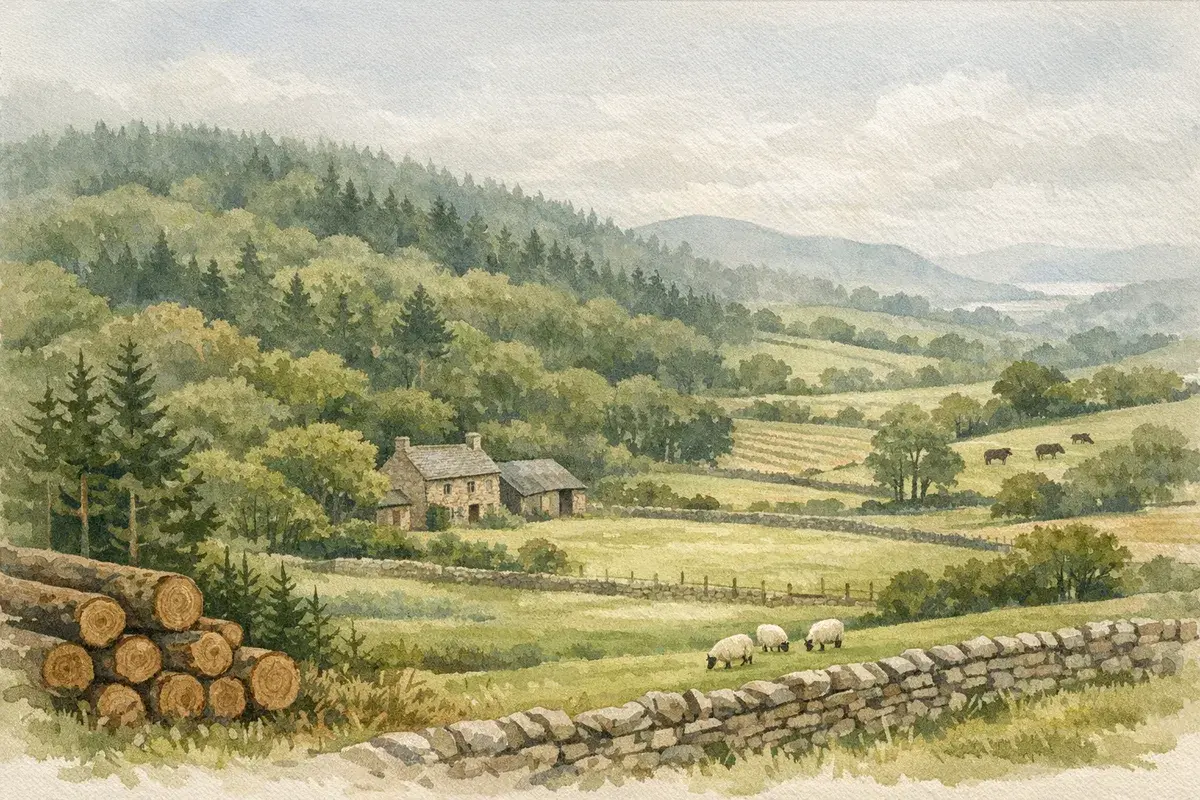
A few years ago, "woodland investment" in the UK often meant one of two things: a farmer buying the rough corner of a neighbour's place, or a family quietly tucking away a small block of trees for the next generation. In 2026, it's a mainstream conversation, driven by timber fundamentals, the pull of natural capital, and a wider sense that land-based assets behave differently when everything else feels a bit… jumpy.
But woodland isn't a magic money tree. Returns depend on species, rotation, access, disease risk, designations, and how you structure ownership. Buy the wrong wood and you can inherit liabilities, not upside.
This guide is built for UK buyers who want a clear-eyed view: how woodland can pay, where it bites, what reliefs are real (and what's overhyped), and how to buy well without getting carried away by the romance of a "little forest" on a sales brochure.
Why UK Woodlands Are On Investors’ Radar In 2026
Woodland investment UK interest has grown for some very practical reasons. You've got a mix of asset security, biological growth, and policy tailwinds, but also genuine supply constraints.
- Timber is still a strategic material. UK demand for construction timber, packaging, and fibre hasn't gone away. And the UK remains a net importer of timber products, which keeps attention on domestic supply.
- Natural capital has moved from niche to board-level. Even where you're not selling carbon, buyers now price in the potential for biodiversity uplift, riparian buffering, and resilience value.
- Land is finite: good forestry land is even more finite. Not all "woodland for sale" is investable woodland. Accessibility, harvesting practicality, and species mix separate the financial woods from the lifestyle copses.
And then there's a quieter driver: woodland feels understandable. You can walk it, measure it, manage it, and improve it over time.
Who Woodland Investment Suits (And Who It Doesn't)
Woodland can suit you if:
- You're comfortable with lumpy cashflows (long periods of costs, then income at thinning/clearfell).
- You value a real asset with optionality, timber, leasing, biodiversity/natural capital, amenity.
- You're willing to take professional advice and run it properly (or appoint a forestry manager).
It's usually a poor fit if:
- You need predictable, annual income from day one.
- You're buying purely for "guaranteed" carbon returns or a promised yield with no downside.
- You don't have time (or appetite) for compliance: felling permissions, restocking, plant health rules, deer control.
If you're starting from scratch, it's worth reading a step-by-step guide to the realities of purchase and early management, our resource on buying woodland in the UK covers the checks that tend to matter in the first 12–24 months.
The Main Ways Woodland Can Make Money
In the UK, woodland returns typically come from a stack, not one silver bullet:
- Timber income
- Thinnings and final harvest (clearfell or selective systems).
- Better access and good harvesting infrastructure can materially improve roadside timber values.
- Land and capital value appreciation
- Not guaranteed, but historically many buyers have been willing to pay more for well-located, well-managed woods with clear access and clean title.
- Leasing and ancillary income
- Sporting rights (where available), wayleaves, small-scale grazing, licences for events/education, or modest amenity uses.
- Natural capital and environmental markets
- Carbon codes and biodiversity-related income can apply in some cases, but these are contract-heavy and compliance-led. Treat them like a project, not a quick add-on.
The trick is buying a woodland where at least two of those levers are realistic, so you're not over-dependent on one narrative.
The Deal Types: Standing Timber, New Planting, And Mixed Estates
Not all woodland investment opportunities are the same thing packaged differently. You'll generally see three deal types, and each has its own risk profile.
Commercial Conifer, Native Broadleaf, And Continuous Cover Forestry
Commercial conifer (often Sitka spruce, Scots pine, Douglas fir in the right places) tends to be the most legible "investment forestry" because it's built around timber production and measurable rotations.
- Pros: clearer yield models, established markets, easier to benchmark
- Cons: exposure to storm risk, disease, and price cycles: sometimes public perception challenges depending on landscape context
Native broadleaf can be brilliant, but returns are often slower and more management-intensive.
- Pros: amenity value, biodiversity upside, potential premium hardwood over long timeframes
- Cons: cashflow patience required: deer/squirrel pressure can be relentless: quality outcomes depend on consistent management
Continuous cover forestry (CCF) aims to avoid large clearfells by managing uneven-aged stands.
- Pros: can improve resilience and landscape fit: potentially smoother outputs
- Cons: management complexity: not always suited to every site/species mix: transition costs can be real
If you're specifically looking for income-oriented forestry blocks, start by understanding what's actually being marketed as "commercial" and what that implies for operations and permissions. We keep a dedicated stream of listings and guidance around commercial woodland opportunities for buyers who want that more production-led profile.
Woodland Creation Schemes And Carbon Projects: What You're Really Buying
New planting can look attractive because you're buying a clean slate. But you're not just buying land, you're buying a delivery obligation.
Questions you should be asking:
- Who designed the scheme, and is it approved under the relevant UK framework for that nation?
- Are there ongoing obligations (maintenance periods, restocking rules, public access expectations, reporting requirements)?
- If carbon is part of the pitch: what standard, what permanence rules, and what happens if disease or windblow reduces stocking?
Carbon-related income is often discussed as if it's "extra rent". In reality it can affect how you manage the woodland for decades. Make sure you like the long-term plan before you like the headline.
Woodland With Extras: Sporting Rights, Natural Capital, And Residential Potential
Some of the most interesting UK woodland deals are mixed: woodland plus rough grazing, a bit of riparian habitat, maybe a track that serves neighbouring land, or sporting potential.
A few "extras" to treat carefully:
- Sporting rights: can add value, but only if they're included in the title and are commercially usable.
- Natural capital potential: can be real, but it's evidence-led. Condition, baselines, and deliverability matter.
- Residential potential: usually the most over-assumed. In most cases you should buy woodland on the basis it remains woodland. Planning is site-specific and policy-led, and "maybe I'll get a cabin" is not a strategy.
For many buyers, the sweet spot is a woodland that works financially and is enjoyable to own. If your priority is amenity, access, and recreation with modest upside, it's worth looking at how smaller lifestyle woods are priced and sold, the buyer mindset (and risk tolerance) is often different from the pure timber angle.
What Drives Value: Location, Access, Timber Quality, And Constraints
Woodland valuation in the UK is part science, part realism. Two woods can be the same acreage and feel similar underfoot, yet price and future returns diverge sharply because the practical constraints are different.
Roads, Loading, And Harvest Practicalities (The Bit That Moves The Numbers)
If you take only one point seriously, take this one: access is value.
A woodland with:
- a legal right of access for timber haulage,
- an internal track that can take machinery,
- a sensible timber stacking/loading area,
- and proximity to a road network that HGVs can actually use,
…will often outperform a "prettier" wood that needs expensive upgrades or awkward permissions.
Poor access doesn't just add cost: it can change the silvicultural choices you can make. If you can't economically extract thinnings, the crop quality can suffer. If you can't get kit in after a storm event, losses can compound.
Designations And Legal Constraints: SSSI, AONB, TPOs, And Felling Controls
UK woodlands sit inside a patchwork of designations and controls. None of these automatically make a woodland unbuyable, but they do change what you can do and how long it takes.
- SSSI (Site of Special Scientific Interest): expect stricter management constraints and consultation requirements.
- AONB / National Landscape: emphasis on conserving character: forestry operations can still happen, but aesthetics and method matter.
- TPOs (Tree Preservation Orders): more common around settlements: can affect felling and management work.
- Felling controls: most felling requires permission, and restocking conditions are common.
The practical takeaway: don't assume you're buying "a woodland" in the abstract. You're buying a woodland within a specific regulatory wrapper.
Water, Peat, And Protected Species: Ecology Issues That Affect Management
Water is both an opportunity and a constraint.
- Riparian buffers and wet woodlands can be valuable habitat and may suit certain schemes.
- But high water tables, floodplain constraints, or peat soils can restrict planting choices, machinery use, and harvesting seasons.
Then there's protected species. Bats, badgers, nesting birds, and various invertebrates can affect timing and method of works. This isn't about getting spooked by ecology: it's about budgeting for surveys, seasonal constraints, and appropriate management.
If you want a quick sense of how woodland pricing behaves in different regions and woodland types, it helps to anchor your expectations on realistic metrics rather than hearsay. Our explainer on the cost of woodland per acre is a useful starting point when you're sanity-checking asking prices against fundamentals.
Tax And Structuring: The Reliefs That Matter (And The Traps)
Tax is one of the reasons woodland investment UK remains popular with long-term owners. But it's also where people get themselves in trouble, usually by assuming reliefs are automatic, or by structuring ownership without thinking through succession, income, and reporting.
You should always get advice from a tax specialist who understands rural assets. In the meantime, here's the practical landscape.
Inheritance Tax And Business Property Relief: When Woodland Qualifies
Inheritance Tax (IHT) planning is often part of the woodland conversation, but eligibility depends on the facts.
Key points you'll commonly encounter:
- Commercial woodland managed with a view to profit may support certain relief positions, but you need to evidence management and commercial intent.
- Agricultural Property Relief (APR) can apply to agricultural land: woodland treatment can be nuanced, particularly where woodland is ancillary to farmland.
- Business Property Relief (BPR) is often discussed, but it's not a blanket woodland relief. The boundary between investment and trading activities matters.
What tends to help in the real world: a proper management plan, documented operations, and professional input.
If you want a deeper, UK-specific overview of what buyers often look at (and what gets misunderstood), we've set out the main considerations around woodland tax advantages in plain English.
Income And Capital: Timber Receipts, Capital Gains, And VAT Considerations
Woodland taxation is full of "it depends," but a few themes recur:
- Timber receipts vs land value: the tax treatment can differ depending on what's being sold and how the woodland is run.
- Capital Gains Tax (CGT): may arise on the disposal of land/woodland: reliefs and base cost calculations can be complex.
- VAT: forestry can create tricky VAT questions, especially if you're combining timber sales, leases, and grant income.
The trap is trying to DIY this based on a forum post. Woodland can be tax-efficient, but only when aligned with your wider position.
Ownership Structures: Personal, Partnership, Company, And Trusts
How you buy can be as important as what you buy.
Common approaches include:
- Personal ownership: simple, flexible: can be efficient for amenity-led ownership, but succession planning may be less controlled.
- Partnership: can suit families and farm businesses, but you need a tight agreement, especially around capital contributions and exit.
- Company: sometimes used for liability management and clarity of ownership, but comes with administration and potentially different tax outcomes.
- Trusts: can be useful in succession planning, yet require specialist advice and careful ongoing management.
Your choice should be driven by your time horizon, whether the woodland is part of an existing farm business, and how you want to pass value on.
Due Diligence Checklist Before You Make An Offer
If you want to buy woodland well, your due diligence needs to be more than "walk it and like it". You're looking to confirm: (1) you can legally use it as intended, (2) you can practically manage it, and (3) you're not inheriting someone else's mess.
Title, Boundaries, Rights Of Way, And Third-Party Rights
Start with the basics, then go deeper:
- Title plan vs what's on the ground: are the fences, banks, and ditches where the plan says they are?
- Access: do you have a legal right of access suitable for forestry machinery and timber haulage, or just a footpath?
- Public rights of way: not a deal-breaker, but they affect operations, liability, and sometimes insurance.
- Occupiers and licences: informal arrangements (shooting, grazing, storage) need clarifying before you complete.
Minerals, Sporting, Wayleaves, And Network Easements
This is where surprises hide.
- Mineral rights: can be excluded: understand what you're actually buying.
- Sporting rights: may be owned separately: don't assume they're included.
- Wayleaves/easements: electricity lines, fibre routes, water apparatus, these can restrict planting, felling, and access, but may also provide income.
Ask for copies of agreements and understand termination/compensation clauses.
Management Plans, Restocking Liabilities, And Compliance History
A well-managed woodland often comes with paperwork, and that's a good thing.
Look for:
- A current woodland management plan (or at least an outline of objectives, compartments, and operations).
- Evidence of compliance with felling permissions and any restocking conditions.
- Any history of enforcement, disputes, or failed restocking.
Restocking liabilities are a classic "silent cost". If a previous owner has felled under licence, conditions may still bind the land. Price that in.
If you're lining up finance, start early. Specialist lenders can be cautious about access, title complications, and cashflow profiles in forestry. Our guide to getting a woodland mortgage in the UK lays out what lenders typically want to see (and what tends to slow things down).
Funding, Grants, And Ongoing Costs: Budgeting For Reality
The purchase price is only the entry ticket. The long-term outcome depends on whether you budget properly for management, risk, and compliance.
Woodland Grants By Nation: England, Scotland, Wales, And Northern Ireland
Woodland grants are nation-specific and they change over time, so you need current advice and scheme documents. Broadly:
- England: support often focuses on woodland creation, tree health, and woodland management outcomes aligned with environmental priorities.
- Scotland: forestry is a major land use: creation and management support can be significant, but expectations on design and delivery are robust.
- Wales: schemes and priorities may emphasise habitat outcomes and landscape fit alongside production.
- Northern Ireland: grant support and regulatory processes differ again: always check the current position and local requirements.
Grants can materially improve your numbers, but only if you can deliver the obligations. If you want to explore what tends to be available and what evidence you'll need, see our overview of woodland management grants.
Insurance, Biosecurity, And Day-To-Day Management Costs
Costs that buyers often underestimate:
- Insurance: public liability at a minimum: consider cover for storm damage and fire depending on location and risk appetite.
- Biosecurity: cleaning protocols for contractors, controlling plant movements, and monitoring for pests.
- Professional management: a forestry manager can pay for themselves by improving operations, maintaining compliance, and protecting timber value.
- Infrastructure: tracks, culverts, gates, signage, small items add up.
Deer, Grey Squirrels, And Disease: The Risks That Erode Returns
If you own woodland in the UK, you will deal with at least one of these, often all three:
- Deer: browsing can wreck restocking and natural regeneration. Control isn't optional if you want a productive woodland.
- Grey squirrels: can severely damage broadleaf crops: control is difficult and ongoing.
- Disease: species-specific threats (and the general trend of increasing plant health pressure) make diversification and monitoring important.
Storm risk deserves a mention too. Windblow can turn an orderly rotation into salvage work, and access becomes even more important when you're reacting rather than planning.
A pragmatic budget includes a contingency for the unglamorous stuff, because it's the unglamorous stuff that protects returns.
How To Find And Buy The Right Woodland In The UK
Finding the "right" woodland isn't just about spotting a listing. It's about building a search that fits your objectives and your constraints, then moving quickly when the right block appears.
Building A Search Strategy: Size, Species Mix, Access, And Timescale
Start by writing down what you're actually trying to achieve:
- Are you seeking timber-led returns, or a family asset with some income optionality?
- Do you need vehicle access in all seasons?
- What's your time horizon, 10 years, 25 years, multi-generational?
Then set filters that reflect reality:
- Size: small woods can be great, but per-acre running costs can be higher.
- Species mix and age class: a single-age crop is simpler: mixed age can smooth income but complicates management.
- Access and harvesting practicality: treat this as non-negotiable if investment return matters.
- Constraints: designations, rights of way, neighbouring land uses.
Thinking of selling? AgLand shows you how many registered buyers already match your land before you pay anything - no board at the gate, no commission, and your details stay private until a buyer asks to connect. Check your matches.
Working With Specialists: Agents, Surveyors, Forestry Managers, And Tax Advisers
Good woodland purchases are team efforts.
People you'll typically want around you:
- Specialist rural agents who understand forestry sales (not just lifestyle land).
- Chartered surveyors for valuation, boundaries, rights, and negotiation.
- Forestry managers/consultants to sense-check yield assumptions, operations, and compliance.
- Tax advisers with rural and woodland experience, especially if IHT planning is a driver.
We work with a network of UK agricultural and rural property professionals, and the consistent pattern we see is simple: the buyers who line up specialist advice early tend to negotiate better, and sleep better.
Offer To Completion: Timescales, Reports, And What To Negotiate
Woodland deals can complete quickly, but only when the basics are clean.
Typical steps you should plan for:
- Offer and heads of terms: clarify what's included (sporting rights, timber, equipment, licences).
- Solicitor instructed: choose someone who handles rural/forestry work regularly.
- Reports and surveys: access, boundaries, constraints, and (where relevant) ecology and flooding.
- Management plan review: confirm current permissions, restocking obligations, and any grant commitments.
- Negotiation: price isn't the only lever, retentions for boundary issues, clarity on wayleaves, or conditions around vacant possession can matter more.
A practical note: if a woodland is being sold as "ready to harvest", be extra careful. Confirm felling permissions, contractor availability, extraction routes, and haulage constraints. The value can evaporate if the operational pathway isn't real.
Buying woodland well is mostly about avoiding preventable mistakes, and those mistakes are usually visible if you take the time to look.
Conclusion
Woodland investment in the UK can be genuinely rewarding, financially, practically, and personally. But the best outcomes tend to come from buyers who treat woodland as a managed rural asset, not a passive punt.
If you focus on access, constraints, crop quality, and professional-grade due diligence, you'll put yourself in the small group of buyers who can move confidently when the right woodland appears. And if the numbers only work when you assume perfect timber prices or effortless carbon income, that's usually your cue to slow down and re-check the fundamentals.
Disclaimer: AgLand.co.uk is a UK agricultural land and rural property matching service, where buyers register what they are looking for and owners advertise directly to the buyers who match, and a rural resource hub. Nothing in this text is intended as legal, financial, tax, or investment advice. You should carry out your own due diligence and seek guidance from appropriately qualified professionals (for example, solicitors, chartered surveyors, forestry managers, and tax advisers) before making decisions or committing to any transaction.