
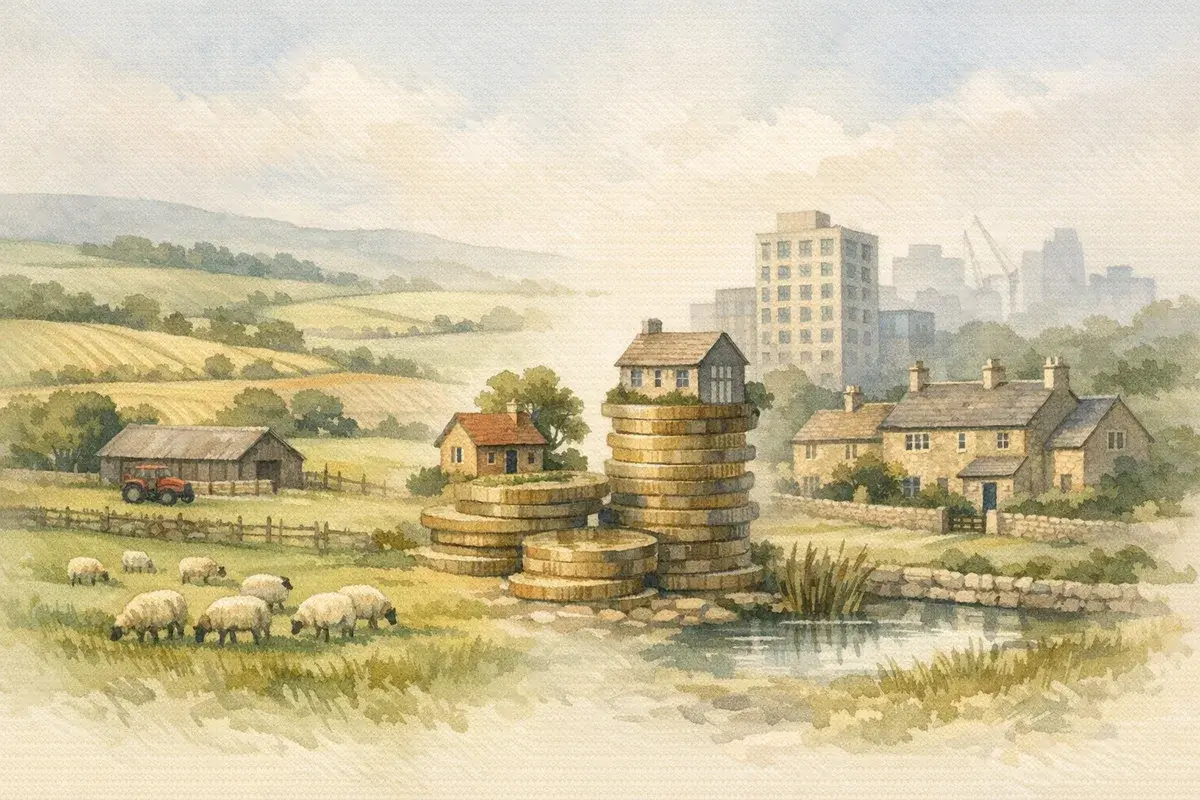
You don't usually end up comparing farmland vs property investment because you're bored. It's normally triggered by a real decision: a farm sale, an inheritance, a lump of retained profits, a rollover deadline, or simply the nagging feeling that "bricks and mortar" sounds safer than it actually is.
In the UK, farmland and mainstream property can both build wealth, but they do it in different ways, with different risks, and (crucially) different tax outcomes depending on how you buy, hold, and exit. Farmland can look slow and illiquid until planning or diversification flips the maths. Property can look predictable until debt costs rise, regulation tightens, or a void period drags on for months.
This guide cuts through the usual pub-chat comparisons and focuses on the practical stuff: how returns really show up, what tends to move each market, where the tax traps live, and how to match the asset to what you actually want your money to do.
How Farmland And Property Investments Actually Make Money
When you're weighing up farmland vs property investment, the cleanest way to think about it is: where does the total return come from, and what can derail it? Farmland returns often look "quiet" on paper because income yields can be modest, but capital values and strategic upside can be meaningful. Property can throw off more visible monthly income, but it's often more sensitive to financing and running costs.
Total Return: Income, Capital Growth, And Costs
Farmland total return typically comes from a blend of:
- Income: Farm Business Tenancy (FBT) rent, grazing/licences, contract farming margin, storage lets, renewables, or environmental schemes (where compatible with your wider objectives).
- Capital growth: Long-term appreciation in land values, plus occasional step-changes when location dynamics shift (infrastructure, local demand, neighbour expansion) or when the land becomes strategically important.
- "Hope value" and uplift: Not guaranteed and often slow, but transformative when it lands, planning gain, change of use, or a promotion agreement that delivers residential/commercial development value.
- Costs: Drainage, fencing, access maintenance, hedge/tree obligations, stewardship compliance, professional fees, and the quiet-but-real admin overhead of managing land properly.
By contrast, mainstream property investment (especially residential) is usually more heavily weighted towards:
- Income yield: Rent less letting/management costs, insurance, repairs, compliance, and increasingly chunky financing costs.
- Capital growth: Driven by local demand, wage growth, supply constraints, and credit availability.
- Costs and friction: Refurb cycles, regulatory compliance, voids, arrears, and transaction taxes.
One important nuance: in farmland, "income" isn't always rent. Plenty of landowners build a return by improving the operating performance of the holding (better drainage, field layout, access, tenant quality) and then crystallising value on sale. With property, you can do something similar via refurbishment and re-letting, but the market is often quicker to price improvements, and regulation can narrow what "value add" looks like.
If you want a deeper, UK-specific breakdown of where farmland returns tend to come from (and what's realistic), it's worth reading our guide to farmland investment returns in practice.
Liquidity And Transaction Friction: Time To Buy, Time To Sell
Liquidity is where many first-time rural investors get surprised.
Farmland is illiquid by nature. The best blocks are scarce, and sellers can be patient. Transactions can take time because due diligence isn't just "survey and searches", you're often unpicking:
- occupancy and grazing arrangements
- access rights and ransom strips
- stewardship obligations
- drainage outfalls and water rights
- boundary history and disputes
- overage/options sitting on title
Property is usually more liquid, but it's not frictionless. In a softer market, a house can sit: a buy-to-let can become unattractive once mortgage terms reset: and "quick sale" often means "price haircut".
A practical way to compare: farmland often has fewer forced sellers: property has more comparable evidence and a bigger buyer pool, but also more leveraged buyers who react faster to rate changes.
And don't ignore the buying friction. If you're new to rural transactions, our step-by-step approach to buying agricultural land as an investment can help you plan timelines, budgets, and professional support from day one.
Risk And Volatility: What Usually Moves Each Market
Risk in farmland vs property investment isn't just about price charts: it's about what forces prices to move and how quickly those forces flow through to your asset.
Interest Rates, Credit Conditions, And Buyer Demand
Property prices in the UK are famously sensitive to:
- interest rates and mortgage affordability
- bank credit conditions and stress testing
- investor sentiment (especially in buy-to-let)
When financing gets expensive, the marginal buyer disappears first, and that can reset prices quickly.
Farmland is affected too, but often less directly, because:
- a proportion of buyers are cash or low-leverage
- purchases can be strategic (business expansion, long-term family plans)
- supply is constrained and many owners don't have to sell
That doesn't make farmland "immune", it just means the transmission mechanism can be slower and more localised.
Inflation, Currency, And The "Real Asset" Argument
Both land and property are "real assets", and both tend to be discussed as inflation hedges. The bit people miss is that inflation doesn't automatically increase your net return.
- If inflation pushes up input costs (repairs, labour, materials), property investors can feel it immediately.
- For farmland, inflation can support land values over time, but your annual cash yield may still be modest unless you've structured income streams carefully.
Currency matters as well. When sterling is weak, UK assets can look cheaper to certain buyers. That said, farmland values are still fundamentally set by UK supply/demand dynamics and local competition, particularly from neighbouring farmers and rural operators.
Location And Micro-Factors: Soil, Access, Planning, And Neighbours
Property investors talk about "location, location, location". In farmland, location has extra layers:
- Soil type, drainage, and field shape affect productivity and tenant demand.
- Access (proper highway access, turning, track condition) affects everything from contracting costs to resale value.
- Neighbours matter more than most people admit. A land-hungry neighbour can anchor your exit value: a difficult boundary history can put buyers off.
- Planning context, green belt, AONB, National Park, settlement boundaries, and local plan direction, can either cap expectations or create long-run optionality.
If you've ever wondered why a field can be valued so differently from a residential plot a mile away, this isn't just "planning jargon", it's the gap between agricultural value and development value. We cover the drivers in detail in our explainer on why agricultural and residential land prices diverge in the UK.
Income Profile: Rent, Lets, And Operational Realities
If your goal is dependable cashflow, the farmland vs property investment debate often comes down to one blunt question: how predictable is the income after all the real-world mess?
Farm Business Tenancies, Grazing Licences, And Contract Farming
Farmland income can be structured in several ways, each with a different risk profile:
- Farm Business Tenancy (FBT): Typically the cleanest "rent for land" model. Your income is clearer, but rent reviews, tenant quality, and term length matter. A poorly written repairing obligation can shift costs back onto you.
- Grazing licences / seasonal lets: More flexible, sometimes attractive where you want to retain control. But you need to manage the licence properly to avoid accidental security of tenure issues.
- Contract farming: Can increase upside if you want exposure to operating performance without taking on full farming risk. It's more complex and needs solid documentation.
In practice, professionals spend a lot of time aligning documents to the reality on the ground, because lenders, valuers, and future buyers will.
If you're at the early stage and want to understand the moving parts without wading through jargon, our primer on investing in farmland as a beginner is designed to give you that foundation.
Residential Buy-To-Let Income Versus Vacancy And Arrears Risk
Residential property can produce stronger headline yield than bare land, but the net figure depends on what you actually experience:
- voids (even one long void can wipe out a year's "expected" profit)
- arrears and enforcement costs
- letting fees / management
- compliance spend (safety, licensing where applicable, upgrades)
You also need to treat rent as a business income stream, not a guarantee. One "bad year" in property can arrive quickly and loudly.
Farmland's income issues tend to be quieter: the rent might be lower, but it's often more stable if the tenancy is well structured and the holding is attractive to good operators.
Capex And Maintenance: Buildings, Drainage, Fences, And Compliance
This is where a lot of returns are won or lost.
With farmland, the big capex surprises often include:
- drainage failures (and the cost of getting outfalls and consents right)
- boundary fencing and hedge work
- access tracks and culverts
- upkeep of agricultural buildings (even "basic" sheds can swallow money)
With property, it's typically:
- boiler/roof/window cycles
- damp and insulation upgrades
- compliance-driven refurb
A useful mindset: farmland maintenance often feels optional until it suddenly isn't (because access fails, a neighbour dispute escalates, or stewardship obligations bite). Property maintenance feels constant, smaller hits, more frequently.
UK Tax And Structuring: Where The Big Differences Show Up
Tax is where comparisons between farmland vs property investment get serious, because the wrong structure can turn a "good asset" into an expensive headache.
This section is UK-focused, but it's still general guidance. Your facts (occupation, agreements, trading status, and family plans) do the heavy lifting, so get proper advice.
Inheritance Tax: APR, BPR, And Common Pitfalls
Agricultural Property Relief (APR) and Business Property Relief (BPR) are often cited as reasons farmland is attractive for long-term planning.
The catch: reliefs are not automatic, and mistakes are common. Pitfalls we see professionals try to avoid include:
- assuming all land automatically qualifies (it may depend on use, occupation, and whether it's genuinely agricultural)
- letting arrangements that weaken the "trading" narrative where BPR is being relied upon
- diversified income (storage, renewables, livery) that needs careful structuring and evidence
If you're thinking specifically about structuring for efficiency, our guide to building a tax-conscious farmland strategy lays out the UK issues to raise with your accountant and rural tax adviser.
Capital Gains Tax, Rollover Relief, And Development Uplift
Both assets can trigger CGT on disposal, but farmland has some distinctive planning angles:
- Rollover Relief may be relevant when you dispose of certain business assets and reinvest into qualifying assets (timing and eligibility matter).
- Development uplift can transform a return profile, but it can also complicate tax and valuation quickly, especially if you sign options, promotion agreements, or overage.
Property investors tend to focus on CGT mechanics and financing: farmland owners often have to manage CGT alongside longer-term family and business planning.
Stamp Duty, VAT, And Entity Choices (Personal, Company, Trust)
Transaction taxes and VAT issues differ depending on what you're buying:
- Residential property brings Stamp Duty Land Tax (SDLT) rules that can be materially higher for additional dwellings, and the numbers can change the viability of a deal.
- Farmland can involve SDLT as well, but VAT becomes a bigger question when there are buildings, commercial lets, or where the seller has opted to tax.
- Entity choice (personal, partnership, company, trust) affects not just tax but borrowing, succession planning, and day-to-day admin.
The core idea: in farmland, the "asset" and the "business" are often intertwined. With buy-to-let, the asset is usually the business.
Planning And Uplift Potential: The Upside With The Sharp Edges
Farmland's optionality is one of the reasons it stays in the conversation against mainstream property. But planning upside is a bit like leverage: powerful when it works, nasty when it doesn't.
Permitted Development, Change Of Use, And Enforcement Risk
In rural property, you'll hear plenty of confident statements about what you "can" do under permitted development.
Reality check: permitted development rights are conditional and procedural. Prior approvals, location constraints, previous use, and technical requirements can all matter. And enforcement risk is real, especially if someone starts building first and asking later.
If you're treating diversification or conversion as part of your investment case, you need to price in:
- planning consultant fees and drawings
- timelines (often longer than you want)
- constraints like highways visibility, flood risk, ecology, or heritage
Overage, Options, Promotion Agreements, And How Value Is Shared
This is where land can produce life-changing numbers, or years of frustration.
- Overage (clawback): A seller may retain a right to future uplift. It can be fair, but it can also reduce your flexibility and affect lender appetite.
- Option agreements: A developer pays for the right to buy later if planning is achieved.
- Promotion agreements: A promoter seeks planning and sells the land on the open market, taking a fee.
If you're buying land where uplift potential is part of the price, treat the contract terms as part of the asset. Because they are.
Access, Easements, Rights Of Way, And Ransom Strips
On paper, a field is simple. On title, it might be anything but.
- A missing legal right of access can kill value.
- A public right of way can restrict development and sometimes complicate day-to-day management.
- A ransom strip, even a narrow sliver of land, can control access and hence bargaining power.
In farmland vs property investment terms, these issues behave a bit like property "title defects", except they're often more historic, less documented, and more expensive to fix.
Due Diligence Checklist: What We See Professionals Check First
Good rural deals are rarely "found", they're verified. The professionals we see performing well in the market follow a repeatable due diligence process, because one overlooked detail can swallow years of return.
Title, Tenure, Boundaries, And Occupation Status
Start with the fundamentals:
- Title review: covenants, easements, overage, restrictions, and any third-party rights.
- Tenure and occupation: is the land vacant possession, under FBT, licence, or something informal that needs tidying?
- Boundaries: compare title plan to what's on the ground. Note fence lines, ditches, hedges, and any "fuzzy" corners.
- Access: not just "can you get there?", but "is it legally documented and suitable for the intended use?"
If you're asking yourself the basic question "is this actually a sensible place to put money?", our longer read on whether farmland stacks up as an investment expands the decision framework beyond the headline price per acre.
Environmental Constraints And Liabilities (SSSI, NVZ, Flood, Contamination)
UK rural due diligence increasingly lives or dies on environmental constraints:
- SSSI designations and protected habitats can limit operations and development potential.
- Nitrate Vulnerable Zones (NVZ) can affect nutrient management and infrastructure decisions.
- Flood risk matters for both farmland productivity and any diversification plan.
- Contamination is less common on bare land, but think about historic uses, old tips, fuel stores, former buildings, treated timber.
You're not trying to eliminate risk: you're trying to avoid paying for upside that can't legally happen.
Water, Drainage, Wayleaves, Minerals, And Sporting Rights
These are the "quiet value levers" professionals check early:
- Water supply and any agreements for abstraction or private systems.
- Drainage responsibilities and whether outfalls cross third-party land.
- Wayleaves and utilities: cables, pylons, pipelines, and what rights exist (plus compensation arrangements).
- Mineral and sporting rights: what's included, what's reserved, and whether that matters in your plan.
If your aim is lower-touch ownership, it's worth thinking through management from day one, who monitors boundaries, deals with notices, and keeps paperwork tidy. For some buyers, a more hands-off approach can be appropriate, but it still requires structure: our overview of hands-off farmland ownership models sets out the practical realities.
Building A Portfolio: Matching The Asset To Your Goal
The most expensive mistake in farmland vs property investment isn't picking the "wrong" asset. It's picking an asset that doesn't match your goal, then forcing it to behave like something it isn't.
Capital Preservation Versus Growth Versus Income
Ask yourself what you're really optimising for:
- Capital preservation: Farmland can suit long horizons where scarcity and strategic value matter, but you accept lower visible income.
- Growth: Property can deliver growth quickly in the right cycle: farmland can deliver growth slowly, with occasional step-changes.
- Income: Buy-to-let can produce stronger monthly cashflow, but it's more operationally intensive and sensitive to leverage and regulation. Farmland income can be steadier when well-let, but often lower unless you add complementary income streams.
You can't optimise all three without trade-offs. Decide which one you won't compromise on.
Diversification: Blending Farmland, Rural Residential, And Commercial
A sensible UK rural portfolio often blends assets that behave differently:
- core farmland for long-term value storage and strategic optionality
- rural residential where local demand is strong and the asset is lettable/saleable
- commercial/rural enterprise space (where planning and access support it)
The key is correlation: you're trying not to rely on one driver (like mortgage affordability) for your entire outcome.
Time Horizon, Leverage, And Exit Strategy Planning
Two practical truths:
- Leverage magnifies the wrong problems. Property investors feel this fast when rates rise. Farmland buyers can feel it when income is low and the asset is slow to sell.
- Your exit route should be believable on day one. Who is the buyer in five, ten, or twenty years? Another farmer? An investor? A neighbour? A developer? Your answer should shape what you buy today.
When you register your requirements with AgLand, think like a buyer and a seller simultaneously: describe what you want now, but also what will be easiest to explain (and evidence) later, access, clean title, sensible occupation terms, and realistic upside.
Conclusion
Farmland vs property investment in the UK isn't a battle of "safe" versus "risky". It's a choice between two assets that reward different behaviours.
If you want visible monthly income, property can do that, provided you respect voids, compliance, and finance costs as first-class risks. If you want long-horizon capital resilience with optionality, farmland can fit, provided you're disciplined about due diligence, documentation, and not overpaying for planning dreams.
The best approach is often the least glamorous: decide your objective, stress-test the weak points (tax, access, occupancy, leverage), and then buy the asset that behaves the way you need, even when the market turns.
Disclaimer: AgLand.co.uk is a UK agricultural land and rural property matching service, where buyers register what they are looking for and owners advertise directly to the buyers who match, and a rural resource hub. Nothing in this text is intended as legal, financial, tax, or investment advice. You should carry out your own due diligence and seek guidance from appropriately qualified professionals (for example, a solicitor, chartered surveyor, tax adviser, and planning consultant) before making decisions.