
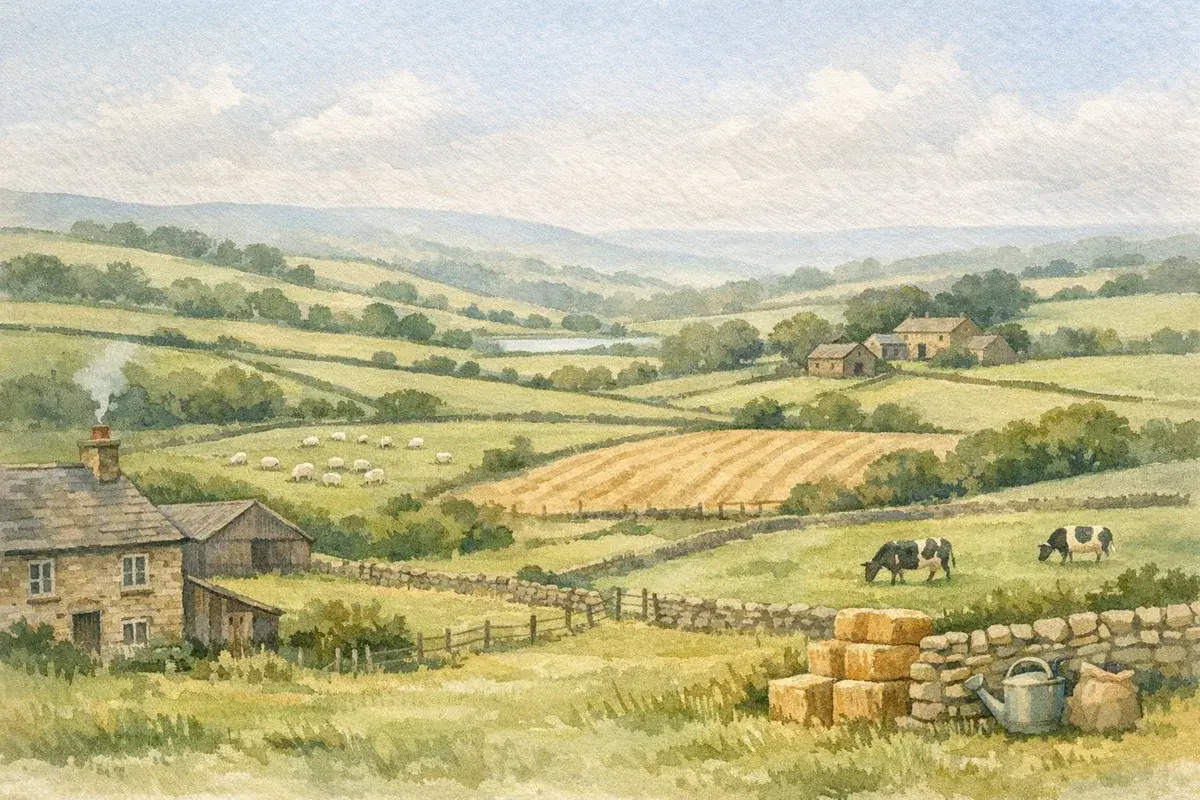
You've probably heard the line that "they're not making any more land." In UK farmland circles it's almost a reflex, usually said right after someone mentions inflation, inheritance tax, or the neighbour who'll "pay whatever it takes" for the next block.
But the real question isn't whether farmland is valuable. It's whether farmland is a good investment for you, in the UK, given how returns actually show up (often slowly), the risks you inherit along with the title deeds, and the practical reality that rural assets don't behave like a FTSE tracker.
This guide takes the romanticism out and puts the numbers, constraints, and decision points on the table, so you can judge farmland like an investor and like a long-term owner.
What Makes Farmland Attractive As An Asset Class
Farmland's appeal in the UK isn't one single thing, it's a bundle: a productive asset, a finite resource, a store of value, and (sometimes) a platform for multiple income streams. That "sometimes" matters.
Income: Rents, Contract Farming, And Diversification
If you're buying farmland as an investment, your starting point is usually: what cash yield can the land generate without heroic assumptions?
In broad terms, income can come from:
- Letting the land (commonly on a Farm Business Tenancy (FBT) under the Agricultural Tenancies Act 1995, occasionally under older AHA arrangements) where your income is rent and the tenant farms.
- Contract farming where you retain more control and take a share of the farming margin, often better aligned with active owners, but operationally more involved.
- Short-term licences (e.g., grazing, mowing) which can be flexible but less secure.
- Diversification where appropriate: storage yards, holiday lets, telecoms masts, flood storage payments, renewable options, or biodiversity/natural capital schemes.
A key reality: bare land rent yields are often modest in the UK. Many buyers accept that because they're also targeting capital growth, tax/estate outcomes, or strategic control.
Capital Growth: Scarcity, Demand Drivers, And Long-Term Trends
Capital appreciation is where farmland has historically done much of its heavy lifting.
Why values can trend upward over time:
- Finite supply of land that can be bought and sold as a whole.
- Local scarcity and neighbour competition, a nearby farmer may value a block far more than an "outsider" because it improves efficiency, cropping rotations, and machinery logistics.
- Strategic value (only when real): proximity to settlements, grid, water, or potential for non-agricultural uses.
- Institutional and private wealth demand for tangible assets when inflation and uncertainty rise.
If you want a grounded comparison against mainstream bricks-and-mortar, it's worth reading our deeper take on how farmland stacks up against standard property investing, because the risk profile and the "return shape" are very different.
Portfolio Benefits: Inflation Link, Low Correlation, And Tangibility
Farmland often features in portfolios for reasons that aren't just spreadsheet returns:
- Inflation sensitivity: land values and rents can (not always, but often) reprice over time as costs and commodity-linked economics shift.
- Low correlation with some financial assets: farmland prices don't typically move in lockstep with equities day-to-day.
- You can touch it: it's not a promise on paper. That matters to many UK landowners and family investors.
But tangibility can tempt you into underpricing risk. Unlike a REIT share, you can't ignore drainage, rights of way, or a badly drafted tenancy clause, you own them, too.
How Farmland Returns Actually Work In Practice
If you're asking "is farmland a good investment?", you're really asking about total return, and whether you'll actually capture it in your holding period.
Separating Total Return: Income Yield Vs Capital Appreciation
Farmland's total return generally splits into:
- Income return: rent, contract farming surplus, or diversification receipts.
- Capital return: the change in land value over time.
In the UK, many buyers mentally anchor on capital growth, sometimes because the income yield is thin, sometimes because they're buying for control, succession, or long-term security.
If you want to sense-check expectations, our analysis of typical agricultural land investment returns in the UK is a good companion, especially for understanding how yields, capital movement, and "one-off" value events affect real outcomes.
A practical way to think about it:
- If you're highly reliant on income (e.g., you need the land to "pay its way" annually), farmland can disappoint unless you have strong letting terms or viable diversification.
- If you're comfortable with lower income and a long horizon, farmland starts to look more sensible, provided you buy well.
Costs That Reduce Net Returns: Finance, Maintenance, And Professional Fees
The headline rent or gross margin is not your return.
Common drags on net performance include:
- Finance costs: interest rates, arrangement fees, lender covenants, and valuation costs.
- Maintenance and compliance: fencing, gates, ditches, hedges, tracks, tree safety, and dealing with fly-tipping or antisocial use.
- Professional fees: land agent, solicitor, accountant, surveyors, environmental consultants.
- Insurance and risk management: public liability, property cover for any buildings, and sometimes specialist policies.
- Tax friction depending on structure and activity.
In other words: farmland can be "low management" only if you buy the right asset and set it up well. If you buy a problematic holding (access disputes, unclear rights, tired buildings), you can create a second job you didn't ask for.
The Holding-Period Reality: Liquidity, Timing, And Patience
Farmland is not liquid. In practice, that means:
- Sales take time (marketing, viewings, negotiations, finance, and legal work).
- Price discovery is local: two near-identical fields can sell at very different levels depending on who needs them.
- Timing risk is real: you may want to exit when the market is quiet, credit is tight, or a local buyer pool is thin.
Patience isn't just a virtue here, it's part of the asset class. If you need flexibility, you either buy with a plan for partial disposals, buy smaller lots, or consider indirect exposure (covered later).
The Biggest UK Farmland Risks And Constraints To Price In
Good farmland investing isn't about being bullish on land. It's about being ruthless on downside: what can go wrong, what you can control, and what you simply have to price in.
Planning, Environmental Designations, And Development Hope Value
A lot of buyers quietly overpay because they've fallen for "hope value", the idea that land might get development consent.
In the UK, you need to treat planning as evidence-led, not vibes:
- Designations bite: Green Belt, National Parks, AONB/NSAs, SSSI, scheduled monuments, flood zones, each changes your realistic options and the likelihood of consent.
- Access and highways can kill a scheme as quickly as ecology.
- Overage/clawback provisions can transfer upside back to the seller later.
If development is your thesis, you're not just buying farmland, you're buying a planning project. That's fine, but it requires specialist advice and a price that reflects the probability-weighted outcome.
Policy And Subsidy Change: From BPS To Environmental Schemes
UK support has been shifting away from direct area-based payments (BPS) towards environmental land management and devolved schemes.
What that means for you:
- You can't buy based on yesterday's subsidy model.
- Scheme income can be meaningful, but it comes with obligations (management prescriptions, monitoring, record-keeping, and sometimes restrictions on future use).
- Policy can change. That's not a moral judgement, it's just a risk factor.
Before you assume stewardship will "cover the mortgage", model the downside: delayed payments, non-compliance penalties, or scheme rules that limit flexibility.
Operational And Physical Risks: Weather, Biosecurity, And Soil Health
Even if you don't farm the land yourself, physical risk still hits your value:
- Waterlogging and drainage failure: crops suffer, tenants negotiate harder, and future buyers discount.
- Soil health decline: compaction, erosion, low organic matter, quietly expensive to fix.
- Biosecurity issues: disease outbreaks, invasive weeds, and the cost of containment.
- Climate variability: drought and extreme rainfall events can alter what's reliably farmable.
A field can look fine on a sunny viewing day. The real test is how it performs in a wet February.
Tenure And Legal Risks: Tenancies, Sporting Rights, Wayleaves, And Title
This is where UK farmland deals win or lose money.
Key risks to identify early:
- Tenancies and occupation: what is the actual legal arrangement, FBT, AHA, grazing licence, or informal? And what are the termination mechanics?
- Sporting rights: who controls shooting? Are there leases, syndicates, liabilities, or neighbour conflicts?
- Wayleaves and easements: pylons, water pipes, fibre routes, access rights, some are fine, some are restrictive.
- Title defects and boundary uncertainty: not always fatal, but always time-consuming.
If you want a structured view of risks and checks, our longer guide to agricultural land investment in the UK lays out a practical due diligence framework you can use with your solicitor and agent.
What Drives Farmland Value In Different Parts Of The UK
"Farmland" isn't one market. In the UK it's a patchwork of micro-markets, each with its own buyers, farming systems, and constraints.
Land Quality And Capability: Soil, Water, Drainage, And Access
Quality still matters, particularly when farming profitability is under pressure.
Buyers (and valuers) typically look for:
- Soil type and depth: versatile loams generally attract more competition than thin upland soils.
- Drainage and workability: can you travel early? Can you harvest reliably?
- Water: availability for livestock, irrigation rights where relevant, and the cost of installing supply.
- Access: safe, wide entrances and proximity to a road network that can take modern kit.
One blunt truth: land that's easy to farm tends to hold value better, because more people can make it work.
Parcel Size, Shape, And Infrastructure: Buildings, Tracks, And Services
Two holdings can be the same acreage and wildly different in value.
What changes the price:
- Blocky, efficient parcels (less headland, fewer awkward corners).
- Internal tracks and gates that reduce labour and machinery wear.
- Buildings: useful modern sheds can add value: obsolete buildings can be liabilities (asbestos, repairs, rates, security).
- Services: mains water, three-phase electricity, fibre, small details that matter a lot when you're trying to diversify.
Local Market Dynamics: Neighbours, Competition, And Supply
In many areas, the strongest bidder is simply the person next door.
Local dynamics that influence value:
- Who's expanding (dairy, arable, mixed, horticulture) and what land type they need.
- How often land comes up: low supply can push prices beyond what an income model suggests.
- Non-farming buyers: lifestyle, equestrian, amenity woodland, sometimes supportive, sometimes distorting.
This is one reason specialist marketing matters. On AgLand, buyers register exactly what they want - use class, acreage, budget, area - so an owner advertising a well-presented holding reaches the people who already match it, rather than everyone trawling generic property categories.
With Or Without Strategic Angles: Carbon, Natural Capital, And Renewables
Strategic angles can add value, but only when they're investable, contractable, and compatible with your exit plan.
- Natural capital and biodiversity: potential income exists, but you need to understand permanence, covenants, and how it affects future use and reliefs.
- Woodland creation/peatland restoration: can suit some holdings: can also restrict agricultural flexibility.
- Renewables (solar, wind, AD): often a planning/grid game first, land game second.
If a seller is pricing in "carbon potential" but there's no credible route to a bankable agreement, treat it as marketing, not value.
Routes To Investing In Farmland (And Who Each One Suits)
There's more than one way to get exposure to farmland. The right route depends on how involved you want to be, how much control you need, and what you're trying to achieve.
Buy And Farm It: Owner-Occupier And Active Management
If you're a farmer expanding, this can be the cleanest logic: you're buying land that improves your operating base.
Upsides:
- You capture operational synergies (machinery efficiency, rotation, labour).
- You control standards and stewardship, which can protect long-term value.
- You may unlock diversification more easily as the on-the-ground operator.
Trade-offs:
- Your return becomes linked to farming performance and weather.
- The management burden is real.
If you're newer to the idea and want the basics first, start with our primer on investing in farmland for beginners, it's designed to stop you making the classic early mistakes (overpaying for "potential", underestimating tenure complexity, and skipping professional checks).
Buy And Let It: FBT, AHA, Grazing Licences, And Contract Farming
Letting can suit you if you want the asset exposure with less day-to-day farming involvement.
Typical structures:
- FBT (Farm Business Tenancy): common for new arrangements, flexible terms, clearer end dates.
- AHA tenancies: older and generally more secure for the tenant: can materially affect vacant possession value.
- Grazing licences: short-term and flexible, but must be drafted correctly to avoid accidentally creating a tenancy.
- Contract farming agreements: shared margin model: requires active oversight and good reporting.
The landlord-friendly option isn't automatically the best investment option. The best is the one that matches your risk tolerance, tax position, and time.
Buy With Partners: Syndicates, Joint Ventures, And Family Structures
Partnering is common in UK rural property, siblings buying together, multi-generational structures, or JV arrangements where one side brings capital and the other brings operational capability.
Do it well and you can:
- Access larger, better lots.
- Spread risk and responsibility.
- Combine expertise (capital + farming skill).
Do it badly and you can lock yourself into a dispute for years. Clear heads of terms, governance, and exit provisions aren't optional.
Indirect Options: Funds, REIT-Style Vehicles, And Lending Exposure
Indirect routes may suit you if you want exposure without owning fields directly.
Pros:
- Potentially more liquidity.
- Professional management.
- Easier diversification across regions or farm types.
Cons:
- Less control.
- Fees can bite.
- Your "farmland" exposure may include wider rural assets, leverage, or development risk.
Some buyers also consider "hands-off" direct ownership with a strong letting structure. If that's you, see our guide to passive approaches to farmland investment, it focuses on how to keep involvement sensible without sleepwalking into avoidable landlord liabilities.
Tax, Reliefs, And Structuring Considerations
Tax is often part of the reason people look at UK farmland, but it's also where casual assumptions cause expensive mistakes. Rules change, facts matter, and HMRC cares about detail.
Agricultural Property Relief And Inheritance Tax Planning Basics
Agricultural Property Relief (APR) can reduce the inheritance tax (IHT) burden on qualifying agricultural property, but qualification depends on use, occupation, and the nature of the asset.
Common tripwires include:
- Non-agricultural use creeping in without considering implications.
- Let arrangements that don't align with intended relief.
- Overestimating what qualifies when there's a significant non-farming element.
APR is powerful, but it's not a magic cloak. Treat it as something to plan for with a rural accountant and solicitor, not something to assume.
Capital Gains Tax, Rollover Relief, And Hold-Over Relief In Context
CGT can arise on disposals, and reliefs may be available depending on circumstances.
In practice, these conversations usually come up when:
- You're selling another asset and considering rollover into land.
- You're transferring assets within a family and exploring hold-over.
- You're balancing land deals against wider estate planning.
The point isn't to memorise relief rules, it's to recognise early when a decision is tax-sensitive, and get the structure right before you exchange.
Income Tax And VAT: When "Investment" Starts Looking Like A Trade
Where you sit on the spectrum from passive landlord to active operator matters.
- Diversification income may be taxed differently from agricultural income.
- VAT registration may be beneficial or necessary depending on activities.
- If your "investment" looks like a trade in practice, your tax treatment can change.
If tax efficiency is a key driver, our guide to structuring a tax-efficient farmland investment is a useful starting point, then you'll want bespoke advice tailored to your wider estate and business.
Ownership Structures: Personal, Partnership, Company, And Trusts
Ownership structure affects:
- Tax outcomes (income, CGT, IHT).
- Borrowing and security.
- Succession planning.
- Governance and decision-making.
Broadly:
- Personal ownership can be simple but may not suit succession or partnerships.
- Partnerships can align with farming operations and family involvement.
- Companies can offer governance clarity, but tax outcomes vary and administration is heavier.
- Trusts can be useful in estate planning, but need careful design and ongoing compliance.
There isn't a universally "best" structure, only what's fit for your objectives, timeframe, and family/business reality.
A Due Diligence Checklist Before You Buy
This is where good farmland investments are made. Not by staring at a map, but by verifying what you're actually buying.
Title And Rights: Boundaries, Easements, Minerals, And Sporting
Before you get emotionally attached to a block, confirm:
- What the title includes (and what it doesn't).
- Boundary responsibility: who maintains which fences/hedges/ditches?
- Easements and rights of way: public footpaths, bridleways, private rights, access for neighbours.
- Minerals and sporting rights: reserved by a previous owner? leased out? any liabilities?
- Wayleaves: electricity, telecoms, water, terms and payments should be checked.
A few hours of methodical checking can save you years of "we didn't realise…" conversations.
Tenure And Occupation: Vacant Possession, Notices, And Rent Review
If the land is occupied:
- Identify the exact legal arrangement.
- Check term length, break clauses, assignment provisions, and repair obligations.
- Review rent review mechanics and any side letters.
- Understand the realistic route to vacant possession (if that's part of your plan).
If it's being sold as vacant possession, verify how that will be delivered and whether notices have been served correctly.
Land Condition: Soils, Drainage, Contamination, And Stewardship Obligations
Condition is value.
Checks worth doing (proportionate to deal size):
- Basic soil assessment and recent cropping history.
- Drainage outfalls, ditches, and any history of flooding.
- Signs of compaction or erosion.
- Contamination risk (historic uses, illegal tipping, asbestos around buildings).
- Existing scheme commitments (stewardship prescriptions, capital items, restrictions).
If you inherit an obligation you can't comply with, it stops being "income" and becomes "cost".
Practicalities: Access, Services, Biosecurity, And Neighbour Issues
Practical issues often decide whether a holding is a joy or a nuisance:
- Can you get modern machinery in and out safely?
- Is there a reliable water supply?
- Any shared private tracks with tricky neighbours?
- Biosecurity considerations (especially near livestock operations).
- Evidence of fly-tipping, dog walking pressure, or vandalism.
These aren't minor. They affect your tenant demand, your insurance, and your eventual resale.
Valuation And Funding: Comparable Evidence, Lenders, And Sensible Leverage
Valuation for farmland is not a simple "price per acre" exercise.
Do this properly:
- Ask your agent for local comparable evidence, not just regional averages.
- Consider whether the lot has a special purchaser dynamic (neighbour interest) inflating the price.
- Speak to lenders early: agricultural lending terms can differ materially depending on tenure, buildings, and diversification.
- Use leverage sensibly. Farmland can be resilient, but it's not immune to rate shocks.
If you want a practical buying plan that strings these steps together, our guide on buying agricultural land as an investment in the UK walks through a realistic process from search to offer to completion.
How To Decide If Farmland Is A Good Investment For You
Farmland can be a good investment in the UK, but it's not a generic one. It's very good for some objectives, merely "okay" for others, and completely wrong for a few.
Clarify Your Objective: Income, Legacy, Tax, Lifestyle, Or Upside
Be honest about what you want the land to do.
- If you want reliable income, you'll focus on tenant quality, terms, diversification potential, and low capex.
- If you want legacy and succession, you'll prioritise control, long-term resilience, and how it sits within your family structure.
- If you want tax planning, you need to align use, ownership, and documentation with the intended reliefs.
- If you want upside, you're probably in "strategic land" territory, plan for longer timeframes and a higher chance of disappointment.
Your objective should drive what you buy, not the other way round.
Set Your Risk Tolerance: Policy, Planning, Tenant, And Operational Exposure
Different routes carry different risks:
- Let land and you reduce operational risk, but increase tenant and legal-structure risk.
- Farm it yourself and you increase operational exposure, but you control standards.
- Chase planning upside and you step into planning, community, and infrastructure risk.
A useful self-test: if your expected return relies on two things going right that you can't control, the investment is probably mispriced or misframed.
Define Your Buying Criteria: Region, Quality, Lot Size, And Exit Plan
Good criteria are specific enough to filter, but flexible enough to buy when the right thing appears.
Think about:
- Region and travel time (your ability to manage matters).
- Land grade/soil type and drainage.
- Lot size (and whether you need scale).
- Buildings: asset or liability?
- Tenure: what occupation terms are acceptable?
- Exit plan: who is your buyer in 10–20 years, neighbouring farmers, lifestyle buyers, or investors?
And yes, price discipline matters. If you overpay, farmland's "slow and steady" nature makes it harder to rescue the deal later.
Build Your Adviser Team: Land Agent, Solicitor, Accountant, And Specialist Surveyors
In UK farmland purchases, your adviser team isn't a box-tick. It's your risk control.
At a minimum:
- Agricultural land agent: local comparables, buyer behaviour, negotiation.
- Solicitor with rural experience: title, rights, tenure, overage, wayleaves.
- Accountant/tax adviser: structure, reliefs, cashflow planning.
- Specialists as needed: drainage, environmental, planning, valuation, renewables.
We've seen the best outcomes when buyers treat advisers as part of the buying strategy, not an expense to minimise.
If you're actively searching, AgLand is built to make that process more efficient: you register what you're after - type, acreage, budget and area - and hear the moment a matching property is advertised, free, with no commission on either side.
Conclusion
So, is farmland a good investment in the UK? It can be, but only if you're clear-eyed about what you're buying.
Farmland tends to reward patient owners who buy quality, manage risk, and think in decades. It tends to punish buyers who pay for "potential" they can't evidence, underestimate legal/tenure complexity, or assume the tax story will take care of itself.
Your best next step is simple: decide what you need (income, control, legacy, tax planning, upside), then build a buying brief and an adviser team that match it. If you do that, farmland stops being a vague "safe haven" idea and becomes a properly underwritten rural investment.
Disclaimer: AgLand.co.uk is a UK agricultural land and rural property matching service, where buyers register what they are looking for and owners advertise directly to the buyers who match, and a rural resource hub. Nothing in this text is intended as legal, financial, tax, or investment advice. You should carry out your own due diligence and take advice from appropriately qualified professionals (for example, a rural solicitor, accountant/tax adviser, RICS surveyor, and specialist land agent) before making any decisions.