
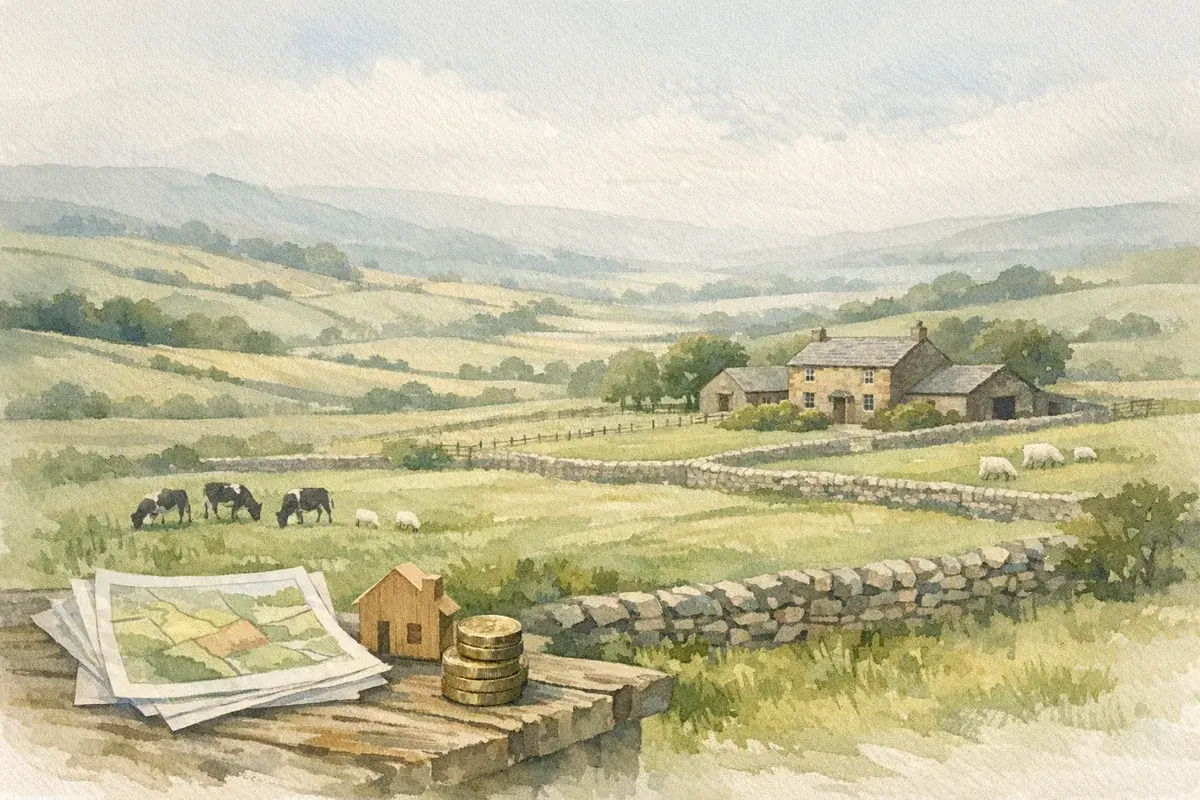
A good farmland purchase rarely looks "exciting" on day one. It looks like access gates that open cleanly, a boundary that matches the title plan, drains that actually work, and a local letting market that doesn't vanish the moment you need a tenant.
If you're buying agricultural land as an investment in the UK, that's the game: build returns from boring fundamentals, protect yourself from hidden constraints, and keep optionality for the future (without paying development money for land that can't realistically deliver it). This guide lays out where the returns really come from, what makes land genuinely investable, and a practical plan you can follow from search to completion.
Why Investors Buy Agricultural Land (And Where The Returns Really Come From)
Most people talk about "farmland as a safe haven". In practice, agricultural land is an investment with three distinct return engines, and you'll usually do best when you're honest about which engine you're paying for.
Income Return: Farm Business Tenancies, Grazing Licences, And Lettings
Income can be steady, but it's rarely effortless.
- Farm Business Tenancies (FBTs) can provide predictable rent and clearer terms than older-style arrangements. But rent review mechanics, repairing obligations, and who carries compliance responsibilities all matter more than the headline rent.
- Grazing licences and seasonal lets can be flexible and may help you retain control, but they can also be admin-heavy and vulnerable to local demand swings.
- Buildings and yards (if included) can improve cashflow, yet they also bring added maintenance, insurance, and often planning/compliance questions.
In UK terms, the "yield" on bare land is often modest. So you're usually underwriting a blend of income plus long-term capital growth, not income alone.
Capital Growth: Land Values, Scarcity, And Long-Term Demand Drivers
Capital growth is where many investors pin their hopes, and it's real, but it's not magic.
- Scarcity: there's only so much quality, accessible land in the right locations.
- Neighbour demand: local farmers expanding, and well-capitalised buyers seeking resilient assets, can keep a floor under values.
- Policy and markets: the post-BPS transition and Environmental Land Management (ELM) options are changing behaviour, which affects what different parcels are "worth" to different buyers.
If you want a grounded sense of the market, it helps to track price evidence rather than headlines. We keep a close eye on signals like soil quality premiums, block size demand, and regional liquidity, see our analysis on what's driving UK farmland pricing when you're sense-checking an asking figure.
Strategic Upside: Renewables, Natural Capital, And Development Potential
This is where buyers can overpay fastest.
- Renewables (solar, wind, battery storage) can transform value, but only where grid, constraints, landform, and planning reality line up.
- Natural capital (biodiversity net gain units, woodland creation, carbon-related projects) can be meaningful, but it's contract-led and often long-term. It's not "free money for fields."
- Development potential (residential/commercial) is the classic dream, yet you should treat it as option value unless you have credible planning advice, a viable access strategy, and evidence it's policy-aligned.
If you're weighing these upside angles, use a structured risk lens, not optimism. Our deeper guide to UK agricultural land investment returns and risks is designed for exactly that kind of decision.
What Makes A Good Agricultural Land Investment: The Core Value Drivers
Two parcels can look identical on a map and perform very differently as investments. These are the value drivers we see separating "great on paper" from "great in real life."
Location, Demand, And Local Market Liquidity
Location isn't just postcode prestige, it's who will want this land after you.
Ask yourself:
- Is there a strong local farming community actively renting/buying?
- Are there neighbouring farmers who would pay a premium for adjacency?
- How often does comparable land actually transact locally (liquidity matters when you need to sell)?
Also, be careful with "edge-of-town" narratives. Sometimes that's genuine strategic land. Other times it's simply land with extra constraints (access, neighbours, designations) and no clear route to value creation.
Soil, Topography, Drainage, And Water Access
In UK farmland, the physical basics quietly drive everything.
- Soil type and depth affect cropping flexibility, input costs, and resilience in wet/dry years.
- Topography influences machinery efficiency and erosion risk.
- Drainage is often the hidden decider. A field that looks fine in July can be a write-off in a wet spring.
- Water (for livestock, irrigation potential, or stewardship outcomes) can materially affect rental demand and future uses.
If you're looking specifically at productive cropping ground, it's worth reading our practical notes on how to assess arable fields before you buy so you don't end up paying "prime land" money for average performance.
Access, Services, And Practical Operability
This is the unglamorous stuff that can make or break your ownership experience.
Check:
- Legal and physical access (not just "there's a track") and whether it's suitable for modern kit.
- Gateways and visibility for safe road entry/exit.
- Services: water supply, electricity, wayleaves, and the reality of upgrading anything rural.
- Field shape and internal tracks: odd corners and bottlenecks reduce usable area and can drag down rent.
A quick rule: if the land is awkward to farm, it'll be awkward to let, and that hits both income and resale demand.
Rights, Restrictions, And Due Diligence: What To Check Before You Offer
Farmland due diligence is where investors either protect their downside, or discover, too late, that the "cheap" lot was cheap for a reason.
If you want a full end-to-end checklist, start with our step-by-step UK buying guide. Below are the big-ticket items you should be clear on before you commit.
Title, Boundaries, Easements, And Rights Of Way
You're not just buying acreage. You're buying a bundle of rights, and sometimes other people's rights over your land.
Key checks:
- Title plan vs. reality on the ground: hedges move, fences wander, and "the ditch is the boundary" can cause arguments.
- Easements and wayleaves: utilities apparatus can limit how you use land and complicate future projects.
- Public rights of way: these aren't automatically a deal-breaker, but they affect privacy, liability perceptions, and certain diversification ideas.
- Ransom strips and access ambiguity: if access depends on goodwill, treat that as a real risk.
Tenancies, Occupation, And Vacant Possession Risk
Occupation status changes value, sometimes dramatically.
- Confirm whether the land is vacant, under an FBT, on a licence, or subject to any informal arrangements.
- Understand termination dates, break clauses, and the practical reality of getting land back.
- Factor in that a sitting occupier may also hold valuable local knowledge (drains, flooding history, boundary quirks). Use that, don't ignore it.
If you're buying with a view to change use (renewables, natural capital, long-term strategic value), tenancy terms can limit what you can do and when.
Environmental Designations, Covenants, And Planning Constraints
Constraints aren't bad, surprises are.
Look for:
- Designations such as SSSI, AONB, National Park, Scheduled Monument areas, or Local Wildlife Sites (each comes with different practical implications).
- Restrictive covenants limiting building, commercial use, or even certain farming operations.
- Planning history: refusals, enforcement issues, or conditions that still bind the land.
In the UK, permitted development rights (where relevant) are conditional and can be removed or constrained by location/designations. A planning consultant's view can be worth far more than a "seems likely" assumption.
The Numbers: Pricing, Funding, And The True Cost Of Ownership
One of the easiest mistakes in buying agricultural land as an investment is focusing on the purchase price while underestimating the total ownership cost, and overestimating how quickly you can "do something with it."
Valuation And Comparable Evidence For Farmland
Valuation is part data, part judgement.
- Use comparable sales (adjusted for soil, access, block size, location, tenure, and any uplift angles).
- Split the land into components: productive acres, rough grazing, woodland, tracks, yards/buildings. The blended £/acre figure can hide a lot.
If you're benchmarking affordability, our guide to the typical cost per acre in the UK is a useful starting point, but you'll still need local comparables and professional valuation for anything you're seriously pursuing.
Finance Options: Cash, Specialist Lenders, And Bridging
Financing agricultural land in the UK is specialist territory.
- Cash gives speed and negotiating power, particularly for clean, unmortgageable, or time-sensitive lots.
- Specialist rural lenders may take a more practical view of land quality, tenure, and longer-term plans than mainstream banks.
- Bridging can work for short timelines or where a refinance is planned, but costs can stack up quickly, so you need a credible exit.
Also be clear on what lenders will and won't like: title complexity, access uncertainty, and non-standard tenure can all slow things down.
Ongoing Costs: Maintenance, Insurance, Compliance, And Management
Annual costs vary wildly depending on what you buy.
Budget for:
- Boundary maintenance: hedges, fencing, ditches, gates.
- Weed and invasive species control (and the reputational issues if you ignore it).
- Insurance appropriate to use (public liability is often the first conversation).
- Professional fees: agent management, accounts, compliance support.
- Capital works: track repairs, drainage improvements, building maintenance.
And remember: "low management" can be an illusion. Even a simple grazing licence needs monitoring, paperwork, and a plan for issues like fly-tipping and unauthorised access.
Tax And Structuring: Get The UK Rules Right Early
Tax is where agricultural land investing gets technical fast, and where costly mistakes tend to be avoidable if you plan early.
SDLT, VAT, And When VAT Can Surprise You
- Stamp Duty Land Tax (SDLT) treatment depends on what you're buying and how it's classified (and the specifics matter).
- VAT can catch buyers out where land is opted to tax, where there are buildings, or where a transaction is structured in a way that changes VAT treatment.
Don't treat VAT as a footnote. A "small" VAT misunderstanding can create a very large cashflow problem.
Reliefs And Risks: APR, BPR, CGT, And Income Versus Capital Treatment
This is where you want your tax adviser involved before you exchange, not after.
- APR (Agricultural Property Relief) and BPR (Business Property Relief) can be relevant for inheritance tax planning, but they're not automatic and depend on use/occupation and circumstances.
- CGT matters on disposal, and the availability of reliefs can hinge on how the land has been used, whether it's part of a trading business, and how any development value is realised.
For a practical, UK-specific breakdown, read our guide on how capital gains tax works on agricultural land before you commit to a structure or a strategy.
A common trap: assuming an uplift will be taxed "nicely" as capital when, in some scenarios, HMRC can view activities as trading in nature. That's exactly the sort of nuance where bespoke advice pays for itself.
Ownership Structures: Personal, Company, Partnership, Or Trust
Structure should follow your goals:
- Buying in your personal name may keep things simpler, but may not suit succession or risk management.
- A company can offer flexibility, but tax treatment and extraction planning are key.
- Partnerships can work well where land is integrated into an operating farm business.
- Trusts can be useful in specific family and succession contexts.
There isn't one "best" structure for UK farmland investing, only the one that fits your time horizon, family plans, borrowing needs, and intended use.
Your Buying Process: A Step-By-Step Plan From Search To Completion
If you want a calmer purchase (and fewer late-stage surprises), treat the process like a project: define your criteria, line up your professionals, and pressure-test the deal early.
Sourcing Land: On-Market, Off-Market, And Setting Realistic Criteria
Start with your non-negotiables:
- Minimum/maximum acreage and block shape
- Access requirements (including for modern machinery)
- Soil type/grade priorities
- Tenure (vacant vs let) and acceptable terms
- Your "upside thesis" (income, long-term hold, strategic option, diversification)
Looking for land like this? Tell AgLand what you're after - type, acreage, budget and area - and we'll alert you the moment a matching property is advertised. Registering is free, and there's no commission on either side. Tell us what you're looking for.
Off-market opportunities do exist, but the best ones usually come through relationships with local land agents and professional networks, especially when sellers value discretion.
Building The Right Professional Team: Agent, Solicitor, Surveyor, And Tax Adviser
Trying to "DIY" an agricultural purchase to save fees is a false economy.
Your core team typically includes:
- A specialist rural agent (to sanity-check price, tenant demand, and local comparables)
- A solicitor who regularly handles rural title, rights, and complex tenure
- A surveyor/valuer (often RICS) for condition, access, valuation evidence and practical risks
- A tax adviser who understands land, reliefs, and mixed-use complications
We've seen more deals rescued by one sharp question from a good rural solicitor than by weeks of optimistic spreadsheeting.
Offer Strategy, Heads Of Terms, Surveys, And Exchange Timelines
A strong offer isn't just a number, it's clarity.
- Put key points in writing early: what's included (sporting rights? timber? subsidies/scheme agreements?), intended timeline, and whether you need finance.
- Use heads of terms to reduce misunderstandings.
- Commission the right investigations (title, boundaries, drainage evidence, access verification, environmental constraints).
And be realistic about timelines. Rural transactions can take longer where title is older, boundaries are complex, or occupation is unclear. If you're up against a competitive market, speed matters, but speed without due diligence is how investors buy problems.
Conclusion
Buying agricultural land as an investment in the UK rewards patience and precision. The best-performing purchases tend to be the ones where the fundamentals are right, location, operability, tenure clarity, and any "upside" is treated as a bonus you can evidence, not a story you tell yourself.
If you keep your criteria tight, run due diligence like you mean it, and get specialist advice early (tax and title in particular), you'll give yourself the two things that matter most in farmland: downside protection and long-term optionality.
Disclaimer: AgLand.co.uk is a UK agricultural land and rural property matching service, where buyers register what they are looking for and owners advertise directly to the buyers who match, and a rural resource hub. Nothing in this text is intended as legal, financial, or investment advice. You should carry out your own due diligence and seek guidance from appropriately qualified professionals (for example, a solicitor, chartered surveyor, tax adviser, and planning consultant) before making any decision.