
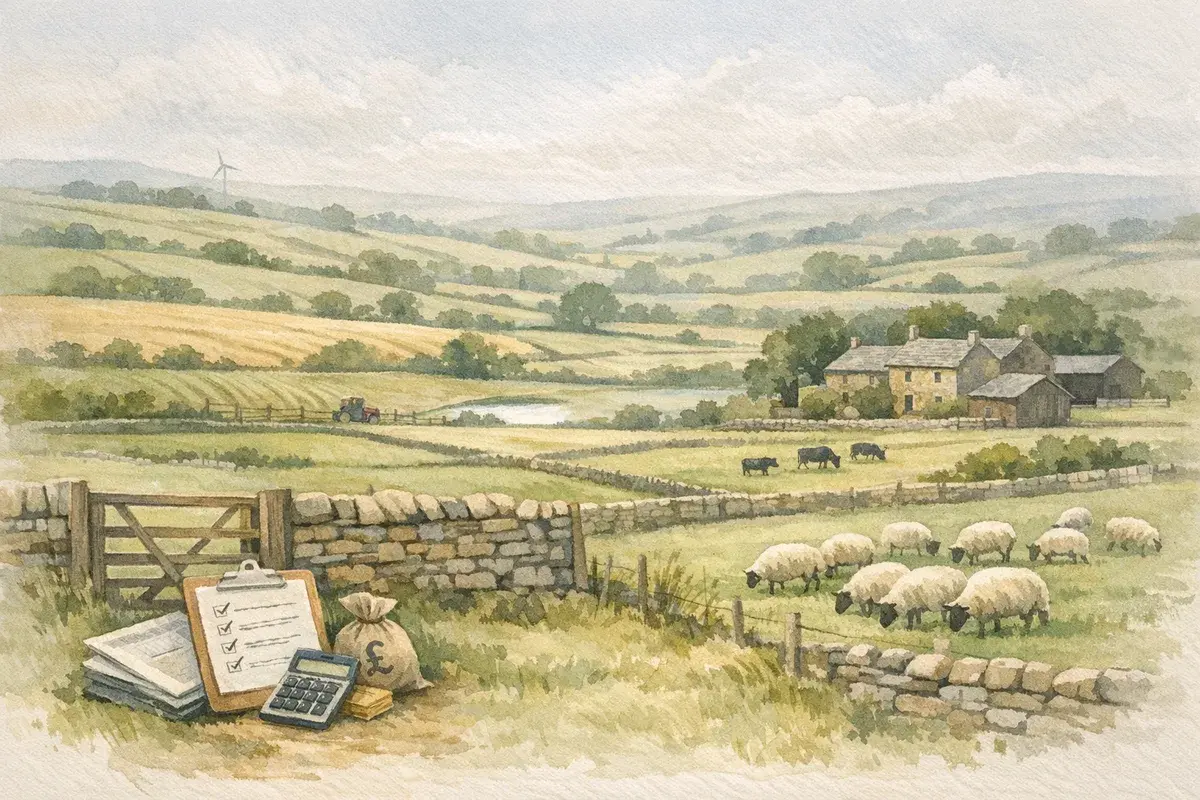
There's a particular kind of calm that comes from owning land. Not the "nice view on a Sunday walk" sort of calm, the deeper, balance‑sheet kind that comes from holding an asset that's finite, productive, and still fundamentally useful when fashions change.
But agricultural land investment in the UK isn't a magic money tree. It's an operational asset wrapped in law, tax, tenancy rights, planning policy, environmental rules, and (increasingly) natural capital markets. The upside can be strong. The pitfalls can be expensive. And the difference between a good buy and a headache usually comes down to how you do your due diligence, before you offer, not after.
This guide cuts through the romance and the rumours. You'll get a UK‑specific view of returns, risks, and the practical checks experienced buyers work through, plus the questions to ask so you can move quickly when the right parcel comes up.
Why Agricultural Land Still Attracts UK Investors
Agricultural land investment keeps pulling in UK buyers, farmers expanding a home block, neighbours tidying boundaries, families looking for a long‑term store of value, and newer entrants who want exposure to food production and environmental markets.
A lot of that interest is rational. Some of it is emotional. The trick is knowing which parts of the story are reliable and which parts need a reality check.
Inflation-Linked Characteristics And Scarcity Value
Land is scarce in a very literal way. You can intensify, you can re‑purpose, you can stitch parcels together, but you can't manufacture more UK farmland. That scarcity value sits underneath the market.
In inflationary periods, land often behaves like an inflation hedge because:
- Rents and farming returns tend to move with input/output prices over time (not perfectly, and not always quickly).
- Replacement costs rise (buildings, drainage, tracks), supporting the value of well‑improved holdings.
- "Real asset" demand increases when people lose faith in paper returns.
But don't assume land prices track CPI neatly year‑to‑year. UK farmland pricing is as much about local supply, neighbouring competition, tax positioning, and long‑term confidence as it is about commodity cycles.
Capital Growth Vs Income: Setting Realistic Expectations
Most buyers who've been around the block will tell you the same thing: the headline return on farmland is usually driven more by capital growth than income.
- Letting bare land can provide a steady, relatively low‑management income, but it's rarely "high yield" once you net off agent fees, drainage maintenance, fencing, and the odd dispute.
- Farming it yourself might improve the overall return if you already have kit, labour, and a system that benefits from extra acres. If you're starting from scratch, the economics can look very different.
The mindset that tends to work best is: you're buying a long‑term asset with optionality. Income helps cover holding costs. Capital growth and strategic value (scale, access, future use) often do the heavy lifting.
The Main Ways To Invest In Agricultural Land
You've got more than one route into agricultural land investment, and the "best" route depends on what you're actually trying to achieve: secure acres for a trading farm, long‑term wealth preservation, development optionality, natural capital exposure, or a blend.
Before you fall in love with a particular strategy, it's worth getting clear on your constraints: time, appetite for management, tax position, finance terms, and whether you need income from day one.
Buying Bare Land To Farm Or Let
This is the classic: buy land, keep it in agricultural use, and either farm it or let it.
- If you're a working farmer, extra acres can improve utilisation of machinery and labour and may strengthen rotation options.
- If you're an investor, you might prefer a tenancy arrangement that keeps management light.
Practically, the buying process can move fast when a good block comes up. If you want the mechanics laid out clearly (from viewing to offer to exchange), start with this step‑by‑step guide on buying agricultural land in the UK, then come back to the due diligence section below.
Purchasing With Residential Or Diversification Upside
Some land trades at a premium because it carries additional angles, existing buildings, lawful uses, tourism potential, equestrian demand, or proximity to settlements.
Just be careful with the word "potential". Potential only becomes value when it's:
- lawful (or realistically consentable),
- evidenced (planning history, pre‑app advice, policy support), and
- financeable/insurable (access, services, flood risk, constraints).
A scruffy yard with decent access and three‑phase power can be worth more than "beautiful" land with no track, no water, and a public footpath through the middle, because one is usable on Monday morning and the other is a management project.
Leasing, Contract Farming, And Share Farming Structures
If you want exposure to land without taking on full operational risk (or you need someone else to run the acres), there are several common structures in the UK:
- Farm Business Tenancy (FBT): usually the most flexible modern letting structure.
- Contract farming: you (or your entity) may retain more "farming business" involvement while a contractor operates the land.
- Share farming: parties share outputs/inputs under an agreed formula.
Each has knock‑on effects for control, risk allocation, and, crucially, how HMRC might view occupation and trading for reliefs. Don't treat structure as paperwork you "sort later": it can change the economics.
What Drives Value: The UK-Specific Price And Rent Fundamentals
In the UK, farmland value is rarely explained by soil alone. Two fields with similar cropping potential can trade very differently because one sits next to three expansion‑hungry neighbours and the other is isolated with awkward access.
Think in layers: local demand, physical quality, and "hidden levers" like water, infrastructure, and constraints.
Location, Access, And Local Competition For Acres
Location isn't just "what county is it in?" It's the micro‑market.
Buyers and valuers will look hard at:
- Road frontage and quality of access (including the width/visibility of entrances for modern kit)
- Distance from your home farm / labour base (extra miles add real cost)
- Local competition (dairy/veg/arable intensity, local estate strategies, lifestyle demand)
- Parcel size and shape (big, clean blocks tend to be more liquid)
Land Quality: Soil Type, Drainage, Topography, And Field Sizes
Land quality is where the agronomy meets the spreadsheet.
- Soil type and structure influence workable days, establishment success, and resilience in wet springs.
- Drainage is a value driver that's easy to underestimate. Old clay tile systems, outfalls, and ditch responsibilities matter.
- Topography and aspect affect erosion risk, workable windows, and future environmental options.
- Field size and layout influence labour and diesel more than people like to admit.
If you're buying to farm, you're effectively buying time: time windows to drill, spray, harvest, graze. Poor access and wet corners can quietly turn "good" land into frustrating land.
Water, Infrastructure, And Services: The Hidden Value Levers
This is the bit that separates paper value from practical value.
Look for:
- Water supply: mains connections, private supplies, abstraction considerations (and any historic licences), trough infrastructure
- Power: proximity to three‑phase if you're eyeing yards or diversification
- Tracks, gates, and boundaries: who maintains them, what condition they're in, and whether they're sufficient for modern machinery
- Telecoms: if you're running a rural business, connectivity can be make‑or‑break
A common "gotcha" in agricultural land investment is assuming services are easy to add later. Sometimes they are. Sometimes you hit wayleaves, third‑party consents, and costs that turn a neat idea into a slow bleed.
A Step-By-Step Due Diligence Process Before You Offer
If you only take one thing from this article, make it this: due diligence is not a bureaucratic hurdle, it's how you price risk.
When you're moving toward an offer, you're trying to answer three questions:
- What am I actually buying (legally and physically)?
- What can I do with it (now and realistically later)?
- What could stop me (rights, occupiers, constraints, costs)?
And yes, some checks can run in parallel with negotiation. But you need a structured process so nothing important gets missed.
Title, Boundaries, And Rights: Easements, Wayleaves, And Ransom Strips
Start with the basics and go deeper than the red line.
- Title plan vs reality: walk boundaries. Check hedges, ditches, fences, and any "informal" access points.
- Easements and rights of way: private rights (neighbours' access, shared tracks) and public rights (footpaths, bridleways) change management and privacy.
- Wayleaves: poles, cables, pipelines. Understand who can access, what notice is required, and what compensation exists.
- Ransom strips: tiny retained strips that control access can kill value. If access relies on third‑party land, confirm rights are properly granted.
A practical tip: take a printed plan on a wet day. If you can't find the boundary in February, you'll argue about it in July.
Tenure And Occupation: FBT, AHA, Grazing Licences, And Vacant Possession
Occupation status is one of the biggest value drivers, and one of the biggest sources of confusion.
- Vacant possession: cleanest for control, but not always available.
- FBT (Farm Business Tenancy): modern, typically time‑limited, often more flexible.
- AHA tenancies (Agricultural Holdings Act 1986): can be long‑standing with significant security of tenure. Valuation impact can be material.
- Grazing licences / seasonal arrangements: can be straightforward, but documentation must match reality.
You're not just checking "is someone on it?" You're checking what rights they have, what notices apply, and whether the agreement aligns with your plan (and your tax assumptions).
Constraints And Designations: AONB, SSSI, NVZ, Flood Risk, And Public Rights Of Way
Constraints don't always mean "don't buy". But they do mean "price it properly and plan accordingly".
Common UK constraints include:
- AONB / National Landscape considerations (stronger landscape sensitivity)
- SSSI (operations may require consent: management can be tightly controlled)
- NVZ rules (nutrient management obligations in designated zones)
- Flood risk (insurance, cropping, and infrastructure resilience)
- Public rights of way (day‑to‑day management, privacy, and liability considerations)
Looking for land like this? Tell AgLand what you're after - type, acreage, budget and area - and we'll alert you the moment a matching property is advertised. Registering is free, and there's no commission on either side. Tell us what you're looking for.
Planning And Development Potential Without Wishful Thinking
Planning is where agricultural land investment stories can get… imaginative. You'll hear plenty of "it'll get a house one day" talk. Sometimes that's grounded. Often it's not.
A good rule: value what exists and what is evidenced, treat everything else as optionality.
Permitted Development Rights And Prior Notification Realities
Permitted development rights (PDR) can be genuinely useful in England, but they're not a free‑for‑all.
For agricultural buildings and certain changes of use, the details matter: unit size, existing use, location constraints, and the prior notification process (where required). Even when something falls under PDR, you can still hit issues around siting, design, highway safety, protected species, or environmental impacts.
Two practical points buyers often miss:
- PDR isn't automatic: you may need prior approval, and conditions/limitations can bite.
- Existing use and history matter: planners will look at what the unit has been used for and whether the proposal is reasonably necessary.
If your whole investment thesis depends on PDR, slow down and get professional planning input early.
Change Of Use, Rural Enterprise, And Overages
Change of use (for example, from agriculture to certain commercial uses) can add value, but it's policy‑driven and evidence‑heavy.
Also, watch for overage/clawback provisions. Sellers (or their funders) may reserve a share of uplift if you later secure planning permission or a more valuable use. Overage isn't "bad": it's common. But you must understand:
- the trigger events,
- the time period,
- the valuation method,
- and the practical enforceability.
Overage can materially change your true return.
What To Ask The Local Planning Authority (And What To Evidence)
When you're testing planning upside, your questions should be specific. Vague questions get vague answers.
Useful lines of enquiry include:
- Relevant local plan policies for countryside development
- Access/highways requirements for the proposed use
- Landscape and heritage constraints (including setting)
- Any known enforcement history on the holding
- Requirements for ecology surveys (protected species, habitats)
And evidence you'll likely need:
- Site plan and red line boundary clarity
- Access visibility splays and tracking for vehicles
- Drainage strategy (especially if you're hardstanding or roofing)
- A genuine functional/financial case for rural enterprise where applicable
If you want more guidance like this as policies evolve, it's worth keeping an eye on AgLand's practical rural property articles and updates rather than relying on pub chat.
Tax, Reliefs, And Ownership Structures To Get Right Early
Tax is where agricultural land investment can go from "simple" to surprisingly technical, fast.
You don't need to become a tax specialist. But you do need to know where the cliff edges are, because a wrong assumption on reliefs or VAT can turn a decent deal into an expensive one.
SDLT On Mixed Use, VAT Traps, And Transaction Costs
Stamp Duty Land Tax (SDLT) treatment can vary depending on whether a purchase is residential, non‑residential, or mixed use (for example, land with a farmhouse, a cottage, or commercial elements).
Other costs that catch buyers out:
- Professional fees (solicitor, surveyor/valuer, agent)
- Searches and reports (environmental, flooding, utilities)
- Finance costs (arrangement fees, valuation fees)
VAT is a common trap in rural property. Some land transactions are exempt, some are standard rated if there's an option to tax in play, and building elements can change the picture. You want your solicitor and accountant talking to each other early, before heads of terms harden.
IHT, APR, And BPR: Qualifying Use, Occupation, And Common Pitfalls
Inheritance Tax (IHT) reliefs are one reason farmland remains attractive to some buyers, but the conditions matter.
- APR (Agricultural Property Relief) is linked to agricultural value and qualifying use/occupation.
- BPR (Business Property Relief) is linked to trading businesses and can interact with diversified income streams.
Common pitfalls include:
- assuming relief applies automatically regardless of use,
- blurring investment activity with trading activity without evidence,
- and failing to document occupation/management properly.
If you're buying with long‑term family planning in mind, treat ownership structure and occupation as part of the investment design, not a bolt‑on.
CGT Planning: Rollover, Hold-Over, BADR, And Record-Keeping
Capital Gains Tax (CGT) planning becomes relevant when you sell, but your options are shaped by what you do now.
Depending on circumstances, reliefs like rollover relief, hold‑over relief, and BADR (Business Asset Disposal Relief) may be relevant. Eligibility can depend on use, timing, and whether activities are genuinely trading.
The most boring advice is often the most valuable: keep records.
- improvement costs (tracks, drainage, fencing),
- professional fees, and
- documentation of use/occupation.
When you're assessing deals, don't rely on memory and a folder of emails. Build a system you can defend.
Practical Risks And How Experienced Buyers Mitigate Them
Most "bad" land deals don't fail because the buyer didn't understand farming. They fail because something unglamorous was ignored: liquidity, occupancy rights, compliance, a neighbour's access, a drainage obligation, a planning assumption.
Here are the risks that experienced UK buyers actively price in, and the habits that reduce regret.
Liquidity, Finance Terms, And Valuation Sensitivity
Farmland can be liquid in strong local markets, but it's not a FTSE tracker you can sell on Tuesday.
Mitigation looks like:
- Buying parcels with broad appeal (access, clean blocks, sensible size)
- Stress‑testing finance: what happens if rates rise, or refinancing is tighter?
- Getting realistic valuations: hope isn't a method
Also be aware that "special" land (tiny paddocks, awkward shapes, heavily constrained parcels) can be harder to exit, even if it looks affordable going in.
Operational Risk: Tenants, Compliance, And Maintaining "Agricultural Use"
Operational risk shows up in two places: people and paperwork.
- Tenants/occupiers: you want clear agreements that reflect reality (and a relationship that doesn't sour at the first repair issue).
- Compliance: cross‑compliance may have shifted post‑BPS, but regulation hasn't disappeared, think NVZ obligations, pesticide storage, water rules, and public rights of way maintenance responsibilities.
- Use: if your tax assumptions rely on agricultural use, make sure the use is genuine and evidenced.
If you're building a shortlist and want to move quickly when something suitable comes up, it helps to widen your net without losing focus. This is where knowing where to look for agricultural land for sale in the UK can shave weeks off your search, especially in tight local markets.
Natural Capital, Carbon, And Biodiversity Net Gain: Opportunity With Caveats
Natural capital has moved from niche to mainstream conversation: carbon sequestration, biodiversity, nutrient neutrality in some catchments, woodland creation, peatland restoration, and Biodiversity Net Gain (BNG) in the planning system.
There is opportunity here. But caveats matter:
- Stacking and eligibility rules can be complex and scheme‑specific.
- Permanence and legal commitments (covenants, long agreements) can affect resale value.
- Neighbour and community considerations: access, views, and local acceptance can influence what's practical.
A sensible approach is to treat natural capital as part of your land's optionality, not a guaranteed uplift. Get specialist advice, and understand the contract terms as ruthlessly as you'd read a tenancy.
Conclusion
Agricultural land investment in the UK can be a robust long‑term play, but it rewards discipline. The best buyers aren't the ones with the loudest "vision": they're the ones who can explain, in plain English, what they're buying, what it can do today, what it might do tomorrow, and what could get in the way.
If you take a practical approach, price risk properly, document your assumptions, and use the right professionals, you give yourself a genuine edge. And you'll sleep better, which is an underrated part of any return.
Disclaimer: AgLand.co.uk is a UK agricultural land and rural property matching service, where buyers register what they are looking for and owners advertise directly to the buyers who match, and a rural resource hub. Nothing in this text is intended as legal, financial, tax, or investment advice. You should carry out your own due diligence and seek advice from appropriately qualified professionals (for example, solicitors, chartered surveyors/valuers, tax advisers, and planning consultants) before making any property or investment decisions.