
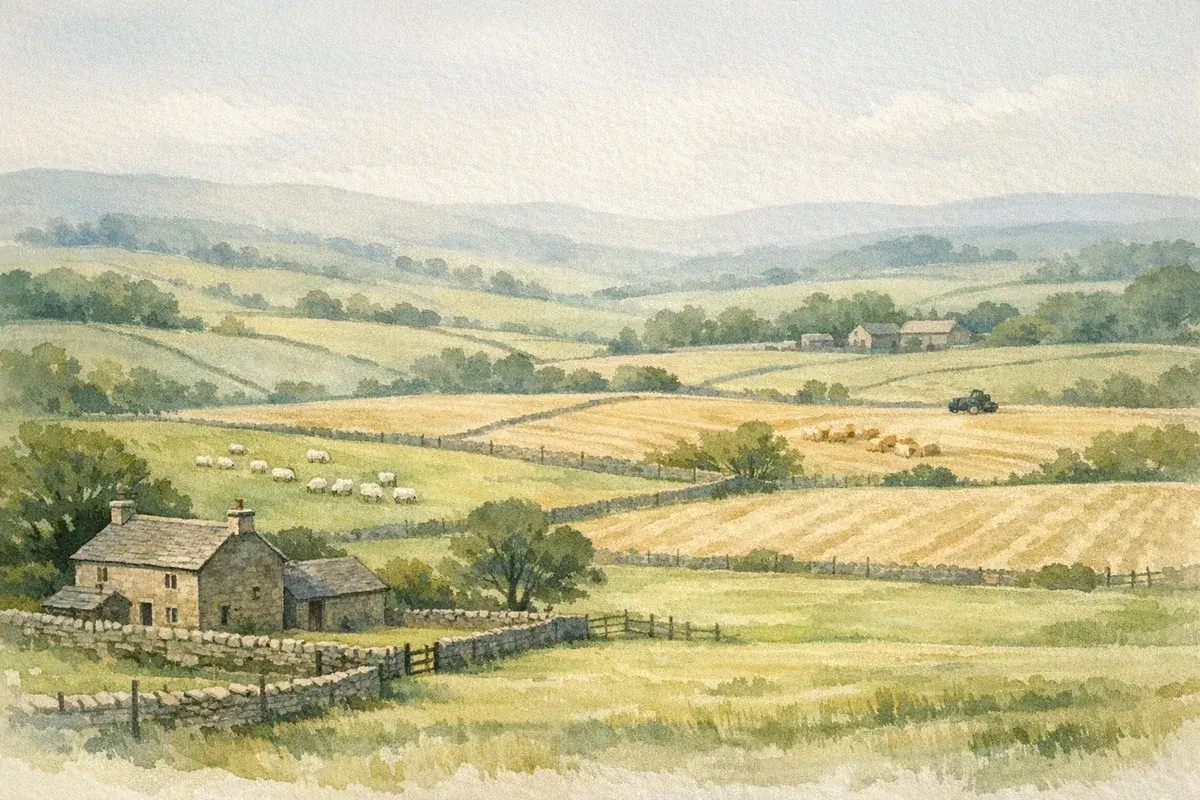
You can grow a lot of profit (and a lot of pain) from the same hectare. When you're buying arable land for cropping, the field you fall in love with on a sunny viewing day can turn into a slow-draining headache in October, or a brilliant performer for decades, depending on what you check before you commit.
This guide is written for UK farmers, landowners and rural investors who want to buy arable land with their eyes open. We'll keep it practical: how to set buying criteria that actually match your rotation and kit, what to inspect beyond the sales particulars, and where the hidden risks tend to sit (title, water, designations, scheme commitments, and first-season timing). The aim isn't to scare you off, it's to help you buy with confidence and avoid expensive surprises.
Define Your Cropping Strategy And Buying Criteria
Buying arable land for cropping is rarely just "find a nice field and crack on". Your rotation, soil resilience, and logistics will dictate what counts as a good buy for you, so get specific early. It's the simplest way to avoid paying a premium for land that doesn't actually suit your system.
Match Soil Type, Rainfall, And Altitude To Your Intended Rotation
Start with what you need the land to do. A heavy clay that carries big wheat yields in a kind spring can still be a drilling disaster if your system relies on timely autumn establishment.
A practical way to sanity-check suitability:
- Soil texture and structure: Light land can suit roots, spring cropping, vegetables and early lifting: heavier land can be fantastic for cereals but punishes bad structure. If you're chasing consistent winter cropping, you're buying workability as much as yield potential.
- Rainfall pattern (not just annual totals): Two areas can share similar averages but differ massively in autumn trafficability. Ask local agronomists what the "normal" drilling window looks like.
- Altitude and exposure: A couple of hundred feet can shift your harvest date, drying costs, and risk of lodging. If you're growing OSR, exposure and flea beetle pressure may matter as much as soil.
If you're trying to secure genuinely versatile land, it's worth cross-referencing the fundamentals against what's usually classed as the UK's most capable arable ground. Our deeper guide on what makes land truly versatile in practice is useful reading before you start viewing, particularly if you're comparing multiple regions.
Set Target Field Sizes, Access Needs, And Machinery Logistics
In cropping, "a field" is also a workflow. The same 50 acres can be efficient or infuriating depending on shape, gateways, and travel time.
Define your non-negotiables:
- Field size and shape: Long thin fields, awkward angles, or multiple pinch points burn labour and diesel. They also increase overlap, compaction, and operator fatigue (which is when mistakes happen).
- Access and road safety: Check gateway widths, sight lines, and whether you'll be turning on a fast A-road. For big drills and combines, one poor entrance can be the difference between "fine" and "not legally or practically usable".
- Travel distance from the yard: The maths changes quickly when you're hauling grain, moving a sprayer, or chasing weather. If the land is remote, you may need a local grain store arrangement or more on-farm storage.
- Services and practicalities: Any on-field poles, overhead lines, telecom masts, culverts, or ditches can limit your working width and headland management.
A simple trick: draw your likely tramlines and headlands on a map. If it looks like a maze, it probably farms like one.
Budget For Working Capital, Not Just The Purchase Price
This is where buyers get caught out, especially if you're stretching to secure land.
Beyond deposit, fees, and SDLT (where applicable), cropping land often demands immediate cash:
- Seed, fertiliser, sprays (and the reality that you may be buying at the "wrong" time of year for input purchasing).
- Soil correction: lime, P & K, trace elements.
- Repairs and enabling works: gateways, tracks, drains, ditching, fencing (yes, even for arable, livestock neighbours and public access can change priorities).
- Bridging the first harvest: if you complete after you can establish your preferred crop, your first cashflow may be delayed.
If you're still forming your buying process and want a structured view of the sequence, budgeting, offers, due diligence, exchange and completion, our step-by-step guide to how agricultural land purchases typically run in the UK can help you plan the timeline and the cash calls.
Assess Land Quality Beyond The Sales Particulars
Sales particulars are marketing documents, not agronomy reports. When you're buying arable land for cropping, the value is in what you can reliably grow and harvest, not in the best-case yield story.
Soils, Drainage, Compaction, And Field Condition Checks
On a viewing, look for clues that don't make the brochure:
- Dig inspection holes (with permission): You're looking for rooting depth, structure, pans, and whether the soil is smeary and anaerobic.
- Mole drainage and tile drainage evidence: Ask what was installed, when, and whether there are plans/records. Old drains can be brilliant, or useless if outfalls are blocked.
- Headlands and turn areas: These show compaction first. If the headlands are thin, wet, or full of ruts, you're inheriting a structural problem.
- Stone content and flints: Not always a dealbreaker, but it affects cultivations, machinery wear, and crop choice.
If the land is marketed as higher-grade, be careful not to pay a "Grade 1 price" for a field with Grade 1 patches. If you're specifically targeting top-quality land, it's worth reading up on what's usually behind listings described as Grade 1 arable land for sale, and what you still need to verify on the ground.
Slope, Aspect, Flood Risk, And Microclimate Considerations
A few degrees of slope can change everything: erosion risk, sprayer stability, harvest safety, and how soon you can travel.
Check:
- Slope and aspect: South-facing slopes can be earlier and drier: north-facing can be later and heavier-going. Steeper land increases run-off and soil loss risk, particularly with maize or fine seedbeds.
- Low spots and historic wet patches: Look for rushes, darker vegetation, or uneven crop growth in photos.
- Flood risk (fluvial and surface water): Don't assume "it's never flooded" means much. Ask for any history and consider professional flood data alongside local knowledge.
- Wind exposure: It's not just lodging, wind affects spray windows and drift risk near sensitive boundaries.
Microclimate is one of those things locals understand instantly. A five-minute conversation at a nearby grain store can be more honest than ten pages of marketing.
Weed Burdens, Pest Pressure, And Rotation History
This is where future gross margin lives or dies.
Ask directly about:
- Black-grass and resistant weeds: Not just "is there any?", how bad is it, which chemistry still works, and what cultural controls have been used?
- Bromes, ryegrass, wild oats: Each has different implications for rotation and control cost.
- Rotation history: A field that's been continuous wheat may look tidy but could be carrying disease pressure and poor structure.
- Pest pressure: CSFB in OSR areas, leatherjackets, wireworm, slugs, local context matters.
If the vendor can share spray records, cropping history, and any soil tests, treat that as a serious positive. And if they can't (or won't), assume you'll need to spend more time and money finding out what you've bought.
Investigate Title, Rights, And Constraints That Affect Cropping
You're not just buying soil, you're buying a bundle of rights, reservations, and constraints. Some are manageable. Some can quietly cap what you can do with the land (or what it's worth).
Boundaries, Wayleaves, Easements, And Rights Of Way
For arable buyers, the practical impacts are immediate:
- Boundaries: Are they on the ground where the title plan suggests? Small "nibbles" add up over time, especially where hedges have crept.
- Public rights of way: Footpaths and bridleways affect spraying, drilling around margins, and biosecurity. They can also influence whether you can gate or reroute access (usually not without process and time).
- Wayleaves and easements: Overhead electricity lines, water pipes, fibre routes, or drainage rights can restrict deep cultivations, tree planting, new tracks, or irrigation infrastructure.
In practice, you want your solicitor and agent to reconcile what's in the paperwork with what's on the ground. If you're new to this, our guide for first-time buyers stepping into agricultural land breaks down the kinds of title and access issues that tend to surprise people.
Water Abstraction, Riparian Rights, And Irrigation Practicalities
If irrigation is part of your cropping plan (or could be in future), water is a due diligence topic, not an afterthought.
Key UK realities:
- Abstraction licensing: In England, the Environment Agency regulates abstraction. Licensing rules and "hands-off flow" conditions can limit when you can pump. In Scotland, this sits with SEPA. Wales has Natural Resources Wales.
- Source matters: Surface water, groundwater, reservoirs, and transfer schemes all have different risk profiles.
- Infrastructure: Pumps, mains, hydrants, lagoons, reservoirs, what's included, what's excluded, and what condition it's in.
- Practical reach: A water source isn't helpful if the field layout, rights, or distances make it uneconomic to use.
If you're specifically searching for irrigated cropping opportunities, you'll want to compare like with like. This is exactly why we keep separate guidance on irrigated arable land opportunities, because "has water nearby" and "can reliably irrigate" are not the same thing.
Tenancies, Grazing Licences, Sporting Rights, And Occupation Risks
Vacant possession is everything if your goal is to crop immediately.
Check for:
- Agricultural tenancies: Farm Business Tenancies (FBTs), older tenancies, or informal arrangements. The paperwork (or lack of it) matters.
- Grazing or mowing licences: Common on arable stubbles and margins. They can be harmless, but they must be terminable and properly documented.
- Sporting rights: Shooting rights can affect how you manage cover crops, margins, and access. Sometimes they're reserved to a third party.
- Contract farming agreements: Clarify whether any contractor has expectations, stored equipment, or rights to crop.
If there's any uncertainty, get it clarified pre-exchange. "We think it'll be fine" is not a strategy when you're trying to drill.
Scrutinise Planning, Designations, And Environmental Rules
Most arable land purchases aren't "planning-led", but planning and designations still shape what you can do, tracks, grain stores, reservoirs, even simple operations near protected features. And environmental rules can affect cultivation choices more than many buyers expect.
SSSIs, Protected Habitats, AONBs, And Local Plan Constraints
Designations don't automatically make land unbuyable. They do change risk and process.
- SSSIs (Sites of Special Scientific Interest): Farming operations may be restricted or require consent for certain activities. If any part of the holding is SSSI, treat it as a specialist due diligence line.
- AONBs and National Parks: You can still farm, but new development (tracks, buildings, reservoirs) can be harder to justify and may face conditions.
- Local Plan policies: Even for "agricultural permitted development", local context can affect expectations, design, and supporting evidence.
If your cropping plan relies on new infrastructure, say a yard, grain storage, a new access, or water storage, bring a planning consultant into the conversation early. It's far cheaper than redesigning after a refusal.
Cross-Compliance, Hedgerow Rules, And Cultivation Restrictions
Although the old EU cross-compliance regime has changed, the UK still operates a framework of environmental and farming rules that can bite.
Focus on practical pinch points:
- Hedgerow protections: Hedgerows can be protected from removal under the Hedgerows Regulations 1997, and there are rules around cutting times and management. That affects field enlargement plans.
- Watercourse buffers and pollution risk: Cultivating to the edge of ditches and streams can create enforcement risk and soil loss. Expect to manage margins sensibly.
- Historic or scheduled features: Ridge and furrow, archaeology, or scheduled monuments can restrict deep cultivation or drainage works.
A strong habit: assume you'll need to prove you've managed soil and water responsibly. That proof comes from records, maps, and consistent practice.
ELM, Countryside Stewardship, And Scheme Commitments On The Land
Schemes can be a benefit or a constraint depending on your system.
Ask:
- Is the land in Countryside Stewardship or similar agreements? If yes, what options are in place, and when do they end?
- Are there capital items funded (tracks, fencing, hedges) with ongoing obligations? Some items have conditions lasting years.
- Are there ELM (Environmental Land Management) options planned or already applied for? Agreements and management requirements may affect cropping flexibility.
Be especially careful with land that's been managed for environmental outcomes if your intention is to return it to intensive cropping quickly. It might be possible, but you need to know what you're stepping into.
Model The Financials: Returns, Costs, And Tax
When you're buying arable land for cropping, the purchase is often justified by a mix of farming return, long-term value, and strategic control. That's fine, as long as your model is honest about costs, volatility, and the capital you'll need to unlock the land's potential.
Gross Margin Reality Checks And Sensitivity Testing
Start with a base gross margin for your likely rotation, then stress test it:
- What happens if wheat drops £30–£50/tonne?
- What if you lose a spray timing and yield drops 0.5–1.0t/ha?
- What if you can't drill until late October, or have to switch to spring?
- What if drying costs spike in a wet harvest?
A useful mindset is to model good, normal, and grim seasons. Arable businesses don't fail in average years, they fail when two or three risks stack at once.
If you want a UK-specific lens on what tends to move values and decision-making, our overview of agricultural land for sale across the UK can help you frame pricing, demand drivers, and the key checks that affect both usability and resale.
Drainage, Lime, Nutrients, Tracks, And Infrastructure Capex
The silent return-killer is underestimating "getting it right".
Common capex lines for newly acquired arable ground:
- Drainage repairs/renewals: Fixing outfalls, jetting, replacing broken tiles, installing new runs, ditching.
- Lime and soil correction: If indices are low, you may need a multi-year plan.
- Nutrients: Rebuilding P & K can be expensive and slow, but it's foundational.
- Access tracks and gateways: Particularly if you need all-weather access for sugar beet, veg, or late harvests.
- Water storage / irrigation kit: Only if reliable and lawful, otherwise it's a stranded asset.
Treat these as part of the purchase decision, not "we'll sort it later". Later tends to coincide with the worst possible weather window.
Tax And Reliefs To Discuss Early With Advisers
Tax is highly circumstance-specific, but you should still raise it early, before you structure an offer or decide who buys (personally, partnership, company, trust).
Topics UK buyers commonly explore with advisers include:
- Stamp Duty Land Tax (SDLT) in England and Northern Ireland (and LBTT in Scotland, LTT in Wales).
- Inheritance Tax considerations, including how Agricultural Property Relief (APR) and Business Property Relief (BPR) might apply depending on occupation and use.
- Capital Gains Tax planning if you're selling other assets to fund the purchase.
- VAT position on any buildings, development elements, or opted-to-tax scenarios.
This is where your accountant/tax adviser earns their fee. The "right" structure can be worth more than a negotiation win on the price.
Choose A Buying Route And Run The Transaction Properly
In the UK, arable land changes hands through private treaty, informal tender, formal tender, and auction. The route affects speed, leverage, and how much time you realistically have to do due diligence.
Private Treaty Vs Tender Vs Auction: What Changes For Buyers
- Private treaty: Usually offers more scope to ask questions, negotiate on conditions, and align timing around cropping. Still, you need to move fast if there's competition.
- Tender: Can be opaque. You often get one shot, and your offer needs to be clean and compelling. Clarify what due diligence is expected pre-offer.
- Auction: Highest speed, highest commitment. You typically exchange on the fall of the hammer, so you need your solicitor, finance, and risk checks lined up in advance.
In all cases, insist on clarity around what's included (crop, environmental margins, basic equipment, access rights) and what the seller is warranting (often: very little).
Surveys, Searches, And The Role Of A Rural Solicitor And Agent
You're buying a legal title and a working asset. You need professionals who understand both.
A robust UK arable purchase usually involves:
- Rural solicitor: Title review, easements/wayleaves, covenants, searches, contract negotiation, and completion.
- Land agent: Local market insight, negotiation, and reality-checking what you're being told.
- Surveyor (as needed): Boundaries, plans, access, and occasionally valuation for finance.
- Specialists where relevant: drainage contractor, agronomist, ecologist, planning consultant.
Searches and checks commonly include:
- Local authority searches (planning/designations)
- Environmental and flood data
- Water and drainage context
- Highways and access verification
For a deeper look at the mechanics, documents, and common pitfalls, see our practical guide to finding and buying arable land with confidence. It's particularly useful when you're trying to compare multiple parcels quickly without missing the big red flags.
Timelines, Completion Dates, And Protecting Your First Season
If cropping is your primary motive, timing is not a detail, it's the deal.
Think through:
- When can you realistically take possession? Not "completion date on paper", but keys in hand, access confirmed, occupiers out.
- What's in the ground? If there's a growing crop, who owns it at completion? Who carries the risk? Is there an apportionment?
- Can you get inputs and operations done? If you complete in late autumn, you may be pushed into spring cropping whether you like it or not.
- Condition of stubbles and cultivations: If you're taking land after a wet harvest, factor in remedial work.
A pragmatic approach we've seen work well: build your first season plan before exchange, then stress test it against different completion dates. If the plan breaks under a realistic delay, renegotiate timing or price, or be prepared to change your cropping.
Plan The Handover And Your First 12 Months Of Cropping
The purchase is one milestone. The real value is created (or lost) in the first year, when you're learning how the land behaves and setting standards that will either compound, or cause recurring problems.
Getting Vacant Possession, Handing Over Records, And Input Planning
Before completion, confirm the handover items you actually need:
- Vacant possession evidence (where relevant) and confirmation that any licences/agreements are terminated.
- Cropping and spray records: last 3–5 years if possible.
- Drainage plans, abstraction licences, scheme documents, maps.
- Boundary responsibilities: who maintains which hedge/ditch, and any neighbour agreements.
Then build an input plan that suits what you've inherited, not what you wish you'd inherited. If the field is late-harvested, compacted, or weedy, your best first-year choice might be a "reset" crop rather than your ideal rotation.
Mapping, Soil Testing, And Setting Up Field Records And Compliance
Do this early, do it properly:
- Accurate mapping: gateways, drains, ditches, margins, rights of way, wet spots.
- Soil sampling: pH, P, K, Mg as a baseline: consider organic matter and texture mapping if you're variable-rate minded.
- Compaction assessment: dig pits and record where pans exist: decide whether to remediate and when.
- Record-keeping: spray records, nutrient applications, cultivations, margins and environmental actions.
Even if you're not in a formal scheme, good records protect you in disputes (drift, boundary issues, water pollution accusations) and help you make better decisions faster.
Building Your Local Team: Contractors, Agronomists, And Neighbours
Arable land doesn't farm itself, and no one farms well in isolation.
In the first year, prioritise relationships:
- A reliable local contractor (even if you have your own kit) as a contingency for breakdowns and weather windows.
- An agronomist who knows the area's weed pressures and has a realistic view of what works locally.
- Drainage and groundwork contacts, you'll want them before you need them.
- Neighbours and local stakeholders: It sounds soft, but it's practical. Access, ditches, shared tracks, vermin control, and even informal weather intel matter.
One of the most consistent "wins" we see: buyers who walk boundaries with neighbours early. It flushes out issues while everyone is still in a cooperative mood.
Conclusion
Buying arable land for cropping in the UK is eventually a bet on reliability: can you establish crops on time, protect yield potential, and operate efficiently year after year? The best buyers don't just chase the prettiest soils or the biggest acreage, they match land to a cropping strategy, pressure-test the constraints, and plan the first season like it matters (because it does).
If you take one practical step after reading this, make it this: write your "cropping must-haves" and your "dealbreakers" on one page before you view anything. Then stick to it. It's amazing how much money and stress that single page can save you.
Disclaimer: AgLand.co.uk is a UK agricultural land and rural property matching service, where buyers register what they are looking for and owners advertise directly to the buyers who match, and a rural resource hub. Nothing in this text is intended as legal, financial, tax, or investment advice. You should carry out your own due diligence and take advice from appropriately qualified professionals (such as rural solicitors, chartered surveyors, accountants/tax advisers, agronomists, and planning or environmental consultants) before making any decisions.