
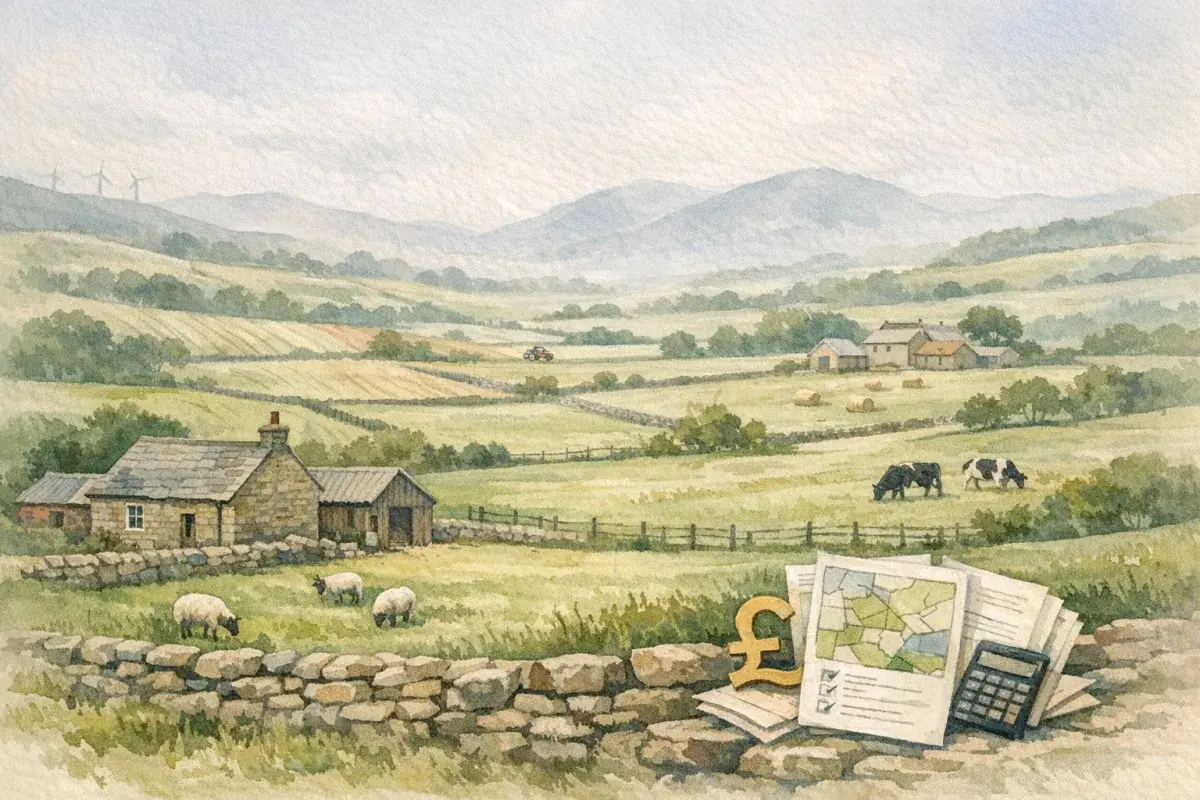
A field in Aberdeenshire and a hill unit in Argyll can both be described as "agricultural land Scotland", but they behave like completely different assets. One might be driven by cropping margins, grain haulage routes and drainage: the other by stock carrying capacity, peat depth, deer pressure and access tracks that vanish in a wet October.
If you're buying, renting, or restructuring a Scottish holding, the hard part isn't finding land. It's understanding what you're actually buying: the legal set-up, the real income options, the planning constraints, and the schemes that can quietly make (or break) the numbers. This guide cuts through the moving parts, practically, and with a Scotland-first lens.
Why Scotland’s Agricultural Land Market Works Differently
Scotland's rural land market is its own ecosystem. Yes, there are UK-wide economic forces, interest rates, commodity prices, labour shortages, but Scotland has distinct legal structures (including crofting and different conveyancing norms), different land use mixes (forestry and natural capital can dominate value), and a buyer pool that often thinks beyond straightforward farming returns.
Two realities worth keeping in mind:
- Scale and diversity are extreme. A "farm" listing might mean 40 acres of prime arable with sheds and a house, or 4,000 acres of rough grazing with sporting rights, peatland, woodland, and a handful of in-bye parks.
- Non-farming motivations are normal. Forestry, carbon, biodiversity, lifestyle, and long-term wealth preservation often sit alongside (or even ahead of) agricultural output.
Regional Variation: From Prime Arable To Upland Grazing
Scottish agricultural land value and usability is heavily regional.
- North East (e.g., Aberdeenshire, Angus, Moray): Generally where you'll see the most consistent demand for prime arable and high-performing mixed units. Soil type, field size, road access and proximity to processors can matter as much as the acreage.
- Central belt fringes and accessible mixed areas (e.g., parts of Perthshire, Stirling, Borders): Often attractive for mixed farming and diversification, but planning sensitivity can rise quickly near settlements.
- Upland and west (e.g., Argyll, Highlands, islands): A different proposition, rough grazing, fragmented blocks, exposure, and higher infrastructure costs. Here, value can hinge on tracks, wintering, and what land use change is feasible.
- Crofting counties and crofting communities: Not "a region" in the simple sense, but a legal and cultural layer that can redefine what you can do with land and how it changes hands.
The point: when you compare prices (or yields, or rent levels) across Scotland, you need to compare like with like. A superficial "£/acre" number doesn't tell you what you can actually run, build, claim, or sell.
Who's Buying And Why: Farmers, Estates, Forestry, Natural Capital
You'll typically see four overlapping buyer motivations:
- Farmers expanding or consolidating
- You'll care about field shape, road frontage, existing drainage, building capacity, and whether the unit fits your labour and machinery.
- Estates and long-term landowners
- Often focused on resilience: mixed income streams (agriculture, forestry, renewables, sporting, lets) and long-term capital.
- Forestry and land-use change buyers
- Woodland creation economics can stack up in the right place, but it's not a one-size-fits-all win, peat depth, designations, access, and deer management can be decisive.
- Natural capital and "impact" capital
- Carbon and biodiversity-related income can influence value, but it's paperwork-heavy and can constrain future options. You're not just buying land, you're buying future obligations if you commit to long-term projects.
If you're trying to triangulate value, keep your benchmark broad. A useful starting reference is the wider UK picture, then narrow it to Scottish comparables and local drivers. For context on the national direction of travel, see AgLand's guide to UK farmland price movements and drivers (useful background before you dial in to Scottish nuance).
Land Prices And What Really Drives Value
Scottish land can look "cheap" or "expensive" depending on what you assume the land can do. The market pays for certainty: certainty of productive capability, certainty of access, certainty of income, and certainty of future flexibility.
A practical way to think about value is to split it into two parts:
- Intrinsic agricultural value (what you can reliably produce)
- Optionality value (what else you might be able to do, forestry, renewables, development, natural capital)
How Land Is Valued: Soil, Climate, Access, And Infrastructure
If you're buying for farming, the fundamentals still win.
- Soils and capability: Scotland's land capability varies sharply. Prime arable ground can justify a premium because it supports repeatable outputs and rotation flexibility.
- Climate and elevation: Upland rainfall and exposure don't just reduce carrying capacity: they increase costs (tracks, winter housing, fodder logistics) and risk (poaching, access problems).
- Access and internal roads: A block that's "near the road" on a map can still be operationally awkward if gateways are poor, bridges are weight-limited, or internal tracks are soft.
- Buildings and infrastructure: Sheds, grain storage, slurry systems, handling facilities, and yard layout can shift value significantly, especially given the cost (and planning effort) of replacing them.
- Water and services: Mains water, private supplies, and electricity capacity matter. If you're thinking diversification, grid connection and capacity can become critical very quickly.
One of the most expensive mistakes we see is buyers pricing land as if infrastructure is "good enough," then discovering it's not suited to their system (or it's non-compliant, or it's at end-of-life).
Tenure, Occupation, And Income Potential
In Scotland, "vacant possession" is rarely just a phrase in particulars, it's a value lever.
- Existing tenancies or occupiers: If land is let, grazed informally, or subject to rights you didn't expect, you may not control the land on day one. That affects finance, cropping plans, and scheme eligibility.
- Sporting and mineral rights: These can be included or excluded. Even if you don't plan to use them, they can impact management (e.g., deer control affecting woodland creation).
- Renewables and wayleaves: Income from masts, pipelines, or cables can be positive, but it also comes with constraints and ongoing negotiation.
If your plan depends on specific income streams, grazing lets, contract farming, woodland creation, holiday lets, price it like a business. Assume delays. Assume professional fees. And assume you'll need good paperwork to keep lenders and future buyers comfortable.
Looking for land like this? Tell AgLand what you're after - type, acreage, budget and area - and we'll alert you the moment a matching property is advertised. Registering is free, and there's no commission on either side. Tell us what you're looking for.
Legal And Practical Buying Rules In Scotland
Scottish buying rules feel familiar if you've bought property elsewhere in the UK, but the mechanics and conventions differ, and those differences matter when you're lining up finance, planning an entry date, or competing for a sought-after block.
The Scottish Conveyancing Process And Typical Timelines
In broad terms, rural purchases in Scotland run through:
- Offer (often "subject to contract" equivalents exist in practice, but the Scottish system is built around written missives)
- Missives (negotiation of contract terms)
- Conclusion of missives (once concluded, the deal becomes legally binding)
- Settlement/entry (funds transfer, keys, possession)
Timelines vary depending on title complexity, lender requirements, and whether there are tenancies, occupiers, or unusual rights. A clean, straightforward title can progress quickly: a multi-title farm with historic boundary quirks, private water supplies, and servitudes can take longer than you'd like, especially if you only start asking the right questions late in the process.
Practical tip: align your entry date with your farming calendar and scheme calendar, not just convenience. Getting the keys a week late can mean missing a drilling window or inheriting an awkward compliance position.
Title, Boundaries, Access, And Servitudes (Wayleaves, Rights Of Access)
Rural title issues are rarely dramatic, but they're frequently expensive.
Things to look for (and to ask your solicitor and land agent to stress-test):
- Mapped boundaries vs. fenced boundaries: Fences drift, ditches move, and historic plans can be vague. If there's a mismatch, you'll want clarity before you commit.
- Access rights: Does the land have legal access, not just "a track everyone uses"? If access crosses third-party land, you'll need robust rights set out in title.
- Servitudes and wayleaves: These can cover cables, water pipes, drainage outfalls, and access routes. They may restrict building sites, tree planting, or even future subdivision.
- Public rights of way and access rights: Scotland's access regime, set out in the Land Reform (Scotland) Act 2003, is broader than many people expect. That doesn't prevent farming, but it does shape signage, biosecurity, and diversification plans.
In practice, you want to know: What can someone else legally do on your land (or under it), and what can you legally do that depends on someone else's land? That's the operational reality behind the legal language.
Crofting: When It Applies And Why It Changes Everything
Crofting, governed by the Crofters (Scotland) Act 1993, is the big "Scotland-only" factor that catches non-local buyers.
If crofting applies, it can affect:
- How the land is occupied and transferred
- What consents are needed for changes
- How you manage and use the land over time
The rule of thumb: don't treat crofting as a footnote. If any part of what you're buying involves crofts, croft land, common grazings, or rights linked to them, you need specialist legal advice early. It can be perfectly workable, but it is not the same as buying a straightforward farm. Crofting is not the only Scotland-only factor worth flushing out early, because where a community body has registered an interest in the land the owner's decision to sell can trigger a pre-emptive purchase process, and how the community right to buy runs in practice explains what that does to the timetable and the price.
If you're building your shortlist and want to keep your search tidy (for example, filtering by location, acreage, land type, or whether there's a house), it helps to use tools designed for rural transactions rather than retrofitting residential filters. Start from specialist search and then speak to the right agents, AgLand is set up for exactly that, through the AgLand search experience and direct connections to agricultural estate agents.
Planning, Buildings, And Change Of Use: What You Can (And Can’t) Do
Planning is where optimism goes to get audited. In Scotland, the planning regime is its own system (separate to England's permitted development framework), and local authorities can take different views depending on landscape sensitivity, access, servicing, and policy priorities.
The best mindset is: assume you need evidence. Evidence of need, evidence of siting logic, evidence of environmental impact management, and evidence you can service what you propose.
Agricultural Buildings And Prior Approvals: Getting The Paperwork Right
Agricultural buildings can be straightforward, until they aren't.
Before you price in a new shed, cattle court, or grain store, get clarity on:
- What consents are required in that council area (and whether conditions are likely)
- Siting constraints (roads, neighbours, landscape, watercourses, designations)
- Access and visibility splays (a surprisingly common sticking point)
- Private water supplies and drainage (especially if you're adding livestock housing)
If the unit already has buildings, don't assume they're compliant or fit for your intended use. Condition, drainage, slurry capacity, and historic build paperwork can all matter, particularly for lenders and insurers.
Rural Housing, Agricultural Occupancy, And Diversification Pitfalls
Rural housing is where people most often overpay, because they're paying for a permission that either doesn't exist, won't be granted, or comes with an occupancy condition they can't live with.
Common pitfalls:
- Assuming a farmhouse can be "split off" cleanly without implications for access, services, and valuation of the remaining land.
- Underestimating agricultural occupancy conditions and how strictly they can be applied (and how they affect resale value).
- Diversification by default: holiday lets, livery, farm shops, and yard lets can work well, but they also trigger traffic, neighbour, and environmental questions, plus insurance and business rates issues.
A good test: if your business case relies on a planning outcome, treat it as conditional, not guaranteed. Build contingencies into your offer and timetable.
Environmental Constraints: Peatland, Designations, And Water Rules
In Scotland, environmental constraints aren't a "nice-to-know", they can reshape land use completely.
Watch-outs include:
- Peatland presence and depth: affects foundations, tracks, drainage works, and woodland creation suitability.
- Designations: National Scenic Areas, SSSIs, SPAs/SACs and other protected areas can limit what's feasible and extend timelines.
- Water environment rules: field drainage, culverts, bank works, abstractions, and private supply upgrades may require consents and careful method statements.
If your plan includes woodland creation, peatland restoration, or nature-market projects, these constraints move from "planning detail" to "core economics." You'll want early screening by the right professionals.
And if you're trying to keep your options open, buying a unit that can pivot between farming, forestry, and diversified uses, capture your reasoning in writing. It helps when you later speak to planners, lenders, or potential partners.
For practical market context and to keep an eye on opportunities as they appear (including smaller blocks that can be strategically valuable), it's worth monitoring specialist listings through AgLand's rural property feed, especially if you're prepared to move quickly when the right parcel comes up.
Subsidies, Grants, And Support Schemes That Affect Land Decisions
Support schemes won't replace good farming, but they can influence what land is worth to you, and whether a tenancy or purchase actually works.
In Scotland, the direction of travel has been towards a more conditional support environment with stronger emphasis on outcomes, and with growing relevance of woodland and peatland-related funding routes.
Post-CAP Support: What To Check Before You Buy Or Rent
If you're buying or taking on a tenancy, check early:
- What the current occupier is claiming and on what basis
- Whether there are scheme commitments tied to specific parcels (and how long they run)
- Whether mapping is accurate (field boundaries, ineligible features, habitat areas)
- Any cross-compliance-style obligations and inspection history (where relevant)
The practical issue is continuity. A gap between occupiers, or unclear mapping, can create delays and disputes. So, when you negotiate entry dates and handover, think like an operator: you want clean transfer of records and a clear understanding of what you're inheriting.
Woodland Creation, Peatland Restoration, And Natural Capital Income
Woodland and peatland projects can be meaningful, financially and environmentally, but they're not "set and forget."
Key considerations:
- Permanence and constraints: Some projects run long-term and can restrict future agricultural flexibility.
- Deer management and maintenance: Costs and responsibilities can be underestimated, and they matter to outcomes.
- Access and ground conditions: If you can't build and maintain tracks responsibly, establishment and monitoring become a headache.
- Stacking and double counting: Be careful about what income streams can legitimately sit together. You'll want specialist advice before signing anything.
We've seen buyers get excited about natural capital, then discover the land's best use is still straightforward livestock, because the ground, designations, or access simply don't support the shiny plan.
If your purchase decision depends on future scheme income, make it a due diligence workstream: talk to a land agent, a rural surveyor, and (where relevant) an ecologist or forestry consultant. Do it before you commit, not after.
Tax, Structuring, And Succession Considerations
Tax shouldn't drive every decision, but it's too expensive to ignore, especially when you're buying land in Scotland as part of a longer-term family plan or an investment-with-operations model.
Your structure affects:
- acquisition costs and cashflow
- eligibility for reliefs
- flexibility to bring in family members or partners
- how cleanly you can exit or transfer later
LBTT, VAT On Land, And Option Agreements
In Scotland, Land and Buildings Transaction Tax (LBTT) applies to land purchases, and the detail depends on what you're buying (and how it's classified). Practical points to raise with your solicitor and tax adviser early:
- What exactly is included in the consideration (land, buildings, any residential element, fixtures)
- Whether any part is treated differently due to use or configuration
- VAT position: most bare land transactions are outside VAT, but there are scenarios (for example, opted-to-tax property or certain commercial arrangements) where VAT becomes relevant.
- Option agreements and conditionality: if you're buying with development potential, the structure of options, conditional contracts, and overage can change risk and tax outcomes.
This is one of those areas where "we'll sort it later" tends to cost more later.
Reliefs And Risk Areas: APR, BPR, CGT, And Trading Versus Investment
You'll often hear people talk about Agricultural Property Relief (APR) and Business Property Relief (BPR) as if they're automatic. They aren't.
What matters in real life is how the land is used and evidenced:
- Trading versus investment: If the land is effectively an investment asset with minimal trading activity, that can affect relief positions.
- Documentation: agreements, accounts, cropping and stocking records, and management evidence can matter.
- Mixed-use complexity: diversification can be great, but it can also blur the picture. That doesn't mean "don't diversify", it means structure it properly.
For Capital Gains Tax (CGT), rollover and hold-over routes may be relevant in certain circumstances, but they're detail-heavy and depend on facts and timing.
Buying For The Long Term: Partnerships, Trusts, And Family Transfer
If you're buying with succession in mind, a clean structure at the start can save years of friction later.
Consider:
- Partnerships: can suit working farms where roles and profit shares evolve, but you'll want a robust agreement and clear capital accounts.
- Trusts and family transfer planning: potentially useful in some circumstances, but you need tailored advice and a clear view of control and future flexibility.
- Keeping the business "lendable" and "sellable": lenders and future buyers like clarity. Complicated occupation arrangements, undocumented lets, or vague family deals can reduce flexibility when you need it most.
If your plan includes bringing in the next generation, or you're buying with family members, it's worth having the "awkward" conversations early: who controls decisions, who invests capital, and what happens if someone wants out.
If you're collecting resources as you plan the purchase and structure, AgLand also curates practical guidance alongside listings, use the AgLand knowledge hub as a starting point, then take the specifics to your solicitor, accountant, and land agent.
A Due Diligence Checklist For Scottish Agricultural Land
Due diligence is where you protect yourself from expensive surprises. It's also where you find leverage for negotiation, because when you can evidence a risk or cost, you can often renegotiate price, entry terms, or conditionality.
Think of due diligence in three layers: people, ground-truthing, and paperwork.
What To Instruct Early: Solicitor, Land Agent, Surveyor, And Specialists
Get the right team in early. For Scottish agricultural land, that typically includes:
- Scottish rural solicitor (conveyancing, title, missives, servitudes, crofting where relevant)
- Land agent (valuation, negotiation, local comparables, practical management realities)
- Rural surveyor (buildings condition, reinstatement costs, access and infrastructure)
- Specialists as needed:
- ecologist (designations, habitat constraints)
- forestry consultant (woodland creation feasibility)
- renewables adviser (grid, leases, constraints)
- drainage/soil specialist (if you're buying for arable performance)
Don't wait until after offer acceptance to start lining these up, especially in competitive areas where timescales are tight.
What To Verify On The Ground: Water, Drainage, Fences, Tracks, And Biosecurity
A site walk sounds basic, but it's where you uncover the truth.
- Water: identify all supplies (mains and private), storage, troughing, and reliability in dry spells.
- Drainage: check outlets, wet spots, historic field drainage evidence, and whether any works would trigger consents.
- Boundaries and fences: walk the full perimeter if possible: check who maintains what and where livestock pressure will hit.
- Access and tracks: note gradients, soft sections, bridge limits, and winter usability.
- Biosecurity: assess proximity to neighbours' livestock, shared handling areas, access points used by third parties, and what practical controls you can put in place.
A useful habit: take geo-tagged photos and keep them in a dated folder. It's not glamorous, but it's invaluable when you later debate condition, boundaries, or representations.
Documents To Request: Maps, Cropping Records, Tenancies, And Compliance Files
Ask for documentation early, and expect gaps (then plan for them).
Your request list should typically include:
- Title documents and title plan (and any deeds referring to servitudes/wayleaves)
- A clear map pack: field numbers, areas, boundary features, access routes
- Tenancy and occupation documents: leases, licences, grazing agreements, contract farming arrangements
- Cropping and input records (if you're buying for arable performance)
- Stewardship/scheme documentation and mapping evidence
- Building paperwork (consents, completion certificates where relevant, service records)
- Utilities and wayleave agreements (electricity, water, telecoms)
If you discover informal arrangements, "the neighbour just grazes it", treat that as a real issue until it's formalised or ended. Informality is comfortable right up until it collides with finance, liability, or a boundary dispute.
To keep your process organised, it helps to use a central workspace for listings, notes, and your viewing shortlist. Many buyers use AgLand not just to find opportunities, but to track them, especially via AgLand's browsing and shortlisting tools when multiple parcels are being assessed at once.
Finding Agricultural Land In Scotland And Making A Credible Offer
In Scotland, the best parcels often feel like they sell "quietly", because the serious buyers are ready, informed, and decisive.
A credible offer isn't just the number. It's your ability to proceed on the timetable the seller needs, with minimal uncertainty.
How To Search Smarter: Requirements, Alerts, And Comparable Evidence
Start by getting brutally clear on your requirements:
- Non-negotiables: location radius, minimum usable acreage, access, water, existing buildings, housing
- Negotiables: exact shape, tenure type, level of kit included, diversification potential
- Red lines: crofting exposure (if it doesn't fit your plan), lack of legal access, severe designations for your intended use
Then build comparable evidence:
- Track recent sales and asking prices in the specific locality (not just "Highlands" broadly)
- Adjust for occupancy, building quality, access, and infrastructure
- Keep notes from viewings, what looked good on paper but failed on the ground is just as useful
Good agents respond well to buyers who can explain their numbers calmly: "Here's what we think it will cost to get the yard workable," or "We've priced in track upgrades and fencing." That's not being difficult, that's being professional.
Negotiation Tactics: Overages, Conditionality, And Entry Dates
Rural negotiations often come down to managing future uncertainty.
Tools you might encounter (or use) include:
- Overage/clawback: if there's development or non-agricultural upside, sellers may want a share later. Get clear on triggers, duration, and how it's calculated.
- Conditional offers: where price or completion depends on finance, planning, or vacant possession. These can work, but the seller will weigh certainty heavily.
- Entry dates and handover: align these with cropping cycles, livestock movements, and scheme deadlines.
- Inclusions/exclusions: machinery, feed, fertiliser, grain in store, fuel, livestock handling kit, write it down clearly.
A tactic that often helps: offer a clean timeline and a strong professional team. Sellers and agents like seeing that your solicitor is instructed, your funding is progressing, and your due diligence plan is realistic.
If you're actively searching now, keep your pipeline full. Land comes up in bursts, not on your schedule, and the buyers who win are usually the ones who've already done their assignments and can move fast.
Conclusion
Agricultural land in Scotland rewards buyers who treat it like a working asset with legal and environmental nuance, not a simple acreage purchase. If you get the fundamentals right (title, access, water, occupation, and realistic income), you give yourself options. And in Scotland, optionality is often where long-term value sits.
Your next step is simple, if not always easy: define your non-negotiables, line up the right professional advice early, and only move when the paperwork and the ground truth match your plan.
Disclaimer: AgLand.co.uk is a UK agricultural land and rural property matching service, where buyers register what they are looking for and owners advertise directly to the buyers who match, and a rural resource hub. Nothing in this text is intended as legal, financial, tax, or investment advice. You should carry out your own due diligence and seek guidance from appropriately qualified professionals (for example, solicitors, surveyors, land agents, accountants, planners, and specialist consultants) before making any decisions.