
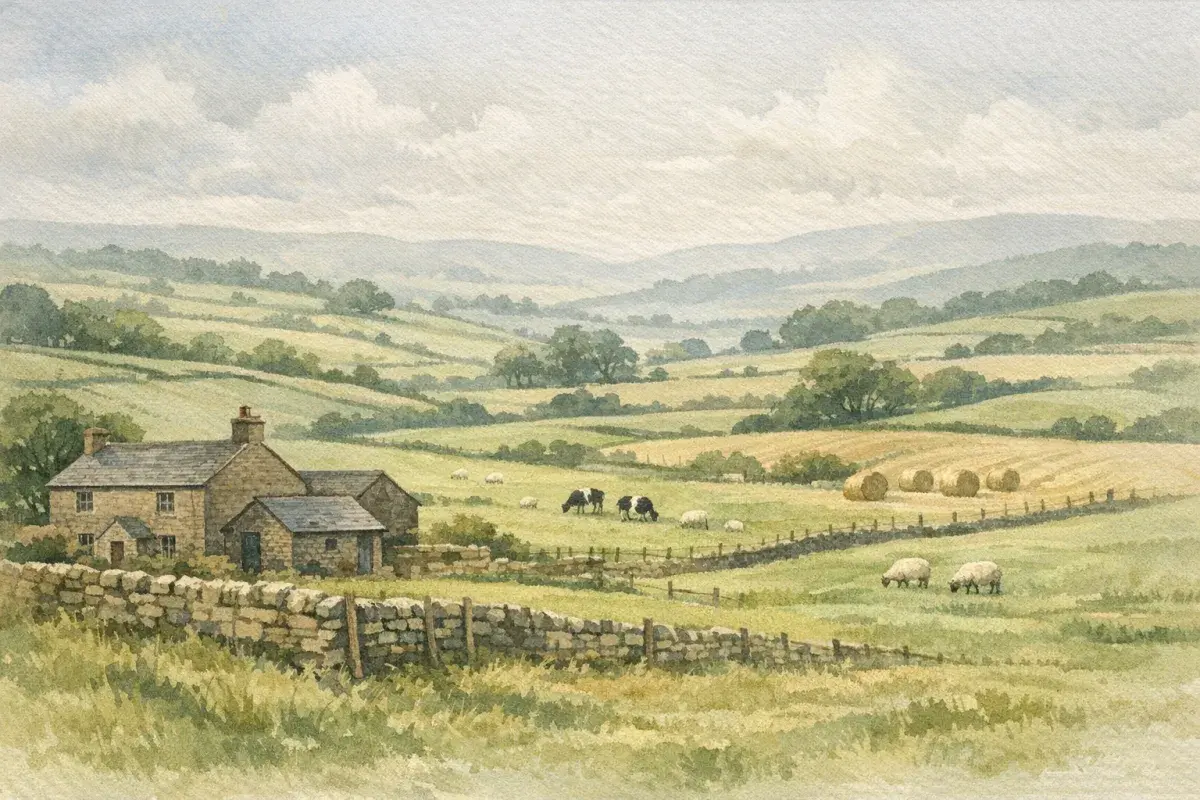
If you've been watching Scottish agricultural land prices over the last couple of years, you'll know the market has a habit of doing two things at once: holding firm in the best spots while quietly repricing anything with practical headaches (access, exposure, drainage, awkward shapes… you know the sort).
In 2026, the question isn't simply "what's the going rate per acre?" It's what type of land, in which micro‑market, with what strings attached, and who else wants it? This guide gives you a clear, Scotland‑specific view of today's values, what's really driving them, and how to buy with your eyes open.
The Scottish Farmland Market In 2026: What Prices Look Like Now
Scottish agricultural land prices in 2026 are best understood as a set of overlapping markets rather than one headline number. Prime arable behaves differently to permanent pasture: upland ground behaves differently again: and whole farms (with a house and a usable steading) can sit in their own "scarcity bubble".
You'll still hear plenty of talk about £/acre at the mart café. But in practice, buyers and agents are looking at a bundle of value drivers: output potential, scheme eligibility, access and operating efficiency, development/renewables optionality, and, crucially, how easy the title and occupation position is.
Average Price Ranges By Land Type (Arable, Grass, Hill, Mixed)
The ranges below are intentionally broad. They reflect how quickly values change once you shift from prime land with good access to "it'll do, but…" land with constraints.
- Prime arable (East/NE Scotland in particular): often the strongest £/acre in Scotland, especially where fields are workable, blocks are decent, and you're not fighting waterlogging or long road hauls.
- Good quality grass and mixed land: typically trades on stock-carrying ability, wintering potential, and how well it complements neighbouring units (or your own system).
- Upland/hill ground: value is heavily shaped by altitude, exposure, in-bye balance, tracks, and whether there's realistic upside via forestry, natural capital, or renewables.
- Whole farms: the presence of a liveable house, a functional steading, and tidy infrastructure can add a premium that isn't captured by a simple land-only rate.
If you want a wider UK baseline to sanity-check Scottish agricultural land prices against broader trends (without losing the Scotland nuance), it's worth keeping an eye on AgLand's UK-wide pricing overview in tandem with local intel.
How Scottish Pricing Differs From England And Wales
Scotland's pricing differences aren't just about "north vs south" economics, there are structural reasons:
- Land type mix is different. Scotland has a larger share of upland, rough grazing, and land where "productive" depends on system, infrastructure, and weather resilience.
- Bigger role for whole-farm scarcity. In some areas, a well-located unit with a house and a decent steading is rarer than people assume. That scarcity can keep achieved prices surprisingly firm.
- Distinct legal and tenure landscape. Scottish title, servitudes, access rights, and agricultural holdings rules shape what's buyable, and what lenders will comfortably support.
- Different non-farming demand profile. Lifestyle buyers, forestry buyers, and natural-capital interest can be very localised, strong in some districts, absent in others.
Bottom line: you can't simply import an English per-acre expectation and "adjust it down a bit". You need to price Scotland as Scotland.
Where Prices Are Highest And Lowest: Regional Patterns Across Scotland
Regional patterns exist, but the truth is more granular than a map of Scotland shaded from "cheap" to "dear". Two farms five miles apart can be worlds apart in value if one is efficient, accessible, and scheme-friendly while the other is fragmented or constrained.
Prime Arable Areas And Consistently Strong Demand Hotspots
In broad terms, prime arable districts tend to be where you see the strongest and most consistent demand:
- Depth and reliability of soils (and how well they carry machinery in wet seasons)
- Field size and shape (straightforward operations reduce labour and kit costs)
- Access to markets and infrastructure (including storage, feed, and haulage routes)
- Local concentration of progressive farming businesses looking to expand
That "neighbour effect" matters. When two or three serious local operators want the same block, pricing behaves less like a spreadsheet and more like a contest.
Livestock, Upland, And Marginal Land Markets: What Moves The Needle
Livestock and upland markets can look softer on paper, yet still produce sharp bidding when the land fits a buyer's exact need.
What typically moves the needle:
- In-bye to hill balance. A holding with enough better ground to winter and finish stock can outperform a higher-acreage unit that's mostly rough grazing.
- Access and tracks. If you can't move stock, feed, or contractors efficiently, your cost base rises fast.
- Forestry and natural capital demand. In some locations, these buyers create a "floor" under values, but only where practical and policy conditions stack up.
If you're looking north, don't treat "Highland" as one uniform market. Values can shift dramatically with distance to services, local demand, sporting factors, and pure exposure. Our deeper piece on Highland land dynamics is useful context when you're comparing holdings that look similar in acreage but not in reality.
Local Constraints That Shape Values (Access, Parcel Size, Aspect, Exposure)
A few constraints show up again and again when Scottish agricultural land prices disappoint expectations:
- Access: shared private roads, weak bridges, awkward visibility splays, or long narrow routes through neighbours can all create cost and risk.
- Parcel size and fragmentation: a 40-acre block is not the same as two 20-acre blocks if you're moving kit, labour, and livestock.
- Aspect and exposure: in upland districts especially, wind and elevation can cut utilisable days and push you toward a different system than you planned.
- Services and water: private supplies, drainage condition, and the practicality of improving them matter a lot more than brochures admit.
If you're pricing a farm, price the operational reality, not the boundary line.
What Actually Drives Scottish Agricultural Land Prices
When people talk about Scottish agricultural land prices, they often jump straight to interest rates or subsidies. Those matter, but they're not the only levers.
In practice, value is driven by a stack of "fits": fit for your farming system, fit for the next buyer's plan, fit for policy, and fit for the local market's quirks.
Productivity And Farm System Fit (Soils, Climate, Field Layout)
Productivity is not just soil type, it's how the land behaves in a Scottish year.
- Soils and drainage: good land that stays wet can still become an operational headache if you're constantly waiting to travel.
- Climate and growing season: upland versus coastal conditions can change carrying capacity and forage reliability.
- Field layout: awkward shapes, lots of corners, or poor gateways quietly add labour and machinery hours.
A useful mindset is to treat land like a piece of kit: if it doesn't suit your system, it's expensive even at a lower price.
Supply, Neighbour Competition, And Expansion Value
Scarcity is real in many Scottish micro‑markets.
- If your neighbour wants it to square off a block or secure access, they may pay a premium that doesn't reflect "pure" farming return.
- Conversely, if land comes with practical downsides (rights issues, complicated occupation, or expensive repairs), the buyer pool shrinks, and achieved price can slide.
Non-Farming Demand (Lifestyle, Forestry, Natural Capital, Renewables)
Non-farming buyers can support values, but they don't support every asset.
- Lifestyle demand tends to push up holdings with an attractive house, manageable acreage, and easy access to towns.
- Forestry demand is highly sensitive to ground conditions, access for timber extraction, and policy/market sentiment.
- Natural capital can add value where projects are credible and additionality is clear, but it can also attract hype and unrealistic expectations.
- Renewables can create optionality (or restrictions) depending on grid capacity, planning constraints, and lease terms.
This is where it helps to step back and look at value drivers systematically. AgLand's guide to what really affects agricultural land value breaks those drivers down in a way you can apply to Scottish holdings without hand-waving.
Policy And Regulation Factors (SRUC/SAF, Subsidy Changes, Tenancy Rules)
Policy affects land in two main ways: income confidence and compliance risk.
- Support schemes and claims: how the land has been managed and claimed historically (and whether that's cleanly evidenced) matters when you're underwriting affordability.
- Regulatory constraints: protected sites, peatland considerations, and water environment rules can all limit what you can practically do.
- Tenancy and occupation rules: in Scotland, the structure of occupation can materially change value, especially where you're buying with a plan to occupy, restructure, or diversify.
It's not glamorous, but paperwork and compliance are often where "cheap" land stops being cheap.
Pricing Benchmarks Buyers Use: How Land Is Valued In Practice
Valuation in the Scottish farmland market is part maths, part local intelligence, part realism about risk. If you're buying, your job is to understand what benchmark is being used, and whether it flatters or hides the truth.
Guide Price Vs Achieved Price: Understanding The Gap
Guide prices do a job: they set the marketing tone, attract a buyer pool, and create momentum.
But achieved price is shaped by:
- How many credible bidders are in the room (and whether they're cash or leveraged)
- The lotting strategy (one block vs multiple lots can change outcomes)
- The due diligence story (clean title and clear occupation tends to tighten the gap)
- Timing (seasonality matters more than many admit, especially for farming buyers)
If you're looking at "best and final offers," assume the winning bid has solved a problem for someone, not simply "paid the most".
Per-Acre, Per-Hectare, And Whole-Farm Pricing: When Each Metric Misleads
Per-acre and per-hectare pricing is helpful for quick comparisons, but it can mislead you when:
- Net productive area differs from the headline area (woodland, tracks, wetlands, steep banks)
- Quality varies within the boundary (a farm can contain three different land classes)
- Infrastructure is the real asset (house, steading, grain store, drainage investment)
Whole-farm pricing can also mislead if the house is being valued like a stand-alone dwelling rather than as part of a working unit (with its own constraints and opportunities).
If you want to compare apples with apples, it helps to understand how buyers and surveyors treat the unit of measurement. AgLand's explainer on pricing land by the hectare is a good reference point when listings mix gross area, net area, and "about" figures.
Premium Value Features (House, Steading, Water, Tracks, Sporting)
Certain features regularly command premiums in Scotland:
- A liveable farmhouse (or genuinely upgradeable) where location works for schools, services, and staff
- A steading you can use without swallowing a rebuild budget on day one
- Reliable water (especially for livestock systems)
- Good internal tracks and manageable field parcels
- Sporting potential where it's established, clearly documented, and not in conflict with farming operations
The key is functionality. "Traditional" can be charming: "traditional and falling down" is a different financial model.
Discount Factors (Fragmentation, Resumption Risk, Rights, Restrictions)
Discounts tend to cluster around uncertainty and cost:
- Fragmentation: multiple blocks with road miles between them
- Occupation complexity: tenancies, grazings, or informal arrangements that aren't neatly documented
- Rights and restrictions: access rights, wayleaves, telecoms masts, mineral reservations
- Designations and constraints: protected sites, flood risk, peat depth issues
A price that looks soft may simply be the market pricing-in hassle you haven't discovered yet.
What Buyers Should Check Before Relying On A Price Per Acre
A price per acre is only meaningful if you understand what you're actually buying, and what you're inheriting.
In Scotland, buyers get caught out less by the obvious things (like "it's hilly") and more by the quiet ones: title oddities, unresolved access arrangements, and occupation details that limit your options for years.
Title, Boundaries, And Rights (Access, Servitudes, Minerals, Wayleaves)
Before you anchor on Scottish agricultural land prices, pressure-test the legal package.
Check, with your solicitor and surveyor:
- Title extent and boundary responsibilities: fences, ditches, marches, who maintains what?
- Servitudes and access rights: are they clearly granted, and do they suit modern machinery?
- Wayleaves and utility easements: overhead lines, pipes, fibre routes, pylons, what are the rights and compensation arrangements?
- Minerals and sporting: are they included, reserved, or subject to third-party rights?
If something is "by arrangement" rather than written and recorded, assume it's a risk until proven otherwise.
Tenancies And Occupation (SLDT, 1991 Act, Grazings, Short Lets)
Occupation is one of the biggest price shapers in Scotland.
You'll want clarity on:
- What type of tenancy (if any) exists, and what rights attach to it (including assignation and succession in relevant cases)
- Crofting or grazings issues where applicable, these can materially affect use, management, and saleability
- Vacant possession assumptions: if the marketing implies it, make sure the legal position supports it
If you're exploring tenanted land or established holding structures, AgLand's overview of Scottish agricultural holdings is a solid starting point before you get into the detail with your professional team.
Designations And Planning Constraints (SSSI, SAC/SPA, NNR, Flood Risk)
Designations aren't automatically deal-breakers, but they change what "improvement" means.
Look for:
- Nature designations (e.g., SSSI, SAC/SPA, NNR) and what consents are needed for operations
- Flood risk mapping and on-the-ground signs (silt lines, washed-out banks, repeated waterlogging)
- Planning history: prior refusals can be as informative as permissions
If your plan relies on diversification, don't wait until after you've agreed a price to discover constraints.
Land Capability, Drainage, And Environmental Obligations
In a Scottish context, "capability" is practical as well as technical:
- Drainage condition and outfalls (and who controls downstream sections)
- Soil structure and compaction, especially if you're buying land that's been worked hard
- Peat and wetland considerations on upland ground
- Any existing environmental commitments (management agreements, restrictions, ongoing obligations)
The best buyers treat environmental constraints the same way they treat a roof survey: a known condition you price properly.
How To Buy Scottish Farmland Confidently: A Practical Step-By-Step
Buying well in Scotland is rarely about being the fastest. It's about being prepared, so when the right farm appears, you can move with confidence.
Set Your Brief And Budget: What You Can Realistically Buy
Start by writing a brief that's honest about your system and your tolerance for complexity:
- What's your primary objective: expansion, a new unit, mixed farming, livestock wintering, or a long-term investment?
- What are your non-negotiables: access, water, proximity to existing land, steading capacity, a house?
- What's your "deal-breaker list": floodplain, heavy fragmentation, no hard track, complex occupation?
Budget properly too, Scottish transactions come with professional fees and, depending on your circumstances, tax considerations. Your lender (if you're borrowing) will also want comfort on title, access, and marketability.
Search Efficiently: On-Market, Off-Market, And Alert Strategy
Good farms don't always sit around waiting to be discovered.
To search efficiently:
- Use specialist filters. You'll save hours by narrowing by land type, acreage bands, and rural property features that matter in agriculture.
- Set alerts and act quickly when something close to your brief appears.
- Build relationships with agents in your target districts, some opportunities are shared quietly before formal marketing.
If you're new to Scottish buying or want a deeper Scotland-specific checklist (cropping, grass, crofting, access, schemes, local constraints), AgLand's guide to buying agricultural land in Scotland pairs well with local professional advice.
Offer Structure And Negotiation: Entry Dates, Conditions, And Timescales
Scottish deals often hinge on the details:
- Entry date realism: align it to cropping, livestock moves, and staff planning, not just your excitement.
- Conditions: if you need finance, specific searches, or consents, be clear on how you'll handle them.
- Lots vs whole: sometimes bidding on a specific lot is smarter than stretching for the whole unit.
A strong offer isn't always the highest, it's the one that the seller believes will complete without drama.
Due Diligence And Professional Team (Solicitor, Surveyor, Agent, Lender)
If you want to buy confidently, assemble your team early:
- Solicitor (Scottish rural property experience): title, servitudes, burdens, missives, completion
- Chartered surveyor/valuer: condition, value rationale, lender support, practical constraints
- Land agent: local pricing reality, negotiation, off-market intel
- Lender/broker: realistic terms, timescales, and what they will (and won't) accept
Treat due diligence as a value-creation step. Every risk you identify early is either a negotiation lever, or a reason to walk away before costs mount.
What Could Change Prices Next: Signals To Watch
Scottish agricultural land prices don't usually "crash" without a trigger, but they can drift quickly when buyer confidence changes. In 2026, you'll want to watch the signals that change affordability, alter non-farming demand, or increase perceived risk.
Interest Rates, Lending Appetite, And Cash Buyer Behaviour
Rates matter, but so does credit confidence.
- If lenders tighten on rural property (or become more conservative on land with occupation complexity), the buyer pool can thin.
- Cash and equity-backed buyers can keep prime land firm even when leveraged buyers pause.
If you're planning a purchase over the next 12–24 months, scenario planning helps. AgLand's price forecast guide lays out practical upside/downside drivers you can adapt to your district.
Carbon, Biodiversity, And Woodland Values: Opportunity And Hype Risks
Natural-capital narratives can add value when projects are credible, but you should be cautious about underwriting a "carbon premium" without:
- Clear additionality and documentation
- Practical feasibility (access, planting conditions, constraints)
- A realistic view of contract terms and long-term obligations
The land still has to make sense on its fundamentals. If a deal only works because of a speculative upside, treat that as a risk, not a bonus.
Renewables And Grid Constraints: When Options Add Value (And When They Don't)
Renewables can add value where there's genuine deliverability, but Scotland has real-world constraints:
- Grid capacity and queue realities can turn "promising" into "parked for years".
- Planning and designation constraints can limit siting.
- Heads of terms can look attractive while hiding onerous access rights or reinstatement obligations.
Options can be valuable, but only if you understand the probability of progress and the costs of getting there.
Supply Outlook: Farm Restructures, Inheritance, And Portfolio Sales
Supply is the sleeper variable.
- A cluster of portfolio sales can temporarily increase choice and soften bidding.
- Inheritance-driven sales and restructures can bring good assets to market, but timing is unpredictable.
- Lotting decisions (splitting farms vs selling as a whole) can change the effective supply in your acreage band.
Your best edge is preparation: a clear brief, finance lined up, and the ability to move quickly when the right holding appears.
Conclusion
Scottish agricultural land prices in 2026 aren't best understood through a single national average. You'll make better decisions by pricing the land you're actually buying: its productive reality, its constraints, its occupation position, and its fit with your system (or your investment thesis).
If you take one practical step after reading this, make it this: build a repeatable process, shortlist, inspect, interrogate title/occupation, then price with cold realism. When you do that, you stop being surprised by "why that farm made a premium" or "why that one looked cheap." You'll already know.
Disclaimer: AgLand.co.uk is a UK agricultural land and rural property matching service, where buyers register what they are looking for and owners advertise directly to the buyers who match, and a rural resource hub. Nothing in this text is intended as legal, financial, or investment advice. You should do your own due diligence and seek guidance from relevant professionals (such as Scottish rural solicitors, chartered surveyors, land agents, tax advisers, and lenders) before acting.