
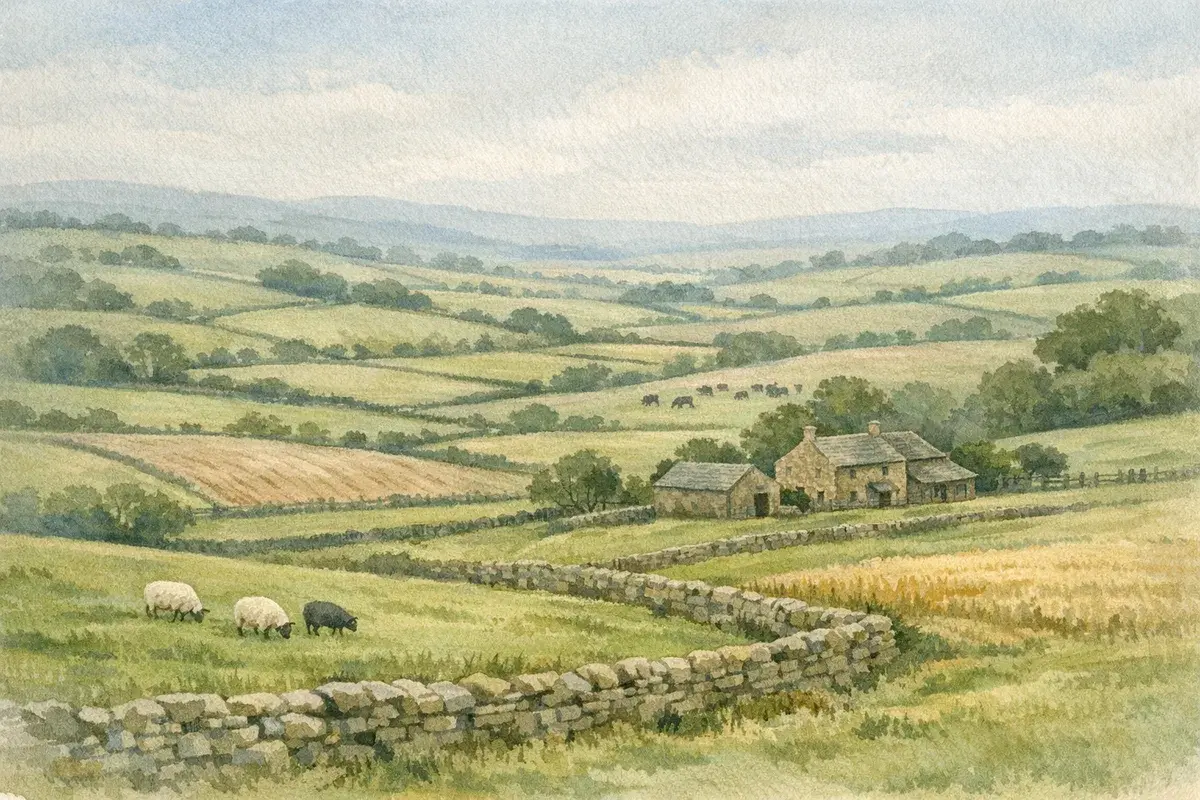
If you're trying to time a land purchase, decide whether to sell a block, or work out what your balance sheet might look like in two years' time, you've probably noticed an awkward truth: UK farmland doesn't behave like a neat "market chart". It's thinly traded, deeply local, and driven as much by confidence and scarcity as it is by farm profit.
This agricultural land price forecast is about getting you to better decisions, not pretending anyone can call the top (or bottom). We'll look at where values sit in 2026, the drivers likely to matter most over the next 12–36 months, and realistic scenarios for 2026–2028. Then we'll translate the forecast into practical moves for buyers and sellers, because knowing the direction is one thing: protecting your downside on a specific field is the real work.
Where UK Agricultural Land Prices Stand In 2026
In 2026, UK agricultural land values are still being shaped by the same big forces that have dominated the last decade: scarcity of supply, the "safe-haven" appeal of real assets, and a wide gap between average land and the best blocks.
But the texture of the market has changed. You'll likely see:
- Fewer forced sellers than in a typical housing downturn, many landowners have low gearing and can wait.
- More price sensitivity around borrowing costs and short-term farm margins.
- Sharper splits between land that's easy to farm, easy to access, and easy to finance versus land with constraints (tenancies, access issues, awkward parcels, designations).
If you want a tighter grounding on what today's prices look like (and what's been driving them), it's worth cross-checking AgLand's overview of current UK farmland values before you start building your own forecast assumptions.
How UK Land Values Are Measured (And Why Headlines Can Mislead)
A lot of confusion comes from how "UK farmland prices" get quoted.
Here's what tends to distort headlines:
- Average vs prime: A national "average" often hides the fact that prime arable in the right place trades in a different universe to marginal grass with access constraints.
- Deal mix: One large, high-quality arable sale can skew quarterly figures. In a thin market, the "sample" matters.
- What's included: Some reports blend bare land with farmhouses, buildings, and sometimes even residential value.
- Hope value: Parcels with long-shot development potential can print a number that looks like "farmland", but is really a planning bet.
A more practical way to read the market is to think in price-per-hectare bands for broadly comparable land types and locations. If you want to sanity-check numbers in that language, the guide to typical price-per-hectare ranges is a useful anchor, then you adjust for the specific field's attributes (access, drainage, shape, tenure, scheme income, and so on).
The Key Drivers Behind The Next 12–36 Months Of Land Prices
Forecasting UK agricultural land is really forecasting a bundle of markets at once: food and fibre, finance, policy, and planning. Over the next 12–36 months, a few drivers are likely to matter more than the rest.
Farm Profitability, Commodity Cycles, And Cost Inflation
Farm margins don't drive land prices one-for-one, but they do shape behaviour:
- Owner-occupiers bid harder when cashflow is strong. That's especially true when they're buying "next door" land that improves the efficiency of the core business.
- Inputs volatility changes risk appetite. Fertiliser, fuel, and feed costs don't just hit profit, they hit confidence. If your working capital feels tight, you're less likely to stretch for land.
- Sector splits matter. Arable-heavy areas react differently to grain cycles than livestock regions do to store and fat prices.
The catch: even when farming returns are under pressure, land can stay firm because other buyers (long-term investors, neighbours with strong balance sheets, lifestyle buyers, natural capital aggregators) step in.
For a quick read on how these cycles have shown up in the data, you can compare against AgLand's explainer on farmland price trend patterns and note where today's environment differs (notably the cost-of-debt backdrop).
Interest Rates, Credit Conditions, And Investor Demand
If you're borrowing, the interest-rate story isn't abstract, it changes your maximum bid.
What to watch in 2026–2028:
- Base rate direction and lender appetite: Even if headline rates ease, lenders can tighten criteria for agricultural loans if they feel land values are "peaking".
- Cash buyers vs leveraged buyers: Prime blocks often attract cash-rich bidders who aren't sensitive to monthly payments. Secondary land can be more rate-sensitive.
- Alternative yields: When gilts and savings accounts pay more, some investors demand more "value" from land (through income, diversification, or future upside) rather than buying purely for capital preservation.
The practical implication for you: the market may not collapse, but the top end can keep moving while the middle gets sticky, fewer bidders, longer decision cycles, and more deals falling over on finance or due diligence.
Policy, Subsidy Transition, And Environmental Markets (ELM, BNG, Carbon)
UK policy is no longer "one scheme fits all", and that's a big deal for forecasting values.
- England (ELM: SFI/CS/LNR): The value impact tends to be field-by-field. Land that can stack reliable scheme income (without restricting future flexibility) can command a premium.
- Wales (SFS direction of travel): Ongoing policy development can add uncertainty, which can cool bidding where buyers can't model future net income.
- Scotland (support reform): Similar story, buyers price in uncertainty when scheme rules are shifting.
- BNG (Biodiversity Net Gain): In England, BNG creates demand for certain habitat creation opportunities, but it's not a magic money button. You need suitability, access, legal structure, and a buyer.
- Carbon and natural capital markets: Some projects can enhance value: others can reduce flexibility or complicate finance. The quality of the agreement matters more than the headline "£/acre".
This is where due diligence becomes part of the forecast. Two neighbouring farms can face different pricing simply because one has land that's clean, eligible, and easy to contract, while the other has constraints.
Planning Upside, Development Hope Value, And Infrastructure
Planning is the classic accelerator of price… but it's also the fastest way to misprice risk.
Over the next 12–36 months, expect:
- Continued competition for land with credible strategic potential (settlement edges, transport links, utility corridors). Even when the planning system feels slow, money still chases a good story.
- More scrutiny of "hope value": With higher finance costs and stretched viability in some development sectors, buyers may demand stronger evidence before paying up.
- Infrastructure impacts: Major road/rail/energy projects can cut both ways, uplift in some pockets, blight in others.
If you're buying farmland with a planning angle, build your forecast around probabilities and time, then stress-test it. A 10-year planning horizon behaves very differently from a 2-year farming return.
2026–2028 Scenarios: Base Case, Upside, And Downside Forecasts
A sensible agricultural land price forecast isn't a single number, it's a range with reasons.
Below are three scenarios you can actually use when making decisions. Think of them as decision frameworks, not predictions carved in stone.
- Prime, scarce blocks (ring-fenced, good access, clean title, strong local demand) continue to attract competition.
- Average land sees slower sales and more negotiation, especially where borrowing is involved.
- Discounts widen for land with constraints (tenancies, access rights, awkward shapes, poor drainage, heavy capital needs).
In this base case, the "headline" market might look steady, but you'll feel a growing difference between easy, financeable land and everything else.
You could see stronger price rises if a few things happen together:
- Borrowing costs ease faster than expected.
- Commodity prices stabilise while input costs soften.
- Environmental markets become simpler to transact (clearer templates, more bankable income).
In that environment, pent-up demand (especially from neighbours) tends to reappear quickly, because quality land doesn't sit around waiting.
Prices can fall when:
- Credit is available but expensive and lenders become more conservative on agricultural valuations.
- Farm margins get squeezed (price down, cost up) at the same time as policy uncertainty rises.
- A wave of supply appears (less common, but possible if there's a sector-specific shock).
Even then, the downside in UK land is often uneven rather than uniform. A weak market doesn't necessarily "mark down" prime land to the same extent as secondary parcels.
What Would Shift The Forecast Fast: Triggers To Watch
If you want to keep your forecast live (rather than setting it once a year), watch these triggers:
- Bank behaviour: not just base rate moves, but LTVs, covenants, and valuation conservatism.
- Scheme rule changes: especially anything that changes eligibility, payment certainty, or the ability to stack options.
- Supply shocks: large estates bringing big acreage to market, or policy/tax changes altering succession and selling decisions.
- Local planning decisions: one strategic allocation can re-rate a whole fringe area.
A practical habit: keep a short "watch list" of local comparables and note whether they're actually selling, not just being advertised.
Regional And Land-Type Forecast Differences Across The UK
One reason people get burned by forecasts is that they apply a national narrative to a local asset. Land doesn't price nationally, it prices locally, in a very particular buyer pool.
If you're building your own expectations, start by benchmarking your area rather than the UK average. AgLand's breakdown of agricultural land prices by region is a good place to orient yourself, then you zoom in further to your county and your micro-market.
Arable Versus Pasture, Upland Versus Lowland, And Mixed Units
Different land types respond differently to the same macro forces.
- Arable land: tends to command higher values where it's productive, well-drained, and blocky. It can also be more sensitive to commodity cycles, though prime arable often has a scarcity premium that dampens downturns.
- Pasture: values often relate more to local livestock strength, equestrian demand in some areas, and parcel suitability (water, shelter, access, boundaries).
- Upland: can look "cheap per acre" but may come with higher management costs, scheme dependence, designations, and limited alternative uses. In a tightening credit environment, lenders can be more cautious.
- Mixed units: can trade at a premium when the holding is genuinely efficient (good buildings, practical layout, sensible house-to-land ratio) and at a discount when it's capital-hungry.
The forecast implication: don't assume one land type will "catch up" with another. Sometimes the gap exists for structural reasons.
England, Scotland, Wales, And Northern Ireland: Market Nuances
The UK isn't one land market.
- England: policy transition and environmental markets are often front and centre in buyer conversations. If you're buying here, it's worth grounding yourself in practical buying considerations via AgLand's guide to making sense of land deals in England.
- Scotland: different legal and practical considerations (including how deals are structured and what local demand looks like) can influence liquidity and pricing. If Scotland is your focus, use AgLand's overview of Scottish land buying realities as your baseline before applying any "UK-wide" forecast.
- Wales: policy direction and scheme detail can influence confidence: local buyer pools can be tight, making pricing sensitive to who shows up on the day.
- Northern Ireland: often characterised by strong local demand and limited supply, but the market can still be sensitive to agricultural profitability and lending.
Your main takeaway: a "rates are falling, land will rise" narrative might play out quickly in one region and barely move the needle in another.
Quality, Access, And Parcel Size: Why Two Fields Can Price Miles Apart
This is the part most forecasts miss: land is priced like a product, not a commodity.
Two fields of the same acreage can diverge dramatically because of:
- Soil and capability (yield reliability, workability, erosion risk)
- Road frontage and access (a gateway you can get a drill through matters)
- Drainage and water (both too much and too little create long-term cost)
- Shape and efficiency (square beats sausage-shaped, all else equal)
- Services and nuisance factors (wayleaves, pylons, nearby development)
- Title and rights (easements, sporting rights, ransom strips)
If you want a structured checklist of what typically moves value, AgLand's rundown of the main factors that affect rural land worth helps you translate a forecast into a specific "this field, at this price, with these risks" decision.
Forecast Implications For Buyers: How To Bid With Confidence
If you're buying in 2026–2028, the goal isn't to "win" by paying the highest price. It's to buy land that still looks smart after the next rate change, policy tweak, or bad harvest year.
Here's how to turn an agricultural land price forecast into a bidding approach that protects you.
Due Diligence That Protects Value (Tenure, Easements, Stewardship, Title)
In a flatter market, hidden problems don't just sting, they can trap you.
Focus your due diligence on value-protecting fundamentals:
- Tenure and possession: Are you buying with vacant possession, an FBT in place, a grazing licence, or something messier? Tenanted land can be the right purchase, but it must be priced as such.
- Rights and burdens: Public footpaths, private rights of way, wayleaves for utilities, sporting reservations, and any restrictive covenants. These can alter how financeable (and saleable) the land is later.
- Scheme obligations: If the land is in a stewardship agreement administered by the Rural Payments Agency, understand what transfers, what can be varied, and what could trigger repayment.
- Access and ransom risk: If access runs over a third party, check it's legally secure and practically usable for modern kit.
- Basic mapping reality: Boundaries on paper don't always match what's fenced. Small discrepancies can become big arguments when you're trying to refinance or resell.
You're not being paranoid: you're being bankable. In a cautious lending environment, "clean and simple" attracts better finance terms and broader resale demand.
Buying Strategy: Timing, Off-Market Routes, And Setting A Walk-Away Price
A forecast is most useful when it changes how you behave.
- Timing: Don't wait for a perfect macro signal if the land is genuinely strategic to your business (next door, water access, yard expansion). Those opportunities don't repeat on schedule.
- Off-market routes: Quiet conversations still matter in rural property. If you know you'll buy, build relationships with local agents, surveyors, and solicitors who actually see deals before they hit the wider market.
- Set a walk-away price: Base it on what you can afford under stress, higher interest, lower commodity prices, or a slower route to scheme income. If you need everything to go right to make the deal work, it's not a plan: it's a gamble.
A simple tool: write down three numbers before you offer, (1) a "happy" price, (2) a "still okay if rates stay higher" price, and (3) the walk-away.
Forecast Implications For Sellers And Landlords: When And How To Go To Market
If you're selling, the next 12–36 months are less about "top of the market" and more about maximising certainty. In a deal environment where buyers are cautious, the seller who makes it easy to buy usually achieves the stronger net result.
Preparing A Sale: Presentation, Pack Documents, And Overages
If you want the best price in a market with more scrutiny, reduce uncertainty.
A strong seller's pack often includes:
- Title documents, plans, and clarity on boundaries
- Details of rights of way, wayleaves, and any third-party access
- Stewardship/scheme information and obligations
- Drainage info where known (or at least a candid note of issues)
- A clear explanation of what's included (fences, gates, water supply arrangements)
On overage (clawback): it can be a smart tool if there's plausible planning upside, because it lets you sell now while retaining a share of future uplift. But it needs careful drafting, get proper legal advice and keep it realistic, otherwise it can put buyers off or complicate lending.
And don't underestimate presentation. A tidy boundary, workable gateways, and a clear plan that matches what's on the ground can make your land feel "low hassle", which buyers often price as a premium.
Lettings And Rent Reviews: Positioning In A Changing Yield Environment
For landlords, the forecast question is often: will rent keep pace?
A few pragmatic points:
- Rents are sticky: They don't move as fast as interest rates. Reviews take time, and comparables matter.
- Good tenants are valuable: In uncertain policy environments, a capable tenant who looks after the holding and communicates well can be worth more than a slightly higher rent from a marginal operator.
- Flexibility has value: Shorter terms or well-structured break clauses can protect you if you expect a shift in environmental income opportunities, but too much flexibility can deter better tenants.
If you're reviewing or granting a tenancy, consider how scheme income is treated, who carries compliance risk, and whether the agreement preserves the holding's future options (for farming, diversification, or environmental projects).
Conclusion
The most useful agricultural land price forecast isn't the one with the most confident number attached, it's the one that changes how you prepare.
If you're buying, anchor yourself to local comparables, stress-test finance, and treat due diligence as value protection rather than admin. If you're selling or letting, reduce uncertainty, present the asset well, and make it easy for a cautious buyer (or tenant) to say yes.
Land is long-term by nature. Your edge isn't guessing the next quarter: it's structuring decisions so you can live with them for the next decade.
Disclaimer: AgLand.co.uk is a UK agricultural land and rural property matching service, where buyers register what they are looking for and owners advertise directly to the buyers who match, and a rural resource hub. Nothing in this text is intended to be legal, financial, tax, or investment advice. You should carry out your own due diligence and seek guidance from suitably qualified professionals (for example, a chartered surveyor, agricultural valuer, solicitor, accountant, and planning adviser) before making decisions about buying, selling, letting, or investing in agricultural land.