
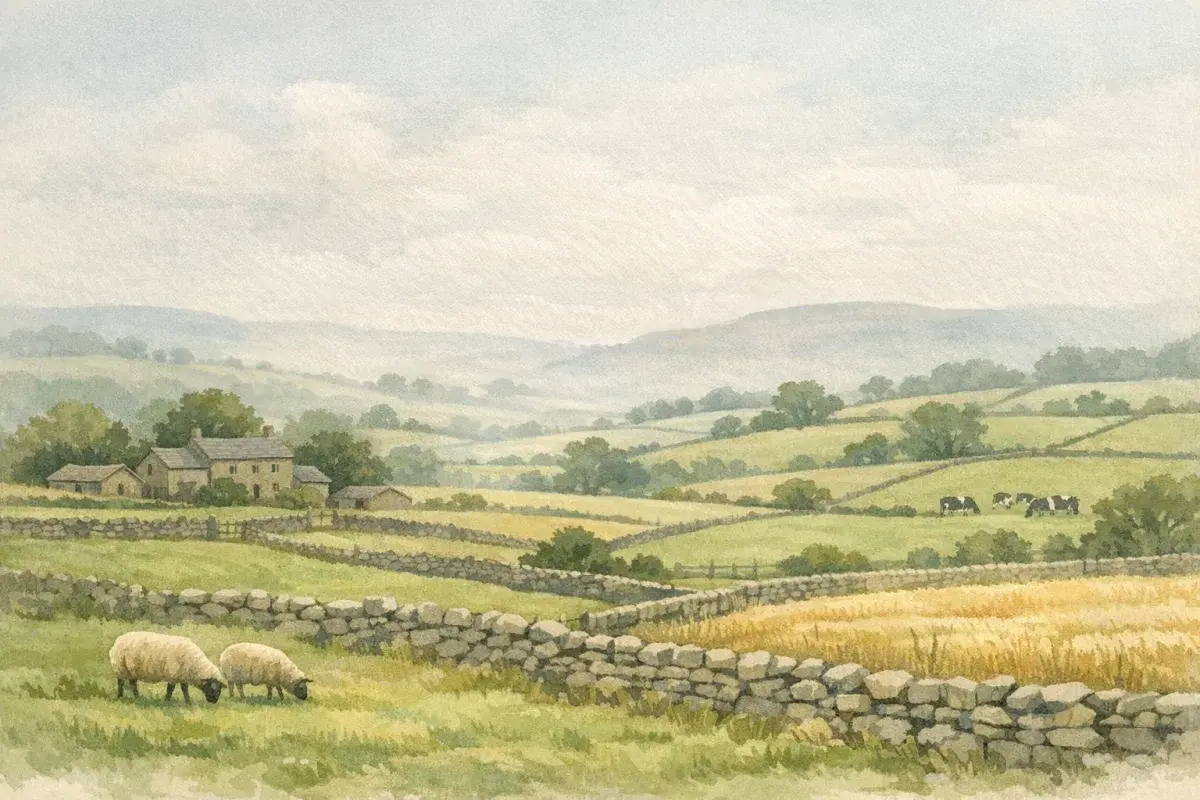
If you've tried to pin down the average price of farmland per acre UK, you've probably found the same frustrating pattern: one headline number, a lot of noise, and not much clarity on what's actually being bought. Is it bare arable land? A ring-fenced grass block with a shed? A whole farm with a house (where the "per acre" maths gets weird fast)?
This guide is designed to help you interpret the averages properly, understand what really moves £/acre in the real world, and value a specific block with fewer nasty surprises. We'll keep it UK-focused, practical, and current for 2026, because in farmland, context isn't a footnote, it's the price.
What “Average Farmland Price Per Acre” Really Means
The "average" is useful, but only if you know what's inside the calculation. Farmland is not a uniform commodity. Two fields the same size can differ wildly in value due to soil, access, schemes, neighbours, and whether you can actually farm it the way you intend.
Farmland Types Included (Arable, Pasture, Mixed, Upland)
When you see an average farmland price per acre UK figure quoted, it may blend several land types:
- Arable land: Generally the highest £/acre in most regions because it's flexible, productive, and often suits scale.
- Pasture/grassland: Can be close to arable in prime livestock areas, but more often sits below arable unless there's scarcity or strong non-farming demand.
- Mixed farmland: A blend of arable and grass, sometimes with woods, tracks, ponds, awkward corners, "average" is a broad brush.
- Upland/rough grazing: Value can be far lower on paper, but access, sporting rights, forestry potential, and carbon/natural capital can complicate the picture.
Averages rarely tell you which of those categories dominates the data.
Headline Averages Vs Achieved Sale Prices Vs Asking Prices
There are three "prices" you'll encounter:
- Asking price: What's on the particulars. It's a marketing position, not a fact.
- Achieved sale price: What a buyer actually paid. This is the benchmark you want, when you can get it.
- Headline averages: Often derived from a mixture of achieved prices, reported deals, and modelled estimates. Useful for trend direction, less useful for any single farm.
In a thin market (and UK farmland is often thin), one or two exceptional transactions can tug an "average" around.
Freehold Vs Leasehold And The Role Of Farm Business Tenancies
Most "average per acre" figures assume freehold, vacant possession, clean title, no ongoing occupation.
But plenty of land is held and traded with tenancy considerations, including:
- Farm Business Tenancies (FBTs) (Agricultural Tenancies Act 1995): flexible, common for grazing lets and longer-term arrangements.
- Older tenancies (often under the Agricultural Holdings Act 1986): can materially affect value because control and possession are constrained.
If you're comparing £/acre, always ask: is this freehold vacant possession, or is income/occupation part of the deal? The "average" can't answer that for you.
The Latest UK Farmland Price Benchmarks And Ranges
Let's talk numbers, carefully.
In 2026, you'll still see plenty of headlines trying to boil the market down to one figure. In practice, the UK doesn't have one farmland market: it has many micro-markets.
A solid way to use benchmarks is to treat them as bands, then work backwards into the reasons.
Typical £/Acre Bands And What Moves A Holding Up Or Down
As a broad rule of thumb, bare land in the UK often trades within wide ranges depending on quality, location, and competition:
- Prime arable: commonly in the high four figures to five figures per acre, with standout parcels pushing higher where supply is tight and competition intense.
- Average arable/mixed blocks: often sits in the mid-to-high four figures per acre.
- Good grassland: often £6,000 an acre or more in England, and can climb where dairy/beef demand is strong and blocks are scarce.
- Upland/rough grazing: can be significantly lower, but "rough" doesn't always mean "cheap" once sporting, forestry, and natural capital enter the chat.
What moves a holding up or down, fast:
- Vacant possession vs occupied
- Access (public highway, gateways, rights)
- Drainage and soil condition
- Field size and layout
- Neighbour interest (the "marriage value" effect)
If you want a deeper dive on how pricing is shaping up, including drivers and what to watch next, you can cross-check our dedicated overview on current agricultural land prices across the UK (linked here only for context, your specific farm will still need local comparable evidence).
Regional Differences Across England, Scotland, Wales, And Northern Ireland
Regional variation isn't just about "north vs south". It's about farming systems, land quality, local buyer pools, and the mix of lifestyle/non-farming demand.
- England: Often shows the highest top-end pricing for prime arable, especially where blocks are scarce and competition includes neighbouring farmers, estates, and private buyers.
- Scotland: Diverse, prime arable in the east can be very different to upland blocks. Tax, land reform discussion, and local estate dynamics can affect sentiment as well as price.
- Wales: Strong livestock identity, with values driven heavily by grass quality, rainfall, access, and local demand for ring-fenced blocks.
- Northern Ireland: A distinct market with its own supply/demand dynamics and strong local competition for good land.
If you're trying to sense-check a number, it helps to look at patterns rather than a single UK-wide average. Our breakdown of agricultural land prices by region is a useful starting point when you're comparing like with like.
Arable Vs Grassland: Why The Gap Can Be Wider Than You Expect
People often assume arable is "always" worth more per acre than grass. Usually, yes, but the gap can widen dramatically when:
- Arable land is genuinely prime (deep soils, good structure, workable early/late)
- Grassland is fragmented or hard to access
- Local livestock demand is weak (or holdings are already fully supplied)
- Cropping flexibility matters to the buyer (rotation options, contract farming models, future tenant appeal)
On the flip side, grassland can surprise on the upside when it's ring-fenced, well-watered, with tidy fencing/hedges and strong nearby dairy/beef demand. In those situations, a "grass discount" doesn't always show up.
What Drives Farmland Prices In Practice
Farmland value isn't a spreadsheet exercise, it's a bundle of risks and opportunities priced by whoever wants it most.
You'll hear people say "it's all about location," but in rural land, "location" often means very specific things: how it farms, how it accesses, what it might become, and who else is bidding.
Soils, Rainfall, And Productive Capacity
Productivity still matters, even with all the noise around natural capital.
Buyers look at:
- Soil type and depth (and whether it caps your cropping options)
- Drainage status (and evidence of historic issues)
- Rainfall and exposure (workability windows and yield stability)
- Compaction and structure (subsoiling needs aren't free)
The key point: the market prices reliability. A farm that performs consistently and is workable in a wider range of seasons typically commands a premium.
Parcel Size, Shape, And Field Layout (Economies Of Scale)
Two 100-acre opportunities can price very differently.
Premium characteristics include:
- Ring-fenced blocks (one continuous parcel rather than scattered fields)
- Large, regular fields (fewer awkward headlands)
- Good internal tracks and turning space
Scale buyers, whether owner-occupiers or those using contract farming, pay for operational efficiency. Conversely, small parcels can still command strong £/acre if there's "special buyer" interest (neighbours, lifestyle, pony land, amenity value).
Access, Services, Drainage, And Development Constraints
This is where "cheap per acre" can become expensive.
Practical value drivers include:
- Direct access to an adopted highway (or, at least, robust rights)
- Gateways and visibility (HGV-friendly access matters if you're moving grain/livestock)
- Water (mains, boreholes, natural supply, and the legal position)
- Drainage (existing outfalls, ditches, maintenance responsibility)
Constraints that can suppress price:
- Restrictive covenants
- Third-party access rights
- Designations and environmental restrictions
Subsidy And Scheme Effects (ELM, SFI, Countryside Stewardship)
In England, BPS has been replaced by small delinked payments that end in 2027, so scheme income and obligations weigh more in buyers' thinking.
In England, the Environmental Land Management (ELM) framework, particularly SFI, has changed how some buyers view "marginal" land. Options can support cashflow, but they also come with management prescriptions and record-keeping.
Across the UK, legacy and current agreements can:
- Add value (if income is attractive and obligations are compatible)
- Reduce flexibility (if prescriptions limit cropping, grazing, or future use)
Practical tip: never treat scheme income as "free money". Buyers will discount for hassle, compliance risk, and inflexibility.
Non-Farming Demand: Lifestyle, Carbon, Natural Capital, And Biodiversity Net Gain
Non-farming demand isn't new, but it's broader than it used to be.
Common non-farming buyer motivations:
- Lifestyle/amenity (privacy, views, horses, "a bit of land"), often strongest near population centres
- Woodland creation / carbon projects (where eligibility and permanence stack up)
- Natural capital and biodiversity (including interest linked to Biodiversity Net Gain, depending on local project pipelines and planning context)
This demand can push certain parcels above agricultural earning power. That's not necessarily a bubble: it's simply different value logic.
Land With “Extras”: Buildings, Planning, And Strategic Potential
Here's where per-acre averages become genuinely misleading.
A 200-acre farm with a house, buildings, and a whiff of development potential might sell for a headline total that looks "high per acre". But what you're really paying for is a mix of assets, some agricultural, some residential, some strategic.
Farmhouses And Residential Value Dilution (Or Uplift)
A farmhouse can either:
- Lift the total value (obviously), but
- Distort the £/acre calculation because you're not buying "land only".
Example logic: if a farmhouse accounts for a big chunk of the purchase price, the "per acre" number can look inflated compared to bare land. But the reverse can happen too, some buyers mentally allocate a high value to the house and then feel the land is "cheap". Both can be dangerous shortcuts.
Agricultural Buildings, Yards, And Infrastructure Value
Useful infrastructure changes what a farm can do from day one.
Value-positive infrastructure typically includes:
- Modern sheds with good spans and clearance
- Concrete yards with drainage
- Grain handling/drying (for arable units)
- Livestock handling systems
- Electricity supply that's actually adequate for your plans
But condition matters. A yard full of tired buildings can become a liability if replacement is likely and planning is uncertain.
Hope Value, Overage, And Option Agreements Explained
"Hope value" is what you're paying for the possibility of something more valuable later, typically development.
Three terms you'll see:
- Hope value: a premium above agricultural value based on development potential.
- Option agreement: a developer (or promoter) secures the right to buy land at a future date if planning is achieved.
- Overage (clawback): a contractual mechanism where the seller receives additional payment if value is uplifted later (for example, via planning permission).
If you're a buyer, hope value can be worth it, but only if you're realistic on timescales, policy risk, and the costs of getting to consent. If you're a seller, overage can protect your upside, but it needs careful drafting and monitoring.
Permitted Development And Prior Approval: When It Matters To Value
Permitted development (PD) rights can be valuable, especially where new buildings or changes of use could reduce your capital spend.
But PD in the countryside is not a free-for-all. It's conditional, often requires prior approval, and can be restricted by location, previous development history, and designations.
The market will sometimes price in PD "potential" even when it's uncertain. Your job is to ask: is that potential real, or just a hopeful line in the sales particulars?
How To Value A Specific Farm Or Block Of Land Per Acre
When you're valuing a real holding, the only number that matters is the one a willing buyer will pay, given what they can verify.
This is where you move from averages to evidence.
Comparable Evidence: How Agents And Surveyors Benchmark £/Acre
Good valuers start with comparable transactions and then adjust.
Comparable evidence typically considers:
- Location (not just county, often parish-level)
- Land type and capability (arable vs grass vs mixed)
- Sale method (private treaty vs tender/auction)
- Lotting (whole vs split lots can change competition)
- Date (markets move: last year's comps may mislead)
If you want to sanity-check how the market has moved over time, it helps to look at the longer curve as well as the latest deals. Our explainer on historical farmland pricing in the UK can help you contextualise whether a "strong" price is actually out of line, or simply consistent with the trend.
Adjustments For Tenure, Condition, Covenants, And Rights
Once you've got comps, you adjust for reality:
- Tenure/possession: vacant possession usually commands a premium.
- Condition: drainage, compaction, weeds, neglected boundaries, buyers price remedial cost and disruption.
- Covenants and restrictions: can cap use and hence cap value.
- Rights: third-party rights (or your own) can either help or hinder.
A classic human behaviour in land buying: you mentally downplay "small" issues because you want the block. That's exactly when small issues get expensive.
Checking Title: Easements, Wayleaves, Ransom Strips, And Mineral Rights
Title is where deals wobble.
You (and your solicitor) should be clear on:
- Easements: rights of way, rights to run services, access for maintenance.
- Wayleaves: often for electricity poles/lines or other utilities, check payments, obligations, and access rights.
- Ransom strips: tiny retained pieces of land that can block access or development.
- Mineral rights: what's included or excluded, and whether there are extraction rights or historic reservations.
If you're buying because you want control and flexibility, title clarity is non-negotiable.
Due Diligence That Protects Price (And Stops Expensive Surprises)
A surprising amount of "overpaying" is just underestimating risk.
When we speak to agents we work with, the stories are usually the same: the buyer who didn't check access properly, the overlooked environmental restriction, the grazing arrangement that wasn't documented, the boundary that "everyone knows" is wrong.
Environmental And Designation Checks (SSSI, AONB, NVZ, Flood Risk)
Environmental context can influence both value and what you can do day-to-day.
Key checks often include:
- SSSI (Site of Special Scientific Interest): can materially restrict operations and consents.
- National Landscapes (AONB) and other landscape designations: can affect development prospects and sometimes building design/material requirements.
- NVZ (Nitrate Vulnerable Zone): impacts nutrient management and storage requirements.
- Flood risk: not just river flooding, surface water and groundwater matter too.
None of these are automatic deal-breakers. But they should influence price, management plans, and your appetite for compliance.
Occupations, Grazing Licences, Sporting Rights, And Vacant Possession
Never assume land is "vacant" because it looks empty.
You want clarity on:
- Who's in occupation (even informally)
- Grazing licences and their actual terms
- Sporting rights (retained, let, or included)
- Timings for vacant possession if that's essential for your plans
A low-key grazing arrangement can become a high-friction issue if it's undocumented and expectations don't match.
Boundaries, Hedgerows, Public Rights Of Way, And Access Points
Boundaries aren't glamorous, but they're where disputes live.
Do the basics well:
- Walk key boundaries (or have them walked)
- Cross-check the title plan against what's on the ground
- Identify public rights of way and how they cut through field operations
- Check hedge responsibilities and whether any hedgerows are protected
If you're budgeting for fencing, gateways, or hedge laying, price it early. It can move your "effective £/acre" more than you think.
How To Track Farmland Prices And Find Opportunities
Farmland isn't bought like a normal commodity. The best blocks don't always hang around, and the best-fit opportunities can look "wrong" until you understand why they're available.
Keeping Track Of £/Acre Without Trawling The Market
If you're actively in the market, you need two things: coverage and speed.
Practical ways to track £/acre:
- Build a watchlist of your target areas and land types
- Track price changes and withdrawn/relisted lots (often tells you where the market pushed back)
- Keep notes on soil, access, and scheme position so you're comparing like with like
If you're also converting between units when benchmarking, our guide to agricultural land price per hectare can help you translate £/ha to a meaningful £/acre view without mental gymnastics.
And if you're specifically focused on cropping land, it's worth reading our practical checklist on finding and buying the right arable field to avoid the classic "it looked perfect from the road" mistake.
On-Market Vs Off-Market: How Deals Really Happen
On-market is straightforward: listings, open marketing, competitive bidding.
Off-market is different. It often happens when:
- A neighbour quietly wants to sell but doesn't want a public campaign
- An agent matches a buyer to a seller based on clear requirements
- A family situation demands discretion
You can't force off-market supply. But you can make yourself easy to place: know your criteria, prove funding, and move decisively when the right block appears.
Working With The Right Professionals (Land Agent, Surveyor, Solicitor, Tax Adviser)
Farmland buying is a team sport.
At minimum, you'll want:
- A specialist land agent who understands local values, not just national averages
- A rural surveyor (especially where buildings, condition, or strategy matter)
- A solicitor experienced in rural title, rights, and overage
- A tax adviser who understands reliefs and the practical realities of farming businesses
If you're newer to the process, or you simply want a robust refresher, our step-by-step guide on how to buy agricultural land in the UK lays out the sequence that tends to prevent costly last-minute surprises.
Conclusion
The average price of farmland per acre in the UK is a helpful headline, but it's not a valuation. Your real question is always: what is this specific block worth to me, given what I can prove about soils, access, schemes, title, and constraints?
If you treat benchmarks as a starting point, rely on comparable evidence, and do due diligence like you're looking for reasons not to buy (before you fall in love with it), you'll make better decisions, whether you're expanding a farming business, restructuring an estate, or investing for the long term.
Disclaimer: AgLand.co.uk is a UK agricultural land and rural property matching service, where buyers register what they are looking for and owners advertise directly to the buyers who match, and a rural resource hub. Nothing in this text is intended as legal, financial, tax, or investment advice. You should carry out your own due diligence and seek advice from appropriately qualified professionals (for example, rural surveyors, solicitors, accountants, and tax advisers) before making decisions or entering into transactions.