
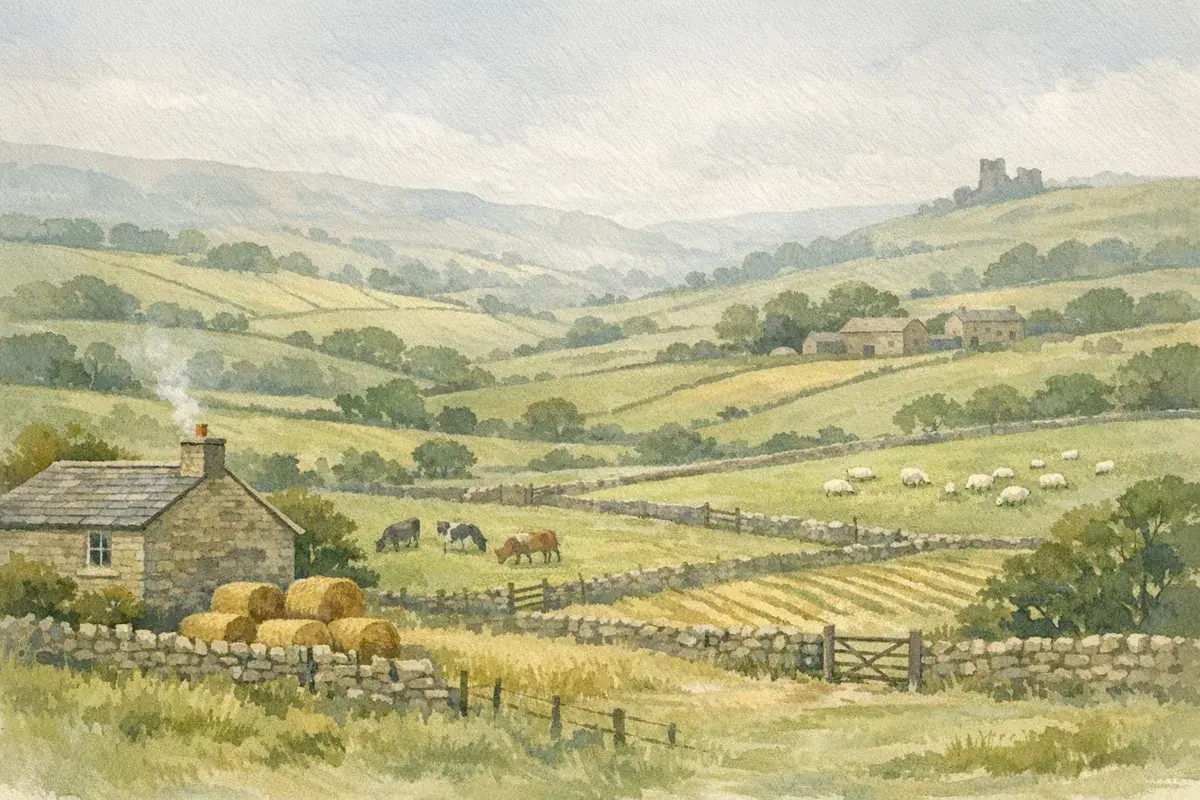
Farmland prices in the UK have a habit of looking "surprisingly steady"… right up until you zoom in. Then you see the real story: sharp regional spikes, quality premiums that widen (or snap shut), and periods where two neighbouring blocks of land can trade on completely different logic.
If you're buying, selling, restructuring a tenancy, or simply trying to understand what your balance sheet is really saying, historical farmland prices aren't trivia, they're context. They tell you how the market behaves when credit tightens, when policy shifts, and when non-farming demand turns up with a different set of priorities.
This guide breaks down what UK farmland price history actually measures, the big turning points over the last couple of decades, and, most importantly, how you can use that history to make better decisions now without falling for misleading averages.
What Counts As “Farmland Price” In UK Data (And Why Figures Vary)
Ask three people for "the farmland price" and you can get three numbers that are all technically correct.
That's not because the market is opaque (though it can be), but because what's being priced varies hugely between transactions and datasets. When you're looking at historical farmland prices UK-wide, your first job is to sanity-check what's actually in the basket.
Bare Land Vs Equipped Farms
A clean block of arable land sold as bare land is the closest thing you'll get to an "apples to apples" price per acre. It typically reflects:
- soil and cropping potential
- access and parcel shape
- local demand and scarcity
- any constraints (flood risk, designations, rights)
An equipped farm can include buildings, yards, grain storage, livestock housing, internal tracks, drainage, and sometimes plant and machinery (less common in a straightforward sale). That package can push the headline total price up dramatically, without meaning the land itself has suddenly "outperformed".
If you're trying to benchmark, it often helps to split your thinking:
- £/acre for the land (comparables)
- replacement cost / utility value of buildings and infrastructure
- residential element (which can behave like a different market)
Vacant Possession Vs Tenanted Land
Vacant possession usually commands a premium because it gives the buyer options: owner-occupy, contract farm, let on an FBT, enter environmental options, or pursue diversification (subject to planning).
Tenanted land pricing depends on what's in place:
- FBT (Farm Business Tenancy): length, rent level, break clauses, and repairing obligations matter.
- AHA (Agricultural Holdings Act 1986): long security of tenure often means the investment value is driven more by rent and reversion prospects than by day-one farming potential.
So when you see historic figures, check whether the series is vacant possession only, mixed tenure, or "all farmland". A small shift in the proportion of tenanted land in a dataset can move the average.
What's Included: Entitlements, Buildings, Residential Value, And Development Hope Value
UK farmland transactions can carry extra ingredients that distort comparisons over time.
- Subsidy entitlements / scheme value: while the Basic Payment Scheme has been phased down in England, legacy impacts still show up in how land was valued historically, and devolved pathways differ.
- Farmhouse and cottages: residential value can dwarf agricultural value in some locations.
- Buildings: useful, compliant buildings add value: obsolete or constrained buildings can be neutral, or even negative if they create liabilities.
- "Hope value": even without allocated development land, the mere possibility of future non-agricultural use can inflate prices near settlements or infrastructure.
If you want a practical companion piece for how today's numbers are being quoted (and why), see our breakdown of where current UK farmland pricing is heading in the context of recent market drivers.
The takeaway: historical farmland prices are only meaningful when you know what was being sold, and what wasn't.
The Big Picture: A Timeline Of UK Farmland Prices
A neat line chart of UK farmland prices suggests a simple narrative: long-term resilience with a few bumps. Real life is messier.
Below is a timeline of the forces that have mattered most, because the "why" is what helps you interpret the "what".
Pre-2008: Credit, Commodity Cycles, And Early Institutional Interest
In the years leading up to 2008, farmland benefited from a broadly supportive credit environment and the early stages of institutional and high-net-worth interest in land as a strategic asset.
What that meant on the ground:
- good blocks of land (especially arable) could attract competitive bidding
- larger, well-equipped units found buyers who valued operational efficiency
- scarcity began to show, good land simply didn't come up often enough
2008–2013: Financial Crisis Effects And The Search For Real Assets
The financial crisis didn't hit UK farmland in the same way it hit some other asset classes. While confidence wobbled and lending tightened, land often became more attractive to buyers seeking tangible assets.
Two market behaviours were common:
- quality pulled away: the best land stayed liquid: compromised land took longer.
- cash and low-leverage buyers gained power: deals favoured those who could proceed without complex finance.
2014–2019: Policy Change, Brexit Uncertainty, And Localised Markets
This era is where "UK farmland market" starts to look like a collection of micro-markets.
- Brexit uncertainty fed into questions about future support and trade.
- Some buyers leaned in (seeing opportunity and scarcity): others paused.
- Environmental and natural capital conversations started moving from niche to mainstream.
You can see the practical impact of these localised patterns when you compare longer-run farmland price trends across the UK with what actually happened in specific counties.
2020–2022: Pandemic Demand, Lifestyle Buyers, And Low Rates
This period was unusual not just for the pandemic itself, but for the combination of:
- very low interest rates
- a surge in lifestyle-driven moves
- businesses reassessing supply chains, resilience, and land-based opportunities
In some areas, demand spilled beyond traditional farming buyers into amenity purchasers who prized location, privacy, or future flexibility.
2023–2026: Higher Interest Rates, Supply Constraints, And A More Selective Market
From 2023 onwards, higher interest rates changed the tone. Not necessarily a collapse, more a shift in who had the upper hand and what buyers were prepared to pay for.
Common themes we've seen agents talk about:
- buyers becoming pickier: drainage, access, parcel shape, and tenure detail matter more.
- pricing becoming more "two-speed": prime land stays competitive: compromised land needs a sharper strategy.
- supply staying tight: many owners don't need to sell, and that underpins pricing.
For current benchmarks and how they're typically expressed, it helps to compare against the average farmland price per acre in the UK, but only after you've adjusted for quality and terms.
Why Farmland Prices Move: The Core Drivers Over Time
Farmland doesn't reprice every minute like shares, but it does respond, sometimes slowly, sometimes abruptly, to a set of recurring drivers.
If you're trying to interpret historical farmland prices UK-wide, these are the levers that usually explain the big moves.
Farm Profitability: Commodity Prices, Input Costs, And Margins
At heart, farmland is a productive asset. When margins are healthy, confidence rises, and so does a buyer's willingness to stretch for the right block.
But it's rarely as simple as "commodity price up, land price up". What matters is margin stability:
- fertiliser and fuel costs
- labour availability
- machinery and finance costs
- weather volatility and risk tolerance
When margins are volatile, buyers often shift their focus from expansion-at-all-costs to "only if it's strategic": next door, better soils, better shape, better access.
Subsidies And Schemes: From BPS To ELM And Devolved Differences
Support has historically been capitalised into land values, partly because it underpins farm income and partly because it can make marginal land viable.
But the UK isn't one policy environment:
- England's transition away from BPS and towards environmental schemes has changed business planning.
- Scotland, Wales, and Northern Ireland have their own pathways and timescales.
That difference matters historically and now, because buyers don't price "UK support": they price the support regime where the land sits, plus the practical ability to deliver scheme requirements.
Finance Conditions: Interest Rates, Inflation, And Access To Credit
If you want a single driver that explains why some periods feel "easy" and others feel like wading through treacle, it's finance.
- Lower rates can inflate asset values by making borrowing cheaper and alternative investments less attractive.
- Higher rates tend to sharpen buyer discipline and increase the cost of holding land that isn't immediately productive.
Inflation complicates things: land can be seen as a hedge, but only if your cashflow can survive the short-term squeeze.
Non-Farming Demand: Amenity, Natural Capital, And "Lifestyle" Premiums
Non-farming demand is not one thing, it's a mix.
- Amenity buyers: privacy, sporting, equestrian, "room to breathe".
- Natural capital buyers: woodland creation, biodiversity, carbon, habitat banks (with all the caveats and paperwork that implies).
- Strategic buyers: long-term land security for a business, a supply chain, or future optionality.
This is one reason the gap between "headline average" and "what good land actually makes" can feel wide. And it's also why you should understand how agricultural values can diverge from other land types, our explainer on agricultural land versus residential land pricing is useful if you're comparing a farm sale with local housing headlines.
Land Quality And Practical Farming Factors That Explain Price Gaps
Historical price charts are blunt instruments. In practice, farmland pricing is a long list of "yes, but…" details.
Two blocks can be five miles apart, both labelled "arable", and still trade at meaningfully different £/acre because the farming reality is different.
Soil Type, Rainfall, Topography, And Field Size
Soil isn't just about yield potential: it's about timeliness, trafficability, and risk.
- Heavy land can be excellent, but only if you can work it when you need to.
- Lighter land may be easier to travel, but it can be drought-prone.
- Topography affects erosion risk, machinery efficiency, and field operations.
- Field size and shape matter more than many non-farmers realise: awkward parcels quietly drain margin every year.
Land grade can heavily influence pricing, especially when supply is scarce. If you're buying for output, it's worth understanding what sits behind the premium paid for top-quality arable ground.
Access, Services, And Farm Infrastructure
A classic mistake when reading historical farmland prices is assuming buildings "always add value". They add value when they're usable.
Buyers will look hard at:
- road access and visibility (including whether gateways work with modern kit)
- water supply, electricity, and telecoms
- drainage condition and outfalls
- internal tracks and yard layouts
- biosecurity and practical livestock handling (if relevant)
Where infrastructure is poor, buyers discount, not always dramatically on paper, but enough to change who's willing to bid.
Constraints And Designations: SSSI, AONB, Flood Risk, And Rights Of Way
Constraints aren't automatically bad. Some are manageable: some are deal-shapers.
- SSSI can restrict operations and increase consent requirements.
- AONB / National Scenic Areas can affect what you can build or change.
- Flood risk alters cropping choices, insurance comfort, and lender appetite.
- Public rights of way can be fine, or a headache if they cut through yards or key fields.
Historically, when markets are hot, constraints can be overlooked. When markets are cautious, constraints become negotiation points.
Tenure And Security: FBT, AHA, Grazing Licences, And Vacant Possession Value
Tenure isn't paperwork: it's value.
- Short FBTs can be workable for some buyers, but they limit long-term cropping or environmental plans.
- AHA holdings are a different proposition entirely, with pricing tied to rent, security, and reversion.
- Grazing licences can be simple, but only if they are truly licences in substance and practice.
When you're comparing historical prices, always ask: was it vacant possession? If not, the £/acre is often a reflection of the income stream and constraints, not the inherent "quality" of the land.
Regional Differences Across The UK (And Why Comparing Averages Misleads)
If you only remember one thing about historical farmland prices UK-wide, make it this: the UK average is not a place you can buy land.
The market is fragmented by farming systems, buyer pools, local scarcity, and law.
For a more granular view, you'll want to compare against agricultural land prices by region, then refine again based on land type, access, and tenure.
England: High-Pressure Areas, Mixed Farming Regions, And Market Depth
England often shows the widest spread between prime and secondary land because:
- buyer depth can be strong in certain counties
- non-farming demand can be intense in commuter belts and lifestyle hotspots
- block size and parcel quality vary hugely
In higher-pressure areas, "strategic" purchases (next door, or to secure rotations) can push prices beyond what a simple budget model would predict.
Scotland: Scale, Sporting Influence, And Different Legal Context
Scotland can look different for several reasons:
- larger-scale estates and bigger block sizes are more common
- sporting value can be a genuine component of pricing in some locations
- the legal context and market practices differ, so comparing Scottish deals directly to English comparables can be misleading
If you're buying north of the border, you'll want advice from professionals who operate there day-to-day: the texture of the market matters.
Wales And Northern Ireland: Supply Constraints, Local Demand, And Enterprise Mix
Wales and Northern Ireland can see strong pricing where:
- supply is particularly constrained
- local demand is resilient
- land supports enterprises with reliable local economics (often livestock-focused)
In these markets, family succession, neighbour interest, and the availability of finance can have an outsized impact on whether a block makes a "full" price or quietly trades at a figure outsiders might not predict.
Comparing historical series across regions is still useful, but only if you treat them as directional and then do the local work.
How To Read Historical Price Series Without Getting Caught Out
Price history is helpful until it becomes a trap. The trap is thinking the chart is the market.
Here's how you keep historical farmland prices useful, without letting them mislead you.
Headline £/Acre Vs Like-For-Like Comparable Evidence
Headline £/acre is handy for quick orientation. But for real decisions (offer levels, reserve prices, bank discussions), you need like-for-like comparables:
- similar land use (arable, grass, mixed)
- similar grade and soil behaviour
- similar access and field size
- similar tenure (vacant possession vs tenanted)
- similar location pressures (near a town can change everything)
A single "special" sale can distort an area's perceived value for months.
Land Indexes Vs Real Transactions: What Each Is Good For
Indexes are good for:
- spotting turning points (market heating or cooling)
- comparing one period to another
- getting a broad sense of volatility
Transactions are good for:
- setting real-world expectations for your specific land
- understanding buyer motivations
- identifying premiums and discounts (shape, access, constraints, tenure)
In other words: use indexes for the weather report, and transactions for what to wear.
Adjusting For Inflation And Changing Land Use Value
Nominal prices (the number on the sale contract) aren't the full story.
- Over long periods, inflation can make "record prices" look more dramatic than they are in real terms.
- Land use value changes too, what buyers want from land in 2006 isn't identical to 2026.
This is one reason a modern buyer might pay a premium for land that enables environmental income streams or biodiversity delivery, even if its pure cropping output is average.
Sample Size, Off-Market Deals, And "Best And Final" Effects
UK farmland doesn't trade in huge volumes. Many deals are:
- privately negotiated (especially between neighbours)
- agreed before full marketing
- influenced by time pressure (tax, family, partnership, refinancing)
And when good land does hit the open market, "best and final" bidding can create sharp peaks that don't necessarily represent the next five sales.
So when you see historical farmland prices, ask yourself:
- How many sales are in the sample?
- Were they broadly comparable blocks?
- Is the series mixing land-with-houses and bare land?
If you're disciplined about those questions, the history becomes insight, not noise.
Using Historical Prices To Make Better Decisions Today
History doesn't give you a price. It gives you a framework.
If you're buying or selling now, here's how to use historical farmland prices UK data in a way that actually improves outcomes.
Setting A Realistic Buying Budget And Shortlist Criteria
Start with the unglamorous truth: you don't need "the average price". You need the right price range for land like yours.
Build your shortlist criteria before you fall in love with a parcel:
- minimum field size / workable shape
- access for modern kit
- drainage condition and evidence
- constraints (designations, flood risk, rights)
- your target tenure outcome (vacant possession, FBT potential, etc.)
Then sense-check your budget using current benchmarks and regional evidence, and keep an eye on what the longer cycle is doing. If you want to add a forward-looking layer, our view on the agricultural land price outlook can help you think in scenarios rather than certainties.
Timing A Sale: Matching Marketing Strategy To Market Conditions
You can't control the macro cycle, but you can control how you go to market.
In stronger periods:
- competition is your friend: broad marketing and tight timelines can work.
- the premium for "ready to farm" presentation often pays back.
In more selective periods:
- clarity beats hype: buyers want documents, maps, and straight answers.
- pricing needs to acknowledge constraints rather than hope they'll be ignored.
We've seen well-prepared vendors achieve strong results in cautious markets simply by making the buyer's due diligence easier.
Negotiating With Context: What Past Cycles Suggest (And What They Don't)
Historical patterns can keep you grounded:
- When rates rise, price sensitivity usually increases.
- When supply is tight, prime land can stay stubbornly expensive.
- "Average" often hides a two-tier market.
But don't force history to predict your exact deal. One of the most common negotiation mistakes is arguing from a national chart when your counterparty is looking at three local comparables and a neighbour's appetite.
Due Diligence That Protects Value: Overages, Access, Rights, And Title
This is where the money is saved (or lost).
Before you commit, you'll usually want professional help to check:
- title and boundaries (including ransom strips and unregistered land)
- access rights (recorded easements, private tracks, maintenance obligations)
- rights of way and wayleaves (and the practical implications)
- sporting, mineral, and timber rights (what's included, what's reserved)
- overage / clawback provisions (especially where there's hope value)
- tenancies and occupational rights (and whether paperwork matches reality)
Looking for land like this? Tell AgLand what you're after - type, acreage, budget and area - and we'll alert you the moment a matching property is advertised. Registering is free, and there's no commission on either side. Tell us what you're looking for.
Conclusion
Historical farmland prices in the UK don't give you a crystal ball, but they do give you something better: perspective.
When you understand what sits behind the numbers (tenure, land quality, finance conditions, policy shifts, and non-farming demand), you stop being surprised by "odd" results and you start making cleaner decisions: what to pay, when to sell, and which compromises are genuinely acceptable.
If you're about to act, buy, sell, let, restructure, treat price history as your context, then get specific: local comparables, scheme eligibility, constraints, and the legal detail that turns a "nice block of land" into a sound acquisition.
Disclaimer: AgLand.co.uk is a UK agricultural land and rural property matching service, where buyers register what they are looking for and owners advertise directly to the buyers who match, and a rural resource hub. Nothing in this text is intended as legal, financial, tax, or investment advice. You should carry out your own due diligence and seek advice from appropriately qualified professionals (for example, a chartered surveyor, agricultural valuer, solicitor, accountant, and planning consultant) before making decisions or entering into any transaction.