
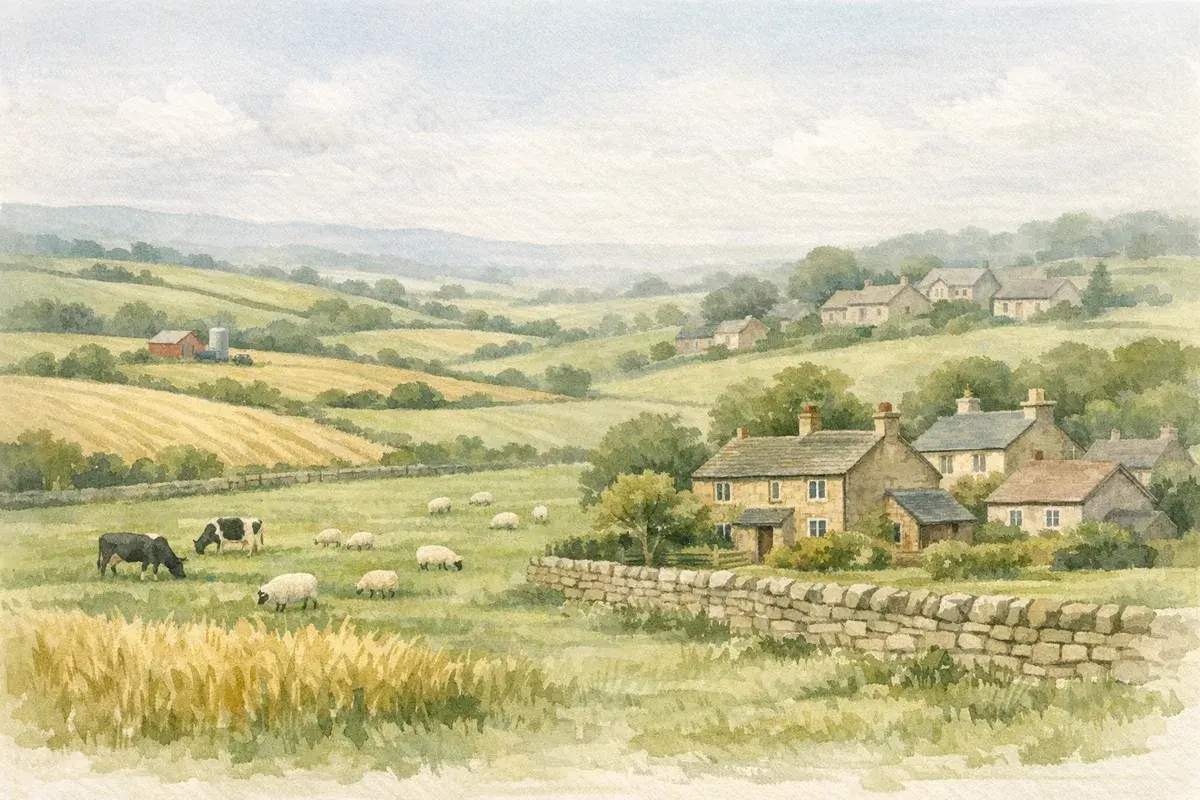
If you've ever looked at a block of bare pasture and then glanced at the price of a small residential plot a mile down the road, the difference can feel… irrational. Same county, same views, same rain. Yet one is priced like a long-term working asset and the other like a scarce permission slip.
That's the real story behind agricultural land vs residential land prices in the UK: it's not just "houses are worth more than fields". It's planning risk, infrastructure, policy, finance, and, crucially, what the land is allowed to become.
In this guide, you'll get a practical way to compare values without kidding yourself (or being sold a dream), and a clear sense of when the gap is justified, when it's exaggerated, and how to assess land when change of use is on the table.
How Agricultural And Residential Land Prices Are Measured (And Why Comparisons Get Messy)
Comparing agricultural land vs residential land prices sounds straightforward until you try to do it properly. The two markets speak different languages: hectares versus plots, productivity versus permissions, "vacant possession" versus "deliverable allocation".
Price Per Acre Vs Price Per Plot: Like-For-Like Metrics
Agricultural land is usually priced per acre or per hectare, with adjustments for quality, access, and any "extras" (sporting, timber, buildings, Basic Payment history where relevant, and so on). Residential land is more often priced per plot, per developable acre, or as a residual land value based on what can be built and sold.
A useful mental reset:
- Agricultural pricing tends to be anchored to income utility (what it can earn or save your business) plus scarcity and strategic value.
- Residential pricing is anchored to end value (GDV, gross development value) minus costs and risk.
So when you see a headline figure for "land at £X per acre", ask: acre of what, exactly? A net developable acre inside a settlement boundary is not the same thing as a gross acre of grazing with no services.
If you want a grounded starting point for farmland benchmarks, it helps to look at typical ranges for price per hectare and then adjust for the specifics of your holding and local market.
Hope Value, Development Value, And Existing Use Value
To make sense of the gap, you need three concepts:
- Existing Use Value (EUV): what the land is worth in its current lawful use (e.g., agriculture). This is where most "normal" farmland trades.
- Hope value: an uplift above EUV reflecting a chance (not a promise) of future development or alternative use.
- Development value: what the land is worth once planning permission is secured (or when allocation/consent is sufficiently certain that the market prices it that way).
Most confusion comes from mixing these up. Sellers talk in development value: buyers often want to pay EUV: and "hope value" sits in the middle with a lot of emotion attached.
Micro-Markets: Region, Access, Services, And Local Demand
Even within the UK, there's no single "agricultural land price" or "residential land price", there are micro-markets.
A few of the small factors that create big swings:
- Region and local competition: lifestyle buyers, neighbour farmers, institutional money, and environmental buyers don't show up evenly across the country.
- Access and road frontage: a field with clean access and visibility can attract strategic interest faster.
- Services nearby: not just mains utilities (often absent), but proximity to towns, schools, and transport nodes.
- Constraints: flood risk, SSSI designations, AONB, heritage constraints, public rights of way, and ransom strips.
If you're comparing areas, don't rely on UK-wide averages alone, local evidence matters. We keep a running view of agricultural land prices by region because a "typical" acre in one county can be a very different proposition in another.
The Big Drivers Of Agricultural Land Prices
Agricultural land values in the UK are rarely just about last year's profit. They're shaped by long-term scarcity, farm strategy, non-farming demand, and policy signals that can change what an acre is "for".
Farm Profitability, Commodity Cycles, And Tenure (Vacant Possession Vs Let)
Productive capacity still matters, especially for buyers who need land to make their business work. But the link between commodity prices and land prices is looser than many expect.
What does move the needle:
- Vacant possession (VP) versus let land: VP is generally more attractive because you can integrate it immediately, redesign rotations, or enter schemes. Land sold subject to tenancies (FBTs, AHA agreements) can be priced differently depending on term, rent, and control.
- "Marriage value" for neighbours: an adjoining 30 acres can be worth more to a nearby farm than to anyone else, because it reduces travel time and inefficiency.
- Funding conditions: when borrowing is tighter, buyer pools thin out, particularly for marginal parcels.
If you want the broader picture of what's moving the market right now, our overview of UK agricultural land prices and the drivers to watch is a helpful companion read.
Soil, Water, Topography, And Field Layout
In agriculture, "land is land" is a myth.
Valuation tends to reward:
- Soil type and workability: heavier land can be productive but costly to manage: lighter land can be versatile but drought-prone.
- Water availability and drainage: both for cropping and livestock. A field with persistent wet issues can be a long-term drag.
- Topography: slope affects machinery efficiency, erosion risk, and stocking.
- Field size/shape and internal access: awkward fields waste time and fuel. Buyers notice.
In practical terms, two blocks with the same acreage can command very different prices because one integrates smoothly into modern farming and the other constantly fights you.
Public Money And Policy Signals (ELM, Schemes, And Environmental Demand)
Public money is no longer just a farm support line: it's part of the land-use economy.
In England, ELM (including SFI and Countryside Stewardship actions) can influence demand for certain land types, particularly where there's a strong fit for environmental delivery. In Scotland and Wales, the direction of travel is similar: more focus on outcomes and conditional support, though the detail and pace differ.
Also worth noting: non-farming buyers may value land for natural capital, biodiversity uplift, woodland creation, or carbon-related objectives (always check what's credible and what's marketing).
This is one reason people ask "why on earth is farmland so pricey now?", and there isn't one answer. If you're exploring that angle, this explainer on why agricultural land can look expensive maps the main forces without pretending the market is simple.
The Big Drivers Of Residential Land Prices
Residential land is priced less like a productive asset and more like a risk-adjusted permission. The "land" is often the cheap part: the right to build (and to sell what you build) is where the value sits.
Planning Permission As The Value Multiplier
In the UK, planning permission is the multiplier that turns ordinary ground into residential land value.
A simplified chain looks like this:
- Pure agricultural use: EUV with maybe a sliver of hope value.
- Allocation signal / emerging plan support: hope value rises because probability improves.
- Outline consent: value can jump materially, risk reduces, finance becomes easier.
- Reserved matters / detailed consent: even more certainty: buyers price it accordingly.
That's why the same field can have three different "values" depending on where it sits in the planning journey.
Local Plan Allocation, Housing Need, And Political Risk
Residential values are heavily shaped by the planning system, especially local plan allocation and deliverability.
Key realities to keep in mind:
- Housing targets and land supply: councils must demonstrate a deliverable supply of housing sites. Where supply is tight, pressure rises, but it doesn't automatically mean your field is next.
- Politics and community response: a technically good site can still be delayed or reshaped by local opposition, committee dynamics, or policy shifts.
- Timing risk: residential land is priced on expected timelines. Add two years to a programme and your land value today can shrink.
Servicing And Abnormals: Utilities, Ground Conditions, And Access Rights
This is where residential appraisals win or lose.
Residential land value is net of:
- Utilities: water, electricity, gas (if relevant), broadband, and, often the big one, foul drainage.
- Ground conditions: contamination, made ground, high water table, archaeology.
- Access and rights: visibility splays, third-party land, rights of way diversions.
- Ecology mitigation: biodiversity net gain requirements, protected species surveys, and seasonal survey constraints.
If someone is offering you "residential money" for a site without talking through abnormals, be cautious. They may be pricing optimistically, or simply expecting you to carry the risk.
What Typically Creates The Price Gap Between Agricultural And Residential Land
The gap in agricultural land vs residential land prices isn't just "houses are more valuable." It's the stacking of risk, cost, and time, and who is willing (or able) to hold that risk.
Planning Risk And Time Value Of Money
Planning isn't binary: it's probability over time.
A rational buyer asks:
- What's the chance this gets permission (or allocation)?
- How long will it take?
- What will it cost to get there?
- What's the opportunity cost of tying up capital?
If the realistic timeline is 5–10 years with an uncertain outcome, the market will discount heavily. That discount is the price gap.
Infrastructure And Section 106/CIL Costs
Even with consent, residential land value is not "free uplift". Development often carries:
- Section 106 obligations: affordable housing, highways, education contributions, open space, etc.
- CIL (Community Infrastructure Levy): applicable in many areas depending on local policy.
- Highways and drainage works: which can be expensive and non-negotiable.
These costs don't just reduce profit: they reduce what a developer can pay for land.
Market Liquidity, Finance, And Buyer Pools
Farmland typically has a relatively consistent buyer pool (farmers, neighbours, investors, environmental buyers). Residential land buyers are fewer, more specialist, and more sensitive to finance conditions.
Also, lenders treat risk differently:
- Agricultural purchases may be supported by existing farm balance sheets and long-term security.
- Residential land funding tends to depend on planning status, programme certainty, and exit values.
So the "residential" premium is real, but it's not evenly accessible. It concentrates in land where permission is secured or highly probable.
Where The Lines Blur: Edge-Of-Settlement Land, Barns, And Rural Homes
This is the territory where agricultural land vs residential land prices becomes genuinely interesting, and where people most often overpay (or undersell).
You'll usually be dealing with land that still looks agricultural, but sits close enough to settlement or infrastructure that alternative use is plausible.
Strategic Land And Option Agreements
Strategic land is agricultural land with a credible route to development, typically promoted through:
- Option agreements: a developer/promoter has the right (not obligation) to buy at an agreed valuation method if planning is achieved.
- Promotion agreements: a promoter markets the land once planning is obtained and takes a fee from proceeds.
These structures can be sensible because they align incentives: the specialist takes on planning cost/risk (to an agreed extent), and you share the upside.
But read the small print. Length, control, and the definition of "market value" can make a life-changing difference.
If you're trying to understand whether your parcel has more than ordinary farm value, start by assessing its development potential rather than jumping straight to "what's it worth as housing?"
Permitted Development, Barn Conversions, And Rural Exceptions
There are legitimate routes to residential outcomes in rural areas, but they're conditional, and the planning system is not a loophole.
Common routes people explore:
- Agricultural-to-residential change of use in specific circumstances
- Barn conversions under permitted development (where criteria are met)
- Rural exception sites (primarily for affordable housing, tightly policy-led)
The good news? Some projects are genuinely viable.
But here's the catch: permitted development is a privilege, not an automatic right, and prior approval constraints can be deal-breakers (transport/highways, contamination, flooding, design/external appearance, and more).
If your decision hinges on conversion or new build, get clear on the planning route first. These two guides are worth having open while you talk to an adviser: agricultural to residential planning permission and building a house on agricultural land.
Overage (Clawback) And Promotion Agreements In Practice
Overage (also called clawback) is how sellers protect themselves when selling land at agricultural (or modest hope) value that later becomes much more valuable.
In practice, overage hinges on:
- Trigger events: planning grant, implementation, sale, or even allocation.
- Duration: 10, 20, 30+ years, longer terms can bite later.
- Calculation: uplift on gross value? net of costs? which costs are allowed?
- Security: restrictions on title, legal charges, or other mechanisms.
Overage isn't automatically "good" or "bad". It's a tool. If you're selling and you're not sure you're capturing the upside, overage can be fair. If you're buying, sloppy overage can make the asset unmortgageable or unattractive to future buyers.
How To Value Land When A Change Of Use Is Possible
When change of use is plausible, you're no longer valuing land as a single thing. You're valuing scenarios.
A Practical Appraisal Framework: Scenarios, Probabilities, And Timelines
A workable approach (used in one form or another by land agents and surveyors) is to map three layers:
- Base case (EUV): value as agricultural land today.
- Upside case: value if you achieve a defined planning outcome (outline, full, conversion, etc.).
- Probability and time: your best estimate of likelihood and programme length.
Then you discount for:
- planning and professional costs (planner, highways, ecology, surveys)
- holding costs (finance, management)
- risk (including policy change)
This gives you an "expected value" range rather than a single fantasy number.
A quick example (deliberately simplified):
- EUV: £12,000/acre
- Development value (if consent achieved): £250,000/acre
- Probability of success: 15%
- Expected timeline: 7 years
- Costs and discounting: significant
Your "today" value might still be far nearer agricultural than residential. That's not pessimism: it's pricing risk.
Comparable Evidence: What To Use And What To Ignore
Comparable evidence is only as good as the comparability.
Use:
- Recent local farmland sales with similar quality, access, and tenure.
- Local strategic/hope value transactions where the planning status is genuinely similar.
- Residential land comps only when the planning status, abnormal costs, and deliverability match.
Ignore (or heavily adjust):
- headline "per plot" prices with no detail on s106/CIL
- comps that already have services installed when yours doesn't
- comps where access rights were already solved (that can be the whole battle)
In edge-of-settlement situations, the most dangerous comparable is the one that "feels close" but sits in a different planning universe.
Due Diligence Checklist: Title, Rights, Constraints, And Neighbours
Before you pay hope value, or sell too cheaply, tighten your due diligence. At minimum, you want clarity on:
- Title and boundaries: what are you actually buying/selling?
- Rights and easements: rights of way, rights to drain, rights to take services.
- Ransom strips and third-party ownerships: small slivers can control big outcomes.
- Designations and constraints: AONB, SSSI, conservation areas, listed buildings, flood zones.
- Neighbours and operational realities: odour, noise, access conflicts, biosecurity concerns.
And don't underestimate the soft factors. A neighbour's willingness to grant access for a visibility splay (or not) can be worth six figures in land value.
Tax, Structuring, And Professional Advice That Can Change Net Outcomes
Gross prices make headlines. Net outcomes change lives. Tax, structuring, and timing can materially alter what you keep, sometimes enough to change the "right" decision.
CGT, IHT Reliefs (APR/BPR), And Rollover/Hold-Over Considerations
In the UK, land decisions often intersect with:
- Capital Gains Tax (CGT): selling land can create a substantial CGT exposure depending on base cost, reliefs, and how the land has been used.
- Inheritance Tax (IHT) reliefs: Agricultural Property Relief (APR) and Business Property Relief (BPR) can be crucial, but eligibility depends on facts, occupation, use, and business structure.
- Rollover relief / hold-over relief: potentially relevant when proceeds are reinvested or when gifts/charges are involved.
The catch is that "development" can complicate reliefs. Once land is treated as trading stock or part of a development trade, the tax profile can change significantly.
VAT, SDLT, And When Land Becomes "Trading" Income
VAT and SDLT (Stamp Duty Land Tax) can become real costs, not footnotes.
Points that commonly surprise people:
- VAT option to tax: can apply to certain land/buildings and affects buyers' cost position.
- SDLT on land: depends on whether it's residential, non-residential, or mixed-use, and the difference matters.
- Trading vs capital: land that moves into a development trade can shift receipts into income treatment, altering the overall tax take.
You don't need to memorise tax law to make good decisions. You do need to involve the right adviser early enough that structure isn't an afterthought.
Who To Involve: Land Agent, Planner, Surveyor, And Tax Adviser
When residential potential is in play, you'll usually benefit from a small team:
- Land agent: market evidence, buyer strategy, negotiation, and credible positioning.
- Planning consultant: route-to-consent strategy, policy analysis, submission management.
- Surveyor (often RICS): valuation rigour, development appraisal inputs, measured surveys.
- Tax adviser (often with rural specialism): reliefs, structuring, and risk management.
We've seen the best outcomes when everyone is aligned early: planning strategy informs valuation, valuation informs negotiation, and tax informs structure, before you sign anything binding.
Buying Or Selling Well: Tactics For Farmers, Landowners, And Investors
You can't control the wider market. But you can control preparation, positioning, and the way risk is priced.
For Sellers: Presenting A Credible Planning Story Without Overpromising
If you're selling farmland with potential, your job isn't to promise planning. It's to present a credible, evidence-backed route.
Practical steps that help:
- Commission a planning feasibility note that references local policy, constraints, and realistic outcomes.
- Package the basics: title plan, access details, services info, tenancy/occupational arrangements.
- Be transparent about constraints (flooding, designations, rights of way). Surprises kill deals.
- Consider whether overage or an option/promotion structure better matches your risk appetite.
The market pays more for certainty, so even reducing unknowns can lift bids without inventing a story.
For Buyers: Search Strategy, Filters, And Spotting Mispriced Risk
If you're buying, your edge is process.
A sensible approach:
- Define your aim: income, expansion, lifestyle, environmental delivery, or strategic uplift.
- Separate "nice-to-have" from "non-negotiable": access, water, proximity, field size.
- Treat hope value like an investment thesis: what's the planning hook, and what could kill it?
Looking for land like this? Tell AgLand what you're after - type, acreage, budget and area - and we'll alert you the moment a matching property is advertised. Registering is free, and there's no commission on either side. Tell us what you're looking for.
Negotiation Levers: Vacant Possession, Uplift Splits, And Timetables
In rural property, negotiation isn't just about price: it's about terms that reprice risk.
Common levers include:
- Vacant possession: agreeing handover timing, cropping compensation, or early access.
- Uplift splits: in overage or option structures, what percentage, net/gross, which costs are deductible.
- Timetables and long-stop dates: preventing open-ended agreements that tie up land.
- Information conditions: surveys, ecology, and access rights resolution before price is fixed.
If you're on either side of a deal involving potential, aim for terms that make risk explicit. When risk is explicit, it can be priced. When it's vague, somebody usually loses.
Conclusion
The gap in agricultural land vs residential land prices in the UK is rarely mysterious once you separate the land from the permission, and then price the probability, timeline, and costs of changing one into the other.
If you take one practical habit from this: stop asking "what's it worth as housing?" and start asking "what's it worth today, given a realistic planning pathway?" That shift protects you from paying residential prices for agricultural risk, and from selling genuine upside too cheaply.
If you're actively buying or selling, build your decision around local evidence, tight due diligence, and clear professional input. The deals that go well in rural property are usually the ones where nobody had to rely on luck.
Disclaimer: AgLand.co.uk is a UK agricultural land and rural property matching service, where buyers register what they are looking for and owners advertise directly to the buyers who match, and a rural resource hub. Nothing in this text is intended as legal, financial, tax, or investment advice. You should do your own due diligence and seek advice from appropriately qualified professionals (for example, a RICS surveyor, planning consultant, solicitor, and rural tax adviser) before making decisions or entering into any transaction.