
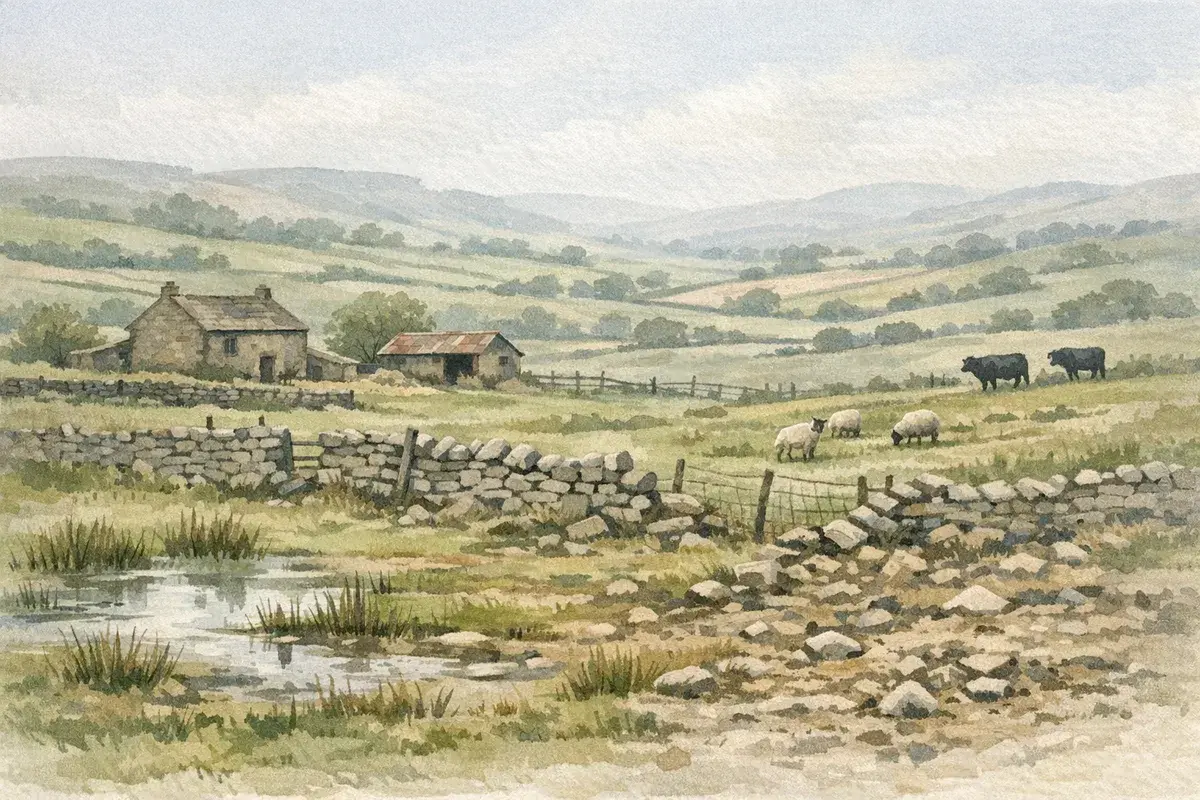
You've found it: land that's the right size, in the right area, and, crucially, priced like it's got a problem. Maybe it's heavy and wet, maybe it burns up in summer, maybe it's steep or chopped into awkward parcels. In the UK, "poor quality agricultural land" isn't just a vague insult: it's often a shorthand for limits you'll feel in your yield, your stocking rate, your machinery costs, your tenancy terms, and your resale.
The opportunity is that marginal land can still be a very smart buy or let, if you're honest about what it can (and can't) do, and you price the constraints properly. This guide walks you through how to spot poor quality land early, what really drives value, where the best returns often sit (spoiler: not always in "improving it"), and how to buy it without getting surprised later.
What Counts As Poor Quality Agricultural Land (And Why It Matters)
"Poor quality" means different things depending on your enterprise. A hill sheep unit can thrive where an arable rotation would be a financial bruise. A paddock-based equine setup might tolerate lighter soils that a forage grower would struggle with. So it helps to pin the term down in UK frameworks and day-to-day reality.
In practice, poor quality agricultural land usually shows up as one (or more) of the following:
- Low or unreliable output (yield and/or grazing days) because of soil, slope, exposure, or water.
- High costs to operate (fieldwork windows are short, machinery wear is higher, access is awkward).
- Constraints that don't "improve away" easily (floodplain restrictions, peat depth, altitude, protected habitats, fragmented access).
- Higher risk: crop failure, poaching, erosion, nutrient loss, or enforcement issues if you push it too hard.
Why it matters is simple: if you misread marginal land, you don't just lose a bit of performance, you can lock yourself into capex you can't justify, a cropping plan you can't execute, or a rent you can't service.
Land Capability Vs Agricultural Land Classification (ALC)
In the UK you'll hear two related ideas:
- Agricultural Land Classification (ALC): a Natural England grading system (commonly Grade 1 to Grade 5) focused on the land's versatility and limitations for agriculture, historically used in planning and appraisal contexts.
- Land capability: a broader "what can this land sustainably do?" lens, often closer to how a farmer or land manager thinks, taking in climate, slope, soil limitations, and management practicality.
The trick is not to treat either as gospel. ALC is useful for benchmarking and early screening, but it can be mapped at broad resolution and may not reflect field-by-field variation or improvements (and it won't tell you if the only access is via a neighbour's track with a temper).
If you want to get your head around the language and the way professionals use it, it's worth reading up on how land capability is assessed in practice and how it differs from simple "good/bad" talk.
Typical UK Causes: Soil, Climate, Topography, And Access
Most "poor quality" land in the UK is poor for stubbornly physical reasons:
- Soil limitations: heavy clay that stays wet, shallow soils over rock, droughty sands, high stone content, peat soils with drainage constraints.
- Climate and exposure: altitude, wind, late frosts, short growing season (common across upland fringes and coastal exposure).
- Topography: steepness reduces workable area, increases erosion risk, and makes even basic tasks (fencing, reseeding, hauling bales) cost more.
- Hydrology: floodplain meadows, high water tables, springs, or run-off issues.
- Access and layout: narrow lanes, weak bridges, no formal gateway, land split by roads/rail, or no practical internal tracks.
Common Types Of Poor Quality Land In Practice
You'll often see these patterns:
- Grade 4–5 grassland: workable only with extensive grazing, limited silage cuts, and careful winter management.
- Wet, heavy ground: useful in dry years, punishing in wet ones: poaching and compaction are constant threats.
- Upland/rough grazing: valuable for the right livestock system and environmental schemes, but not a quick win.
- Reclaimed/modified land: past tipping, made ground, or historically disturbed soils can create unpredictable performance.
- Peat and organic soils: productive in certain systems, but increasingly constrained by environmental rules and water management realities.
If you're specifically looking at the bottom end of the ALC scale, it's also helpful to understand what "Grade 5" can still be good for (and what it rarely is). See practical examples of Grade 5 land uses to sanity-check your plan.
How To Identify Poor Quality Land Before You Buy Or Rent
The best time to discover land is poor quality is before you've agreed a price, not after your first winter when the gateways resemble a bog museum. Good due diligence is a mix of desk research, a critical read of particulars, and time on the ground.
Red Flags On Listings And Sales Particulars
Listings don't usually say "this is a nightmare to farm." They say things like:
- "Suitable for grazing" with no mention of cutting or cropping.
- "Access via a track" without clarity on ownership or rights.
- "In-hand for many years" (could be fine, but it can also mean nobody's tested the rental market reality).
- Vague acreage descriptions without field parcel references.
- Lots of photos in summer and none in winter, ask yourself why.
- Mentions of "seasonal flooding" or "water meadow" (not automatically bad, but price and use must reflect it).
If you're trying to work out whether the vendor is hinting at ALC without naming it, you can build a quick framework by learning how to find the agricultural land grade and then challenging the particulars with evidence.
Desk Checks: ALC Maps, Flood Risk, Peat, NVZs, Designations, And Rights Of Way
Before you book a viewing, do the unglamorous checks. You're looking for constraints that affect either productivity or what you're allowed to do.
Key desk checks (England and Wales in particular) include:
- ALC mapping to understand the likely grade and limitations. Start with an agricultural land classification map view, then treat it as a lead, not a verdict.
- Flood risk: not just "does it flood?" but how often, how deep, and what does that do to access and grazing days?
- Peat and organic soils: identify likely peat presence and depth risk areas: peat often brings extra management and compliance sensitivity.
- NVZs (Nitrate Vulnerable Zones) where applicable: the Environment Agency enforces tighter rules on nutrient applications and storage.
- Designations: AONB / National Park, SSSI, SAC/SPA, Local Wildlife Sites, these can change your management options and your timelines.
- Public rights of way: paths through fields affect fencing, livestock choices, and liability management.
Also check the basics that get missed: is the land in one ring-fenced block or scattered? Are there ransom strips? Is there evidence of historic drainage infrastructure that may now be failing?
On-Site Checks: Soil Pits, Compaction, Drainage, Sward Condition, And Water Availability
Viewing marginal land is not a "stand by the gate and nod" job. You want to walk it.
On-site checks that pay for themselves:
- Dig a few small soil inspection holes (with permission) to understand depth, structure, stone content, and whether there's a perched water table.
- Compaction signs: capped soil surface, standing water in wheelings, shallow rooting, and obvious poaching areas.
- Drainage condition: are ditches clear? Are outfalls visible? Are there signs of underdrainage lines working, or failing?
- Sward quality: presence of rushes, moss, sour grasses, bare patches, and weed pressure. Rushes can mean wetness, compaction, acidity, or all three.
- Water availability: mains? spring? troughs? Any history of supply issues in summer?
- Access practicality: try to imagine a wet February, a livestock trailer, and a tight lane. If it feels marginal on a dry day, it's worse when it matters.
If you're renting, do the same checks, but be even more ruthless about what you can realistically fix within a tenancy term.
Valuing Poor Quality Land: What Drives Price, Rent, And Resale
Valuing poor quality agricultural land is less about headline "£/acre" chatter and more about a sober appraisal of net usable output and risk-adjusted costs. The market will forgive limitations, if the price reflects them.
If you want a deeper grounding in what moves rural prices (beyond just soil), it's useful to understand the wider factors that affect agricultural land value and then apply them harder for marginal ground.
Productive Potential And Realistic Gross Margin Assumptions
The most common valuation mistake is assuming the land will perform like the neighbour's better fields "with a bit of TLC." Poor land doesn't just yield less: it often yields less and costs more to get that yield.
A practical approach:
- Work from a conservative stocking rate or yield based on what you can see (and what local operators say they achieve in bad years).
- Price in lost days: if you can't travel it for weeks, you can't fertilise on time, cut on time, or get stock off cleanly.
- Assume higher variability: output swings are part of the package.
For grazing land, ask yourself: how many grazing days can you confidently deliver without wrecking sward and soil structure? For cropping, be honest about workable windows and harvest risk.
Infrastructure And Capex: Tracks, Fencing, Drainage, Buildings, And Power
Marginal land often comes with "hidden capex", and that's where deals turn bad.
Common cost drivers:
- Access tracks and gateways: you can spend serious money just making the land usable.
- Fencing and water: especially if the field layout is awkward or boundaries are tired.
- Drainage: underdrainage, ditching, outfalls, culverts, expensive, and not always feasible.
- Power and services: if you're thinking diversification (storage, yards, small-scale processing), power capacity and routing can be a deal-breaker.
Valuation tip: separate capex into (1) "must do to operate safely" and (2) "nice to have to improve performance." Only the first category should materially affect what you can pay today.
Legal And Title Factors: Tenure, Easements, Sporting, Minerals, And Covenants
On poorer land, legal/title issues can matter even more because there's less margin to absorb surprises.
Check for:
- Access rights (and maintenance obligations): who owns the track, who pays, and can you use it with modern machinery?
- Easements and wayleaves: pipes, cables, overhead lines.
- Sporting rights: if separated, it can affect how you manage cover, access, and livestock safety.
- Mineral rights: rarely a day-to-day issue, but they can matter in certain areas.
- Restrictive covenants: can limit buildings, commercial uses, or even fencing changes.
- Tenure: vacant possession versus tenanted land: grazing licences versus longer farm business tenancies.
If you're buying, make sure your solicitor is comfortable with rural titles, this is not the place for a "tick-box" conveyance approach.
Best Uses For Poor Quality Agricultural Land
The fastest way to "make marginal land pay" is usually not to force it into a high-input system. It's to match land limitations to an enterprise that tolerates them, and then be deliberate about income stacking (livestock + environmental payments + sensible diversification).
Extensive Grazing, Forage, And Low-Input Livestock Systems
For many UK buyers and tenants, poor quality land works best as:
- Extensive cattle or sheep grazing with flexible stocking and good infrastructure (water, fencing, handling).
- Forage production where feasible (often later cuts, sometimes hay rather than high-output silage, depending on ground conditions and access).
- Outwintering only with caution: heavy ground and high rainfall areas can't take it without long-term damage.
The "win" is often in keeping costs low, avoiding soil damage, and using the land for what it can reliably deliver.
Woodland Creation, Agroforestry, And Carbon-Oriented Projects
Woodland creation can be a strong fit for genuinely marginal ground, particularly where cultivation is risky and grazing is low-output.
But be practical:
- Establishment risk (deer pressure, exposure, waterlogging) can be high.
- Designations and peat can restrict what's acceptable.
- Long timelines mean you need a plan for interim cashflow.
Agroforestry can also work where you still want grazing, shelter, and multiple outputs, but it's not a set-and-forget project.
Biodiversity Net Gain, SFI/CS Options, And Habitat Banks
Environmental income can be a lifeline for poor land, but it's not "free money." You're signing up to management prescriptions, record-keeping, and inspections.
Depending on location and scheme availability, marginal land may suit:
- Low-input grassland options
- Wetland and riparian habitat management
- Buffer strips and water quality measures
- Species-rich grassland creation (where soils and seedbank make it realistic)
If you're considering Biodiversity Net Gain or habitat banking, treat it like a commercial agreement: baseline surveys, long-term obligations, and legal mechanisms matter.
Non-Farming Uses Where Suitable: Equine, Storage, And Diversification
Some poor agricultural land performs better economically when it supports a non-farming use, provided planning and access stack up.
Examples you'll see in the UK market:
- Equine grazing and turnout (though wet land can churn quickly: you'll need hardstanding, rotation, and strict manure management)
- Open storage (contractor materials, container storage) where access and screening are acceptable
- Small-scale diversification tied to an existing holding (subject to consents)
Be wary of "it's only storage" thinking: neighbour relations, highways visibility, drainage/run-off, and enforcement risk can turn minor uses into major headaches.
Improving Poor Quality Land: Practical Options And Realistic Limits
Some land responds brilliantly to basic agronomy and infrastructure. Other land fights you forever. The art is knowing which you're looking at, and costing the improvement honestly.
Soil Structure Fixes: Compaction Relief, Organic Matter, And Reseeding
If the land is suffering from management-induced issues (rather than inherent limitations), you may have room to improve.
Practical options:
- Address compaction: subsoiling/aeration only when conditions are right, and only if you've fixed the cause (traffic, stocking, poor gateways).
- Increase organic matter: FYM/compost where available, and careful sward management to build root mass.
- Reseeding or overseeding: targeted, not automatic. On wet heavy land, species choice and timing matter more than throwing seed at it.
If you want a more grounded view of what "good soil" looks like in an agricultural land context, it's worth revisiting the fundamentals of soil quality and how it influences land performance.
Drainage And Water Management: Ditches, Underdrainage, And Floodplain Constraints
Drainage can transform land, but it can also burn capital with limited return.
Think in layers:
- Surface water first: ditch maintenance, grips, outfalls, and keeping water moving.
- Gateways and tracks: often the worst poaching starts here: hardening these areas can deliver more benefit than a whole-field intervention.
- Underdrainage: expensive and disruptive: it needs correct design and ongoing maintenance.
Also, not all wetness is "fixable." If the land sits in a natural floodplain or has high environmental sensitivity, aggressive drainage may be restricted or simply unwise.
Nutrients, Lime, And Trace Elements: Testing And Targeted Application
On poor land, blanket approaches waste money.
- Soil testing (pH, P, K, Mg: plus organic matter where possible) is the starting point.
- Lime can be one of the best ROI inputs on acidic grassland, if access and timing allow.
- Trace elements: only apply with evidence. Deficiencies can be real (especially on certain upland soils), but "tonics" without testing are a classic money leak.
Access And Boundary Works: Costing, Consents, And Neighbour Relations
Access is often the quiet killer of marginal land budgets.
- New or improved access may trigger highways visibility requirements, drainage works, and neighbour negotiations.
- Boundary renewal (fences/hedges) can be straightforward, unless you're on a boundary dispute, a right of way line, or a designated hedgerow with restrictions.
Do the maths before you fall in love with a "cheap" block: a few hundred metres of track and fencing can quickly rewrite your per-acre cost.
Planning, Compliance, And Environmental Constraints You Cannot Ignore
On poor quality agricultural land, compliance and environmental constraints often matter as much as agronomy, sometimes more. And because marginal land frequently overlaps with upland, wetland, or designated landscapes, your room to manoeuvre can be tighter than you expect.
Permitted Development Realities On Marginal Land
Permitted development rights can help agricultural businesses put up certain buildings or tracks, but they're not an automatic right, and they're not a workaround for land that isn't genuinely in agricultural use.
Two realities to keep in mind:
- Functional need and siting still matter: if the proposal looks like it's really for equine, storage, or residential creep, expect scrutiny.
- Access and highways impact can become the sticking point, especially if the lane network is weak.
If your marginal land purchase is partly driven by future options, you should assess development potential in an agricultural land context early, before you build value assumptions into your offer.
Protected Landscapes And Habitats: AONB, SSSI, SAC/SPA, And Peatland Rules
Designations don't always prevent productive use, but they change the process.
- AONB / National Parks: development is possible, but visual impact and "need" tests are more sensitive.
- SSSI / SAC / SPA: management may require consents: operations can be restricted: timelines lengthen.
- Peatland: there's increasing focus on protecting peat soils because of carbon storage and water impacts. Drainage or conversion can be contentious or restricted.
If you're buying, ask for clear evidence of any historic consents or management agreements, and factor in future limitations.
Cross-Compliance Successors, Hedgerow Rules, And Water Pollution Risk
Even as policy evolves post-BPS, the direction of travel is consistent: more evidence, more standards, and more accountability.
On poorer land, water pollution risk and soil loss can be higher (think run-off on slopes, poached gateways, sediment into ditches). So:
- Keep records of nutrient applications and timings
- Treat high-risk areas (tracks, troughs, feeders) as priority infrastructure
- Respect hedgerow protections and seasonal constraints
If you're relying on environmental scheme income, assume you'll need robust paperwork and tidy delivery, because you will.
Tax, Reliefs, And Structuring Considerations
Tax isn't the fun bit, but it's often where marginal land deals succeed or fail, especially when the land's value is partly tied to "alternative use" narratives.
APR And BPR: When Poor Land Still Qualifies (And When It Doesn't)
In broad terms, Agricultural Property Relief (APR) can apply to agricultural value if the land is occupied for agriculture and other conditions are met. Poor quality doesn't automatically mean "no relief."
Where people come unstuck is when the land's use drifts:
- Non-agricultural use (or mainly non-agricultural benefit) can reduce relief.
- Letting arrangements and who carries the farming risk can matter.
- "Hope value" for development isn't the same thing as agricultural value.
This is squarely in "get bespoke advice" territory, especially for estates and long-term family planning.
Lettings, Grazing Licences, And Income Tax Vs Capital Treatment
Poor land is frequently let on short-term arrangements because it suits flexibility. But the structure can change tax treatment and practical control.
Consider:
- Grazing licences: useful for short-term occupation, but the paperwork needs to match reality.
- Farm business tenancies: more stability, but also more tenant rights and different negotiation dynamics.
- Diversification income: storage/equine lets can look simple but may carry different tax consequences.
Don't rely on "everyone does it this way" advice, your facts matter.
Development Hope Value, Overage, And Option Agreements
If your deal has any element of development potential (even remote), you'll run into:
- Overage/clawback: vendor wants a share of future uplift.
- Option agreements: control without immediate purchase, often used when planning risk is high.
On poor land, hope value can be seductive because the agricultural baseline is low. Just remember: planning is uncertain, timelines are long, and legal fees can be chunky. Build your numbers on what the land can do now, not on a best-case planning story.
How To Buy Poor Quality Land Well: A Step-By-Step UK Checklist
Buying poor quality agricultural land well is mostly about discipline. You're not trying to "win" the negotiation with charm, you're trying to avoid being the person who discovers the real costs after completion.
Build A Search Shortlist: Location, Parcels, Access, And Utilities
Start with filters that reflect operational reality:
- Travel time to your yard (marginal land needs more checks, more moves, more attention)
- Parcel shape and fragmentation (one block usually beats five awkward ones)
- Documented access (rights, width, surfaces, maintenance)
- Water and power (especially if livestock or diversification is in your plan)
- Local market context: who will rent it, buy it, or contract it if your plan changes?
For England-specific context, tenancies, values, due diligence themes, it can help to review a practical overview of agricultural land in England and then layer your local knowledge on top.
Commission The Right Advisers: Agent, Surveyor, Agronomist, And Solicitor
On marginal land, the best money you spend is often on people who stop you making the wrong assumptions.
A strong team typically includes:
- A specialist rural agent who understands local rents, schemes, and demand (and can sense when a "cheap" parcel is cheap for a reason).
- A rural surveyor for boundaries, access, and practical valuation.
- An agronomist/soil adviser if you're betting on improvement or cropping.
- A solicitor experienced in rural property for rights, title, covenants, and overage.
If you're buying as an investor rather than an operator, you may also want a land manager lined up early, because execution is where returns are made.
Negotiate With Evidence: Condition Reports, Capex Schedules, And Comparable Evidence
When you negotiate, aim to be specific. "The land is wet" won't move price. "The land needs £X of track work and £Y of fencing to be usable, and comparable local grazing land rents at £Z/acre" will.
A simple evidence pack can include:
- Photos showing access pinch points, poaching, rush burden
- A capex schedule with quotes or realistic cost ranges
- A short note on workable days/limitations
- Comparable evidence from local transactions your agent can support
And if the vendor won't budge? Sometimes the best negotiation is walking away. Poor land isn't rare. Bad deals are.
Conclusion
Poor quality agricultural land in the UK can be a bargain, a stable long-term asset, or a slow-motion cash drain, often depending on whether you price the limitations properly and choose a use that fits the land's nature.
Your best edge is a calm, methodical process: verify the constraints at desk stage, walk the ground like you'll be farming it in February, cost the "boring" infrastructure, and assume nature will win any argument you try to have with it. Then, and only then, decide whether the deal works.
Disclaimer: AgLand.co.uk is a UK agricultural land and rural property matching service, where buyers register what they are looking for and owners advertise directly to the buyers who match, and a rural resource hub. Nothing in this text is intended as legal, financial, tax, or investment advice. You should do your own due diligence and take professional advice from suitably qualified advisers (for example, a rural surveyor, land agent, solicitor, accountant/tax adviser, agronomist, or planning consultant) before buying, selling, renting, or changing the use of agricultural land.