
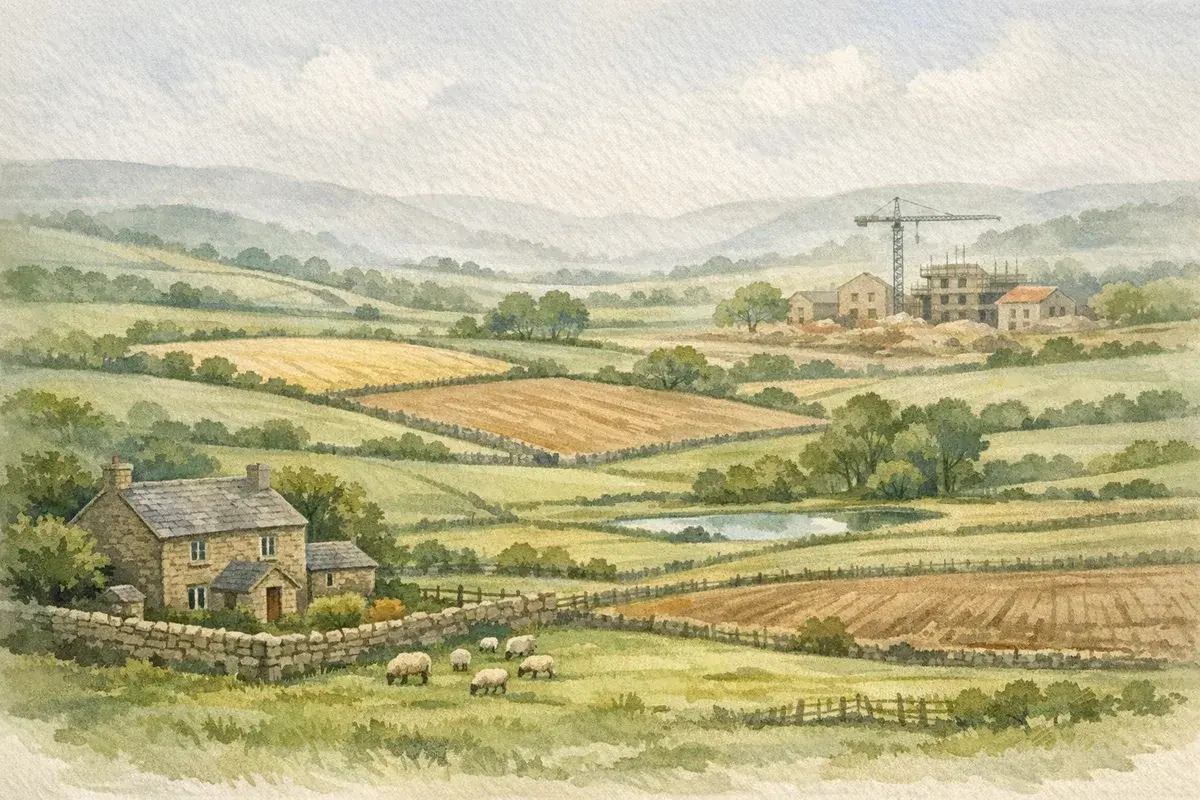
You don't need to be a volume housebuilder to care about agricultural land development potential. If you own, rent, or are looking to buy farmland, the "what could this become?" question has a habit of turning an ordinary decision into a six‑ or seven‑figure one.
But development potential in the UK isn't a vague hunch and it definitely isn't just "it's near a village, so it'll get planning." It's a combination of policy direction, physical constraints, deliverability, and commercial structure, and the weakest link usually decides the outcome.
This guide is built to help you assess uplift realistically: where value is actually made, what commonly blocks progress, and how to choose a strategy that fits your appetite for time, risk, and professional input.
What “Development Potential” Really Means For Agricultural Land
Development potential is shorthand for one thing: the plausible probability of a value change driven by a different use, usually residential, but sometimes commercial, tourism, renewables, or equestrian.
The tricky bit is that probability is doing a lot of heavy lifting. In UK rural markets, two parcels can look identical on a viewing day, same hedge line, same outlook, same "feels like it should go", yet one is a genuine strategic opportunity and the other is a planning dead end.
A good starting point is to separate what the land is worth today from what it might be worth if something changes, and then ask what evidence supports that change.
Agricultural Value Vs Hope Value Vs Development Value
You'll hear these terms in agent conversations and valuation reports because they describe three very different pricing logics:
- Agricultural value: what the land is worth for farming (cropping, grazing, stewardship income potential), usually evidenced by farmland sales, productivity, tenure, and local demand.
- Hope value: a premium someone pays because they believe there's a chance of consent in the future, even without allocation or a clear route. Hope value can be rational, but it can also be expensive optimism.
- Development value: what a site is worth with a planning permission (or strong probability of one) after accounting for build costs, planning obligations, finance, abnormal costs, and profit, assessed under RICS valuation standards.
If you're trying to judge uplift, you need to be honest about which category you're in. In practice, a lot of "development potential" farmland is actually agricultural value + hope value, not true development land.
And don't ignore the agronomy either. Better land often has stronger baseline value and broader buyer demand. If you're weighing "sell now vs promote," it's worth understanding how land quality underpins resilience, including where your soils sit within agricultural land capability and what that means for cropping flexibility.
Short-Term Options Vs Long-Term Promotion Land
Most UK land with realistic uplift falls into one of two buckets:
- Short-term, consent-led opportunities (months to ~2 years)
- Conversion/change of use of buildings (subject to rules)
- Small yard intensification
- Renewable or storage uses where policy support is clearer
- Minor settlement edge schemes already aligned with local policy
- Long-term "promotion land" (often 3–10+ years)
- Sites requiring allocation in a Local Plan
- Land dependent on infrastructure or access upgrades
- Larger schemes requiring extensive surveys, masterplanning, and negotiation
Your strategy changes depending on which bucket you're in. Short-term plays are about precision and compliance. Long-term promotion is about patience, evidence, and getting the commercial mechanics right so you don't give away the upside.
The UK Planning Reality: Policy, Process, And Where Value Is Made
Planning is where agricultural land uplift is either created, or quietly destroyed through delay, missteps, or a weak planning narrative.
At a high level, land value tends to rise most sharply at two points:
- When the planning system signals support (allocation in a plan, favourable policy context, or strong appeal prospects, as framed by the National Planning Policy Framework)
- When permission is secured (especially where conditions and legal agreements are manageable)
The gap between those points is where many owners underestimate cost, time, and risk.
Local Plans, Settlement Boundaries, And Five-Year Housing Land Supply
If you're looking at residential potential, your first serious question is: what does the Local Plan say, and is it up to date?
Local Plans shape:
- Where growth is directed (settlements, corridors, regeneration areas)
- Which sites are allocated
- What design and infrastructure standards apply
Settlement boundaries matter because being inside, adjacent to, or clearly separate from a settlement can change the policy presumption. Then there's the ever-practical issue of housing land supply. When a council can't demonstrate an adequate supply, it can tilt decisions toward sustainable sites that might otherwise be refused.
The nuance (and this is where experienced planning consultants earn their fees) is that policy isn't just a yes/no document. It's a framework you can sometimes work within, if your site is genuinely sustainable and deliverable.
Planning Permission Pathways: Outline, Full, Reserved Matters, And Pre-App
Planning routes are often misunderstood, and misunderstanding leads to overpaying.
- Pre-application (pre-app): a paid conversation with the planning authority. Not binding, but it can flush out fatal issues early.
- Outline permission: agrees the principle of development (often with parameters). Value uplift can be meaningful here, but lenders and developers still price in risk.
- Reserved matters: later applications to approve details (layout, appearance, landscaping, access, scale). This stage can still bite if surveys or highways detail undermine the scheme.
- Full permission: detailed consent up front. Usually stronger for value, but it costs more to reach.
If you're buying land on the assumption you'll "just get outline," treat that as a commercial hypothesis, not a plan.
When Permitted Development Helps (And When It Doesn't)
Permitted Development (PD) can be useful, particularly around operational farm needs and certain change-of-use scenarios. But PD is not a loophole: it's a conditional privilege.
PD can help you unlock value when:
- You're working with existing, lawful agricultural use
- The proposal sits cleanly within the relevant class and thresholds
- You can satisfy prior approval requirements (transport, design, flood, noise, contamination, etc.)
PD doesn't help when:
- The building isn't eligible (or its use history is messy)
- The site sits in a more restricted planning context (and constraints bite)
- You're trying to "step" from agriculture to a clearly urban use without policy support
If you want a clear, UK-specific grounding on what's realistic, it's worth reading AgLand's guide to what you can and can't do on agricultural land before you spend money on drawings.
The Core Site Checks That Decide Whether Uplift Is Plausible
You can save yourself a lot of grief by doing the unglamorous checks early. Development potential lives or dies on deliverability: can you physically access it, service it, and build something that policy can accept without crippling costs?
Access, Highways, Visibility Splays, And Rights Of Way
In rural UK planning, highways is where "good ideas" go to die.
Key questions to ask:
- Do you have legal access? Not "we've always used that gate," but legally documented rights.
- Is the access safe by modern standards? Visibility splays, speed limits, junction geometry, and footway provision matter.
- Can you improve the access within your control? If splays require third-party land, you may be negotiating a ransom situation.
- Are there public rights of way crossing the site? Diversions are possible, but not quick or guaranteed.
A quick site walk with a land agent is useful, but highways visibility often needs a surveyor's eye (and sometimes a transport consultant) to avoid expensive surprises.
Services Capacity: Water, Power, Drainage, And Telecoms
In a town, services are assumed. In the countryside, services are a strategy.
Look at:
- Electricity: Is there 3‑phase nearby? What's the reinforcement cost? Grid upgrades can transform viability.
- Water: Mains availability vs private supply: new connections: pressure.
- Foul drainage: Can you connect to a sewer? If not, is a package treatment plant feasible given land levels, outfalls, and permitting?
- Surface water: SuDS expectations are now standard: infiltration may depend on soil.
- Telecoms: For commercial diversification (or higher-end residential), poor connectivity can be a deal breaker.
Services are also where timelines slip. Even when technically feasible, lead times can stretch, and that affects option periods, promotion agreements, and how you negotiate milestones.
Designations And Constraints: Green Belt, AONB, SSSI, Flood Risk, Heritage
Constraints aren't always an automatic "no", but they change the burden of proof.
Common UK constraints that reshape development potential:
- Green Belt: development is tightly controlled: you're usually in "very special circumstances" territory.
- National Landscapes (AONB): you can do things, but design and landscape impact become central.
- SSSI / protected habitats: ecology can dictate layout, timing, and even whether development is acceptable.
- Flood risk: Flood Zones, surface water mapping, and sequential testing can limit density or use.
- Heritage: listed buildings, conservation areas, and settings can constrain scale and access.
Overlay these constraints with agricultural value questions too. For example, if your land is genuinely high-quality, think stronger ALC grades, it may be harder to justify losing it to development without robust need and mitigation. You can ground your understanding by checking how ALC works in practice and how people use an agricultural land classification map when weighing planning arguments.
A Practical Uplift “Scorecard”: Market Signals, Evidence, And Red Flags
When you're trying to judge agricultural land development potential, it helps to think like a cautious developer and a cautious valuer.
Here's a pragmatic scorecard approach: you're looking for evidence that demand exists, policy support is plausible, and the site is buildable without abnormal costs wiping out the uplift.
Comparable Evidence, Local Demand, And Likely Density
Start with local reality, not national headlines.
- Comparable sales: Has nearby land sold with similar planning prospects? What premiums were paid?
- Comparable permissions: What did recent consents allow (housing numbers, access arrangements, open space requirements)?
- Local demand: Are sites delivering, or are permissions stalling? Delivery rates tell you a lot about viability.
- Likely density: Rural edge schemes often achieve lower densities than urban assumptions, and that affects land value calculations.
And remember: land value is not just "houses x price." It's residual. If build costs, planning obligations, and finance are high, the land bid shrinks.
On the farming side, your baseline value matters because it influences your "walk-away" number. Soil and classification play into this. For instance, genuinely premium arable parcels, especially those resembling Grade 1 agricultural land in the UK, tend to hold value strongly even without development angles, which can change the risk-reward balance of waiting.
Abnormal Costs And Net Developable Area
Abnormal costs are the silent killers. A site can be "in the right place" but still be unviable because too much of it can't be built on, or costs too much to service.
Watch for:
- Net developable area loss: buffers for ecology, drainage basins, landscape belts, rights of way, heritage settings.
- Ground conditions: contamination (even on rural sites, think historic tipping), peat, poor bearing capacity.
- Topography: steep gradients increase earthworks and drainage complexity.
- Highways works: turning lanes, footpaths, lighting, visibility improvements.
- Utilities reinforcement: particularly electricity.
A quick back-of-envelope residual appraisal can be useful, but if you're negotiating serious money, get a professional viability view.
Red Flags That Commonly Kill Deals
Some red flags don't just lower value, they change the game entirely.
- No legal access, and no realistic way to secure it
- Ransom strip risk: a third party controls the only workable access/service route
- Policy conflict with no clear planning route (e.g., isolated countryside housing without justification)
- Constraint stacking: multiple designations + highways difficulty + services complexity
- Unclear title / historic rights issues that will take years to unwind
If you're buying, treat these as price leverage at best, and deal breakers at worst.
Routes To Unlock Value: From Farm Diversification To Strategic Promotion
Not every uplift story ends with a housing site. In fact, for many landowners the most bankable "development potential" is diversification that strengthens the farm business without betting the farm on a Local Plan.
Farm Buildings And Yard Opportunities: Change Of Use And Replacement Dwellings
Existing buildings can be the most efficient starting point because the planning system often distinguishes between new build in open countryside and re-use of existing structures.
Practical angles you might explore:
- Change of use of redundant buildings (where eligible) to lighter rural commercial uses
- Yard improvements to support modern agricultural operations
- Replacement dwelling discussions where there's a lawful residential use to replace
The catch: eligibility, prior use, and design/detail matter hugely. If you're relying on PD, document use history and get the right professional advice early. A "we'll sort that later" approach is how deals unravel.
Diversification Uses: Storage, Renewables, Tourism, And Rural Enterprise
Diversification can be a sensible middle path: less upside than housing, but often more achievable and aligned with local policy.
Common UK routes:
- Storage and light industrial (where access and neighbour impact are manageable)
- Renewables: solar, battery storage, anaerobic digestion (site-specific and grid-led)
- Tourism: glamping, holiday lets, farm shops, visitor uses (often design and highways sensitive)
- Rural enterprise space: small workshops, offices, agri-tech hubs
These uses still require rigorous checks, especially highways, noise, landscape impact, and utilities.
And don't forget the baseline: if your soils are strong, the opportunity cost of losing productive land is higher. Understanding soil quality on agricultural land helps you weigh whether a diversification footprint is worth it (and it can support your narrative when you're trying to minimise loss of the best land).
Strategic Land Promotion: Promotion Agreements Vs Options
If your land is a longer-term planning play, the two structures you'll hear most are:
- Option agreements: a developer pays for the right (not obligation) to buy the land at an agreed basis if planning is achieved.
- Promotion agreements: a promoter funds and manages the planning process, then the land is sold on the open market: proceeds are split after costs and promoter fee.
Neither is "better" universally. Options can be simpler but can lock you into one buyer and one valuation mechanism. Promotion can align incentives to maximise price but requires robust governance: decision-making, cost control, and a clear strategy on when to sell.
If you're land rich but time poor, we've seen promotion work well where the promoter is genuinely local, well-networked, and transparent on spend. If you're more risk-averse, a carefully negotiated option with clear longstop dates and price provisions can be calmer.
Commercial Terms And Legal Mechanics That Protect (Or Undermine) Value
A surprising amount of "development potential" is lost in the small print.
Even if planning is plausible, the deal structure can transfer upside away from you, or leave you paying for problems you didn't create.
Overage, Clawback, And Trigger Events
Overage (also called clawback) is a mechanism where the seller shares in future uplift if planning (or other value-enhancing events) happen after completion.
Key points you'll want clarity on:
- Trigger events: is it planning submission, consent, implementation, sale on, or occupation?
- Duration: 10, 20, 30 years? Longer periods need careful thought.
- Calculation: fixed sum per unit, percentage of uplift, percentage of sale proceeds, or a residual calculation.
- Costs: what costs are deductible before overage is calculated?
- Security: restriction on title, legal charge, or other protection.
Overage can be fair and sensible, but ambiguous drafting is a recipe for disputes.
Ransom Strips, Easements, Wayleaves, And Access Rights
If access or services cross third-party land, you're into negotiation territory.
- Ransom strips: a small piece of land controlling access can command a disproportionate premium.
- Easements: permanent rights for access, drainage, utilities.
- Wayleaves: rights for cables/pipes (often with utilities companies).
In rural settings, these issues crop up constantly because boundaries, tracks, and historic arrangements don't always match modern needs. A title plan that looks fine at 9am can feel very different after a highways consultant asks for a wider bellmouth.
Title, Tenancies, Sporting Rights, And Mineral Reservations
Before you assume you can develop, you need to know what you actually control.
Pay attention to:
- Tenancies: AHA and FBT arrangements can limit vacant possession and complicate promotion.
- Sporting rights: shooting leases can conflict with access, ecology mitigation, or construction timelines.
- Minerals: reservations can affect groundworks and value in edge cases.
- Covenants: historic restrictions can block certain uses.
If you're valuing uplift, you're not just valuing land, you're valuing a bundle of rights.
Tax, Reliefs, And Structuring: What Changes When Land Turns “Development”
Tax is where agricultural land development potential can get quietly expensive.
The same physical outcome (a sale at a higher price) can be taxed very differently depending on how HMRC views your activity, what reliefs apply, and how the transaction is structured.
You should get UK tax advice early, before you sign options, promotion agreements, or heads of terms, because by then you may have already shaped the tax outcome.
CGT, Income Tax Risk, And The "Trading" Grey Area
Many land sales are within Capital Gains Tax territory. But if HMRC views what you're doing as trading (rather than investing), you can drift toward income tax treatment.
Factors that can increase "trading" risk include:
- Doing more than passive landholding (active development work, repeated transactions)
- Significant levels of work to enhance value (beyond securing consent)
- Short holding periods with a clear intention to profit from development
This isn't an area for guesswork. The line can be fact-specific.
IHT: APR, BPR, And The Impact Of Development Activity
Inheritance Tax reliefs are often central to farm succession planning.
- APR (Agricultural Property Relief) can apply to agricultural value, subject to conditions.
- BPR (Business Property Relief) may apply to business assets in some circumstances.
The complication: when land is being actively developed, or held with significant hope/development value, the relief position can change, and the agricultural value vs development value split becomes more than just a valuation debate.
If succession planning matters to you, align your planning strategy with your adviser's view on reliefs. Don't let "we'll promote it" accidentally create an IHT headache.
VAT, SDLT, And How Deals Are Commonly Structured
VAT and SDLT can affect cashflow, pricing, and who bears what cost.
Examples of issues that come up:
- Whether land is opted to tax
- Whether a sale is treated as a transfer of a going concern (in specific scenarios)
- SDLT implications for the buyer depending on the nature of the property/transaction
None of this is theoretical, it feeds straight into the bid a developer can make.
And stepping back, it's worth recognising that "uplift" is only meaningful after costs and taxes. If you want a clearer picture of what actually drives pricing in the real market, AgLand's overview of the factors that affect agricultural land value is a solid reference point.
A Step-By-Step Due Diligence Workflow Before You Commit
Whether you're buying, selling, or considering promotion, a repeatable workflow keeps you out of the weeds.
Here's a due diligence sequence we see working well across UK rural transactions.
Desktop Research: Planning Search, Constraints Mapping, And Market Review
Before you spend money, build a disciplined desktop pack:
- Planning context: Local Plan status, emerging plan, relevant policies, settlement boundary.
- Planning history: nearby applications and appeals, what was refused and why.
- Constraints mapping: flood risk, heritage, landscape designations, ecology indicators.
- Access and ownership view: title plan review, aerial imagery, likely splay control.
- Market sense-check: local delivery, likely product (executive homes, affordable-led scheme, small infill), and comparable pricing.
The goal is to identify: (a) deal breakers, (b) issues needing specialist input, and (c) what a credible planning story might be.
Professional Inputs: Land Agent, Planning Consultant, Surveyor, Tax Adviser
There's a point where DIY research stops being "savvy" and starts being false economy.
For most uplift-led decisions, the core team usually includes:
- A specialist land agent (rural market evidence, deal structure, negotiation)
- A planning consultant (policy strategy, pre-app, appeal positioning)
- A surveyor (site constraints, access geometry, abnormal risks)
- A tax adviser (CGT/IHT/VAT structuring and risk)
If the site is complex, add highways, ecology, drainage, and utilities input early rather than after you've emotionally committed.
And if you're comparing opportunities, it helps to standardise your checks. Many buyers and investors use a due diligence checklist approach: AgLand's guide to agricultural land investment in the UK is useful even if you're not "an investor" in the traditional sense, because the discipline is the same.
Negotiation Checklist: Price, Timelines, Conditions, And Exit Routes
Finally, make sure the paperwork matches the reality.
Key negotiation points to pressure-test:
- Price basis: fixed price, uplift formula, or % of market value on consent.
- Timelines: option period, promotion period, longstop dates.
- Cost responsibility: who pays for surveys, applications, appeal, and holding costs.
- Control: who decides strategy, consultants, and when to sell.
- Conditions precedent: access rights, services confirmations, title clean-up.
- Exit routes: what happens if consent fails, policy shifts, or viability collapses.
If a deal relies on "we'll work it out later," assume you'll be the one paying for the uncertainty.
Conclusion
Agricultural land development potential in the UK is rarely about spotting a pretty field near a village. It's about stacking evidence: policy direction, deliverability, constraints, and a commercial structure that leaves you with the upside you're taking the risk for.
If you take one practical habit away, make it this: separate the story from the proof. The story is "this could be housing." The proof is access control, services feasibility, planning policy alignment, and a route through the process that's realistic on time and cost.
And if you're unsure which strategy fits, short-term diversification, consent-led improvement, or longer-term promotion, get the right professionals around the table early. In rural property, the expensive mistakes are usually the avoidable ones.
Disclaimer: AgLand.co.uk is a UK agricultural land and rural property matching service, where buyers register what they are looking for and owners advertise directly to the buyers who match, and a rural resource hub. Nothing in this text is intended as legal, financial, tax, or investment advice. You should carry out your own due diligence and seek advice from suitably qualified professionals (for example, a planning consultant, chartered surveyor, land agent, and tax adviser) before making decisions or entering into any transaction.