
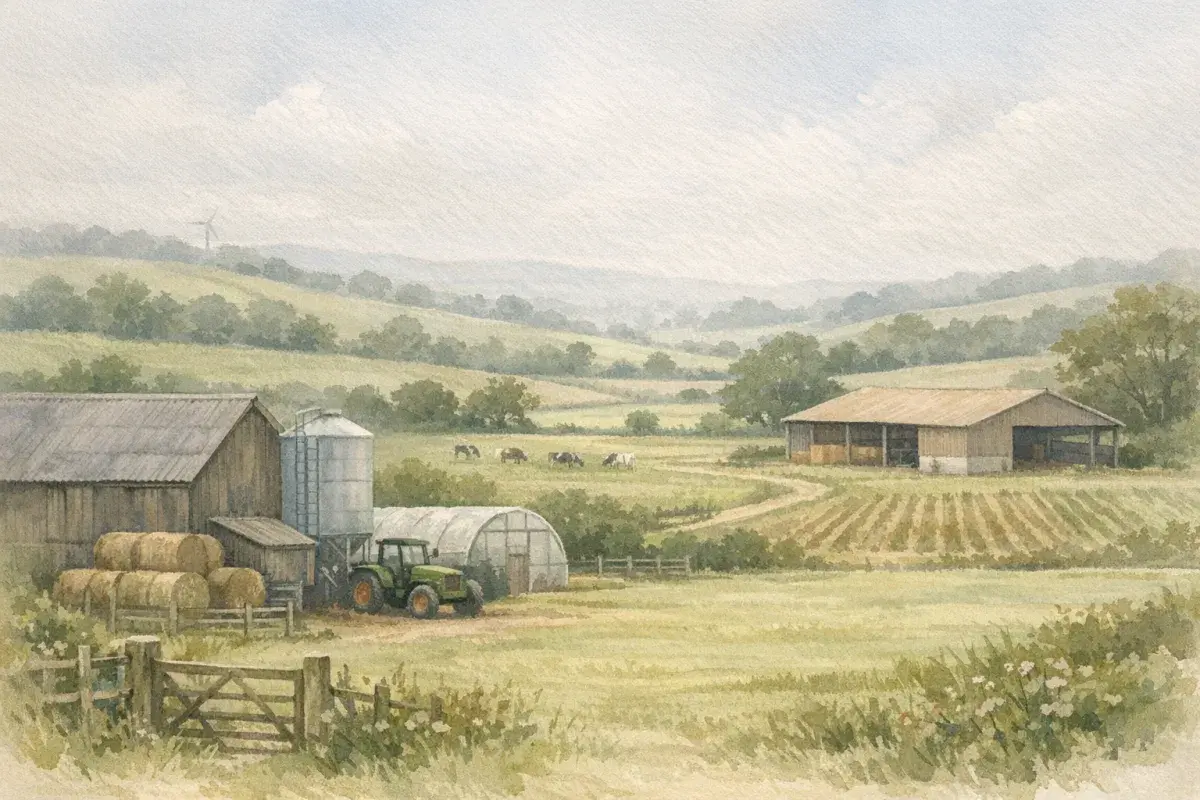
Permitted development on agricultural land can let farmers make useful changes without a full planning application, but the rules are tighter than many expect. Get it wrong, and a simple project can turn into a costly enforcement headache.
For landowners, farmers, and rural investors, the big question is usually simple: what can I build or change, and when do I need prior approval or full planning consent? The answer depends on the type of farm building, the land use, the location, and whether the proposal falls within Class Q or another permitted development right.
That matters because the difference between a new grain store, a livestock shed, a track, or a barn conversion can be significant. We would argue that the smartest approach is to understand the constraints first, then shape the project around them, rather than starting with a wish list and hoping the planning officer agrees.
What Permitted Development Means On Agricultural Land
Permitted development is a set of rights that allow certain works without a full planning application. On agricultural land, these rights are mainly designed for genuine farming operations, although some rights also support changes of use or conversions if the proposal meets strict tests.
In plain English, that means you may be able to put up a shed, repair an access track, or convert a redundant building, but only if the land, building, and use all fall within the rules. The key point is that permitted development rights are not a free-for-all; they are conditional, and the details matter.
The Difference Between Permitted Development And Full Planning
Full planning consent is the standard route and gives the local planning authority the chance to assess the proposal in the round. Permitted development skips that formal application stage, but often requires prior approval, where the council still checks matters such as transport, noise, flooding, contamination, and design.
That distinction trips people up. A project may be described as permitted development, yet still need a prior approval application before work starts.
- Permitted development: Development allowed under national rules, subject to conditions.
- Prior approval: A lighter planning check on specific impacts before works begin.
- Full planning: The standard route for schemes outside the permitted categories.
Why Farms Use These Rights So Often
Farms need practical structures. Cattle housing, silage clamp cover, grain storage, machinery sheds, and drainage works are all common examples of development that can fall within agricultural rights if they are genuinely tied to agriculture.
That is useful in a fast-moving market. As of March 2025, buyers continue to place a premium on holdings with functional infrastructure because a usable yard or modern building can improve operating efficiency and market appeal.
What You Can Usually Build Or Change Without Full Consent
The exact rights depend on whether the proposal sits within the agricultural unit and whether it is needed for agricultural purposes. In practice, many straightforward farm developments can proceed more quickly than other rural schemes, provided the scale, siting, and design stay within the rules.
Typical examples include agricultural buildings, extensions to existing farm buildings, hardstanding, tracks, and some drainage works. But don't assume every project qualifies. A building used for storage that is really about equestrian, industrial, or residential purposes may fall outside agricultural permitted development.
Agricultural Buildings, Tracks, And Hardstanding
New barns, livestock sheds, general-purpose stores, feed buildings, and similar structures are often the starting point. The council will want to know whether the building is genuinely for agriculture, whether it is reasonably necessary, and whether it sits well in the landscape.
Tracks and hardstanding are similarly common. A new field access track in Norfolk, a concrete yard extension in Shropshire, or a loading area in Perthshire may all be workable, but drainage, visual impact, and highway safety still matter.
- New barn: Often possible under agricultural rights, subject to size and siting.
- Farm track: Usually easier to justify where it serves a real operational need.
- Hardstanding: Often linked to machinery storage, loading, or animal welfare.
- Drainage works: May be covered if they are part of sensible farm management.
Repairs, Alterations, And Redevelopment
Repairs and maintenance are usually the least controversial, especially where a structure remains in agricultural use. More substantial alterations can also be possible, but if the works amount to rebuilding rather than repair, or change the character of the building too much, the position becomes less clear.
We would say this is where many owners overestimate what is allowed. A tired cattle shed in Cumbria can often be improved, but if the project starts looking like a near-total replacement, it's wise to check the rules before spending money.
| Development Type | Likely Route | Common Risk Point | As of Date |
|---|---|---|---|
| Agricultural shed | Permitted development, often with prior approval | Genuinely agricultural use | March 2025 |
| Farm track | Permitted development in many cases | Impact on drainage and highways | March 2025 |
| Building conversion | May need a specific class of rights | Previous lawful agricultural use | March 2025 |
When Prior Approval Is Needed
Prior approval is a common feature of agricultural permitted development. It is not full planning, but it is still a formal step, and work should not begin until the local authority has either given approval or the relevant period has passed without a determination, depending on the case.
The council may assess siting, design, external appearance, transport, noise, flood risk, contamination, and the impact on the local environment. For estate agents and sellers, this matters because a site with a clean prior approval history is often easier to market than one with unresolved compliance questions.
Common Triggers For Prior Approval
Several farm projects often trigger prior approval rather than being wholly automatic. New agricultural buildings are a classic example, especially where size, height, or position could affect neighbours or the wider landscape.
Likewise, proposals near villages, roads, rivers, or protected sites can attract more scrutiny. In the Yorkshire Dales or the edge of the South Downs, for example, visual impact can be more important than it might be on a large, enclosed lowland unit.
- Siting: Whether the building is placed where it causes least harm.
- Design: Whether materials and form are suitable for the setting.
- Transport: Whether access is safe for farm traffic and deliveries.
- Flood risk: Important on low-lying land, river meadows, and coastal holdings.
Why Documentation Matters
Good paperwork can save time. Plans, elevations, land registry details, proof of agricultural use, and a clear description of the farming need all strengthen the case and reduce back-and-forth with the council.
If the land history is messy, sort it out early. A building in Devon or Worcestershire that has mixed uses over time may need evidence to show it still qualifies for the right being claimed.
Class Q And Farm Building Conversions
Class Q gets a lot of attention because it can allow a redundant agricultural building to be converted to residential use under permitted development, subject to strict limits. It is one of the most commercially important rights in rural property, but also one of the easiest to misunderstand.
The building usually needs to have been in agricultural use on the relevant date and to be structurally capable of conversion. The proposal must stay within the permitted scope, and external changes are often limited. The result can be attractive, but it is rarely a simple shortcut to a home in the countryside.
What Makes A Building Eligible
Eligibility often turns on lawful agricultural use, physical permanence, and structural suitability. A steel portal frame barn in Lancashire might be a better candidate than a flimsy Cotswold timber store that has strong agricultural character but poor conversion potential.
That said, the devil is in the details. Open-fronted buildings, heavily altered structures, and buildings with unclear use histories can all create problems.
- Lawful use: The building must usually have been part of an agricultural unit.
- Structural capacity: It needs to be capable of conversion without total replacement.
- Location: Some sites face extra restrictions due to landscape or environmental designations.
Why Class Q Often Shapes Land Value
Class Q potential can materially affect value, especially where the agricultural business is restructuring or where an estate is rationalising redundant buildings. Buyers often pay more for a barn with realistic conversion prospects than for an identical structure with no such potential.
As of March 2025, that premium is most visible in smaller holdings near commuter areas, but it can also matter in remote counties where completed rural homes are scarce and harder to bring forward through ordinary planning routes.
Regional Differences And Practical Planning Risk
Permitted development rules are national, but their application is not always uniform. Local planning authorities interpret landscape sensitivity, highways issues, and heritage concerns differently, and those differences can shape outcomes in real life.
In practice, a project in Cambridgeshire may be treated more favourably for its simple, open landscape than a visually prominent scheme in Northumberland National Park or on the edge of the Lake District. The rulebook is the same, but the setting changes the decision.
Where Extra Caution Is Needed
Some areas carry additional layers of control, including conservation areas, listed buildings, national parks, and areas of outstanding natural beauty, now often called national landscapes. Even when permitted development exists, those designations may restrict or complicate it.
Flood zones are another issue. A well-placed machinery store in Lincolnshire may be fine, but similar development on fenland or by a river corridor may prompt closer scrutiny of drainage and resilience.
- National Parks: Stronger landscape controls and closer design scrutiny.
- Conservation areas: Historic character can limit external alterations.
- Listed buildings: Separate consent may be required.
- Flood zones: Drainage and resilience can affect feasibility.
Local Market Expectations
Regional farming patterns influence what is seen as reasonable. A dairy unit in Somerset may justify different buildings from a sheep enterprise in the Scottish Borders, simply because the operational need is different.
Estate agents should read that carefully. A scheme that looks modest on paper may still be a strong operational improvement, and buyers tend to notice that distinction.
How To Reduce Risk Before You Start
The safest route is to check the legal status of the land, the building, and the proposed use before spending on drawings or contractors. Practical due diligence is not glamorous, but it is much cheaper than dealing with an enforcement notice later.
Useful checks include title documents, historic use evidence, photograph records, existing consents, and farm records showing agricultural activity. If the scheme is borderline, a planning consultant, land agent, or solicitor can help test the assumptions before a formal application goes in.
Common Mistakes To Avoid
One common error is assuming that because something is on or near farmland, it counts as agricultural development. Another is treating a building with old farm character as if it automatically qualifies for conversion rights.
Avoid moving too quickly on foundation works or service connections before permissions are certain. Once physical work starts, your options can narrow fast.
- Assuming use is agricultural: You need evidence, not instinct.
- Mixing uses: Equestrian, storage, and lifestyle uses can break the argument.
- Ignoring neighbours: Noise, traffic, and lighting complaints can derail projects.
Conclusion
Permitted development on agricultural land can be a genuinely useful tool, but only when the proposal fits the right category and the paperwork stacks up. The rewards are real: faster delivery, lower costs, and more flexibility for working farms and rural estates.
Still, the safest approach is to treat each scheme on its facts, especially where prior approval, Class Q, or a sensitive county setting is involved. Get the basics right, and permitted development on agricultural land can unlock practical improvements without the delay of a full planning battle.
Disclaimer: AgLand.co.uk is a UK agricultural land and rural property matching service, where buyers register what they are looking for and owners advertise directly to the buyers who match, and a rural resource hub. Nothing in this text is intended as legal, financial, or investment advice. You should carry out your own due diligence and seek guidance from appropriately qualified professionals (for example, solicitors, land agents, surveyors, and financial advisors) for your specific circumstances.