
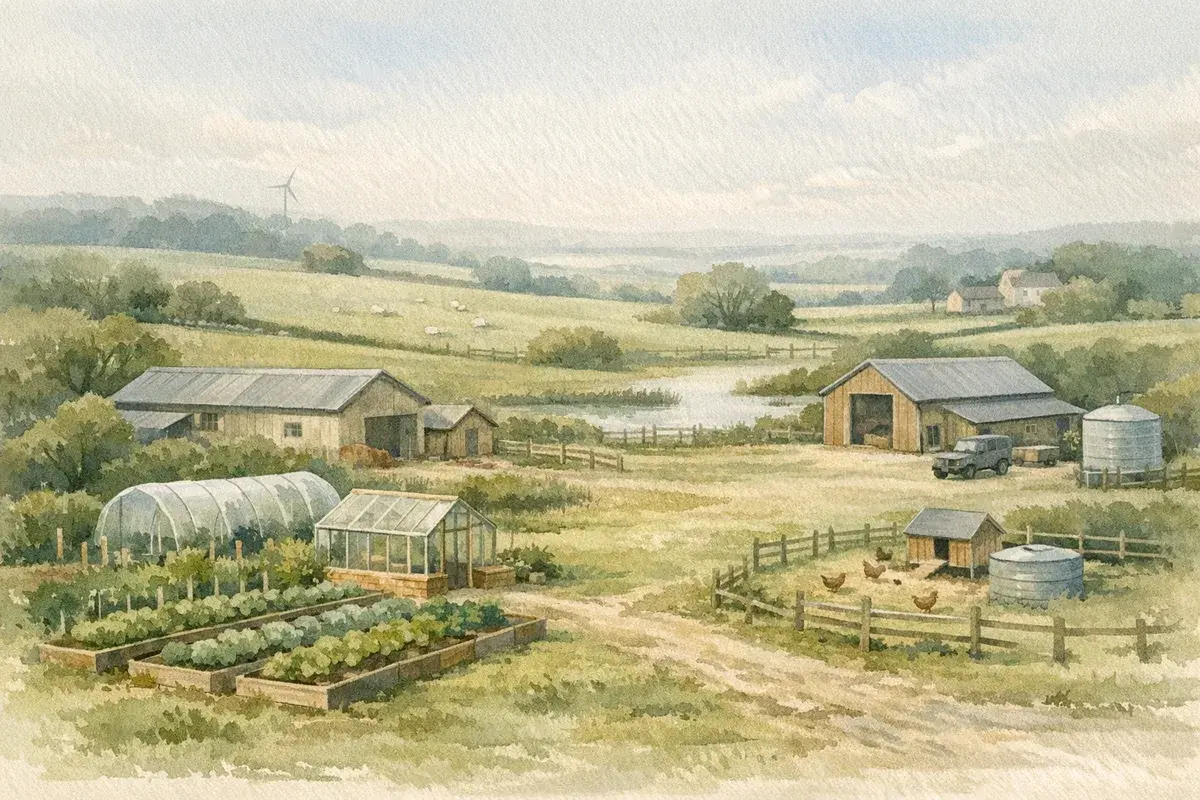
Permitted development on agricultural land more than 5 hectares can save time, cut costs, and unlock practical improvements without a full planning application — but only if you stay within the rules. If you’re considering a new farm building, an access track, slurry storage, or a change of use, the size of the holding matters, but it’s not the whole story.
The key question is this: what can you do on a farm of over 5 hectares without asking the local planning authority for full permission? In many cases, agricultural permitted development rights under the General Permitted Development Order (GPDO) will help, especially for bona fide agriculture. Yet the bigger the farm, the more likely it is that designations, prior approval requirements, and location-specific controls will shape what’s possible.
We’d argue the safest approach is to treat permitted development as a powerful shortcut, not a free pass. You still need to check building dimensions, siting, environmental constraints, and whether prior approval is required. Get that wrong, and a “quick” project can turn into a costly enforcement headache.
In this guide, we’ll explain the rules in plain English, show where farms over 5 hectares sit within the planning system, and highlight the practical steps that matter in England, with useful regional context for counties such as Norfolk, Devon, Cumbria, Lincolnshire, Yorkshire, Somerset, Kent, and Gloucestershire. If you’re an owner, tenant, or agent, this should give you the full picture without having to go elsewhere.
What Permitted Development Means on a Farm Over 5 Hectares
Permitted development means certain agricultural works can go ahead without a full planning application, provided they meet the conditions in planning law. For farmland above 5 hectares, the most relevant rights typically relate to agricultural buildings and operations, including barns, stores, hardstanding, and some infrastructure connected to agriculture. Below that threshold the rights get tighter rather than disappearing, and councils tend to look harder for evidence that the land is in genuine agricultural use rather than equestrian, amenity or hobby use, which is the ground covered in our companion guide to holdings under 5 hectares.
The 5-hectare threshold matters because it affects the scale of development rights and the level of scrutiny. On holdings over 5 hectares, larger agricultural buildings often fall within a more flexible regime than on smaller units, but you’ll still need to assess whether the development is genuinely agricultural and whether prior approval applies.
“Agricultural” has a specific meaning. It usually covers the use of land for agriculture, including horticulture, fruit growing, seed growing, dairy farming, livestock breeding and keeping, grazing, meadow land, and market gardens. It doesn’t automatically include equestrian use, tourism, retail sales, or diversified non-farm enterprises, even if they sit on a working farm.
The practical benefit is obvious. If you need a new grain store in Lincolnshire, a livestock shed in Cumbria, or a machinery shed in Devon, permitted development can shorten the timeline compared with a full planning process. But the authority may still want details on siting, design, transport impacts, noise, and building appearance.
One important distinction: permitted development is not full permission. It is a legal right, but a qualified one. In practice, the detail matters more than many landowners expect, especially where landscape sensitivity, conservation designations, flood risk, or nearby dwellings come into play.
What You Can Usually Build or Change Without Full Planning
On agricultural land more than 5 hectares, the most common permitted development projects include agricultural buildings, extensions to existing farm buildings, hard surfaces used for agricultural purposes, and some engineering operations connected to the holding. The exact rights vary depending on the type and size of development.
A classic example is a general-purpose farm building. If it supports a genuine agricultural enterprise, it may be capable of proceeding under permitted development, subject to prior approval in many cases. The authority may assess siting, design, and whether the building is reasonably necessary for the agricultural unit.
Another typical example is a concrete yard or access track needed for machinery, forage movement, or livestock handling. These can often be acceptable where they are part of ordinary farm operations, though drainage and environmental effects can trigger further scrutiny. In wetter counties like Somerset, Lancashire, and parts of Yorkshire, surface water and run-off concerns can be just as important as the building itself.
There are also limits. Permitted development usually won’t cover houses, holiday lets, glamping, industrial buildings, or retail units. A farm diversification scheme may need full planning permission even if the core agricultural business does not. That’s where many owners get caught out: the farm may be legal, but the new enterprise isn’t automatically covered.
To make it clearer, here’s a simple comparison of typical scenarios.
| Development type | Often possible under PD? | Typical constraint | Common risk area |
|---|---|---|---|
| Agricultural barn | Yes, usually with prior approval | Size, siting, design | Landscape and neighbour impact |
| Gravel or concrete yard | Sometimes | Agricultural need | Drainage and run-off |
| Farm access track | Often | Must serve agriculture | Ecology and visibility |
| Holiday accommodation | No, usually not | Change of use | Full planning needed |
As of June 2026, planning authorities still apply these rights cautiously where intensification is obvious or where the land sits near protected landscapes, according to the government’s published planning framework and standard local planning practice. That means the same barn proposal can face very different treatment in Northumberland compared with the Cotswolds.
Prior Approval, Planning Notices, and the Real Process on the Ground
For many agricultural projects on holdings over 5 hectares, the issue isn’t whether permitted development exists, but whether prior approval is required. Prior approval is a lighter-touch procedure than full planning permission, but it still gives the local authority a say over specific matters before you proceed.
Typical prior approval considerations include siting, design, external appearance, and whether the location is reasonably necessary for the agricultural operation. In some cases, the authority may also want to look at transport, flood risk, or contamination. If the site is close to homes, odour and noise concerns can become relevant too.
The process usually starts with a written submission. You’ll set out the proposal, explain the agricultural need, include plans, and provide dimensions. If the land is in an area with special constraints, you may also need supporting surveys or statements covering ecology, drainage, heritage, or access.
Timelines are often shorter than full planning, but don’t assume it’s instant. In England, prior approval decisions commonly take around 56 days from a valid submission, although extensions can happen if the authority asks for more information. As of June 2026, that remains the practical benchmark many agents and applicants work to.
It’s worth remembering the order of operations. If you start building before you’ve confirmed the right route, you may lose the benefit of permitted development entirely. That can happen on smaller jobs too, not just major barns. Welded steel frame? Fine. Wrong siting? That’s where the trouble starts.
Agents in county markets often say the best applications are the boring ones: clear, factual, and backed by sensible drawings. A concise business case for why the building is needed on that exact holding can make a real difference, especially in areas such as Norfolk, Suffolk, Lincolnshire, and Cheshire where arable and mixed units frequently expand storage and machinery capacity.
How Local Factors Change the Answer by County and Region
Even where the national rules are the same, regional planning culture is not. A proposal that sails through in one district may face more questions in another, particularly in National Parks, Areas of Outstanding Natural Beauty, conservation areas, or flood-prone lowlands.
In East Anglia, particularly Norfolk, Suffolk, Cambridgeshire, and Lincolnshire, larger arable enterprises often need grain stores, drying facilities, and machinery accommodation. That can make permitted development especially useful, but local authorities may still focus on scale, dust, traffic, and views across open countryside.
In the South West, including Devon, Somerset, and parts of Cornwall and Dorset, topography, hedgerows, drainage, and tourism sensitivity often shape the discussion. A building near a lane or village edge may attract more scrutiny, even where the agricultural case is strong.
In the North West and upland counties such as Cumbria, Lancashire, and North Yorkshire, livestock infrastructure is common, but landscape impact can be a bigger factor. Where farms are small-to-medium in physical footprint but intensive in operation, the authority may want better justification for siting and visual mitigation.
Here’s a practical regional snapshot of recurring issues local agents report.
| Region/county example | Common farm development need | Likely planning focus |
|---|---|---|
| Lincolnshire | Grain and storage buildings | Scale, traffic, amenity |
| Devon | Livestock sheds and yards | Landscape, drainage |
| Cumbria | Stock housing and silage storage | Visual impact, ecology |
| Kent | Packhouses and crop support | Highways, use class issues |
Market reality matters too. In counties with strong tenancy demand, a well-planned permitted development scheme can improve the holding’s operational value without overexposing it to planning risk. But if the farm is close to residential or lifestyle ownership patterns, neighbour sensitivity can slow things down.
Common Mistakes, Exemptions, and When to Get Advice
The biggest mistake is assuming that because the land is agricultural and over 5 hectares, everything is allowed. It isn’t. Permitted development rights are conditional, and those conditions can be tripped by location, design, previous development, or the exact nature of the business.
Another common error is mixing agricultural and non-agricultural uses in the same scheme. A barn for hay and machinery may be fine; the same structure adapted for wedding storage or a café may not be. Similarly, a yard used for farm operations is different from one intended for commercial vehicle parking or resale activity.
You should also check whether the holding sits within an exempt or constrained area. Designated landscapes, conservation sites, listed building settings, flood zones, and archaeological sensitivity can all change the route. In some cases, even if the right exists, the local authority may still require additional evidence before you proceed.
Before you commit, it’s sensible to test the scheme against these points: Is it truly agricultural? Is prior approval required? Does the site have designations or known constraints? Will the scale and appearance fit the locality? If the answer to any of those is uncertain, professional advice is worthwhile. Frankly, it’s usually cheaper than a planning mistake.
We’d also suggest keeping a clean paper trail. Farm business records, land maps, stock numbers, cropping plans, and machinery schedules can all support the case that the development is needed for a genuine agricultural enterprise rather than a speculative one.
What the Market is Telling Us
We’ve noticed that agricultural buyers are asking more questions about planning certainty than they did a few years ago. A farm with existing buildings, clear access, and room for future permitted development often commands stronger interest than a similar block with no obvious development strategy.
Agricultural agents often tell us the appetite is strongest where the land can support practical improvements without a full planning battle. That’s especially true in arable counties such as Lincolnshire and Norfolk, and in dairy and livestock regions where storage, housing, and yard efficiency drive value.
What’s changed recently is the level of scrutiny around siting, drainage, and environmental impact. As of June 2026, agent feedback suggests buyers are factoring in the risk of delay more heavily, because a simple permitted development project can still stall if local constraints are overlooked.
Conclusion
If you own or are buying farmland, permitted development on agricultural land more than 5 hectares can be a very useful route for practical farm improvements, but only when the use is genuinely agricultural and the site checks out. The real win is speed and flexibility; the real risk is assuming the right applies more widely than it does.
So, start with the holding, then test the proposal, then check the local constraints. That sequence will save time, money, and a fair bit of frustration. If you’re weighing up a purchase, a sale, or a development-led strategy, the next sensible step is to speak to people who know the market and the planning terrain.
Disclaimer: This information is provided for educational purposes and should not constitute professional advice. Property values and market conditions can change rapidly. Always consult with qualified agricultural property professionals and financial advisors before making investment decisions. AgLand.co.uk lets buyers register free what they're looking for, and lets owners advertise directly to the buyers who already match, for one flat fee and no commission.