
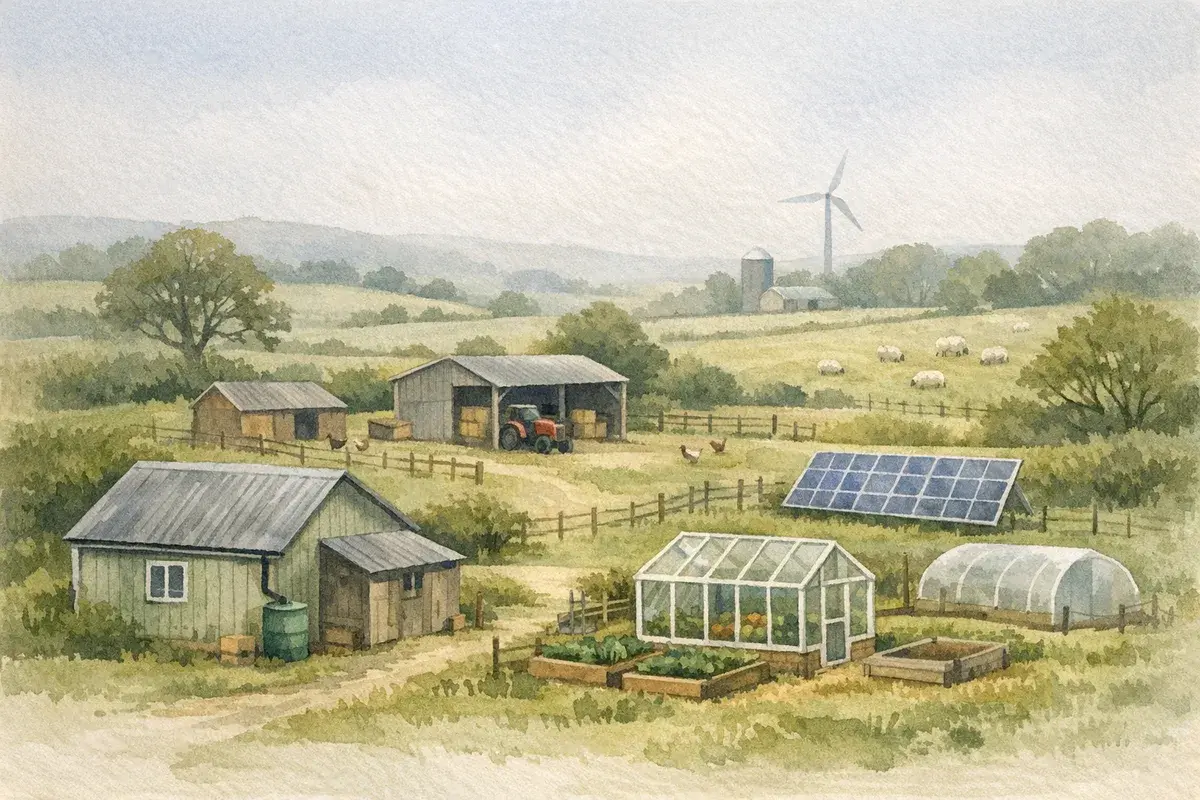
If you’re asking about permitted development on agricultural land less than 5 hectares, the short answer is this: the size of the holding doesn’t automatically block development, but it can affect what you’re allowed to do and how much evidence you’ll need. In England, many agricultural buildings still benefit from permitted development rights (PD rights), which let certain works proceed without a full planning application, provided the proposal fits the rules.
That matters because smaller farms, lifestyle holdings and mixed rural units often want to convert barns, add sheds, store machinery, or improve worker accommodation without the cost and delay of a full application. The catch? “Less than 5 hectares” is not a magic exemption. Different PD classes apply to different uses, and the local planning authority will expect the land to be genuinely agricultural, not just rural in appearance.
We’d argue the safest way to think about it is this: the smaller the holding, the more important your records become. Expect questions about agricultural use, stocking, cropping, building history, and whether the proposal stays within the GPDO rules. Get those wrong and a simple job can turn into a retrospective planning headache.
This guide explains what can usually be done, where the traps are, how the rules vary across England and the nations, and when a full application is still the better route. If you own a compact farm in Norfolk, a small upland unit in Cumbria, or a block of arable land in Lincolnshire, the principles are broadly similar, but local practice can differ more than you might expect.
What Permitted Development Means on Small Agricultural Holdings
Permitted development is development granted by national planning rules rather than needing a formal planning permission every time. For agricultural land, that usually sits under the General Permitted Development Order (GPDO), which sets out what can be done without a full planning application, subject to limits and conditions.
For holdings under 5 hectares, the key point is not usually the acreage itself, but whether the land is used for agriculture and whether the proposal falls within the relevant class. Agricultural use covers the growing of crops, grazing of livestock, horticulture, seed growing and certain ancillary activities, and the planning authority will look for consistent, practical evidence of that use.
Smaller holdings often trigger more scrutiny because they’re easier to confuse with equestrian, amenity or hobby-farm land. A field used for horses, for example, is not the same as agricultural land, even if it sits next to a traditional barn and looks rural from the lane. That distinction can decide everything.
There’s also a practical issue. On a 4.8-hectare unit, a new shed, an access track or a barn conversion may materially change the character of the site. That can invite closer inspection of drainage, traffic, neighbour impact and whether prior approval is required before work starts.
In plain English, permitted development can be a quicker route, but it isn’t a free-for-all. If you want certainty, you need to match the project to the right class, gather site evidence early, and check for restrictions like listed building status, Conservation Area controls, environmental designations or Article 4 directions that remove PD rights.
Which Agricultural Projects Can Usually Proceed
The most common PD projects on agricultural land include agricultural buildings, certain changes of use, and in some cases tracks, hardstanding and drainage-related works. The exact rights depend on the structure and the use, but the familiar route for barns and outbuildings is often through the agricultural PD classes, with prior approval where required.
One of the best-known examples is Class Q, which can allow the conversion of an agricultural building to dwellinghouses, provided strict criteria are met. Not every barn qualifies. It must have been in agricultural use on the relevant date, fit the size and structural test, and be capable of conversion without major rebuilding (that last one trips people up all the time).
Other routes may cover new agricultural buildings or extensions to existing ones, but the local planning authority will usually assess the practical effect on the landscape, highways, flood risk and the siting of the structure. On a smaller holding, the design quality matters more than many owners expect. A modest, well-sited shed can pass where a larger, overly prominent one may stall.
Here’s a useful rule of thumb: if the proposal supports an established farm business and stays clearly agricultural, it’s more likely to fit within PD than a scheme that mixes storage, leisure or residential use. That doesn’t mean mixed-use land can’t work, but you’ll need a clearer paper trail and, in many cases, a stronger case for prior approval.
A few examples help:
- A 3.2-hectare dairy smallholding in Somerset wanting a calf shed may well be within agricultural PD, subject to notice and siting rules.
- A 4.6-hectare arable block in Lincolnshire seeking Class Q conversion of an old grain store could succeed if the building is lawful, substantial and structurally eligible.
- A 2.8-hectare amenity holding in Surrey with horses and no farming activity is unlikely to qualify as agricultural land, regardless of form of development.
The lesson? Use comes first, size second. If the land is genuinely agricultural and the building is lawful, permitted development can be very powerful.
How the 5-Hectare Test Affects Evidence and Prior Approval
When land is under 5 hectares, the planning authority is often more interested in how intensively it is farmed and how the buildings fit the holding. You may not face a different legal threshold just because the unit is small, but you are more likely to be asked to prove that the business is real, established and agricultural in character. Above the threshold the emphasis shifts towards siting and scale rather than proof of farming, and the rights that open up on holdings over 5 hectares stretch to hardstanding, farm tracks and larger buildings, still subject to prior approval.
For some forms of agricultural PD, the prior approval process is the deciding stage. This is where the council reviews specific matters before work starts, such as siting, design, transport, flood risk, contamination or noise. In some cases, the authority can only assess limited issues; in others, it can look more widely at the effect of the scheme.
Owners of smaller holdings should expect to provide a stronger evidence pack. That may include farm records, tenancy agreements, Basic Payment-era land use records where relevant, livestock movement details, crop rotation plans, invoices for inputs, and photographs showing agricultural operations over time. The aim is simple: show the land is farmed, not merely maintained.
Timing matters as well. Prior approval can be quicker than a full application, but it still takes weeks, not days. Nationally, planning performance varies, but in practice many PD prior approval decisions are resolved in roughly 4 to 8 weeks depending on consultation and validation checks, based on local authority determination patterns reported publicly as of May 2025. That is still faster than a typical full application, which often runs longer.
Small holdings also face a subtle risk: because they are compact, any new building or conversion can look more visually dominant. So even where the legal test is met, a poorly judged proposal can suffer from siting objections. A screened field edge, a tucked-away yard, or using existing farmstead footprints often improves the odds.
| Scenario | Likely PD position | Main risk | Typical evidence needed |
|---|---|---|---|
| New hay store on 4ha farm | Often possible | Siting and design | Farm records, block plan, elevations |
| Class Q conversion of old barn | Possible if eligible | Structural tests, lawful use | Use history, photos, structural report |
| Horse-led smallholding | Often not agricultural | Use classification | Stocking records, cropping evidence |
| Access track across arable field | May be possible | Ecology, drainage, highways | Location plan, surface details |
As ever, the burden is on the applicant to show the proposal fits the rule. On a modest acreage, that can be the difference between a smooth approval and a refusal.
Local Planning Differences Across Counties and Rural Regions
National PD rules are set in England, but local interpretation still matters. A council in Norfolk may be used to arable holdings and barn conversions, while an authority in North Yorkshire or Devon may scrutinise landscape impact, access and settlement pattern more heavily. The legal test is the same, but the local context shapes the outcome.
In counties with strong livestock sectors, such as Cumbria, Shropshire and parts of Wales, new sheds and ancillary agricultural buildings may be treated as a normal part of farm evolution, provided they’re well sited. In more sensitive landscapes, including parts of the Cotswolds, East Devon or the South Downs, visibility and design quality tend to matter more, especially near designated land.
There are also regional planning quirks. Some councils are quicker to issue lawful development certificates or prior approval decisions, while others ask for additional clarifications, which can slow things down. If your holding is in a parish with a history of barn-to-home conversions, expect more attention on Class Q compliance and evidence of agricultural use at the relevant date.
For landowners and agents, the practical message is clear. Don’t assume that “rural” equals “permitted”. A 4.5-hectare holding outside Chester or Exeter may be treated very differently from a similar site in the Fens. Local plan policies, landscape designations and conservation constraints can all influence how PD is applied on the ground.
If you’re selling or buying such land, ask early whether the holding has any of the following: existing lawful farm buildings, extant prior approvals, history of agricultural occupation, drainage easements, access rights, or contamination from former uses. Those details can materially affect value. They can also decide whether a future PD proposal is viable at all.
When to Apply, When to Seek a Certificate, and When to Go Full Planning
Not every proposal should rely on permitted development alone. If the scheme is borderline, a lawful development certificate can be a smart move, because it gives formal confirmation that the proposed use or building is lawful under the PD rules. That reassurance can be worth a lot when finance, resale or tenancy value is on the line.
For a clear-cut agricultural shed on an active smallholding, you might simply need to notify the council if the class requires prior approval. But if the land use is mixed, the building has changed over time, or the structure is old and partly rebuilt, full planning may be safer. Why gamble on a marginal PD claim when the business rate, resale value or mortgage backing depends on certainty?
Full planning is also sensible where the scheme is commercially significant, highly visible, or likely to be contested. That includes new dwellings on farmyards, larger diversified enterprises, equestrian redevelopment, holiday lets, or schemes near designated countryside. Smaller holdings can be more sensitive because every square metre matters, and there’s less space to absorb a mistake.
If you’re deciding between routes, ask four questions. Is the land genuinely agricultural? Is the building or use lawful? Does the proposal fit a recognised PD class? And would a certificate reduce risk enough to justify the extra time and cost? If the answer to any of those is no, get advice before moving forward.
We’ve seen too many owners rely on a quick assumption, only to discover the holding was never classed as agricultural in the first place. That’s especially common where the land has been used for pony grazing, storage, hobby farming or amenity planting. The outward appearance may be rural, but the planning status can be very different.
What the Market Is Telling Us
We’ve noticed a steady increase in enquiries about smaller agricultural holdings with development potential, especially where barns, grain stores or redundant sheds could support a conversion or improved farm use. Agricultural agents often tell us that buyers are paying close attention to planning history now, not just acreage and soil quality.
What’s changed recently is the premium on certainty. A compact holding with a clean PD history, good access and a well-documented agricultural use can attract stronger interest than a larger but messier site. As of May 2025, farmland values remain highly location-specific, but market commentary from the wider UK rural sector suggests that land with clear development or diversification potential can command materially stronger enquiry levels than land without it.
That doesn’t mean every small farm should chase a conversion. Quite the opposite. The best opportunities are usually the ones that sit comfortably within the rules and don’t overcomplicate the holding. We’d argue that a tidy, legally robust agricultural use case is often more valuable than a speculative planning story.
What buyers tell AgLand.co.uk they're looking for, alongside agent feedback, shows they are asking more questions about prior approvals, lawful use, drainage and access than they did a few years ago. In a market where finance is tighter and due diligence is firmer, those details can make or break a deal.
Conclusion: the Practical Answer for Small Agricultural Holdings
The key takeaway is simple: permitted development on agricultural land less than 5 hectares is absolutely possible, but the holding must be genuinely agricultural and the proposal must fit the relevant PD rules. Size alone doesn’t decide the outcome, yet smaller units often need better evidence, cleaner records and more careful siting.
If you’re planning a shed, barn conversion or other farm-related project, don’t assume the answer will be obvious. A quick check of land use history, building lawfulness and local constraints can save months of delay and a fair bit of money. And if you’re buying, those same issues should be part of your valuation and legal review.
Disclaimer: This information is provided for educational purposes and should not constitute professional advice. Property values and market conditions can change rapidly. Always consult with qualified agricultural property professionals and financial advisors before making investment decisions. AgLand.co.uk lets buyers register free what they're looking for, and lets owners advertise directly to the buyers who already match, for one flat fee and no commission.