
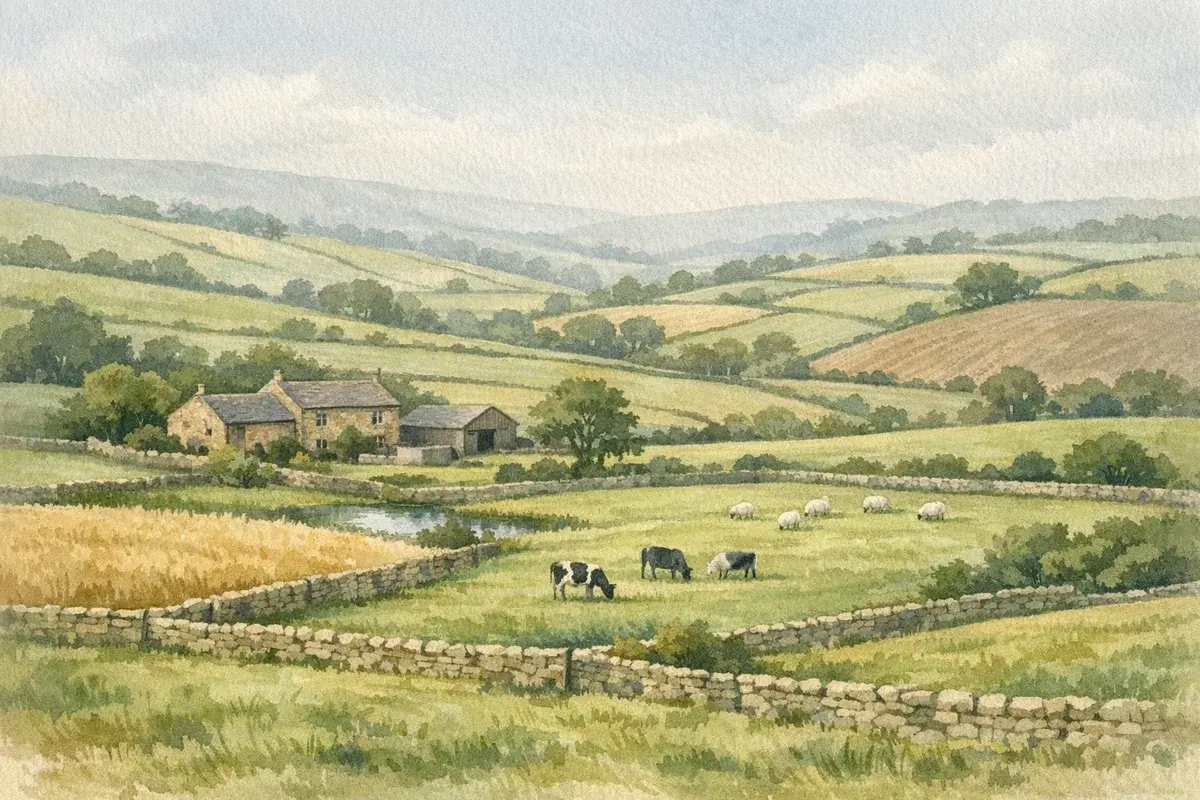
You can walk two fields that look identical from the gate, same crop, same slope, same tidy hedges, and yet one will carry a genuine Grade 1 claim while the other won't get above Grade 2 or 3a once it's properly assessed. That difference matters. It shows up in what you can grow, when you can travel, how reliably the land performs in awkward seasons, and, inevitably, what you'll pay.
Grade 1 agricultural land in the UK is talked about with a sort of shorthand reverence: "top land", "proper arable", "can grow anything". Sometimes that's true. Sometimes it's sales patter built on a map colour, a neighbouring farm's reputation, or a memory of "what it used to be like before the wet years". If you're buying, renting, investing, or restructuring a holding, you need something more solid.
This guide unpacks what Grade 1 actually means under the Agricultural Land Classification (ALC), where it tends to show up, why it commands a premium, and, crucially, how to verify a Grade 1 claim before you commit.
What Grade 1 Agricultural Land Means In The ALC System
Grade 1 sits at the top of the Agricultural Land Classification (ALC) system used across England and Wales to describe the physical quality of land for agricultural use. In plain terms, it's land with very minor limitations, the sort that rarely stop you growing a wide range of crops and rarely stop you getting on the land when you need to.
If you've not dealt with ALC before, it's worth grounding yourself in the wider framework, because Grade 1 only makes sense in context. We've laid out the broader grading logic (and the typical pitfalls when people rely on outdated mapping) in our explainer on how agricultural land is classified.
How The Agricultural Land Classification (ALC) Works
The ALC grades land from 1 to 5, based on the degree to which climate, site and soil limit agricultural use.
- Grade 1: excellent quality agricultural land
- Grade 2: very good quality
- Grade 3: good to moderate quality (split into 3a and 3b)
- Grade 4: poor quality
- Grade 5: very poor quality
Planning policy then commonly groups Grades 1, 2 and 3a as Best and Most Versatile (BMV) land.
A key point people miss: ALC is not a single "soil type" label. It's an assessment of limitations. Drainage, texture, depth, stoniness, droughtiness, frost risk, slope, and even the length of the workable season all feed into the final grade.
What Makes Land "Grade 1" (Soil, Climate, And Limiting Factors)
To justify Grade 1, the land needs to show high versatility with little limitation in most seasons. That normally means:
- Soil: deep, well-structured, workable soils with favourable texture (often medium loams/silt loams), low stone content, and strong natural fertility.
- Water regime: generally good drainage (natural or effectively managed) without persistent waterlogging: and not so free-draining that drought becomes a major constraint.
- Climate: a climate that allows a long growing season and reliable establishment/harvest windows.
- Topography: minimal slope-related limitations for cultivation and machinery.
In practice, Grade 1 is as much about reliability as peak performance. You're paying for land that stays usable when others are parked up, where you can drill, spray, irrigate (where relevant and consented), and lift roots with fewer "lost weeks".
Grade 1 vs Grade 2 And Grade 3: The Differences That Matter In Practice
On paper, Grade 2 is "very good". On farm, the differences can be subtle until you hit a tricky year.
Common real-world differences you'll notice:
- Working windows: Grade 1 usually gives you more days where field operations are possible without causing damage.
- Crop choice: Grade 1 is more consistently suitable for demanding crops (think intensive vegetable rotations, high output potatoes, seed crops), whereas Grade 2 might be excellent but with a limitation that narrows the safest rotation.
- Risk of yield volatility: Grade 3 (especially 3b) can perform well in a good season, but the lows can be lower, because the limitation bites harder.
If you're trying to get your head around the terminology agents use, "Grade 1", "BMV", "3a not 3b", "strong Grade 2", it helps to step back and understand the UK land grading system in full, because most negotiation and planning arguments hang off those distinctions.
Where Grade 1 Land Is Found In The UK (And Why Location Is Not The Whole Story)
People love a neat rule like "that whole area is Grade 1". The reality is messier. Grade 1 land clusters in particular lowland areas with favourable soils and climate, but it can also appear as pockets, and disappear just as quickly when you cross a boundary, a historic drain line, or an old river terrace.
Key Regional Hotspots And Typical Farming Uses
Grade 1 land is most commonly associated with productive lowland arable and horticultural regions, where soil and climate combine to support high-output cropping and intensive rotations.
Typical uses you'll see on land that genuinely merits Grade 1 include:
- high-performing combinable crops (wheat, barley, oilseed rape where it still fits locally)
- potatoes, sugar beet (where viable), and other root crops
- field-scale vegetables and salad production
- specialist seed production where consistency matters
Location matters because it influences climate and market access, but it's not the whole story. Two nearby farms can have very different practical ceilings depending on drainage condition, soil structure, and field history.
ALC Mapping: What It Can And Can't Tell You Before A Viewing
ALC maps are useful for narrowing a search, but they're not a substitute for due diligence.
What mapping can do well:
- give you a broad steer on likely land quality across a district
- flag likely areas of BMV land (important if planning pressure is part of your strategy)
What mapping can't reliably do:
- confirm a field is Grade 1 today
- reflect improvements or degradation since the map was produced
- capture within-field variation that affects how you'll farm it
If you're not sure how to check what grade a parcel is meant to be, or where to find the relevant datasets and supporting evidence, our guide on how to check a land's grade walks through the practical steps.
Why Microclimate, Drainage, And Field History Can Override A Map Colour
This is where buyers (and, occasionally, vendors) get caught out.
A field can sit in a mapped Grade 1 area and still behave like Grade 2/3 land because:
- drainage systems are old, collapsed, or undersized for today's rainfall patterns
- a compaction legacy (heavy trafficking, poor timing, insufficient remedial work) has reduced infiltration and rooting depth
- organic matter has fallen, making the soil less resilient in drought and harder to manage in wet spells
- a small frost pocket or exposure issue clips the growing season
Equally, some land in a mapped Grade 2/3 area can farm like the best land you've ever had, because it's been brilliantly managed and maintained. The map is the start of the conversation, not the end.
Why Grade 1 Land Commands A Premium
Grade 1 agricultural land in the UK is scarce, and scarcity alone would lift values. But the premium isn't just about "bragging rights" or a nicer colour on a map. It's about what the land lets you do, reliably, over a long time horizon.
Yield Potential, Cropping Flexibility, And Longer Working Windows
The big three reasons buyers pay up are:
- Yield potential: the land supports consistently high output when managed well.
- Cropping flexibility: you can run rotations that would be marginal or too risky on more limited soils.
- Timeliness: you can travel and cultivate when others can't, which protects establishment, reduces soil damage, and keeps you on schedule.
That "timeliness" point is underrated. In many businesses, the difference between a good margin and a frustrating one is a handful of workable days in October or a clean lifting window before a wet period sets in.
Resilience: Drought Risk, Water Availability, And Soil Structure
Grade 1 is often assumed to mean "won't drought". Not always. Some very productive soils are also free-draining and can become drought-limited without irrigation or high water-holding capacity.
What you're really buying is resilience, the ability to maintain performance across variable seasons because:
- soil structure supports rooting and infiltration
- drainage is effective (or can be made effective without heroic expense)
- the land recovers well from traffic when worked appropriately
If irrigation is part of your plan, remember it's not just "does the farm have a hosepipe". Abstraction licensing, water source reliability, infrastructure condition, and ongoing costs can make or break the case. And those factors are separate from ALC.
Non-Farming Drivers Of Value: Scarcity, Neighbour Demand, And Strategy
In the Grade 1 market, non-farming factors can be just as price-setting as agronomy:
- block size and adjacency: neighbours will often pay a premium to square off a unit, simplify travel, or secure a strategic boundary
- long-term strategy: some buyers are building resilient core holdings with strong letting potential and future flexibility
- limited supply: truly top-quality, well-presented blocks don't come up every week
If you want to sense-check whether the guide price you're seeing is broadly aligned with the current market, it's worth comparing against up-to-date benchmarks for Grade 1 land values. That won't replace local comparable evidence, but it will stop you negotiating in the dark.
Planning And Policy Implications For Grade 1 Land
Grade 1 isn't just an agronomic badge, it has planning weight because it sits inside the Best and Most Versatile category. That matters if development pressure is part of your world (whether you want it or want to avoid it).
Best And Most Versatile (BMV) Land: Where Grade 1 Sits In Decision-Making
In planning, Grades 1, 2 and 3a are generally treated as BMV. The practical implication is that decision-makers are expected to give weight to protecting higher quality agricultural land, particularly where there are alternative sites of lower quality.
Grade 1 is the top tier within that group. So if you're buying Grade 1 land, it's sensible to assume:
- there may be more scrutiny if non-agricultural development is proposed
- the land's quality can become part of the evidence base in an application or appeal
What Developers Must Show When Grade 1 Land Is Involved
Where Grade 1 (or wider BMV land) is affected, the burden typically shifts towards demonstrating that:
- there are no suitable lower-grade alternatives (or that alternatives are not deliverable)
- the proposal is designed to minimise loss of the best land
- impacts are justified in the context of wider policy objectives
You'll also see arguments about temporary vs permanent change of use, the ability to restore soils, and whether the proposal truly needs that particular site.
If you're on the farming side of the fence, the key is to document what the land actually does for the holding, cropping history, yields, drainage investment, and why that land can't simply be "replaced" elsewhere.
Designations And Constraints That Still Apply (Flood Risk, SSSI, AONB, Rights Of Way)
A common misconception is that "Grade 1 means low constraint". Not necessarily.
Grade 1 land can still sit within or alongside constraints such as:
- flood risk zones (especially where Grade 1 coincides with lowland river systems)
- SSSIs and other ecological designations that influence operations
- AONBs and landscape policies affecting buildings, tracks, lighting, and diversification
- public rights of way that complicate cropping, biosecurity, and future layout
- heritage constraints (scheduled monuments, listed structures) that limit works
In other words: ALC tells you about agricultural potential, not the planning "hassle factor". Treat them as separate workstreams in your due diligence.
How To Verify A Grade 1 Claim Before You Buy Or Rent
If you take one thing from this article, make it this: don't pay Grade 1 money for a Grade 2/3 reality. Verification doesn't have to be adversarial, but it does need to be methodical.
Desktop Due Diligence: ALC Data, Soilscapes, And Farm Records
Start with desktop evidence, then build towards site-specific confirmation.
Useful steps include:
- check the relevant ALC mapping and supporting notes where available
- review soils information (texture, drainage class, limitations)
- ask for cropping history, rotations, and any yield maps (if the vendor/tenant is willing)
- request details of drainage schemes, maintenance schedules, and any known wet spots
- look for evidence of subsoiling/remediation and whether it's routine or reactive
If you're buying a wider holding (not just a single block), it's also worth using a more complete purchase checklist so nothing gets missed, title, access, rights, constraints, tenancies, and the lot. Our step-by-step guide on buying agricultural land is a solid framework to adapt with your agent and solicitor.
Commissioning A Formal ALC Survey: When It's Worth The Cost
A formal ALC survey can be worth commissioning when:
- the price premium is clearly tied to Grade 1 claims
- the land may be involved in planning or long-term strategic decisions
- you suspect the mapped grade is too optimistic (or too pessimistic)
- you're considering a high-capital cropping system where soil limitations could be costly
It's not cheap, and it's not always necessary. But on a large transaction, the survey cost can be minor compared to the risk of overpaying, or building a business plan on the wrong assumptions.
Field Checks On The Day: Structure, Compaction, Drainage, And Weed Burden
When you view, act like a farmer first and a buyer second.
On the day, you (or your adviser) can learn a lot by:
- digging a few small inspection holes to look at topsoil depth, structure and rooting
- checking for grey mottling or other signs of seasonal waterlogging
- looking for platy layers/compaction pans and evidence of remedial work
- assessing headlands (they often tell the truth about trafficking)
- scanning for perennial weed issues (black-grass pressure, couch, thistles) and asking how it's managed
Also take note of what's around the field: outfalls, ditches, culverts, and whether water has somewhere sensible to go. Some Grade 1 land is only Grade 1 because the drainage network is actively maintained. If that system is failing, or not yours to control, that's a different risk profile.
What To Look For In A Grade 1 Land Purchase (Beyond The Soil Grade)
Soil grade is one of the easiest things to talk about and one of the easiest things to overvalue. The smartest buyers treat Grade 1 as a foundation, and then interrogate the practicalities that determine performance and cost.
Access, Shape, Services, And Infrastructure For Modern Arable Systems
Grade 1 land that is awkward to farm can quickly feel like a false economy.
Look closely at:
- access: gateway width, visibility, turning space, and whether access is shared or subject to restrictions
- field shape: long, clean runs suit modern kit: lots of angles and pinch points burn time and diesel
- road network: short road travel to the yard matters more than people admit
- services and infrastructure: water, power, telecoms, and any existing tracks or hardstanding
- biosecurity and traffic flow: especially if you're running high-value crops or contracting
If you're buying as part of a broader England-based strategy, you may also want the bigger picture on tenancy norms, constraints, and regional market behaviour, our guide to agricultural land in England is useful context.
Tenure, Sporting Rights, Wayleaves, Easements, And Boundary Responsibilities
This is where "great land" becomes "painful ownership" if you don't check it properly.
Key items to pin down:
- tenure: vacant possession vs sitting tenant: any grazing licences or crop-share arrangements
- sporting rights: reserved rights can affect cropping, public access, and relationships
- wayleaves/easements: pylons, pipes, fibre routes: and who pays when things need moving or repairing
- boundaries: who maintains what, and whether there are any known disputes
- rights of way: definitive routes, not "we've always walked there" routes
Make your solicitor and agent earn their keep here. Grade 1 land often attracts complex deal structures, and it's far easier to negotiate clarity before exchange than to live with uncertainty after.
Environmental Schemes And Management: How To Protect Grade 1 Performance
There's a lazy assumption that environmental management and Grade 1 performance are in tension. In reality, the best operators use schemes (and good husbandry) to protect the asset.
Practical management considerations include:
- protecting soil organic matter and aggregate stability (so the land stays workable)
- managing traffic and compaction with controlled traffic principles where feasible
- investing in drainage maintenance as an ongoing programme, not an emergency response
- using buffer strips and margins intelligently to reduce erosion and protect watercourses without sacrificing the core productive area
If you're balancing farming returns with longer-term capital value, it can help to think like an investor too, returns, risks, constraints, and exit options. Our piece on agricultural land investment goes deeper on that decision-making lens.
Pricing, Deals, And Negotiation: What We See In The Grade 1 Market
Grade 1 is a small slice of the total market, which makes pricing both competitive and occasionally irrational. You'll see beautiful blocks attract serious heat, while other "Grade 1" offerings sit around because the fundamentals (access, awkward boundaries, overage risk) don't stack up.
How Grade 1 Influences Guide Price And Comparable Evidence
In negotiation, Grade 1 tends to influence price in three ways:
- baseline premium versus nearby Grade 2/3 land
- strength of comparable evidence (recent sales of similar quality and layout)
- competition (particularly from neighbours and well-capitalised buyers)
The trap is to treat Grade 1 like a fixed multiplier. It isn't. Two Grade 1 blocks can justify very different prices depending on irrigation potential, drainage condition, access, and whether the block genuinely "fits" someone else's holding.
Off-Market Opportunities, Overages, And Contract Structures To Watch
We often see the best Grade 1 parcels traded quietly, especially when they're strategic for a neighbour, or when a family wants discretion.
If you're pursuing off-market angles through agents we work with, be ready for:
- tight timelines (vendors won't tolerate endless back-and-forth)
- clean offers (minimal conditions, clear funding)
- overage/clawback clauses where development value is a concern
Overage is not automatically bad. But it needs careful drafting: trigger events, time limits, valuation method, deduction of costs, and how disputes are resolved. Get specialist advice: small wording differences can have large consequences.
Building A Strong Offer: Finance, Timelines, And Professional Team Inputs
When Grade 1 land comes up, "best price" doesn't always win. "Best outcome with least risk" often does.
To strengthen your offer:
- show evidence of funding (or a clear route to it)
- propose a realistic but firm timeline for searches, enquiries, and exchange
- line up your professional team early (land agent, solicitor with rural expertise, surveyor, tax adviser)
- be clear on what you need confirmed (tenure, drainage rights, any licences) and what you're willing to accept as risk
And don't ignore the market signals. If you want a broader view of what's moving values nationally (and what to watch next), our overview of UK agricultural land prices can help you sanity-check whether the mood is rising, steady, or turning cautious.
Finally, use the right tools to find the right land. On AgLand, you can target rural and agricultural listings with filters that reflect how you actually buy, location, acreage, type, and agent detail, then have informed conversations quickly while the opportunity is still live.
Conclusion
Grade 1 agricultural land in the UK is valuable because it stays useful. It gives you flexibility, timeliness, and a level of consistency that underpins strong businesses, whether you're running an arable operation, expanding a mixed farm, or buying with a long-term investment mindset.
But Grade 1 is also a label that can be misunderstood, oversold, or simply assumed from a map. If you're serious about paying a premium, verify the claim, stress-test the practicalities (access, tenure, rights, constraints), and be honest about what your system needs to succeed. That's how you end up with land that performs as well on your balance sheet as it does out of the cab window.
Disclaimer: AgLand.co.uk is a UK agricultural land and rural property matching service, where buyers register what they are looking for and owners advertise directly to the buyers who match, and a rural resource hub. Nothing in this text is intended as legal, financial, tax, or investment advice. You should carry out your own due diligence and seek independent advice from suitably qualified professionals (for example, a rural solicitor, chartered surveyor, land agent, agronomist, and tax adviser) before making decisions.