
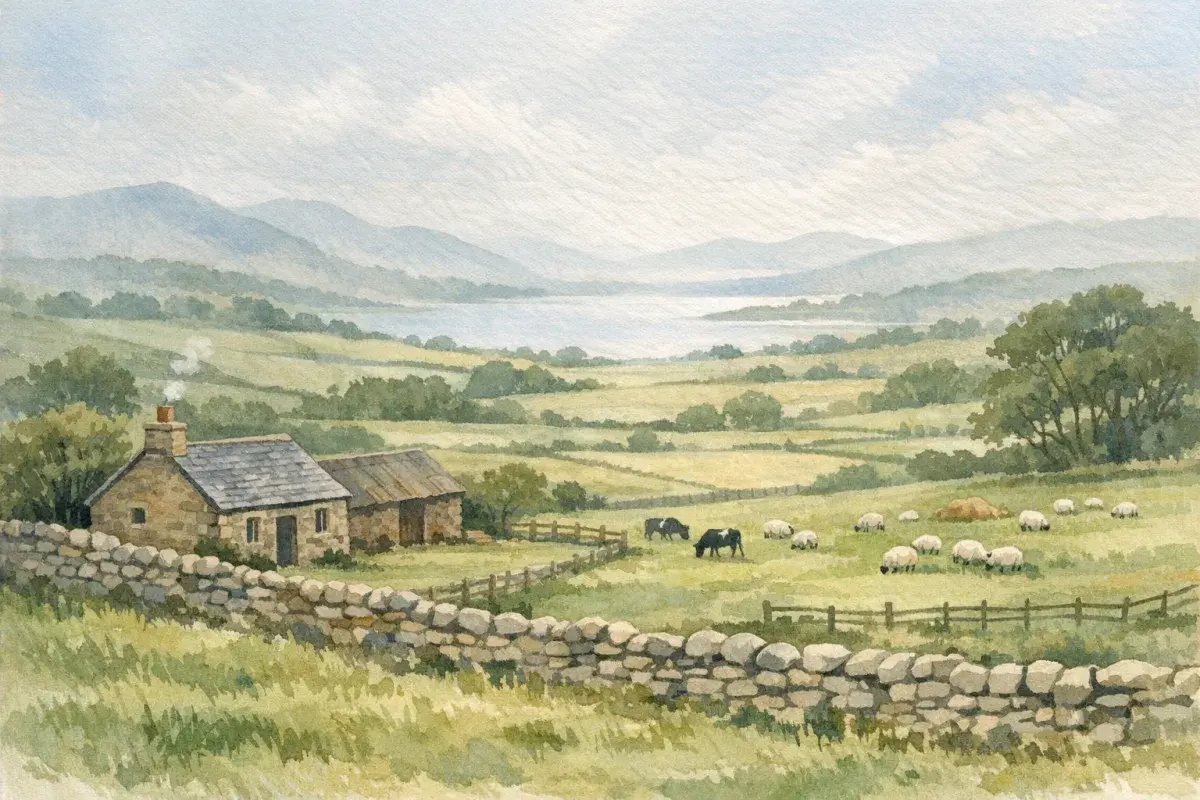
If you've ever looked at a Scottish farm sale brochure and thought, "That's a lot of land for the money," you're not alone. But Scotland doesn't do farmland transactions quite the same way as England, and the differences aren't just cultural. Title conditions can be more nuanced, sporting rights may sit separately, crofting can change the whole legal picture, and the conveyancing process (missives) moves on a different rhythm.
This guide is written for UK buyers who want to buy farmland in Scotland without learning the hard lessons the expensive way. You'll get the market realities, the due diligence you can't skip, the planning and tax gotchas to watch for, and a practical approach to finding a place that actually works for your system and your numbers.
How The Scottish Farmland Market Works
Scottish farmland is a small market in UK terms, and it behaves like one: good units are scarce, competition is lumpy (quiet for weeks, then suddenly intense), and "value" is driven as much by what a holding can become as what it is today. If you're buying farmland in Scotland, you'll do better by understanding the forces behind the asking price than by chasing averages.
Who Sells, Who Buys, And What Typically Comes With The Land
Sellers tend to fall into a few buckets: farming families restructuring, estates rationalising holdings, owners exiting after a tenancy ends, or investors releasing a non-core asset. Buyers are just as mixed, neighbouring farmers looking for scale, new entrants aiming for a manageable starter unit, lifestyle buyers with a farming plan, and investors seeking resilient assets plus alternative income.
What "comes with the land" varies hugely, so don't assume:
- Basic infrastructure (tracks, drainage, water supply, sheds) is a major value driver in Scotland because upgrading it can be slow and costly.
- Sporting rights may be included, reserved, or leased, this matters for income and control.
- Woodland and peat can be an asset (carbon, timber, biodiversity uplift) or a constraint (designations, restoration duties).
- Occupations and informal arrangements (grazing lets, seasonal cropping agreements) can affect possession on day one.
For a Scotland-specific primer on what shifts prices and what to check early, it's worth reading our deeper guide to Scottish agricultural land values and buying rules when you're setting expectations.
Pricing Drivers: Soil, Scale, Location, And Income Potential
In practical terms, price tends to follow four themes:
- Productive capacity: Soil type, drainage, elevation, growing season, exposure, and field size. Prime arable ground (especially where kit can work efficiently) commands a premium.
- Scale and shape: A neat block with sensible boundaries often beats the same acreage in scattered parcels. Fragmentation is more than an annoyance, it's labour, time, and biosecurity risk.
- Location and logistics: Distance to markets, marts, feed suppliers, processors, and, quietly important, contractor availability.
- Income stack: Lettings, renewables potential, timber, sporting, and scheme income can all move a valuation. But buyers often overpay for "maybe" income. Treat potential as potential until it's consented and costed.
One thing we've seen repeatedly: two farms with similar acreages can be worlds apart on a per-acre basis once you price in drainage renewal, access upgrades, or a missing water supply.
Freehold Versus Tenanted Land: What You Are Really Buying
You're not always buying vacant possession.
- Freehold with vacant possession is straightforward in concept, but you still need to verify there's no one with rights to occupy, graze, shoot, or access.
- Tenanted land can be attractive, sometimes at a different price point, but you're buying the landlord's interest and the rent stream, not the operational control. Your options for change (rent review, improvements, resumption, termination) depend on the tenancy type and dates.
Scottish agricultural tenancies have their own framework and terminology, and the detail matters. If a holding is occupied, take time to understand the tenancy category, security, and the tenant's improvements. Our explainer on Scottish agricultural holdings and tenancy realities helps you frame the right questions before you spend money on reports.
The blunt truth: if you need to farm it yourself next spring, you must be very clear on possession, verbally "it should be fine" isn't a plan.
What You Can Buy: Land Types, Uses, And Constraints
"Farmland" in Scotland covers everything from prime combinable units to hill ground where the main output is store lambs (plus a lot of weather). The best buy is the one that matches what you're actually set up to do, and what you can realistically change over time.
Arable, Grass, And Mixed Units: Matching Land To Your System
If you're aiming for arable or high-output grass, pay attention to:
- Field scale and turning space (efficiency matters more than you think)
- Stone, slope, and exposure (wear-and-tear and timing risk)
- Drainage history (old tile systems often need attention)
- Water security (stock water and irrigation are different problems)
Mixed units can be robust because they spread risk: a rotation can stabilise margins, and grass can buffer a bad grain year. But mixed also means management complexity, labour, machinery, and storage need to line up.
Hill Ground, Upland Grazing, And Common Grazings
Hill ground can look like "cheap acres" until you do the maths properly. Productivity may be limited, inputs are higher per unit of output, and weather risk is real.
Key checks:
- Stocking history and practical carrying capacity (not what the seller hopes, what the ground supports)
- Handling facilities and access (you can't manage sheep efficiently without them)
- Common grazings: rights can be valuable, but the governance and practical use need scrutiny. If the holding depends on shared ground, understand how decisions are made and whether your plans fit.
Woodland, Peatland, And Habitat Land: Opportunities And Red Flags
Woodland and habitat land can be a strategic buy, timber income, shelter, sporting value, and biodiversity credits are all part of modern rural economics. But there are red flags:
- Peat depth and condition: peatland restoration can be positive, but it comes with obligations and constraints.
- Designations: SSSIs, SACs, SPAs, National Scenic Areas and other constraints can limit operations and development.
- Access and extraction: woodland is only an asset if you can get timber out without ruining tracks or relationships.
A practical mindset helps: treat "natural capital" as a business line that needs contracts, consents, and long-term management, not a brochure flourish.
Due Diligence Essentials Before You Offer
If you take nothing else from this guide, take this: your due diligence is where you make (or lose) the deal. In Scotland, small legal and practical details can have outsized consequences, especially around access, rights, and what third parties can do on "your" land.
Title, Boundaries, Access, And Servitudes (Easements)
Your solicitor will review title, but you should still understand what they're looking for.
- Boundaries: Are they obvious on the ground? Are fences in the right place? Rural boundary disputes are rarely quick or cheap.
- Access: Do you have a legal right of access from the adopted road? A track you've "always used" isn't the same as a right in title.
- Servitudes: These are Scottish equivalents to easements, rights for access, drainage, water, pipes, and cables. They can be essential (you need them) or restrictive (others use them across your fields).
On viewings, walk the entrance and main tracks like you're driving a silage wagon in February. If it doesn't work then, it won't work when you're under pressure.
Tenancies, Sporting Rights, Mineral Rights, And Wayleaves
This is where buyers get caught out.
- Tenancies and occupational rights: confirm who is in possession, on what basis, and what notice periods apply.
- Sporting rights: in Scotland, shooting/fishing rights may be reserved to a third party, leased, or included. That affects income and your ability to manage deer or control access.
- Mineral rights: sometimes excluded from the sale. That can mean a third party has rights to work minerals, with access provisions.
- Wayleaves: power lines, telecoms, and pipelines often come with payments, but also restrictions and maintenance access.
None of these are automatically "bad". But every one needs to be priced and planned.
Soils, Drainage, Water, Flood Risk, And Environmental Designations
A glossy soil map won't tell you if the land holds water all winter.
What "good" looks like:
- Soil assessment with local context: texture, compaction, pH, organic matter, nutrient indices, plus what neighbouring farmers say about workability.
- Drainage evidence: age of systems, outfalls, maintenance, and any recent improvements.
- Water: private supplies, boreholes, springs, riparian rights, abstraction considerations, and the condition of trough networks.
- Flood risk: check historical events, not just generic mapping: look for silt lines, flattened fences, and debris in hedges.
- Designations and cross-compliance-type obligations: even without getting into scheme detail, you want to know what you can't do.
If the holding includes croft land or sits within crofting counties, the due diligence lens needs to widen, crofting rules under the Crofters (Scotland) Act 1993 can affect use, resale and occupation. For that, see our dedicated resource on crofting land purchases in Scotland, and involve solicitors who do this work routinely.
Scottish Planning, Development, And Change Of Use Reality Checks
Planning is where optimism goes to be tested. Plenty of Scottish rural councils support well-argued rural businesses. But planning permission is never a given, and "it's only a shed" can still become a headache if you get the siting, access, or design wrong.
Agricultural Buildings, New Houses, And Replacement Dwellings
Start with a simple rule: the more your proposal looks like genuine agriculture, the smoother the conversation usually is.
For buildings, you'll want to pin down:
- Use and scale: what's "reasonably necessary" for the enterprise you're running.
- Siting: visual impact, neighbours, access junctions, and proximity to watercourses.
- Services: power, water, drainage, and how you'll manage run-off.
For houses, be cautious. A new dwelling on farmland often needs a strong functional and financial case (or it must fit within specific local policy). Replacement dwellings can be possible, but title conditions, location, and design standards matter. And if there's an existing house with restrictions, read them carefully.
Rural Diversification: What Councils Typically Support
Diversification is a broad church. The proposals that tend to fare better are those that:
- Reuse or sensitively convert existing buildings
- Have safe access and parking
- Show local demand and manageable impacts (noise, traffic, lighting)
- Stack with land-based activity rather than fighting it
Think farm shop, storage, light rural workshops, small-scale tourism, or equestrian (where policy supports it). But do the boring work early: pre-application discussions, ecology checks, and a realistic budget for roads/drainage.
Overage, Clawback, And Development Value: Structuring The Deal
If there's any development angle, housing plots, renewables, mineral potential, expect overage (clawback) to feature.
Overage can be fair. It can also be crippling if it's drafted badly.
What you should look for:
- Trigger events (planning application, consent grant, sale, commencement)
- Percentage and valuation basis (gross uplift vs net of costs)
- Duration (10, 20, 30+ years)
- Security (standard security, title condition, restrictions)
This is solicitor territory, but it's also commercial. You're agreeing what you can do with the asset for decades, so negotiate it like it matters, because it does.
Finance, Tax, And Structuring The Purchase
There's the price, and then there's the cost of buying: tax, professional fees, infrastructure upgrades, and working capital to run the place. Scottish farms can be capital-hungry in year one, especially if you inherit worn fences, tired drainage, or under-specced handling.
Funding Routes: Cash, Bank Lending, And Bridging Considerations
Most buyers use a blend:
- Cash plus term lending: common for established farming businesses and investors.
- Agricultural mortgage: lenders will look at security, income stability, your experience, and sometimes your diversification plan.
- Bridging: can help in chain breaks or where you're buying quickly, but rates and exit plans must be robust.
Your biggest advantage is preparation. Have accounts, forecasts, and a clear plan for the first 24 months. And be honest about what you don't yet know, lenders prefer a cautious borrower to a rosy one.
LBTT, VAT On Land And Buildings, And SDLT Cross-Border Traps
If you're buying farmland in Scotland, the property transaction tax is LBTT (Land and Buildings Transaction Tax), introduced by the Land and Buildings Transaction Tax (Scotland) Act 2013, not SDLT.
Practical points to discuss with your solicitor/tax adviser:
- LBTT rates and reliefs depend on what you're buying (residential elements, mixed use, multiple dwellings, etc.).
- VAT: farmland sales can be VAT-free, but options to tax, commercial buildings, and new builds can complicate things.
- Cross-border traps: if you're buying additional property in Scotland but already own residential property elsewhere in the UK, you may face different "additional dwelling" surcharge rules than you expect.
Don't leave tax as a post-offer afterthought. The wrong assumptions can turn a "good buy" into a stretched one.
Inheritance And Capital Taxes: APR, BPR, CGT, And Relief Conditions
Many buyers are thinking beyond purchase, family succession, long-term investment, or business restructuring.
Key themes:
- APR (Agricultural Property Relief) can reduce Inheritance Tax on agricultural value, but it has conditions around occupation, use, and what counts as "agricultural property."
- BPR (Business Property Relief) may apply to trading businesses, but letting arrangements can weaken claims.
- CGT planning (and reliefs like rollover relief) depends on your structure and intentions.
Reliefs are not automatic, and HMRC scrutiny is real. If your plan involves letting, holiday accommodation, renewables, or non-farming income, get bespoke advice early so you don't accidentally undermine the reliefs you're relying on.
Offers, Missives, And The Scottish Conveyancing Process
Scottish conveyancing has its own logic. The big headline: once missives conclude, the deal is generally binding. So the work you do before that point matters.
Making An Offer: What To Include To Protect Your Position
Your offer should reflect your risk profile and what you still need to verify.
Common protections include:
- Clear conditions around finance (if applicable)
- Title and searches being satisfactory
- Vacant possession or defined occupational arrangements
- Specific inclusions/exclusions: fixtures, equipment, livestock handling kit, stored inputs
- Timescales for conclusion of missives and entry date
In Scotland, buyers sometimes feel pressure to move fast. Move fast on the right things: your solicitor's review, your surveyor's walkover, and your operational checks.
Survey, Valuation, And Specialist Reports: What Good Looks Like
A good rural purchase often involves multiple inputs:
- RICS valuation (especially for lending)
- Building survey for houses and steading conversions
- Farm business review: what's making money and what's being subsidised by deferred maintenance
- Specialist land report: soil, drainage, and practical capability
- Environmental and forestry input where relevant
If you're new to rural transactions, a step-by-step overview helps you sequence tasks and avoid duplication. Our broader guide on how to buy agricultural land in the UK is useful here, then you can layer Scotland-specific checks on top.
From Missives To Completion: Timelines, Deposits, And Possession
Timelines vary with complexity.
Expect:
- Missives negotiation: can be swift for clean titles, slower where rights, access, or tenancies need clarity.
- Completion mechanics: your solicitor handles funds, registration, and settlement.
- Possession: confirm exactly what you get on entry, keys, vacant buildings, and whether any grazing/cropping is still in place.
One practical tip: align entry with the farming calendar where you can. Taking possession mid-winter with no fodder, no handling checks, and no contractor lined up is… a bold choice.
Running The Numbers: Income Streams And Ongoing Obligations
A Scottish farm can be a brilliant asset, but it's rarely a "buy it and forget it" one. The winners are usually the buyers who are clear-eyed about income diversity and relentlessly realistic about ongoing costs.
Lettings, Grazing Licences, Cropping Arrangements, And Renewables
If you won't farm all of it yourself (or you want flexible income), consider structures such as:
- Grazing licences: flexible, but needs careful drafting to avoid creating unintended tenancy rights.
- Contract farming / cropping arrangements: can retain more control while using specialist operators.
- Lettings of houses/cottages: income can be strong, but management and compliance are real work.
- Renewables: wind, solar, hydro, and battery storage can be transformational where viable, but grid constraints, planning, and community engagement can make or break the project.
If your purchase is primarily investment-led, you'll want a disciplined approach to risk and return assumptions. Our guide on buying agricultural land as an investment sets out where returns typically come from and where buyers tend to overestimate them.
Subsidy And Scheme Context In Scotland: What To Check Before You Rely On It
Scheme income is often baked into cashflow projections, but it's not "set and forget". In Scotland, support is evolving, and eligibility hinges on land use, mapping, stocking/activity rules, and compliance.
Before you rely on any scheme-related numbers, confirm:
- What the holding has historically claimed and on what basis
- Any outstanding inspections, disputes, or mapping issues
- Whether land is excluded or constrained by designations
- Whether your intended system fits the scheme requirements
For a Scotland-focused overview of what support can look like, and the practical checks to make before you bank it, see our guide to current farming grants and support in Scotland.
Maintenance Liabilities: Fences, Ditches, Tracks, And Buildings
This is the quiet killer of budgets.
Budget lines buyers often underestimate:
- Fencing and gates (especially boundary lines in exposed areas)
- Ditches, culverts, and track repairs after heavy rain
- Steading roofs and drainage (small leaks become big bills)
- Water systems: troughs, pipes, pumps, filtration
When you view, look for signs of "maintenance deferral": leaning posts, poached gateways, patched gutters, and rutted tracks. None of it is terminal, if you price it and plan it.
How To Find And Secure The Right Farm
Finding Scottish farmland isn't just about scrolling listings. The best outcomes usually come from a clear spec, fast feedback, and a team who understand rural transactions, plus the patience to wait for the right unit rather than forcing the wrong one.
Search Strategy: Specifying Your Must-Haves And Non-Negotiables
Before you book viewings, write down your constraints. Properly.
Consider:
- Non-negotiables: minimum acres, soil type, altitude limit, water supply, buildings, housing, access for HGVs.
- Deal-breakers: no secure access, major designations on core productive land, scattered parcels, unclear sporting/mineral rights.
- Nice-to-haves: river frontage, woodland, potential plots, tourism potential.
Then set your buying logic: are you buying for operational margin, long-term capital, family succession, or a mix? Different goals justify different compromises.
Working With Specialist Scottish Land Agents And Rural Professionals
A good agent can save you months by filtering stock honestly. A good solicitor and surveyor can save you years of regret.
In our experience, the strongest teams tend to:
- Flag title and access issues early
- Know how local planning officers think (and what they've refused before)
- Understand tenancy risk and how to structure licences properly
- Bring in the right specialists, forestry, ecology, renewables, when the holding needs it
If you're comparing options across the UK, it also helps to widen your search method. Our guide on how to find agricultural land for sale across the UK is a useful framework, and you can then narrow it to Scotland-specific realities.
Viewing Checklist: What We Look For On The Ground
A practical viewing checklist beats a second viewing driven by panic.
On site, focus on:
- Access: road junction visibility, turning space, weight limits, track condition
- Water: source, pressure, frost resilience, trough layout
- Soils and drainage: wet holes, rushes, standing water, evidence of drainage outfalls
- Boundaries: fences, ditches, burns, and whether neighbours' use matches the plan
- Buildings: roof condition, concrete, ventilation, power supply, slurry/effluent arrangements
- Neighbour context: nearby houses, public paths, potential conflict points
And ask one question you can't dodge: if you owned it tomorrow, what would you fix first, and what would that cost you in cash, time, and goodwill?
That's usually where the truth sits.
Conclusion
Buying farmland in Scotland can be a strong move, operationally, financially, and personally, but it rewards buyers who stay disciplined. Treat "what's included" as a question, not an assumption. Take tenancies, access rights, sporting interests, and designations seriously. And run the first-year cashflow as if the weather will be unkind and the maintenance list will be longer than the brochure implied.
If you build a clear spec, line up the right rural professionals, and do your due diligence before you emotionally "own" the place, you'll put yourself in a position where a Scottish farm purchase feels exciting for the right reasons, not stressful for the predictable ones.
Disclaimer: AgLand.co.uk is a UK agricultural land and rural property matching service, where buyers register what they are looking for and owners advertise directly to the buyers who match, and a rural resource hub. Nothing in this text is intended as legal, financial, or investment advice. You should carry out your own due diligence and seek independent advice from suitably qualified professionals (such as solicitors, surveyors, tax advisers, and planning consultants) before making any decisions.