
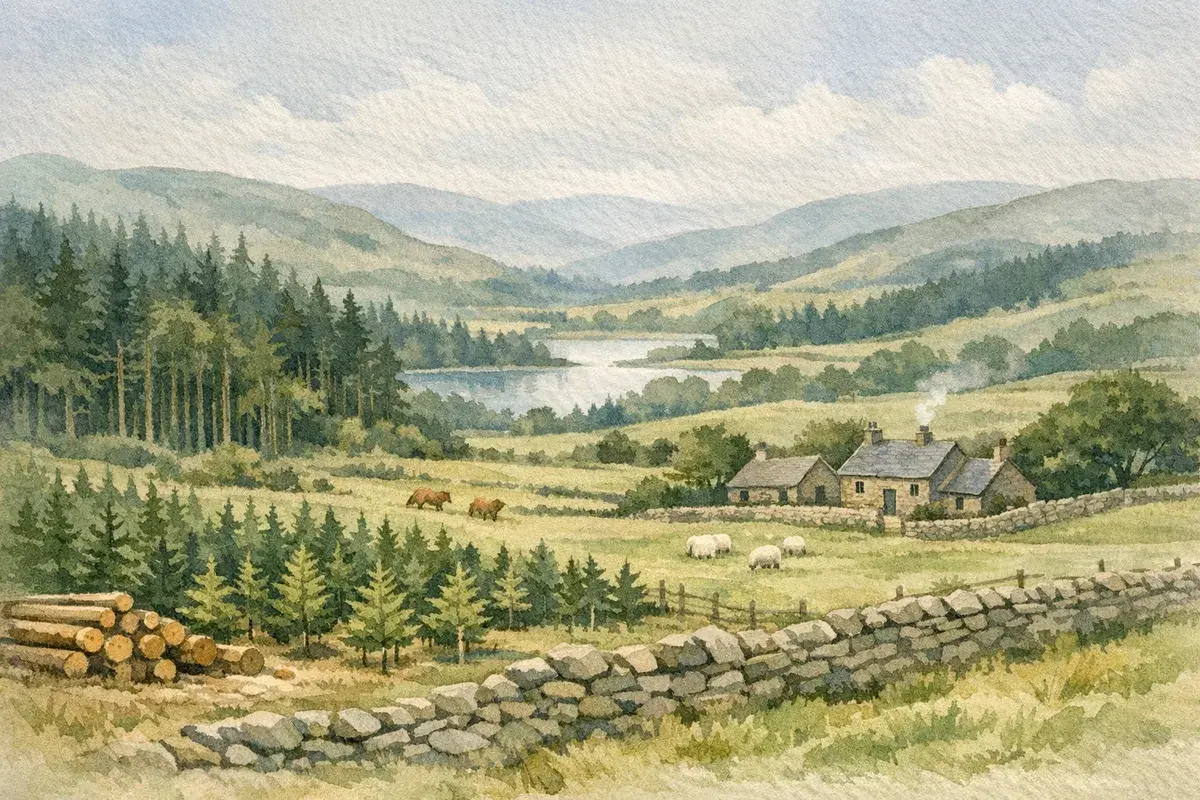
Forestry land in Scotland has a funny way of looking simple on the map, green blocks, tracks, maybe a burn running through it, until you start asking the real questions: Who actually owns the timber? Can you get a lorry in? What's the deer pressure like? Is there peat that changes everything? And if you're buying for carbon, what are you signing up to for the next 30–100 years?
If you're considering forestry land Scotland as an investment, a diversification play, or a long-term family asset, you need more than glossy photos and a hectare figure. You need a grounded understanding of what you're buying, what drives value, what can quietly sink a project, and which professionals you'll want in your corner. This guide walks you through the practicalities, Scottish title quirks, felling permissions, grants, tax touchpoints, day-to-day management, and how to search intelligently, so you can move with confidence rather than hope.
What Counts As Forestry Land In Scotland (And What You’re Actually Buying)
In Scotland, "forestry land" can mean anything from a fully stocked commercial sitka block with an established forest road network to rough grazing with planting potential, to a mixed estate where woodland is only one part of the story.
The catch is that the headline description doesn't always tell you what you're acquiring in legal terms, or what it will cost to turn your plan into something bankable.
Woodland, Commercial Forest, Plantable Ground, And Mixed Estates
Most forestry opportunities you'll see fall into one of these buckets:
- Established commercial woodland: Usually conifer-dominant (often Sitka spruce in the west and north), with measurable yield class, age classes, and a management history. You're buying standing timber value, future rotations, and operational infrastructure (or lack of it).
- Native woodland / conservation woodland: Often smaller, sometimes fragmented, and value leans towards amenity, biodiversity, and long-term stewardship. Income can exist (thinnings, small-scale firewood, habitat payments), but it's usually not "harvest-and-replant" commercial forestry.
- Plantable ground: Bare land where woodland creation is the thesis. Here, the economics swing on peat depth, access, EIA requirements, deer control, and available grants.
- Mixed farms and estates: Woodland can be shelter, sporting cover, riparian planting, or a diversification line. If you're buying alongside farmland, it's worth reading up on how wider rural land value behaves in the same area, our guide to Scottish agricultural land prices is useful context when woodland is part of a broader purchase.
Title, Boundaries, Access, And Servitudes (Rights Of Way, Wayleaves, Water)
In Scottish rural property, the "practical boundary" (a fence on the ground) and the "legal boundary" (the title plan) don't always line up neatly, especially on older titles, hill ground, or where estates historically ran on natural features.
For forestry land, you want clarity on:
- Access rights: Do you have a legal right to use the track you'll need for extraction and haulage, or is it tolerated use? Timber haulage turns minor neighbourly ambiguities into major disputes.
- Servitudes and wayleaves: Rights for utilities (overhead lines, pipes), neighbours' access routes, or water abstractions can affect planting layout, road upgrades, and harvesting operations.
- Water features: Burns and drains aren't just map details. They influence riparian buffers, culvert responsibilities, and sometimes whether ground is viable for creation.
And yes, public access matters. Scotland's access rights are broader than many buyers expect, and while responsible access is the principle, you still need a realistic view of how paths, gates, parking, and signage will work in practice.
Sporting Rights, Mineral Rights, And Timber Rights: Common Scottish Nuances
This is where Scotland can surprise first-time woodland buyers.
- Sporting rights (shooting, stalking, fishing) can be retained, leased, or owned separately from the land in some cases. That matters if deer management is central to successful restocking.
- Mineral rights aren't always included. You may never intend to touch minerals, but lenders and buyers sometimes care.
- Timber rights generally move with ownership, but you still want to confirm there are no unusual reservations, long leases, or third-party interests.
If woodland is being bought as part of a bigger rural holding, it's also worth understanding the wider holding framework and obligations you might inherit, this overview of agricultural holdings in Scotland can help you spot when tenure, occupiers' rights, or management arrangements are part of the picture.
The simplest rule: in forestry land Scotland, never assume the "bundle of rights" is standard. Make it a first-week question, not a last-day panic.
Why People Buy Forestry Land In Scotland
Forestry isn't one market. It's several overlapping markets, timber, carbon, lifestyle, diversification, long-term land banking, each with its own logic and its own red flags.
Timber Income, Carbon Markets, And Natural Capital Uplift
Traditional commercial forestry is still, at heart, about converting sunlight into wood fibre. The financial story is shaped by:
- Rotation and age class: Mature timber can produce near-term cashflow, but you may also inherit restocking duties and a "lumpy" income profile.
- Market access: Price is one thing: getting it to market is another. Poor roading or long extraction distances quietly erode returns.
Then there's carbon and broader natural capital, which can change how buyers price land, especially plantable ground. But carbon isn't free money. You're often signing up to:
- Long-duration commitments (decades)
- Ongoing monitoring and verification
- Restrictions on future land-use change
If your motivation is carbon-led, you need to be brutally clear about who holds permanence liability, what happens if there's windthrow, fire, pest outbreak, or policy change, and whether the contract blocks future flexibility.
Lifestyle, Conservation, And Amenity Value
Plenty of buyers aren't chasing maximum IRR. They're buying woodland because:
- They want a place to work outdoors that isn't a full-time farm
- They value privacy, recreation, and landscape
- They want to restore native woodland, improve habitat, or manage riparian corridors
In these cases, value can sit in location, access, and "useability" rather than yield class. A small, well-situated woodland with solid access and a sensible management plan can be more satisfying (and sometimes more liquid) than a large, remote block that's a logistical headache.
Farm And Estate Strategy: Shelter, Diversification, And Long-Term Resilience
If you already own or operate rural land, forestry can be a practical tool rather than a separate "investment." Think:
- Shelter belts that improve livestock performance
- Diversifying income streams away from purely agricultural margins
- Smoothing weather risk and soil/water management
And if you're looking at mixed purchases, farm plus woodland, your strategy will be stronger if you understand the buying process on the agricultural side too. Our walkthrough on buying farmland in Scotland covers the nuts and bolts that often overlap: access, services, tenancies, and the reality of viewing and offering.
The common thread? The best forestry purchases align the asset with your operational reality. If you don't have time to manage contractors, deer control, and compliance, or you're not budgeting for it, forestry can become an expensive "good intention."
Where To Look And What Drives Value
If you want to understand forestry land Scotland values, stop thinking first about "postcode prestige" and start thinking about biology and logistics: species, growth rates, wind exposure, access to processing, and whether you can physically harvest.
Regions And Terrain: Uplands, Lowlands, And Island Considerations
Scotland's woodland market is shaped by terrain and climate:
- Uplands and west coast: High rainfall, strong growth potential for sitka, but often higher windthrow exposure, steep ground, and heavier extraction costs.
- Lowlands and east: Often better road networks and easier operations: more competition with agriculture and development pressures.
- Islands and peninsulas: Stunning amenity value, but transport and contractor availability can make costs unpredictable.
The Highlands in particular pull together many of the themes, scale, exposure, access, deer, peat. If you're focusing your search there, this guide to Highland agricultural land is a helpful companion, because forestry decisions are rarely isolated from the broader land economics and constraints of the area.
Key Value Drivers: Species Mix, Age Class, Yield Class, And Roading
From a commercial viewpoint, value is usually a combination of:
- Species mix: Sitka can be a workhorse, but diversification can reduce risk (pests, markets, climate). Native species and broadleaves can suit amenity and biodiversity aims.
- Age class profile: A single-age "wall-to-wall" crop can produce big harvest income once… and then require major restocking spend. A mixed age structure can smooth cashflow.
- Yield class and stocking: Better ground grows better trees, but check assumptions, what's on the schedule isn't always what's on the ground.
- Roading and loading areas: This is the unglamorous key. A forest with good internal roads, turning space, and solid loading will often outperform a theoretically "better" crop that's expensive to extract.
A practical way to think about it is this: timber value on paper is only real once you can get the timber safely and legally to a roadside stack.
Practical Constraints: Windthrow Risk, Deer Pressure, Peat, And Watercourses
These four factors can change everything:
- Windthrow: Exposure, soil type, and stand structure drive risk. Historic windblow in neighbouring blocks is a loud signal. Ask what happened in recent storms.
- Deer pressure: High deer numbers can wreck restocking and young trees. If stalking rights are complicated or neighbours won't coordinate, budgets rise fast.
- Peat: Deep peat can limit planting options, trigger EIA issues, and create reputational risk if you're aiming for "green" outcomes.
- Watercourses: They shape buffers, crossings, and machine routes. A few poorly planned crossings can become recurring maintenance and compliance costs.
When you're comparing two listings that look similar in acreage, these constraints are usually where the winner emerges.
Due Diligence Checklist Before You Offer
Forestry purchases can feel deceptively straightforward: there's land, there are trees, there's a price per acre/hectare. But the due diligence is where most of the real work sits, because forestry risk is often hidden until you've got a harvester booked and a neighbour's solicitor on the phone.
Scottish Title Checks: Sasines Vs Land Register, Mapping, And Burdens
In Scotland, some properties are still recorded in the older General Register of Sasines, while others are on the Land Register of Scotland. Either can be perfectly valid, but the practical implications differ.
You (and your solicitor) should be checking:
- Title extent and mapping: Does the title plan correspond to what you're viewing? Are there slivers, gaps, or "march" disputes waiting to happen?
- Burdens and conditions: Old burdens can affect access, building, planting, or use.
- Servitudes: Confirm the rights you need for forestry operations, not just day-to-day access by car.
If you're new to Scottish rural ownership, it's worth understanding how reform and community rights can interact with transactions and longer-term strategy. Our explainer on the Scottish land reform framework sets out the key ideas in plain English.
Designations And Consents: SSSI, SAC/SPA, National Scenic Areas, And Felling Permissions
Designations don't make a purchase "bad", but they do change what's possible and how long everything takes.
Common issues to investigate:
- SSSI (Site of Special Scientific Interest): You may need consent for certain operations: management can be constrained.
- SAC/SPA: European site designations retained in UK law can bring additional protections and assessments.
- National Scenic Areas and local landscape designations: Can influence new tracks, buildings, and sometimes planting design.
- Felling permissions and restocking obligations: If harvesting is planned, confirm the legal route for felling and what restocking is required afterwards.
Bring a forestry consultant into this early. A quick desktop check can save you months.
Environmental And Ground Risks: Peat Depth, Invasive Species, And Contamination
Some of the most expensive surprises come from what's underfoot.
- Peat depth and condition: Deep peat is a major constraint for planting and for track building. Even shallow peat can complicate operations.
- Invasive species: Rhododendron ponticum, Japanese knotweed, and invasive conifers can escalate control costs and restrict grant eligibility.
- Contamination: Less common in remote woodland, but possible near former industrial activity, dumps, or old farm steadings.
If you're buying plantable ground, consider commissioning peat probing and a basic environmental review as part of your pre-offer work.
Neighbouring Uses And Conflicts: Renewables, Sporting, Public Access, And Biosecurity
Woodland doesn't sit in isolation. Before you offer, look beyond your boundary:
- Renewables: Wind and hydro proposals can alter access routes and stakeholder dynamics.
- Sporting: If stalking is commercially important locally, your deer management plan may need coordination.
- Public access pressure: Car parks, well-used paths, and nearby towns change your liability and management approach.
- Biosecurity: If neighbours have active forestry operations, ask about larch disease history, phytophthora issues, and contractor hygiene.
This is the stage where "cheap" land can show you why it's cheap. Don't skip it.
Planning, Regulation, And Grants: What Changes What You Can Do
In Scotland, forestry is regulated in a way that's meant to balance productive land use with environment, landscape, and community impacts. The good news is there's a clear framework. The catch is that timelines and evidence matter.
Felling Licences, Restocking Duties, And Forest Plans (Scottish Forestry)
Most felling requires permission unless an exemption applies. In practice, if you're buying a commercial woodland with harvesting intent, you should assume you'll need:
- A felling permission route that aligns with your harvest plan
- A restocking proposal (species, timing, protection)
- Often, a wider forest plan to set out long-term management and meet regulatory expectations
If a seller talks about "imminent felling" but paperwork is vague, treat that as a due diligence priority. Cashflow forecasts built on unconsented felling are not forecasts, they're wishes.
New Planting: Environmental Impact Assessment, Peatland Rules, And Water Protections
Woodland creation can trigger the Forestry EIA regime depending on scale, sensitivity, and site conditions. Even when it doesn't, you still need to design planting responsibly.
Key practical constraints include:
- Peatland protection: Planting on deep peat is generally inappropriate and can be blocked.
- Water and riparian buffers: Expect constraints near burns, lochs, and drains.
- Landscape and habitats: Open ground isn't "empty" ecologically: it may be important habitat.
This is where buyers sometimes get caught: you pay a price for "plantable" land, then discover only a portion is realistically plantable once peat, buffers, and design constraints are mapped.
Grants And Support: Woodland Creation, Management, And Deer Control Funding
Forestry economics in Scotland often rely on support for establishment and management, especially if your objectives include native woodland, riparian planting, or long-term habitat outcomes.
Your options evolve, so you'll want current guidance, but broadly you'll be looking at:
- Woodland creation support (establishment costs, protection)
- Management funding (thinning, improvements, resilience work)
- Deer control support where it underpins successful regeneration
If you're blending woodland with an existing farm or rural enterprise, it's worth lining up forestry plans with wider rural support. Our roundup of farming grants in Scotland helps you understand the broader landscape so you can avoid designing a project that conflicts with other scheme requirements.
One pragmatic tip: grants can improve viability, but they add compliance and record-keeping. If you hate paperwork, budget for professional support rather than hoping you'll "get to it later."
Buying Structure, Tax, And Finance Considerations
How you buy forestry land in Scotland, personally, through a partnership, a company, or a trust, can materially change tax outcomes, liability, succession planning, and even how easy it is to borrow.
This section is necessarily general: forestry tax can be favourable in some areas, but it's fact-specific and can change with budgets and HMRC practice.
Ownership Options: Personal, Partnership, Company, Or Trust
Common ownership routes include:
- Personal ownership: Simple, but can concentrate liability and may complicate succession.
- Partnership: Useful where woodland is integrated with a trading farm, but needs a well-drafted agreement.
- Company ownership: Can support investment structures and share transfers, but adds admin and different tax treatment.
- Trusts and succession planning: Sometimes used for intergenerational planning, but professional advice is essential.
The "right" answer depends on whether this is a stand-alone woodland investment, part of a working farm, or a family asset intended to be held for decades.
Tax Touchpoints: Income, Capital Gains, Inheritance, And VAT On Timber And Land
Forestry interacts with multiple tax areas:
- Income: Timber sales, leasing income, and certain subsidies can be treated differently depending on circumstances.
- Capital gains: Land value changes and disposals can trigger CGT considerations.
- Inheritance tax (IHT): Reliefs may apply in some circumstances, but don't assume, eligibility can turn on use, structure, and trading status.
- VAT: Forestry and rural transactions often involve VAT questions (options to tax, VAT on timber operations, and contractor invoices).
The practical takeaway: decide early whether your plan is "hold and manage," "harvest and reinvest," or "create and sell," because the tax questions differ.
Borrowing Against Forestry: Valuation, Covenants, And Cashflow Reality
Lenders typically want clarity on:
- Valuation basis: Standing timber, land value, and discounted cashflow from future harvests.
- Covenants: How much leverage is sensible given lumpy timber income.
- Security and access: Legal access and operational feasibility reduce perceived risk.
Forestry cashflow is rarely smooth. You might have years of management costs (roads, fences, deer) before meaningful income arrives, unless you're buying mature timber ready for harvest. Build your finance plan around that reality, not optimism.
If you're comparing woodland against farmland purchases, remember they behave differently, and rules and market drivers differ too. This broader overview of agricultural land in Scotland can help you sense-check how a mixed purchase stacks up.
How To Make Forestry Land Pay (Without Cutting Corners)
"Making woodland pay" in Scotland is often about doing the basics well, consistently, over time. Big wins tend to come from avoiding expensive mistakes: poor contracts, inadequate access, under-budgeted deer control, and signing away upside in long agreements you didn't fully stress-test.
Timber Harvesting Basics: Access, Haulage, Markets, And Contracts
Timber income is operational. A few practical truths:
- Access and loading dictate your contractor options and haulage rates.
- Timing matters: Wet winters, weight restrictions, and local mill demand can shift what's achievable.
- Contracts matter: Know whether you're selling standing, roadside, or delivered. Each shifts risk and responsibility.
If you're not experienced, use a forestry agent/consultant to tender harvesting and haulage. A "mate with a machine" can be fine for small jobs, but commercial harvesting needs robust paperwork, especially around reinstatement, brash management, and damage to roads and drains.
Leasing And Alternative Income: Grazing, Sporting, Telecoms, And Renewables
Depending on location and your objectives, additional income can come from:
- Grazing (especially on mixed ground or recently felled areas, subject to restocking plans)
- Sporting leases (stalking/shooting), but balance income with deer control outcomes
- Telecoms masts / wayleaves where geography suits
- Renewables (small hydro opportunities, or grid-related options nearby)
Be careful with long leases. They can add value, or make resale harder if terms are restrictive.
Carbon And Biodiversity Deals: Heads Of Terms, Permanence, And Who Holds The Risk
Carbon and biodiversity agreements can be attractive, but the hard questions are non-negotiable:
- Permanence and reversal: What happens if trees die, burn, blow over, or are lost to disease?
- Additionality and eligibility: Are you genuinely doing something that qualifies, or will you be rejected later?
- Control and flexibility: Can you still harvest, replant, build tracks, or change species mix?
- Who carries liability: You, your buyer, or a shared buffer mechanism?
A decent heads of terms should make all of this explicit. If it doesn't, slow down.
Done properly, these deals can underpin establishment costs and long-term viability. Done badly, they can lock you into obligations you didn't price, and future buyers will discount for that uncertainty.
Managing Your Woodland Day-To-Day
Day-to-day woodland management is where your plan becomes real. Even if you outsource everything, you're still the decision-maker, and the person eventually responsible for compliance.
Roads, Drainage, Fences, And Ongoing Maintenance Budgets
The unsexy stuff is the expensive stuff.
Budget for:
- Road grading and surfacing (especially after extraction)
- Drainage maintenance to protect roads and reduce erosion
- Fencing and gates (stock control, access management, deer exclusion in some cases)
- Culverts and crossings (these fail at the worst times)
A good rule is to walk the tracks after heavy rain. If you see rutting, ponding, or blowouts, that's not "character", that's a future invoice.
Deer Management, Restocking Success, And Tree Health (Pests And Disease)
In many Scottish areas, deer are the make-or-break factor for restocking and regeneration.
Practical steps include:
- Setting clear cull targets with neighbours or a deer management group
- Planning protection (fencing, guards) realistically, then maintaining it
- Monitoring survival rates, not just planting numbers
Tree health is a moving target. You'll want a plan for surveillance and response for common Scottish issues (for example, phytophthora impacts in some species, or broader biosecurity pressures). Good contractors follow hygiene protocols: great ones document them.
Safety And Liability: Public Access, Insurance, And Contractor Compliance
Scotland's access rights mean you should assume people will be on or near your land at some point.
Protect yourself by:
- Keeping risk assessments and method statements for contractor work
- Using properly insured, competent operators (ask the awkward questions)
- Maintaining signage around active operations
- Holding appropriate public liability insurance and reviewing it when operations change
If you're planning felling near paths or tracks, you need robust exclusion zones and communication. This is not the place for casual arrangements.
The best-managed woodlands aren't necessarily the most intensively worked. They're the ones where maintenance is planned, not reactive.
How To Run A Smart Search And Build The Right Team
A smart search saves you time and money, because in forestry, you can waste months viewing "interesting" blocks that will never fit your objectives.
Search Strategy: Size, Access, Stocking, And Objectives Before You View
Before you book viewings, decide what you're actually trying to achieve. Be specific:
- Minimum viable access: Do you need timber wagon access now, or can you invest in upgrades?
- Stocking and age: Are you targeting near-term harvest cashflow, or long-term creation?
- Your risk tolerance: Windthrow exposure, deer pressure, peat constraints, what can you live with?
- Time and capability: Are you hands-on weekly, or visiting monthly?
If you're blending forestry with farming, be honest about operational overlap. Shelter and biodiversity wins are real, but so are competing demands on your time.
Professionals To Involve: Land Agent, Forestry Consultant, Solicitor, And Tax Adviser
A strong team typically includes:
- Rural land agent: Market knowledge, negotiation, comparable evidence, and access insights.
- Forestry consultant/agent: Crop assessment, yield and harvest planning, grant pathways, EIA screening.
- Scottish solicitor: Title, burdens, servitudes, and transaction mechanics.
- Tax adviser: Structure, reliefs, VAT, and succession planning.
If your purchase is near sensitive habitats or has peat complexity, add an ecologist early. Waiting until after you've agreed a price is how timelines and budgets get away from you.
Viewing Day Questions That Surface Deal-Breakers Early
On viewing day, you're trying to flush out the problems that won't be visible in the sales particulars.
Ask things like:
- "Show me the legal access route, what's the evidence on title?"
- "When was the last extraction, and what did it cost per tonne once haulage was included?"
- "What's the deer management situation, who controls the stalking, and what's the plan?"
- "Are there any designations or pending consents I should know about?"
- "Where are the weak points in the road network after heavy rain?"
- "Any disputes, march issues, or neighbour concerns?"
Then do the simple thing most buyers skip: stand still for a moment and listen. If you can hear a busy road, a shooting line, or a hydro intake nearby, that may be fine, but it should be a conscious choice, not a surprise after completion.
Forestry land Scotland can be an exceptional long-term asset. But the best outcomes come from disciplined searching and a team that's seen the pitfalls before you step in them.
Conclusion
Buying forestry land in Scotland isn't about finding the greenest block on a map. It's about matching ground type, legal rights, operational realities, and long-term obligations to what you actually want, income, resilience, conservation impact, or a bit of all three.
If you take one mindset into your search, let it be this: forestry rewards patience and punishes assumptions. Get access and title clarity early, treat deer and peat as first-order issues (not footnotes), and stress-test any carbon or biodiversity deal as if you'll still be living with it in 20 years, because you might.
When you're ready to act, use a specialist search approach, lean on the right professionals, and keep your decision-making grounded in what's doable on the ground, not just what stacks up in a spreadsheet.
Disclaimer: AgLand.co.uk is a UK agricultural land and rural property matching service, where buyers register what they are looking for and owners advertise directly to the buyers who match, and a rural resource hub. Nothing in this text is intended as legal, financial, tax, or investment advice. You should carry out your own due diligence and seek advice from appropriately qualified professionals (for example, solicitors, surveyors, forestry consultants, accountants, and tax advisers) before making decisions or transactions.