
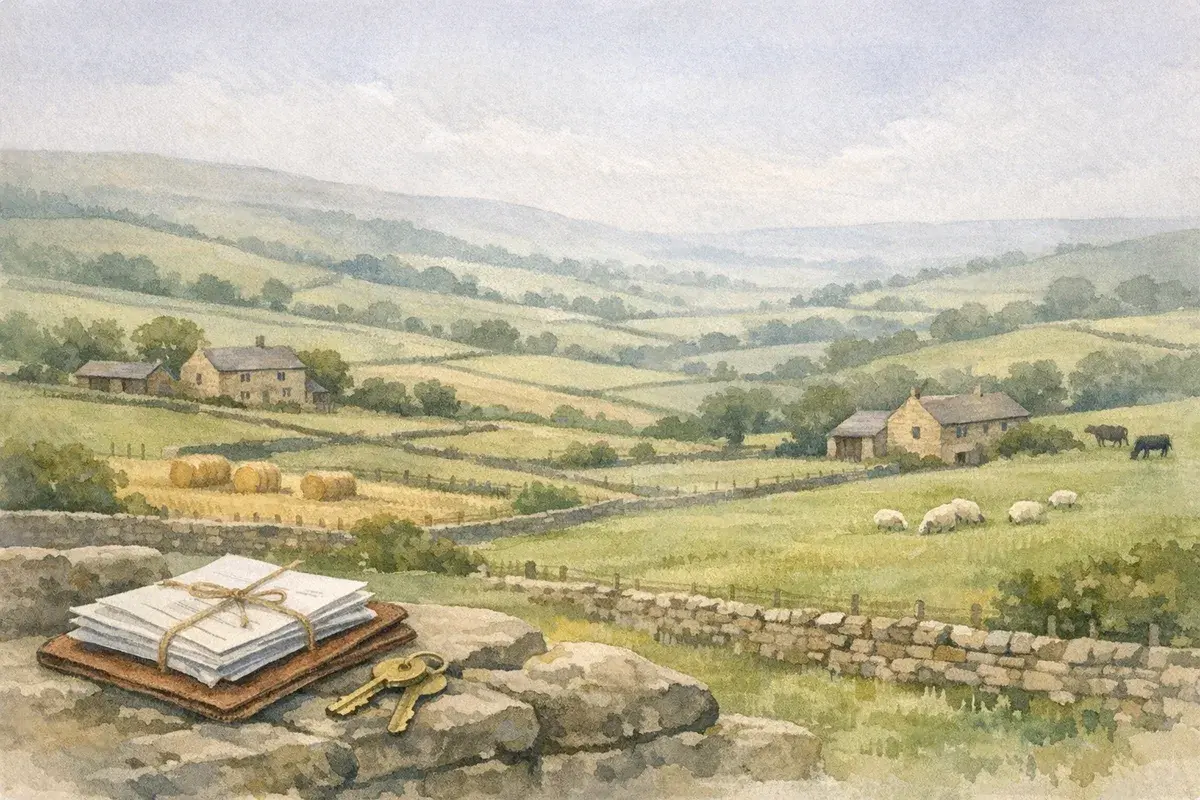
There's a reason "land" keeps cropping up in retirement conversations. Not in the glossy, brochure-y way, more in the quiet, practical way farmers and rural investors talk when they're weighing up what will still hold value in 15 or 25 years.
Buying farmland as a pension investment can make sense in the UK, but only if you're clear-eyed about what you're actually buying: an illiquid, operational asset whose returns depend on rents, policy, weather, tenants, planning, and timing. Done well, it can help diversify retirement wealth away from mainstream markets. Done badly, it can become an expensive hobby, or a tax and compliance headache.
This guide cuts through the noise. You'll see why farmland is being treated like a retirement asset, the main routes to invest (including pension wrappers), what drives value on the ground, the costs and tax angles you must model, and a due diligence checklist that's geared to retirement outcomes, not just "getting a deal over the line."
Why Farmland Is Being Treated Like A Retirement Asset
Farmland has always been a store of wealth in the UK. What's changed is how often it's being discussed in the same breath as pensions and long-term portfolio planning, especially as people look for assets they can understand, touch, and control.
There's a very down-to-earth psychology here: you can't print more land, and you can often see demand drivers coming (food production, environmental markets, renewables, lifestyle buyers, infrastructure). But farmland isn't a magic money tree. It's a long game with rules.
Income, Capital Growth, And Inflation Hedging
In retirement terms, you're typically chasing one of three things (or a blend):
- Income: rent from a Farm Business Tenancy (FBT), a grazing licence, or (in some cases) income from diversification/renewables.
- Capital growth: long-term appreciation in land values, sometimes boosted by structural shifts (local scarcity, strong farming fundamentals, lifestyle pressure) and occasionally by planning or diversification uplift.
- Inflation hedging: land is often perceived as an inflation-resilient asset because it's real, finite, and tied to essentials.
In practice, farmland income in many areas is modest compared to the capital value. That's not a deal-breaker for a pension-style strategy, it just means you should treat yield as supporting cashflow rather than the whole story. If your plan depends on a high annual yield, you'll need to be far more selective about location, tenancy structure, and non-farming income potential.
If you're still working out whether land stacks up versus other long-term assets, it helps to ground yourself in what returns actually look like and where they come from. AgLand's view on agricultural land investment returns is a good starting point for understanding the blend of yield and capital appreciation (and why they vary so much).
Where Farmland Can Underperform: Liquidity, Volatility, And Time Horizons
Here's the catch: buying farmland as a pension investment often goes wrong when people expect it to behave like a listed fund.
- Liquidity is limited. You can't click "sell" on a wet Tuesday. Sales can take months, and market conditions matter.
- Volatility is real, just slower. Values don't reprice daily, but they do move, sometimes sharply at the local level (a big neighbour buying, a policy shift, a local development change, or a run of poor seasons affecting sentiment).
- Time horizons can be unforgiving. If you must exit at a particular moment (to fund retirement spending, for example), farmland may not cooperate.
And there's concentration risk: a single block of land is one asset in one place, exposed to local factors like access, flood risk, and nearby schemes. That's why a retirement-driven approach should start with your risk profile and exit plan, not the romance of ownership.
If you want a broader framing of the pros/cons, without pretending farmland is risk-free, see AgLand's analysis on is farmland a good investment.
Ways To Invest: Direct Ownership Versus Indirect Routes
When people say they're "investing in farmland for retirement", they could mean wildly different things, from buying 20 acres next door to taking a small allocation in a pooled vehicle. Your route affects everything: risk, admin burden, tax position, and how easily you can exit.
Buying Land Outright Or With Borrowing
Direct ownership is the most straightforward conceptually: you own the title, you make the decisions, and you carry the responsibility.
If you buy outright, your return is largely driven by:
- rent (if you let it)
- capital growth
- any uplift you legitimately create (improved water, access, drainage: reconfiguration: diversification)
Borrowing can boost returns if the income and growth comfortably outpace the cost of debt. But leverage also magnifies stress in the wrong conditions, particularly if you're relying on rent to service repayments or you're forced to refinance in a higher-rate environment.
A practical reality: lenders will scrutinise tenure, occupancy, and "what the land is actually used for." Land with clean access, sensible boundaries, decent soil data and a straightforward letting history is usually easier to finance than awkward parcels with constraints and disputes.
Letting Land On A Farm Business Tenancy Or Grazing Licence
If your aim is pension-like income, you'll spend a lot of time on the boring stuff: tenancy terms.
- Farm Business Tenancy (FBT): typically offers more structure and security of income, but your flexibility depends on term length and break clauses.
- Grazing licence: can be more flexible and short-term, but it must be drafted properly. If it drifts into the territory of a tenancy in substance, you can create rights you didn't intend to grant.
Retirement-minded buyers often prefer:
- clear rent review clauses (and a sensible approach to evidence)
- repair and boundary responsibilities spelled out
- a tenant with a track record and adequate insurance
And don't ignore the practicalities: who manages the relationship, who checks compliance, who deals with hedges, ditches, gates, fly-tipping, and the occasional "urgent" phone call?
If you're leaning towards a hands-off approach, it's worth reading up on passive farmland investment, because "passive" in rural property usually means "professionally managed," not "set and forget."
Pooled And Listed Options: Funds, REIT-Style Vehicles, And Crowdfunding
Indirect routes exist for a reason: they can reduce concentration risk and simplify admin.
You might look at:
- pooled farmland funds (where a manager buys and runs a portfolio)
- listed vehicles with land exposure (price moves daily: different risk profile)
- crowdfunded/mini-bond style offerings (be cautious: structure, liquidity, and protections vary massively)
These can be appropriate if you want exposure without the headaches of ownership, but you're swapping control for governance and fees. You also need to understand what sits underneath: is it bare land, tenanted farms, development edge, environmental projects, or something else?
For a UK-specific overview of structures and what to look for in the fine print, AgLand's guide to farmland investment funds UK is a useful framework, especially for comparing liquidity, fees, and how returns are generated.
How Farmland Can Sit Inside A Pension Wrapper
This is where things get technical, and where people can get themselves into trouble by assuming "it's property, so my pension can buy it." Sometimes it can. Sometimes it really can't.
SIPP And SSAS Basics: What They Can Buy And What They Cannot
In broad terms:
- A SIPP (Self-Invested Personal Pension) can hold a range of investments, but what's permitted depends on the scheme provider and the nature of the asset.
- A SSAS (Small Self-Administered Scheme) is typically used by owner-managed businesses and can be more flexible in certain contexts.
The key issue for farmland is whether the investment is treated as a permitted asset and whether any part of it creates problems such as taxable property concerns or prohibited use.
Land that is genuinely agricultural and held on appropriate terms may be feasible in some pension structures, but providers can be cautious. They'll look closely at valuation, liquidity, governance, and ongoing administration. The cleanest cases tend to be bare land let on clean, evidence-backed terms, because pension rules treat residential property as taxable property and a farmhouse or cottage on the holding is where most providers stop, a problem worked through in our guide to holding agricultural land in a SIPP alongside the connected-party rules.
If you're at the early stage of understanding routes and constraints, it can help to read a broader primer on investing in farmland for beginners and then layer pension-specific advice from your regulated adviser.
Connected Parties, Personal Use, And The Practical ‘Do Not Cross' Lines
If you remember one thing here, make it this: pension investments and "personal use" do not mix.
The danger areas often include:
- buying land from (or leasing to) connected parties without proper structure and valuation
- using pension-owned land for your own farming operation without compliant documentation
- allowing any element that looks like personal benefit (storage, horses, informal occupation, "it's only a bit of parking")
Even where something feels harmless day-to-day, pension rules can treat it as a serious breach with tax consequences. This is not a DIY corner of rural property.
VAT, Leases, And Day-To-Day Administration Inside A Pension
Owning farmland inside a pension wrapper isn't just a purchase decision: it's an administration commitment.
You'll need to plan for:
- VAT position: whether the land is opted to tax (or whether any buildings/rights complicate matters)
- leases and invoicing: rent collection, rent reviews, and arrears management
- valuations: regular, defensible valuations (often required by the provider)
- professional fees: trustees, administrators, accountants, and agents
If your pension strategy relies on low friction, these ongoing demands matter. The "headline" return can be quietly eroded by governance and professional costs, especially for smaller parcels.
This is also where specialist advice pays for itself: a rural solicitor who understands pension constraints, a tax adviser who can model outcomes, and a land agent who can set terms that stand up to scrutiny.
What Actually Drives Farmland Value In The UK
If you're buying farmland as a pension investment, you're not just buying acreage, you're buying a bundle of attributes. Two 50-acre blocks can be priced miles apart for reasons you won't spot from a satellite view.
Soil, Water, Access, And Field Layout
The fundamentals are still the fundamentals:
- Soil type and capability: not just "is it Grade 2?" but how it performs in wet springs, how it holds structure, and what it costs to work.
- Water: availability (and rights), stock water practicality, and drainage reality.
- Access: not only a legal right of access, but usable access for modern kit, with turning space and no low bridges.
- Field layout: awkward shapes, narrow gateways, ransom strips, and internal tracks can all affect both rent and long-term buyer demand.
For pension-style investing, you're often better off with land that's easy to understand and easy to let. "Quirky" can be cheap, but it's rarely passive.
Tenure, Occupation, And Subsidy/Stewardship Position
Value is heavily influenced by who's in occupation and on what terms.
- Vacant possession tends to be more flexible (and often more expensive).
- Tenanted land can be attractive for steady income, but the tenancy terms drive the price.
Then there's the stewardship/subsidy angle. In the UK, the shift away from Basic Payment Scheme towards schemes like the Environmental Land Management offer (in England) has changed what buyers ask:
- Are there existing agreements?
- What obligations run with the land?
- How does that affect management flexibility and rental appetite?
You don't need to be an environmental policy specialist, but you do need the paperwork, the maps, and a clear view on what can (and can't) be changed.
Planning, Diversification Potential, And Uplift Scenarios
Planning is where people get starry-eyed, and where pension-driven buyers should be ruthlessly realistic.
Some land carries credible uplift potential:
- existing buildings with lawful use and a sensible conversion story
- locations near settlements where policy might support limited development
- land suited to renewables (subject to grid and planning constraints)
Other land has "hope value" that's basically a pub conversation.
A good retirement asset isn't one that might 10x if everything goes your way. It's one where you can defend the base value on agricultural fundamentals, with optional upside that doesn't sink you if it never happens.
For a deeper UK-specific breakdown of what makes land investable (and how to plan a purchase properly), AgLand's guide on buying agricultural land as an investment is designed to help you sanity-check assumptions before you commit.
Costs, Taxes, And Reliefs To Model Before You Buy
Retirement investing is won and lost in the modelling. Farmland can be tax-efficient in the right circumstances, but the reliefs people assume are "automatic" often come with conditions, and timing matters.
Stamp Duty Land Tax, VAT, And Ongoing Holding Costs
On purchase in England and Northern Ireland, Stamp Duty Land Tax (SDLT) may apply depending on the nature of the land and any residential element. (Scotland uses LBTT: Wales uses LTT.) The presence of a farmhouse or dwelling can change the analysis dramatically.
Then consider:
- legal fees, searches, and Land Registry costs
- agent and survey fees
- insurance (public liability isn't optional in practice)
- fencing, ditches, hedges, gates, and access maintenance
- professional management if you're not local
VAT is a frequent tripwire. Some land transactions are exempt: some are opted to tax: some involve buildings, rights, or commercial arrangements that change the treatment. Treat VAT as a question for your adviser, not a guess.
Income Tax Versus Corporation Tax On Rental Income (And When It Matters)
If you let the land, the rental income will be taxable, how it's taxed depends on the ownership structure.
- Individuals will typically see rental profits taxed under Income Tax rules.
- Companies pay Corporation Tax on profits.
The "best" route depends on your wider circumstances, pension planning, and whether the land is part of a trading operation or a pure investment. You also need to be careful about expenses: what's allowable, what's capital, and what's private.
If you're specifically trying to optimise structure for a retirement plan, it's worth reading AgLand's guide on tax efficient farmland investment and then taking that framework to a tax adviser who can model it against your numbers.
Capital Gains Tax, Rollover Relief, And Timing Sales
When you sell, Capital Gains Tax (CGT) may apply. But reliefs can be available in certain scenarios, particularly where land is connected to a trading business and you're reinvesting.
Timing is not a footnote. If your retirement plan assumes you'll sell a block in year X to fund pension drawdown, you need a Plan B for:
- a slower market
- a buyer pool that's thinner than expected
- tenants in place that affect vacant possession
A sensible pension-driven strategy often uses "staggered optionality": owning land that can be sold as a whole, but also in parcels if needed, without destroying value.
Inheritance Tax: APR, BPR, And The Risk Of Losing Relief
Inheritance Tax (IHT) is where farmland has historically been compelling, largely because of reliefs such as:
- Agricultural Property Relief (APR), subject to conditions about agricultural use and occupation
- Business Property Relief (BPR) in some trading contexts
From 6 April 2026, 100% relief under APR and BPR combined is limited to the first £2.5 million of qualifying property, with 50% relief above that.
Pensions are changing too. From 6 April 2027, most unused pension funds and death benefits will count towards the value of your estate for inheritance tax, so holding land inside a pension will no longer keep it outside your estate. Funds passing to a spouse or civil partner stay exempt. See HMRC's technical note.
But the risk is real: change the use, change the occupation pattern, or lean too hard into non-agricultural income without structuring properly, and relief expectations can fall apart.
This is one of those areas where generic online advice is genuinely dangerous. Get your tax adviser involved early, especially if you're combining farming, letting, diversification, and pension planning.
For a wider due diligence lens that ties risks and returns together, AgLand's resource on agricultural land investment is a solid companion to your professional advice.
A Practical Due Diligence Checklist For Retirement-Driven Buyers
If you were buying a pension fund, you'd expect layers of diligence. Land deserves the same discipline, especially because problems don't show up as a red number on a screen. They show up as a solicitor's letter, an angry neighbour, or a tenant who won't move.
Title, Rights Of Way, Easements, And Minerals
Start with what you actually own.
Check:
- title plan accuracy (boundaries on the ground vs plan)
- rights of way (public and private) and whether they cut across workable field layouts
- easements for water, drainage, access, and services
- ransom strips and third-party ownership oddities
- minerals, sporting rights, and whether anything has been reserved
If you want pension-like certainty, you want title that's boring, in the best way.
Environmental Constraints, Designations, And ELM Agreements
Environmental factors can enhance long-term value (and income opportunities), but they can also restrict your options.
Look for:
- SSSI/AONB/National Park constraints (where relevant)
- protected habitats and species constraints
- existing Countryside Stewardship or ELM-style agreements: obligations, term, payment profile, penalties
- historic landfill, contamination risk, or unusual past uses
Ask for documentation early. If the seller can't produce it, assume delays.
Tenants, Wayleaves, Telecoms, And Renewable Options
Income and third-party rights can make or break your retirement strategy.
Review:
- tenancy documents, rent schedule, arrears history, and disputes
- wayleaves and easements (electricity lines, water mains, pipelines)
- telecoms agreements and mast rights
- renewable leases/options (solar/wind) and, crucially, their breaks, indexation, and assignment clauses
Renewable potential is often discussed as "free money." It isn't. Grid constraints, planning risk, and contract terms determine whether it's a genuine upside or a liability.
Flood Risk, Drainage, And Soil Health Evidence
Climate resilience is no longer a niche consideration.
You'll want:
- flood risk indicators and local knowledge (not just a map screenshot)
- evidence of drainage maintenance, outfalls, and any recurring issues
- cropping history where available
- soil health indicators (organic matter, compaction issues, pH, nutrient profiles)
A retirement-driven buy is often about avoiding nasty surprises. So treat local knowledge as data: talk to neighbouring farmers, local contractors, and (where appropriate) the Internal Drainage Board area context.
One final, slightly unfashionable point: inspect properly. Walk boundaries. Open gates. Look at ditches. If something feels "off", it usually is.
Building A Pension-Focused Land Strategy
Buying farmland as a pension investment isn't just a purchase, it's a strategy you'll live with. You'll make better decisions if you define, upfront, what success looks like in retirement terms.
Choosing A Region And Farm Type That Matches Your Risk Profile
Start with your constraints:
- Do you need income now, or later?
- How hands-on can you realistically be?
- Do you need the option to sell quickly, or can you hold through cycles?
Then match farm type:
- arable land often suits clean, let-and-manage strategies (where soil and access are strong)
- grassland can be resilient and locally liquid, but yield and tenant demand are area-dependent
- upland/rough grazing can suit long-term environmental strategies, but it's not automatically "safe" as an investment
Region matters too. Liquidity, neighbour demand, and local buyer pools vary. If your exit plan relies on selling, you need confidence that there will be buyers beyond "one big neighbour."
Yield Planning: Rent Expectations, Review Clauses, And Vacancy Risk
For pension-style cashflow, get specific:
- What rent is realistic net of costs?
- How often can rent be reviewed, and what evidence will you use?
- Who pays for boundaries, water troughs, or track upkeep?
- What happens if the tenant leaves, how long could it sit empty?
Don't over-optimise. A slightly lower rent from a strong, reliable tenant can be worth more than a top-of-market figure that leads to disputes or churn.
Exit Planning: Break Clauses, Overage, And Selling In Parcels
Retirement investing is future-you's problem. Make it easier for them.
- Break clauses: If you want optionality, don't lock yourself into terms that prevent a sensible sale window.
- Overage: If there's development hope value, overage can protect the seller or the buyer, but it can also spook future purchasers if it's drafted aggressively.
- Selling in parcels: Sometimes the best exit is not "sell the farm," but "sell 30 acres, keep 70." That requires access, sensible boundaries, and services.
A good land agent will challenge your assumptions here. If your plan is "I'll just sell it when I retire," push deeper: sell to whom, in what lotting, and with what constraints?
And if you're aiming to keep involvement minimal, remember that passive ownership still needs active strategy. The land doesn't manage itself: you're just delegating the management.
How To Find Suitable Farmland And Assemble The Right Team
The best retirement-style land deals are often the ones you nearly miss, because they don't fit a generic property search filter and they don't always shout about themselves.
Using Specialist Search Tools, Comparable Evidence, And Off-Market Networks
Your edge comes from specificity.
- Search by what matters: soil type, access quality, lotting, water, tenure, and local buyer behaviour.
- Build a comparable evidence file: not just asking prices, but what actually completed, and why.
- Use networks: local agents, surveyors, and farmers often know what might come up before it hits the wider market.
On AgLand you set out what you need once - type, acreage, budget and area - and are alerted when a property matches, rather than checking portals for stock that was never relevant. The aim is to help you spend your time on the handful of opportunities that match your pension strategy, not the hundreds that don't.
Who To Instruct: Land Agent, Rural Solicitor, Surveyor, Tax Adviser, And Planner
If you're serious about buying farmland as a pension investment, your professional team is part of the "asset".
At minimum, you'll usually want:
- Land agent: for appraisal, negotiation, local comparables, and tenancy structuring.
- Rural solicitor: for title, rights, covenants, and drafting leases/licences correctly.
- Surveyor/valuer: especially where pension wrappers, valuation requirements, or mixed-use elements exist.
- Tax adviser: to model ownership structure, reliefs, and the knock-on effects on your wider plan.
- Planner (where relevant): to sanity-check diversification and uplift claims.
Agents we work with will often say the same thing: most expensive mistakes aren't "overpaying by a bit", they're buying land with a hidden constraint that limits letting, blocks access, or makes exit difficult.
So when you're viewing, don't just ask "what's the rent?" Ask: what's the story if I need to sell in ten years? That question changes what you notice.
If you want a structured buying plan that complements the checklist above, revisit AgLand's guide to agricultural land investment alongside your own numbers and adviser input.
Conclusion
Buying farmland as a pension investment in the UK can be a sensible, durable move, particularly if you value tangible assets, want diversification beyond mainstream markets, and can commit to a long time horizon. But it only works when you treat it like a disciplined investment, not a sentimental purchase.
Get clear on your route (direct, indirect, or via a pension wrapper), model costs and tax properly, and do diligence with the same seriousness you'd expect from any retirement vehicle. Then build a strategy around income resilience and a realistic exit, because that's what turns "land" into a retirement asset you can actually rely on.
Disclaimer: AgLand.co.uk is a UK agricultural land and rural property matching service, where buyers register what they are looking for and owners advertise directly to the buyers who match, and a rural resource hub. Nothing in this text is intended as legal, financial, tax, or investment advice. You should do your own due diligence and take advice from appropriately qualified professionals (for example, a rural solicitor, chartered surveyor/valuer, regulated financial adviser, and tax adviser) before making decisions.