
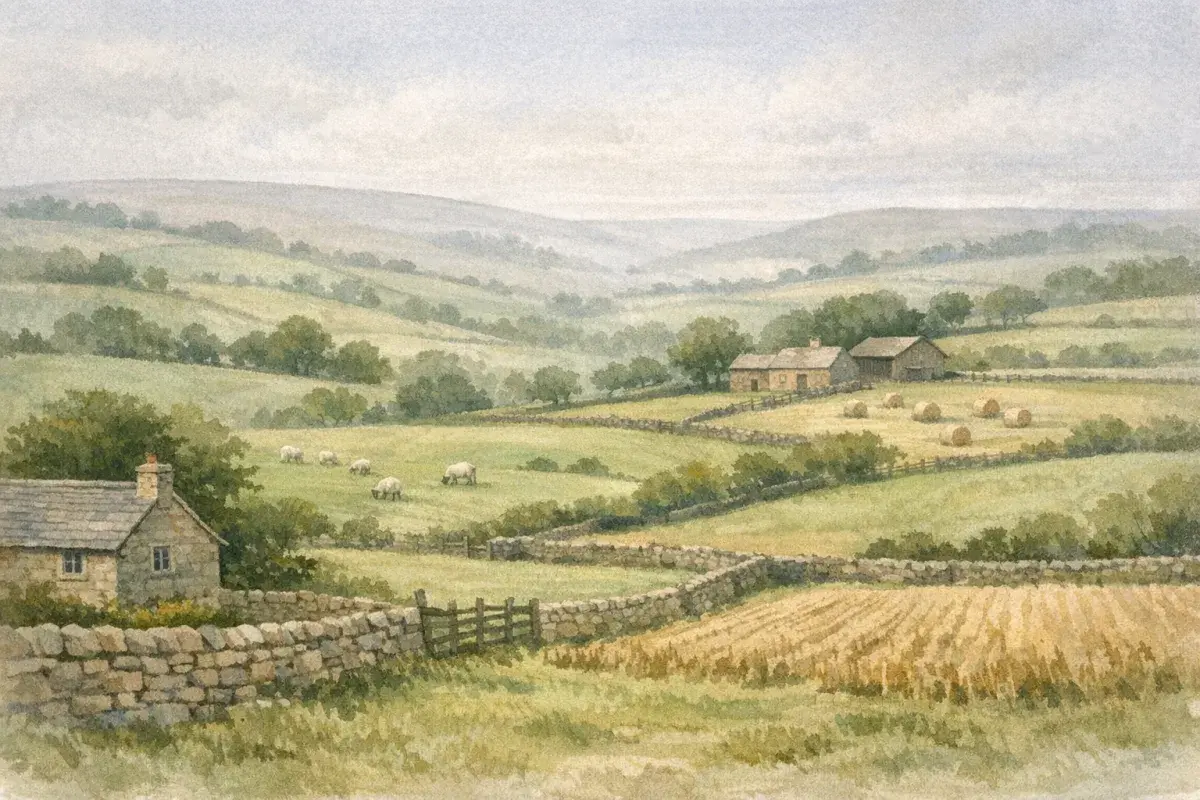
Putting agricultural land into a SIPP (self-invested personal pension) sounds, on the face of it, like a tidy bit of joined-up thinking: you like land, you understand land, and you'd rather your pension was backed by something you can walk, measure, drain, fence, rent out and, sometimes, improve.
But SIPPs aren't "just another buying entity". They sit inside a tightly controlled HMRC pensions framework, and farmland is one of those asset classes that looks simple until you hit the detail: what counts as taxable property, who can use what, how rent has to be set, how borrowing works, and what you quietly give up compared with owning land personally (or through a trading business).
This guide is UK-only and deliberately practical. You'll come away knowing what a pension can realistically buy, where people get caught out (farmhouses and mixed use are the usual culprits), how the transaction runs, and what you should be doing from day one to keep it compliant and saleable later.
What It Means To Hold Agricultural Land Through A SIPP
Buying agricultural land via a SIPP means your pension scheme becomes the legal owner of the land, and the asset is held for the benefit of you (and other members, if it's a group arrangement) under pension rules.
A few implications follow immediately:
- The land isn't "yours" personally. You can't treat it like a personal holding, even if you're the one who sourced it.
- Everything has to be on commercial terms. Rent, licences, any works, any services, documented and benchmarked.
- You generally can't take personal enjoyment or private benefit from the land. "I'll just keep a few horses there" or "I'll camp there occasionally" is the sort of casual thinking that can become expensive.
- Your SIPP provider (or administrator) will have a say. Many providers will only accept specific property types, require professional valuations, insist on certain lease terms, and may refuse anything that looks remotely residential or complex.
In practice, most successful agricultural land SIPP holdings are straightforward bare land or uncontroversial commercial farmland let out on clean, evidence-backed terms.
Why Investors Consider It (And When It Usually Falls Down)
You'll see three common motivations:
- Long-term asset backing: farmland is tangible, scarce, and often behaves differently to mainstream equities and bonds.
- Rental income: a Farm Business Tenancy (FBT) or licence can produce regular income inside the pension.
- Portfolio diversification: for people heavily exposed to a single business or property type, land can spread risk.
Where it tends to fall down is equally predictable:
- Anything that drifts into residential (farmhouse, cottage, annex, "potential dwelling") becomes a major pensions tax red flag.
- Connected-party use gets sloppy (you rent it from your own SIPP at a "friendly" rent, do improvements without paperwork, store personal kit there, or use it in your trade without a proper lease and valuation evidence).
- Liquidity is ignored: land can take time to sell, and pensions eventually need to pay benefits.
- The investor assumes pension ownership equals "IHT-smart ownership". A SIPP can be helpful in estate planning, but it is not the same as Agricultural Property Relief (APR) or Business Property Relief (BPR) planning on personally held/trading assets.
If you're thinking about expected performance, it helps to separate the two drivers, annual yield and long-term uplift, because they behave differently in different regions and across different land types. We've gone deeper on this in our guides to understanding agricultural land investment returns and the realities of agricultural land capital appreciation in the UK market.
SIPP Eligibility: What Land A Pension Can And Cannot Buy
At a high level, UK registered pension schemes (including SIPPs) can hold commercial property, and that can include agricultural land.
The problem isn't "farmland" as a category: it's whether the asset is treated as taxable property (most notably residential property) or whether the way you/connected parties interact with it creates an unauthorised payment or prohibited benefit.
Because your SIPP provider is on the hook for compliance admin (and reputational risk), they often apply stricter practical rules than the bare minimum legislation.
Bare Land Vs Farmland With Buildings
In SIPP terms, bare agricultural land is usually the cleanest proposition:
- minimal ambiguity
- easier valuation
- straightforward lease/licence documentation
- lower risk of "accidental residential"
Farmland with buildings can still be workable, but you need to be precise about what they are and how they're used:
- Barns, modern ag stores, general-purpose buildings used wholly for farming/commercial purposes are often acceptable.
- Yards with multiple uses (storage, small workshops, occasional residential ancillary use) can become messy quickly.
- Derelict buildings can be a trap if there's an obvious route to residential conversion, even if that's not your plan.
A good rule of thumb: if you can describe the asset to a cautious third party without using the word "potential", it's usually easier to place into a SIPP.
Residential Property, Farmhouses, And Mixed-Use Red Flags
This is where most agricultural land SIPP conversations get uncomfortable.
UK pension rules treat residential property as "taxable property" for registered pension schemes, and the tax consequences of getting this wrong can be severe. The typical farmland edge cases include:
- a farmhouse (even if it's "integral" to the holding)
- a cottage, bungalow, static caravan used as a dwelling
- a building with habitable accommodation, even if currently empty
- mixed-use where there's a genuine residential component on the title
Even where you think it's "mostly land", the presence of a residential element can make a SIPP purchase a non-starter with many providers.
Mixed-use doesn't automatically kill it, but it raises the bar:
- you'll likely need specialist tax and pensions advice
- you may need a split valuation and very careful legal drafting
- your provider may simply refuse it
This is also the point where your land search discipline matters. If you're building a shortlist, focus on land that is unambiguously agricultural/commercial, and then work outward. Our practical buying guide for finding and assessing agricultural land for sale in the UK is written with exactly these real-world constraints in mind.
How A SIPP Purchase Works In Practice
A SIPP land purchase feels similar to a normal land transaction, until you get into documentation, valuations and the provider's timetable.
You're essentially coordinating four moving parts:
- your SIPP provider/administrator (their requirements and process)
- your solicitor (who must be comfortable with pension property work)
- the seller's solicitor
- your valuer/agent (for market rent and market value evidence)
If you've only ever bought land personally, expect more "paperwork gravity" here. It's not bureaucracy for the sake of it: it's because HMRC expects registered pension schemes to avoid personal benefit and to evidence arm's-length terms.
Funding Options: Contributions, Transfers, And Borrowing Limits
Most SIPPs fund land purchases through a combination of:
- existing SIPP cash
- new contributions (subject to your personal circumstances and the pensions tax rules that apply to you)
- transfers from other pensions
- borrowing within the scheme
On borrowing: a SIPP can borrow, but there are limits and lender requirements, and not every provider supports borrowing for every type of property. In practice, borrowing tends to be more straightforward when the asset is clean, lettable, and simple to value.
Two practical cautions:
- Don't plan on last-minute funding. Land transactions can move quickly, but pensions money often doesn't.
- Budget for costs outside the purchase price. Your SIPP must cover professional fees, provider charges, valuation fees, and ongoing property costs. If the SIPP is cash-tight, that becomes a compliance risk.
Transaction Steps: Offer, Due Diligence, Completion, And Registration
A sensible "SIPP-ready" sequence looks like this:
- Agree heads of terms that already reflect SIPP realities (no informal occupation, clear boundaries, and a clean commercial use).
- Provider approval in principle before you spend heavily on due diligence.
- Valuation and market-rent evidence commissioned to the provider's standards.
- Legal due diligence: title, rights, restrictions, tenancies, access, utilities, overage, sporting/mineral reservations, and any environmental constraints.
- Completion with your SIPP as purchaser and the correct execution formalities.
- Registration at the relevant UK land registry, with the SIPP trustee/administrator shown appropriately.
Registration and title clarity matter more than people expect, particularly for rural land where plans can be historic and boundaries can be… optimistic. If you want a dedicated explainer on first registration, title plans and rural pitfalls, see our guide to agricultural land registration in the UK.
And one extra market reality: price expectations for land have been sensitive to interest rates, environmental scheme income, and local competition for "blocks that actually work". If you're trying to sanity-check whether a deal is in line with the wider market, our analysis of UK agricultural land prices and the 2026 watch-list is the right place to start.
Running The Land Correctly Once It Is In The SIPP
Buying the land is the easy part. Keeping it cleanly compliant for years, while still making it productive, is where you either do well or quietly build a future problem.
The operating principle is simple: your SIPP must behave like a commercial landlord/investor, not like "you, wearing a pension hat".
Letting Structures: FBTs, Grazing Licences, And Contract Farming
How you let the land affects income stability, flexibility, and how much administration you're signing up for.
Common structures you'll see in UK agricultural land holdings include:
- Farm Business Tenancy (FBT): often the default for longer-term letting. It can produce steady rent and clear responsibilities, but it's a legal tenancy with proper notice provisions and obligations.
- Grazing licences: can be useful for short-term occupation, but only if they're genuinely licences and not tenancies in disguise. Documentation and behaviour matter.
- Contract farming / farming services agreements: can be appropriate where the landowner retains more control, but they're more complex and you'll want specialist advice to avoid accidentally creating a tenancy or triggering prohibited benefit issues.
What tends to work best inside a SIPP is the structure that is:
- easy to evidence as commercial
- easy to value
- easy to exit (or re-let)
If you're an active farmer and you want your trading business to operate on SIPP-owned land, it can be done, but only on demonstrably market terms with the right agreements. You're trying to avoid any suggestion that your pension is providing you (or a connected party) with a bargain.
Prohibited Benefit, Connected Parties, And Market-Value Evidence
This is the section where you should slow down and be slightly paranoid.
HMRC concepts like "unauthorised payments" and "taxable property" sit behind the scenes. You don't need to memorise legislation to act safely, but you do need to internalise the risk pattern:
- Connected parties (you, close family members, your company, certain trusts) are the danger zone.
- Anything non-commercial, peppercorn rent, free storage, informal occupation, doing capital works without the right paperwork, can be framed as a benefit.
Best practice (the stuff we see careful owners do):
- commission a market-rent assessment before granting a tenancy/licence to a connected party
- keep a paper trail: heads of terms, signed agreements, rent review clauses, invoices, rent receipts
- document any improvements and who pays, and whether that creates a premium or affects rent
- treat inspections, insurance and health & safety as you would for any commercial holding
Also be clear on who pays for what. If your SIPP pays costs that your trading business should pay, or vice versa, you're creating ambiguity, and ambiguity is where pension property headaches live.
If your land is in England, you'll also want to keep one eye on scheme participation, public access rules, and how land management choices might affect future buyer demand. Our broader guide to owning and managing agricultural land in England is a useful companion piece alongside the pensions angle.
Tax Position And The Trade-Offs Versus Personal Ownership
People often approach an agricultural land SIPP with a single tax idea in mind, usually "tax-free growth". The reality is more nuanced: yes, a SIPP has powerful tax features, but farmland has its own reliefs and planning angles when held personally or within a trading structure.
So the right question isn't "is a SIPP tax efficient?" It's: is a SIPP more tax efficient for you than the realistic alternatives, after costs and constraints?
Income And Gains Inside The SIPP
In broad UK terms:
- Rental income received by the SIPP is generally sheltered within the pension environment.
- Capital growth on sale is generally sheltered within the pension environment.
That can look attractive if you're comparing it to owning land personally and paying income tax on rents and CGT on gains.
But two practical trade-offs are easy to miss:
- You can't just take the money out when you feel like it. It's a pension. Access is governed by pensions rules, and withdrawals are taxed in the normal way for pension benefits.
- You may accept a "lower-return, higher-friction" reality. Provider fees, valuation requirements and admin can eat into net yield, especially on smaller parcels.
Inheritance Tax And Agricultural Relief: What You Give Up
This is the bit many people don't fully price in.
When you own agricultural land personally (or via certain business structures), you may be able to plan around Inheritance Tax (IHT) using reliefs such as:
- Agricultural Property Relief (APR) (subject to the asset and use conditions)
- Business Property Relief (BPR) in some trading contexts
A SIPP sits in a different world. Pensions can be very effective in estate planning, but they do not give you APR/BPR because the land isn't part of your personal estate in the same way, and you're also bound by pensions rules and nomination/expression of wish mechanics.
So if your underlying goal is intergenerational land ownership with APR-led planning, you need a careful comparison. For many families, the decision is less about "tax-free growth" and more about "what do we want this land to do, and who do we want it to benefit?"
This is exactly why we encourage you to treat land as an investment with multiple return channels (income, uplift, development/option value, environmental scheme value) and multiple risks (liquidity, regulation, tenancy, planning). If you want a non-pensions, land-first framework, our guide to agricultural land investment in the UK is designed as a due diligence spine you can reuse even when ownership structures differ.
Costs, Liquidity, And Exit Planning
A SIPP is long-term money, but it isn't "infinite time". Eventually you'll want flexibility: to take benefits, to rebalance, to deal with life events, or simply because a great opportunity comes along.
Land can absolutely sit inside a pension sensibly, but you need to plan the exit on the day you buy, not ten years later when you're under pressure.
Ongoing Charges, Professional Fees, And Compliance Admin
With SIPP property, you're typically stacking costs from multiple directions:
- SIPP provider property fees (often a mixture of setup and ongoing charges)
- valuation fees (initial and periodic, depending on provider requirements)
- legal fees (purchase, lease documentation, renewals/variations)
- agent fees (letting, rent reviews, sale)
- property costs: insurance, fencing, drainage, access maintenance, weed control, compliance tasks
The smaller the land parcel and the lower the rent, the more those fixed costs matter. A deal that looks fine on gross yield can feel underwhelming on net yield once you include provider charges and mandatory professional work.
A pragmatic approach is to model:
- base rent (conservative)
- void periods
- fixed annual costs
- likely one-off capex (gates, fencing, water, track repairs)
If the numbers are only "just about okay" in a good year, they won't be okay in a wet year with a void and a rent review dispute.
Selling, Partial Sales, And Taking Benefits From The Pension
Exit planning for land in a SIPP usually comes down to three scenarios:
- Sell the land and hold cash/liquid investments inside the SIPP.
- Sell part (if the title and access allow sensible subdivision) to release cash while keeping a core block.
- Transfer the asset out as part of taking benefits (where permitted), which brings its own valuation and tax considerations.
The friction point is that land isn't like a fund you can trim by 2%.
So before you commit, ask:
- Is there clean access to enable a partial sale without ransom-strip drama?
- Are boundaries and services set up in a way that keeps options open?
- Would a buyer pool still exist if environmental scheme rules change?
- Is the letting structure sale-friendly (or will it scare off bidders)?
A little unglamorous planning, good plans, tidy rights, sensible leases, often makes the difference between a calm exit and a forced discount.
Due Diligence Checklist For Agricultural Land In A SIPP
If you only take one thing from this article, take this: SIPP land due diligence is normal rural due diligence, but with less tolerance for mess.
Your provider will want clarity. Future buyers will want clarity. And because the asset sits in a regulated wrapper, you want to avoid anything that could later be argued as non-commercial, mixed-use, or personally beneficial.
Here's a checklist approach we've seen work well.
Title, Rights, And Constraints: Easements, Minerals, Wayleaves, And Covenants
On the legal/title side, focus on issues that hit value, lettability and saleability:
- Access: is there direct highway access, or do you rely on private tracks and third-party rights?
- Rights of way: public footpaths/bridleways crossing working land can affect operations and fencing duties.
- Wayleaves and easements: electricity lines, water pipes, telecoms apparatus, rights to lay and maintain.
- Mineral and sporting rights: are they included, reserved, or leased out? This can matter more than people expect.
- Restrictive covenants: limits on use, building, or alterations.
- Overage/clawback: common where there's development hope value: can complicate valuation and exit.
- Boundaries: do the title plan and the physical features match? If not, fix it early.
For SIPP ownership, you also want to know whether any rights or informal arrangements exist that could look like non-commercial occupation.
Planning, Environmental Designations, And Future Use Assumptions
Planning and environmental constraints don't stop land being a good purchase, but they change what "good" looks like.
Work through:
- Planning history: refusals, enforcement risk, or conditions still binding.
- Designations: SSSI, SAC/SPA, AONB, National Park, flood zones, scheduled monuments.
- Stewardship and ELM options: what agreements are in place, what obligations transfer, and how that affects farming flexibility.
- Water: abstraction licences, riparian responsibilities, drainage board levies where relevant.
- Biodiversity Net Gain (BNG) and offset interest: if you're assuming future option value, sanity-check whether the site characteristics actually suit credible schemes.
And a very human question that cuts through optimism: if none of the "future use" happens, is this still a sound SIPP asset on rent alone? If the answer is no, you're speculating inside a wrapper that doesn't love surprises.
If you want to stress-test the deal like an investor (not just a buyer), our practical buying plan for agricultural land as an investment is a good framework to run alongside your solicitor's legal checks.
Conclusion
Agricultural land in a SIPP can work in the UK, but it works best when you treat it like what it is: a regulated, commercial property investment held inside a pension, not a convenient way to "park" a farm asset.
If you keep the target asset simple (clean title, no residential, straightforward commercial use), evidence everything at market value, and plan your exit from day one, you can avoid most of the traps that trip people up. The moment you introduce mixed use, informal occupation, or vague "future potential", you're not just taking on land risk, you're taking on pensions compliance risk too.
If you're serious about doing this properly, build your team early: a SIPP provider comfortable with rural property, a solicitor who routinely handles pension property, and a valuer/agent who can evidence market rent and market value without hand-waving.
Disclaimer: AgLand.co.uk is a UK agricultural land and rural property matching service, where buyers register what they are looking for and owners advertise directly to the buyers who match, and a rural resource hub. Nothing in this text is intended as legal, financial, tax, or investment advice. You should carry out your own due diligence and take independent advice from appropriately qualified professionals (for example, a solicitor, FCA-authorised financial adviser, chartered surveyor/valuer, and tax specialist) before making decisions.