
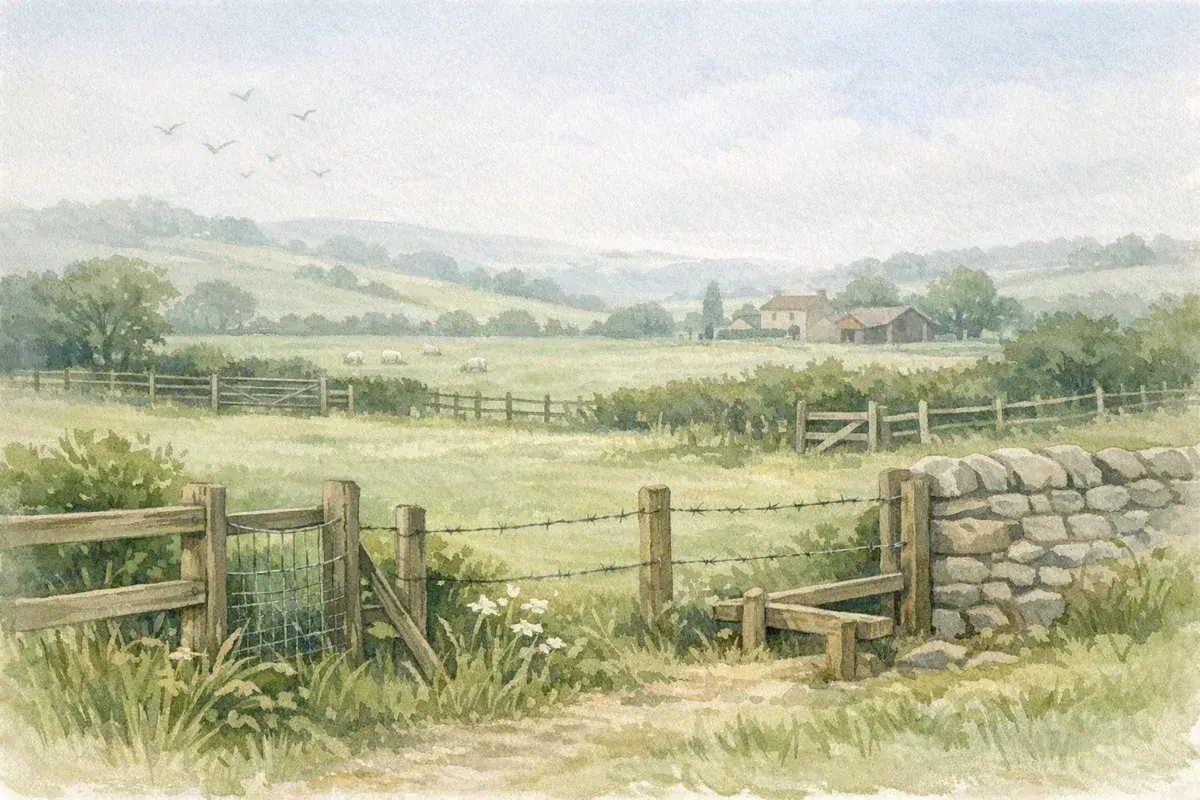
If youare searching for agricultural land fencing rules, the short answer is that fencing is often allowed, but not always without checks. The key issues are planning, boundary ownership, environmental designations, highways, rights of way, and whether the fence is suited to the land use.
That matters whether youare putting up a simple post-and-rail boundary in Devon, replacing stock fencing in North Yorkshire, or fencing a paddock in Aberdeenshire. Get it wrong and you could face a neighbour dispute, a planning breach, or a costly re-do. Get it right, and the fence should do its job for years.
The biggest mistake we see is assuming 'farm land' means 'no rules'. It doesnt. In many cases, agricultural fencing is straightforward, but there are plenty of exceptions where local authority consent, Environmental Impact Assessment consideration, or landowner agreement comes into play. The practical question is not just 'Can I put a fence here?' but 'What type of fence, on whose land, and in what location?'
What Agricultural Land Fencing Rules Usually Cover
Most fencing questions turn on five things: planning permission, boundary ownership, environmental constraints, stock management, and public access. For day-to-day agricultural use, a fence is often treated as permitted development, but that is not a blanket green light. Height, location, and purpose all matter.
In England, Wales, Scotland, and Northern Ireland, the detail varies slightly, but the common sense approach is the same. Ask what the fence is for. A stockproof fence to contain cattle is very different from a perimeter fence on a sensitive moorland site or beside a listed building. We'd argue that most disputes start when someone installs the wrong structure for the location, not because they wanted to do the wrong thing.
Planning Permission And Permitted Development
In many rural settings, fencing for agricultural use can fall within permitted development rights, especially where it is genuinely tied to the lands farming operation. The catch is that permitted development can be restricted by conditions on the holding, by previous planning permissions, or by designations such as conservation areas, SSSIs, or National Parks. In Pembrokeshire, the Lake District, and parts of the Cotswolds, extra sensitivity is common.
A fence close to a road, footpath, or heritage asset may also raise separate concerns. If the land is in a conservation area, beside a listed farmstead, or within a National Landscape, the local planning authority may want to see details first. Height is often a factor too, particularly where visibility splays for entrances or junctions are affected.
Boundary Ownership And Neighbour Agreement
Before you hang a single post, make sure you know who owns the boundary. On many farms the line is practical rather than precise, but fence ownership still matters. If the hedge, ditch, or old stone wall marks the edge, the legal boundary may sit on one side of it, not on the feature itself. That is where a surveyors plan can save a lot of grief.
- Check title documents: Land Registry plans can help, though they are rarely exact to the inch.
- Inspect old features: Hedges, ditches, and banks often indicate historic boundary lines.
- Agree before work starts: A short written note between neighbours can prevent later disputes.
- Stay off adjoining land: Even a few inches can become a trespass issue if a fence is misplaced.
Stock Fencing Standards For Agricultural Use
The right fence depends on the stock. A sheep fence is not a cattle fence, and neither is usually right for horses. Agricultural land fencing rules rarely prescribe one universal design, but the practical expectation is that the fence should be fit for purpose, durable, and safe enough for the animals involved.
For sheep, close-knit mesh or wire with smaller apertures is common. For cattle, stronger posts and rails or high-tensile wire may be better, particularly where pressure on the boundary is heavy. In horse country such as Gloucestershire, Cheshire, and parts of Suffolk, smooth finishes and visibility matter as much as strength. A cynical view? Cheap fencing often ends up expensive after the first winter storm.
Typical Fence Types And Where They Work Best
Post-and-wire remains a staple across the UK because it is relatively economical and adaptable. Post-and-rail has a stronger visual presence and is often chosen where appearance matters or where stock need a more obvious boundary. Electric fencing can be very effective, but only if it is properly maintained and used with an understanding of safety and animal behaviour.
In upland counties such as Cumbria, Perthshire, and Snowdonia-linked grazing areas, fencing must also cope with wind exposure, uneven ground, and wet soils. That means deeper posts, better bracing, and a more careful line. A fence that looks fine in the yard can fail quickly on a hillside if the strain and drainage have not been thought through.
| Fence Type | Typical Farm Use | Practical Note | As Of |
|---|---|---|---|
| Post And Wire | Sheep, general boundary | Flexible and cost-conscious, but needs good tensioning | March/2026 |
| Post And Rail | Horse paddocks, farm entrances | Visible and neat, though pricier than basic wire | March/2026 |
| Electric Fencing | Rotational grazing, temporary divisions | Efficient for quick layout changes, but upkeep is essential | March/2026 |
| Deer Fence | Orchards, woodland edges, conservation land | Higher cost and more likely to need careful siting | March/2026 |
Animal Welfare And Safety Considerations
Whatever the species, fencing should reduce escape risk and injury risk. Sharp ends, loose mesh, poor gate latches, and hidden wire can all cause trouble. For dairy units and intensive grazing blocks, regular inspection is non-negotiable because tired stock and wet ground make weak points show fast.
There is also a welfare angle when calves, lambs, or horses are involved. Clear sight lines, sensible gate widths, and no glaring snags all help. If a fence is intended to control movement on rented land, the tenant and landlord should be clear on who maintains it, because muddy repairs become arguments surprisingly quickly.
Environmental And Local Authority Checks
Some of the most important agricultural land fencing rules are not about the fence itself, but about the land around it. If the site is environmentally sensitive, or if the work could affect habitats, drainage, or landscape character, extra checking is sensible before work begins. This is especially relevant on lowland wetlands, peat soils, and heathland margins.
In practice, local authorities and environmental bodies tend to care most when a fence changes access patterns, blocks wildlife movement, alters field drainage, or affects protected land. If youare near a river corridor in Somerset, a designated site in Norfolk, or common land in Cumbria, ask questions early. Its cheaper than moving posts later.
Protected Landscapes And Designations
Fencing in National Parks, National Landscapes, conservation areas, SSSIs, and Scheduled Monuments can bring extra scrutiny. That does not always mean 'no', but it may mean the fence needs a very specific design or location. Sometimes invisible or low-impact boundaries are preferred, particularly where landscape character matters more than brute stock control.
For example, a closeboard fence that would be acceptable on a farmyard edge might look out of place in the Yorkshire Dales. A simple wire fence or low timber rail may be more appropriate. The point is not just compliance; it is preserving the long-term value and usability of the holding.
Watercourses, Ditches, And Field Margins
Where a fence runs beside a stream, ditch, or pond, the line can affect access for maintenance and wildlife movement. If stock are kept out of a watercourse for environmental reasons, the fence should be sited far enough back to allow sensible management. In some cases, buffer strips are expected, especially where nutrient run-off is a concern.
Depending on the exact land and region, there may also be separate rules on works close to ordinary watercourses or main rivers. If the fencing job involves excavation in soft ground, take care around drainage pipes and embankments. Its not glamorous work, but getting the line wrong can undermine the whole field system.
Costs, Grants, And Regional Price Differences
Fencing costs vary widely because labour, materials, access, terrain, and specification all push the final figure around. As of March/2026, basic agricultural fencing can be modest on a flat, accessible field, but much higher on wet, sloping, or remote land. County differences also matter because labour availability and haulage costs are not uniform.
Across southern England, including Surrey, Hampshire, and Kent, higher labour and access costs often mean pricier installs. In parts of Wales, Northumberland, and the Highlands, the issue is often logistics and exposure rather than labour alone. So, while a budget estimate is useful, site conditions usually determine the real number.
| Region | Indicative Cost Pressure | What Usually Pushes It Up | As Of |
|---|---|---|---|
| South East England | Higher | Labour, access, and land values | March/2026 |
| Midlands | Moderate | Materials and standard labour rates | March/2026 |
| Wales | Moderate To Higher | Terrain, remoteness, and weather exposure | March/2026 |
| Scotland | Varies Widely | Distance, upland conditions, and specification | March/2026 |
Grants and public support can sometimes help, especially where fencing forms part of environmental management, habitat creation, or livestock exclusion from watercourses. These schemes change, though, and local eligibility can differ across England, Scotland, Wales, and Northern Ireland. A good land agent or farm adviser will usually know whether the line you want to fence could qualify for support or requires prior approval.
On capital stack decisions, remember that fencing can be a value play as well as a cost. A properly fenced parcel can improve grazing efficiency, reduce stock losses, and make a holding easier to let or sell. Estate agents know this instinctively: buyers often see good fencing as one less job and one less risk.
Common Disputes And How To Avoid Them
Most fencing disputes are boring, which is exactly why they become expensive. They usually involve boundary position, access during construction, damaged hedges, or a fence that ends up on the wrong side of a ditch. A little paperwork and a few photos can prevent months of back-and-forth.
If a tenant is doing the work, the tenancy agreement should be checked first. Under some farm business tenancy arrangements, structural repairs and boundary maintenance are split between landlord and tenant, while in others the tenant has more flexibility. On short lets in Lancashire or Lincolnshire, even a half-day of uncertainty about responsibility can stall a project.
Practical Checks Before Work Starts
Start with the title plan, then inspect the site on foot. Look for old post holes, wire remnants, hedge centres, ditch lines, and fence stubs. If there is any doubt, agree the line in writing with the neighbour or adjoining owner and keep dated photos before and after installation.
Also think about access for machinery and future repairs. A fence that is inexpensive to install but impossible to maintain is a false economy. That is particularly true on awkward corners, around gateways, or where trailers and livestock handling equipment need regular passage.
When To Get Professional Advice
If the boundary is unclear, the land is designated, or the project is part of a wider farm sale or letting, professional advice is worth the modest cost. A surveyor can help with boundaries. A solicitor can review rights and obligations. A land agent can tell you how the fencing decision may affect the marketability of the holding.
That advice becomes even more valuable where a planning condition, easement, or public right of way runs through the site. Fencing across a footpath or bridleway, for instance, is not just a practical matter, and rural authorities can take a dim view of casual assumptions. Better to ask first than undo later.
Conclusion
The main point is simple: agricultural land fencing rules are usually manageable, but they are never just about buying wire and posts. You need to think about planning, ownership, stock type, environmental constraints, and local conditions before work starts.
When those pieces line up, fencing supports farm efficiency, animal welfare, and land value. When they do not, even a small job can become awkward. For farms, estates, and investors alike, a well-planned fence is still one of the most useful bits of rural infrastructure around.
Disclaimer: AgLand.co.uk is a UK agricultural land and rural property matching service, where buyers register what they are looking for and owners advertise directly to the buyers who match, and a rural resource hub. Nothing in this text is intended as legal, financial, or investment advice. You should carry out your own due diligence and seek guidance from appropriately qualified professionals (for example, solicitors, land agents, surveyors, and financial advisors) for your specific circumstances.