
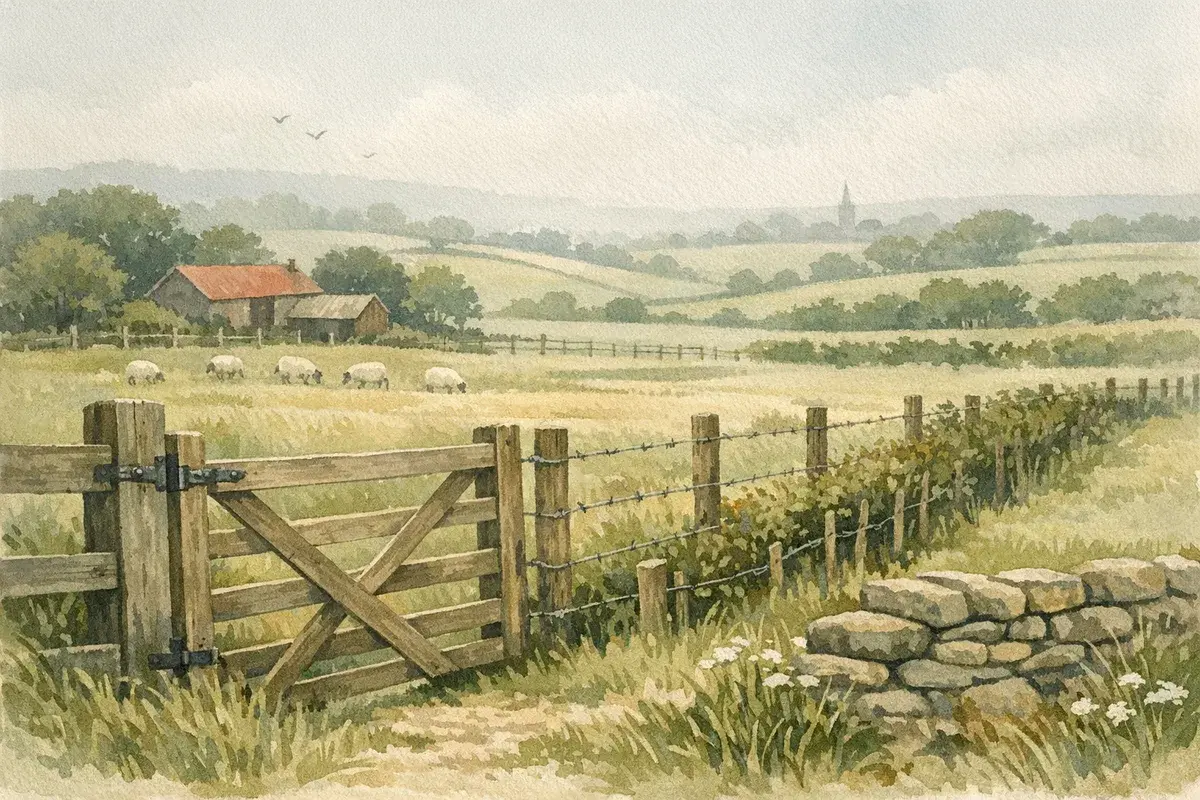
Agricultural fencing laws UK can be a headache if you treat them like a simple boundary issue. In reality, fencing can involve livestock control, tenancy duties, planning rules, neighbour disputes, road safety and environmental constraints.
If you own, let or manage farmland, the first question is usually not 'what fence do I want?' but 'what am I legally trying to achieve?'. A stockproof fence for cattle in Devon is a very different proposition from a post-and-wire boundary in the Welsh borders, or a deer fence in the Yorkshire Dales.
The short answer is this: there is no single all-purpose fencing law for every field edge in England, Wales, Scotland and Northern Ireland. Instead, several rules overlap, and the details often turn on livestock, boundaries, public rights of way, tenancy terms and local authority or protected landscape controls.
What Agricultural Fencing Laws UK Actually Cover
Most people use 'fencing law' to mean boundary ownership, but on farms it reaches much further. Agricultural fences can be about animal control, trespass prevention, public safety, environmental management and, in some cases, grant compliance.
In England and Wales, the key starting point is often the law of boundaries and land ownership, then the Animal Welfare Act 2006, livestock control rules, and common law duties around nuisance and negligence. In Scotland and Northern Ireland, similar principles apply, but local rules and tenancy practice can differ, so assume nothing.
Boundary Ownership And Adjoining Land
Who pays? It comes down to deeds, title plans, tenancy agreements and long-established evidence. Many rural boundaries in counties such as Gloucestershire, Herefordshire and North Yorkshire are historic, which means the legal line and the visible hedge or fence are not always the same thing.
If a fence sits within your registered title, that does not automatically prove you own the responsibility for it, and the reverse is also true. We'd argue this is where many disputes begin, because neighbours rely on old assumptions rather than documents.
- Title plan: outlines general boundary position, but is not precise to the inch.
- Deeds: may state who built or maintains the boundary.
- Physical features: hedges, ditches and banks can indicate ownership, but not conclusively.
- Long use: years of maintenance can become important evidence in a dispute.
Livestock Control Duties
If you keep cattle, sheep, goats, deer or horses, your fencing needs to be strong enough for the species involved. Under livestock control obligations, letting animals stray onto roads or neighbouring crops can lead to claims for damage, injury or disruption, especially in busy areas of Somerset, Lancashire or Cheshire where mixed farming and rural traffic overlap.
Stockproof means different things for different animals. Sheep netting may be fine for lambing paddocks, but cattle often need heavier gauge wire or post-and-rail with strainers, while horses usually need highly visible, safer fencing with fewer sharp edges.
When Planning Permission And Other Controls Matter
Not every farm fence needs planning permission, but some do. The key factors are height, location, whether the land is within a designated landscape, and whether the fence affects a highway, right of way or protected habitat.
Permitted development rights can help, yet they are not a free pass. In National Parks, Areas of Outstanding Natural Beauty, Sites of Special Scientific Interest and conservation areas, local authority scrutiny is often tighter, particularly in counties like Cumbria, Devon, Pembrokeshire and the Cairngorms. In those places the outcome is more often a design change than a refusal, with plain wire or a low timber rail accepted where closeboard would not be, which is one of the practical points covered in the fencing rules that apply to agricultural land.
Height, Visible Location And Neighbour Impact
As a rule of thumb, fences next to highways or in sensitive locations draw more attention than internal field divisions. A tall deer fence, for example, may be acceptable for forestry or game management, but it can trigger greater review if it changes landscape character or affects a public footpath.
If your boundary adjoins a dwelling, yard or garden, the impact can become a civil issue as much as a countryside one. Overshadowing, loss of outlook and access obstruction can all become talking points, and they are best sorted early rather than after the posts are in the ground. The stock behind the fence raises the same civil questions, because UK law sets no fixed distance between animals and homes and judges the position on nuisance, planning conditions and slurry management instead, which is the subject of how close livestock can sit to neighbouring houses.
Roads, Rights Of Way And Visibility
Fencing close to a junction, bend or farm access should not create a hazard. That matters when a hedge has been grubbed out and replaced, or when a new fence line alters visibility for tractors, lorries or milk tankers entering a lane.
Public footpaths and bridleways also matter. A fence crossing a public right of way without proper authority can lead to enforcement action, and gates or stiles must be safe, usable and properly positioned.
| Issue | Typical Trigger | Why It Matters | Date Reference |
|---|---|---|---|
| Boundary dispute | Fence line differs from title evidence | Can affect ownership and maintenance liability | As of June 2026 |
| Planning scrutiny | Tall or visually prominent fence | May need permission in protected areas | As of June 2026 |
| Livestock escape | Weak stock fencing | Risk of damage, injury and liability claims | As of June 2026 |
| Rights of way | Fence blocks a path or bridleway | Can trigger enforcement and reinstatement costs | As of June 2026 |
Tenancies, Grants And Maintenance Responsibilities
On let land, fencing responsibility usually sits with the tenancy agreement, not with a general assumption about who uses the field. Agricultural Holdings Act tenancies, Farm Business Tenancies and grazing licences can all allocate duties differently, so the paperwork matters more than folk memory.
That point is especially important in counties with lots of rented acreage, such as Lincolnshire, Norfolk and parts of the Scottish Borders, where tenants often manage extensive boundaries but do not own them. If the lease says the tenant maintains internal fences only, replacing an outer boundary may be a landlord job even if the tenant wants it done faster.
Repair Versus Replacement
A small repair is one thing. Full replacement is another. A tenancy might require the tenant to keep stockproof fencing in good order, but not to replace a rotten boundary hedge line or rebuild old concrete posts after storm damage.
Storms are increasingly relevant, too. After heavy winds or saturated ground, a blown-down fence can expose grazing stock within hours, so many land managers now keep a contingency stock of strainers, wire and posts. Practical? Absolutely. Legally safer? Even more so.
Grant-Supported Fencing And Environmental Schemes
Where fencing is linked to stewardship, biodiversity net gain, buffer strips or river protection, the grant conditions can be as important as the law itself. For example, fencing out livestock from watercourses may be required to meet scheme standards, and the placement of gates, troughs and access points can matter just as much as the boundary line.
In Wales and parts of upland Scotland, fencing for habitat management often needs to fit around landscape and ecology rules. If you are removing old sheep fencing or installing deer exclusion fencing, check whether the scheme expects native hedging, set-back margins or specific materials.
- Tenancy wording: decides who must maintain, repair or replace.
- Scheme conditions: may set fence type, line and purpose.
- Access rights: can require gates, gaps or safe crossings.
- Damage clauses: may affect who pays after stock or storm damage.
Practical Fencing Choices For Different Farm Types
Good legal compliance starts with good design. The fence has to fit the enterprise, or you are wasting money and inviting problems. There is little point in fitting light sheep wire where cattle pressure is constant, or putting in an expensive deer fence where a simpler boundary will do. Settling the enterprise comes first, and on small acreages that decision turns on intensity rather than size, because a well-run five-acre market garden can outperform a poorly planned forty-acre holding, as our practical guide to small scale farming explains.
Across the UK market, farm fencing costs vary widely by specification and terrain. As of June 2026, basic agricultural post-and-wire work may often start around £30 to £50 per metre, standard stock fencing can sit in the £40 to £80 per metre range, and deer fencing or complex boundary works can run well above that depending on height, ground conditions and gates. Remote upland sites in areas such as Snowdonia, Dartmoor or the Cairngorms usually cost more because access is harder and labour productivity is lower.
Choosing The Right Specification
For cattle, strength and post spacing matter most. For sheep, keeping lambs in and foxes out is the challenge. For horses, visibility and safety usually beat brute strength, while for pigs or deer, buried or heightened barriers may be necessary.
Webargue the best fence is the one you can maintain. A top-specification fence that nobody repairs is false economy, especially on exposed ground in East Anglia or upland Cumbria where strain and weather quickly find weak points.
Common Legal And Practical Mistakes
One frequent mistake is placing a fence too close to a hedge or ditch without confirming where the boundary sits. Another is assuming a farm gate can simply be chained open or removed without affecting access rights, stock control or public footpaths.
A third mistake is using unsuitable materials near roads or equestrian routes. Sharp wire ends, loose staples and poorly fixed rails can create liability if a person or animal is injured.
- Stockproof fence: designed to prevent livestock escape.
- Strainer post: a heavy end post that takes wire tension.
- Turnbuckle: a tensioning device for wire fencing.
- Set-back: a gap kept from watercourses or paths for compliance.
How To Avoid Disputes And Stay Compliant
The simplest way to keep out of trouble is to check the documents before you dig the first post hole. Title registers, tenancy agreements, stewardship terms and historic maps usually tell you far more than a verbal agreement ever will.
If there is any doubt, get the boundary looked at before spending money. That advice sounds obvious, but in practice many disputes in Kent, Devon and the Midlands start because one party assumed the old fence was on the legal line and the other party quietly disagreed.
Documentation And Evidence
Keep photographs of the boundary before and after work, especially where old hedges are being replaced or where a ditch is being regraded. Keep invoices, drawings, supplier notes and any written agreement with a neighbour or landlord.
If the land is farmed under a tenancy, note who authorised the job and what was agreed about future maintenance. That record can save a lot of pain if the fence fails later or if the relationship sours.
Regional Checks Worth Making
Rules can bite differently depending on where the farm sits. In England, local planning and rights of way issues are often decisive; in Wales, bilingual records and countryside designations can matter more; in Scotland, tenancy and access arrangements may have a different flavour; and in Northern Ireland, local planning and agricultural practice should be checked carefully.
If your land is in or near a National Landscape, a National Park or a conservation area, assume there will be extra questions. Not impossible ones, just questions you should answer before ordering materials.
Conclusion
Agricultural fencing laws UK are less about one rule and more about several overlapping ones. Boundary evidence, stock control, planning, tenancy terms and public access can all be relevant to a single fence line.
For farmers and landowners, the safest approach is simple: check the ownership documents, match the fence to the livestock and the site, and confirm whether planning or tenancy consent is needed before work starts. Get those basics right and yount reduce risk, avoid disputes and spend money where it actually protects the business. In short, the law follows the practical realities of farming, and agricultural fencing laws UK reward the owner who plans ahead.
Disclaimer: AgLand.co.uk is a UK agricultural land and rural property matching service, where buyers register what they are looking for and owners advertise directly to the buyers who match, and a rural resource hub. Nothing in this text is intended as legal, financial, or investment advice. You should carry out your own due diligence and seek guidance from appropriately qualified professionals (for example, solicitors, land agents, surveyors, and financial advisors) for your specific circumstances.