
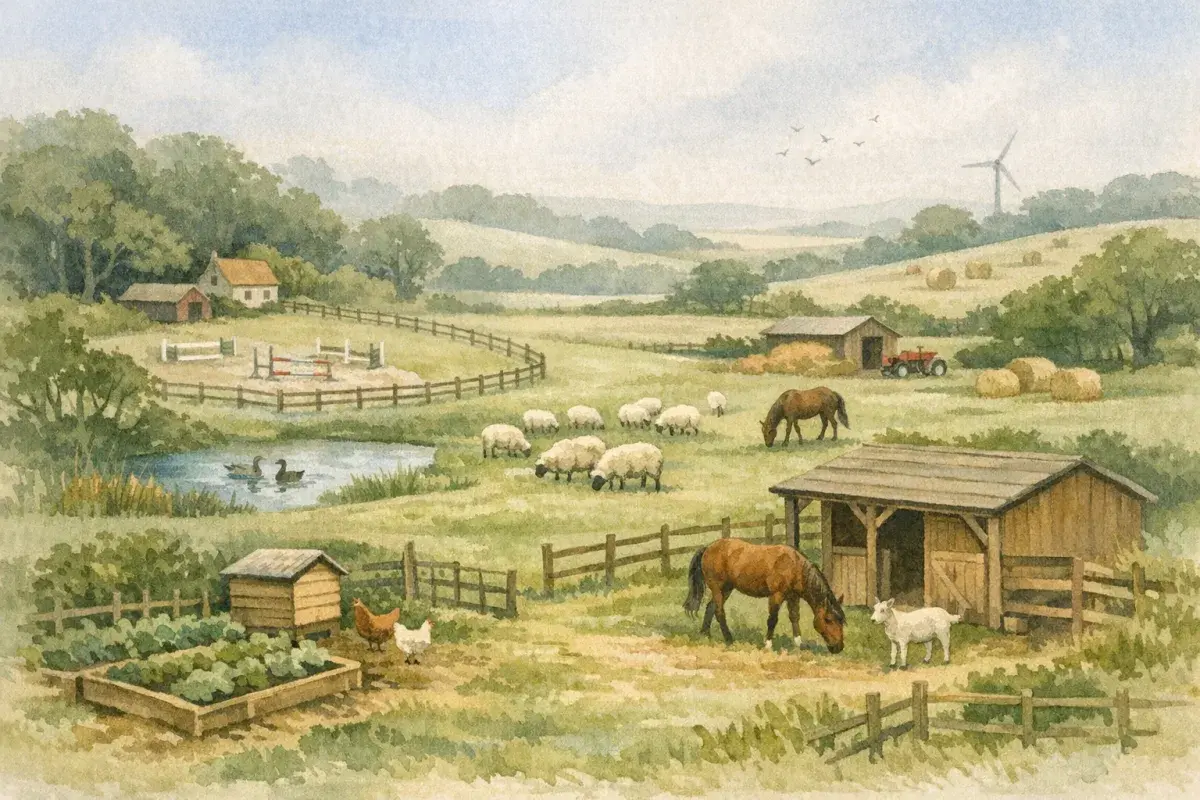
Pasture land can do far more than feed livestock. If you're asking what can you do with pasture land, the short answer is: graze stock, grow forage, cut hay, diversify income, and in some cases improve biodiversity or seek planning-led change of use.
The long answer depends on the land's quality, access, drainage, permissions and local market demand. A well-placed block in Norfolk, Cheshire or Dumfries and Galloway may suit a very different strategy from a small parcel outside Exeter or in the Yorkshire Dales.
For farmers, the main question is usually practical: how can the grass be used profitably without damaging soil or basic agricultural value? For landowners and investors, it's often about flexibility, planning risk and long-term returns. We'd argue that pasture land is one of the most versatile rural assets in the UK, but only if you match the use to the land in front of you.
In this guide, we'll look at the main uses, the legal and planning boundaries, and the income opportunities that matter in real life. We'll also cover regional differences, because a hectare of grazing ground in Devon won't behave, or trade, like a hectare near Aberdeen.
Core Agricultural Uses For Pasture Land
The most obvious answer to what can you do with pasture land is still the best one: keep it in productive agricultural use. That usually means grazing livestock, cutting forage, or a mixed system that balances both. On heavier ground, especially in parts of Lancashire, Somerset and the Welsh borders, pasture may be better suited to rotational grazing than intensive cutting.
Good pasture land supports sheep, beef cattle, horses and, in some settings, dairy youngstock. The right stocking rate matters more than the species alone. Overstock a wet field in Cumbria and you'll damage sward structure and poach the ground; understock a useful paddock in Leicestershire and you're simply wasting grass growth.
Grazing Livestock Well
Grazing is the backbone of most pasture land use. It turns grass into saleable output, improves sward control, and can strengthen soil cover when managed carefully. On free-draining land in Lincolnshire or East Anglia, grazing windows can be long; on clay soils in Shropshire or North Yorkshire, you may need tighter movement plans to avoid compaction.
- Rotational grazing: Moves animals between paddocks to rest grass and maintain regrowth.
- Continuous grazing: Simpler to run, but often less efficient.
- Mob grazing: Short, intense grazing periods with longer recovery; useful where grass quality is variable.
- Extensive grazing: Lower input systems suited to rougher or wetter pasture.
Cutting Hay Or Silage
Pasture land can also produce forage. Hay is dried grass baled for winter feed, while silage is preserved grass with higher moisture content, usually wrapped or stored in clamps. In practice, good meadow pasture in Oxfordshire or Herefordshire may be cut once or twice a year, then grazed afterwards.
The trade-off is simple. If you cut for forage, you usually reduce immediate grazing availability. But the feed value can be significant, especially when bought-in feed costs bite. In a mixed holding, that can make the difference between a tight year and a workable one.
| Use | Typical Benefit | Main Limitation | As Of Date |
|---|---|---|---|
| Grazing cattle or sheep | Steady agricultural income and sward control | Requires grass and stock management | As of June 2026 |
| Hay production | Winter fodder and marketable surplus | Weather-dependent harvest window | As of June 2026 |
| Silage production | Higher-feed-value forage for livestock systems | Needs storage, wrapping or clamp infrastructure | As of June 2026 |
Income Opportunities Beyond Traditional Farming
Pasture land doesn't have to remain purely agricultural in a narrow sense. Many owners are now looking at low-impact diversification, especially where the land sits near towns, tourism corridors or main roads. The best ideas tend to preserve the rural character while creating a separate income stream.
That said, not every field should become a project. Access, flooding risk, visibility and local planning policy all matter. A parcel beside a village in Kent may suit livery or small-scale events; a remote upland block in Perth and Kinross may be better left to grazing or environmental schemes.
Livery And Equestrian Use
Horse-related uses are a common fit for pasture land, particularly near affluent commuter belts in Surrey, Gloucestershire and parts of Cheshire. Livery, which means keeping other people's horses for a fee, can create stable recurring income if the site has safe access, water, fencing and parking.
But this isn't passive money. It brings liability, wear on gateways and a need for strong fencing and field drainage. If the land is already adapted for horses, fine. If not, the cost of getting it there can eat into returns quickly.
Camping, Glamping And Farm Diversification
Low-key tourism uses can work well on pasture land, especially where views, seclusion or local attractions add value. In parts of Cornwall, Pembrokeshire and the Lake District fringe, even modest glamping can outperform standard grazing income on a per-acre basis.
Still, planning permission, seasonal access and waste management are critical. If you're considering this route, the question is not just what can you do with pasture land, but what can you do without triggering avoidable costs or enforcement issues?
- Dog walking fields: Useful near settlements, but need secure fencing and liability cover.
- Storage yards: Sometimes possible, though planning and surfacing requirements can be substantial.
- Seasonal events: Worth considering where parking and local roads can cope.
- Renewable schemes: Solar or battery projects may interest some sites, but pasture use may be significantly altered.
Planning, Change Of Use And Environmental Limits
Not every idea is straightforwardly allowed. In England, Wales, Scotland and Northern Ireland, the planning position varies, and even straightforward agricultural works can become complicated if drainage, buildings, hardstanding or public access is involved. If pasture land is protected by designation, such as green belt, AONB or floodplain policy, the room for manoeuvre may be tighter still.
Owners sometimes assume that because land is grassed, it can easily switch use. That's rarely true. A field can stay in agricultural use while supporting grazing, hay or habitat enhancement. Once you start introducing non-agricultural structures or materially changing the use, the planning picture changes fast.
When Permitted Development May Help
Some agricultural works can fall under permitted development rights, especially modest buildings, fencing or tracks, but this depends on scale, location and prior notification rules. In practice, county planners and local authorities will look at impact on landscape, neighbours and highway access, particularly in places like Devon, Northumberland and the Cotswolds.
It's wise to check whether the land is tied to an agricultural unit, what the previous use history is, and whether any conservation or heritage designations apply. A field can be physically suitable and still be a planning headache.
Environmental Stewardship And Biodiversity Gain
Pasture land is increasingly used for environmental schemes, from buffer strips and pollen-rich margins to wet grassland and species-rich swards. In the right place, this can improve farm resilience and income stability, especially where grazing margins, flood management or soil health are already priorities.
As of June 2026, environmental payments and private biodiversity markets remain important considerations, but they vary widely. Richer permanent pasture, especially old grassland, may also have significant ecological value that should be protected rather than ploughed up without thought.
| Potential Use | Planning Sensitivity | Best Fit Regions | As Of Date |
|---|---|---|---|
| Simple livestock grazing | Low | Nationwide | As of June 2026 |
| Livery yard or paddocks | Moderate | South East, Midlands, Cheshire | As of June 2026 |
| Glamping or camping | Moderate to High | Cornwall, Cumbria, Pembrokeshire | As of June 2026 |
| Storage or commercial yard uses | High | Edge-of-town sites | As of June 2026 |
What Affects Value And Marketability
If you're thinking as a seller or investor, the answer to what can you do with pasture land also comes down to what the market will pay for. Location, access, soil type, agricultural quality and future flexibility all move the dial. Good roadside pasture near an urban edge can attract very different interest from isolated hill grazing in the Scottish Borders.
As of June 2026, UK pasture land values remain highly localised. Farms and investors still pay a premium for well-located, fertile, adaptable land, while poorer or remote pasture trades on yield, area and long-term strategic use rather than headline price alone. We'd argue that access and versatility now matter almost as much as raw grass growth in many buyer decisions.
Quality, Access And Water
Three practical factors keep cropping up: drainage, access and water supply. If the land is boggy, landlocked or short of water, that narrows the menu of possible uses. Well-fenced pasture with good entry points, mains or reliable natural water, and decent ground conditions is easier to farm and easier to market.
County context matters too. Free-draining land in Suffolk may appeal to arable farmers seeking grazing blocks, while stocked grassland in County Down may suit mixed livestock systems. In both cases, the underlying point is the same: the more usable the land, the wider the buyer pool.
Regional Demand Patterns
Demand varies by region because the end use varies. In Wales and the South West, pasture is often sought for livestock continuity and lifestyle holdings. In the Midlands and South East, there can be stronger demand for equestrian land, smaller commercial units and conversion potential near main routes.
When land is marketed, agents will often stress the strongest use case first. That might be grazing, but it could just as easily be amenity, equestrian, or a longer-term planning angle if the site genuinely supports it. Buyers are not paying for grass alone; they're paying for potential.
- Access: Serves farming, equestrian and diversification uses alike.
- Drainage: Shapes stocking rates and seasonal usability.
- Location: Influences buyer type and alternative use value.
- Infrastructure: Fencing, water and shelter can materially improve marketability.
Practical Ways To Decide The Best Use
The best answer is rarely one-size-fits-all. Start with the land itself, then work out what the market, the planning system and your own resources can support. For many owners, the optimal approach is a blended one: grazing first, environmental margins second, and diversification only where the site truly justifies it.
Ask three disciplined questions. What is the land naturally good at? What income is realistic after costs? And what could go wrong if you push it too far? That last one matters, because pasture land can deteriorate quickly if you overwork it, compact it or ignore weed pressure.
A Simple Decision Framework
If the pasture is productive, accessible and well-fenced, usual agricultural use often gives the best risk-adjusted return. If the land is scenic, near visitors or close to a high-value market, modest diversification may deserve a closer look. If the site has ecological sensitivity, environmental stewardship may be the most sensible route.
In other words, don't force a field into the wrong role. A marginal upland parcel in the Pennines might be worth more in a stewardship scheme and light grazing than in any fancy scheme that needs better roads and parking. A flatter parcel on the edge of Reading may have an entirely different future.
Conclusion
So, what can you do with pasture land? In most cases, you can graze livestock, produce forage, support equestrian use, add low-impact diversification, or pursue environmental management, provided the land and permissions line up. The real skill is matching the use to the site, not trying to squeeze every possible option from it.
For buyers, sellers and landowners alike, the strongest pasture land is usually the land that can do several jobs well without losing its core agricultural value. That flexibility is often what makes it useful, marketable and resilient over time.
Disclaimer: AgLand.co.uk is a UK agricultural land and rural property matching service, where buyers register what they are looking for and owners advertise directly to the buyers who match, and a rural resource hub. Nothing in this text is intended as legal, financial, or investment advice. You should carry out your own due diligence and seek guidance from appropriately qualified professionals (for example, solicitors, land agents, surveyors, and financial advisors) for your specific circumstances.