
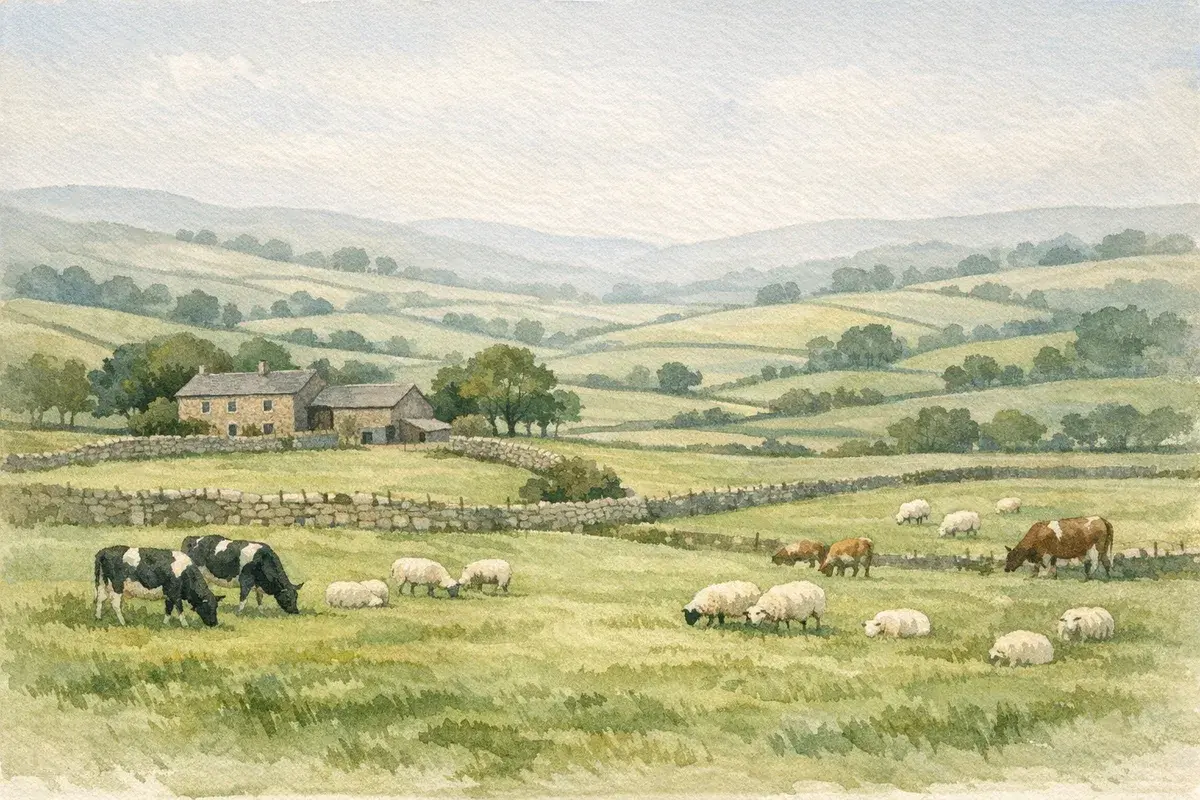
You can usually tell when stocking density on pasture land is "off" long before you run the figures. The grass gets a tired, chewed look. Bare patches turn to mud in gateways. Or the opposite: you're topping and topping, watching seed heads race ahead while quality slips.
Getting the numbers right isn't about chasing a textbook "stocking rate". It's about matching animals to grass in your conditions, soil, rainfall, infrastructure, and the way you move stock, so you can carry what the land can genuinely support without quietly robbing next month's growth.
This guide gives you a UK-grounded way to think about stocking density pasture land decisions: clear definitions, practical calculations, sensible benchmarks (with caveats), and the management levers that let you adapt when the weather or prices shift.
What Stocking Density Means In Practice (And Why It Matters)
Stocking density sounds like a spreadsheet problem. In reality, it's a day-to-day management decision that shows up in sward quality, animal performance, and how much damage you do (or don't do) in a wet week.
At its simplest, stocking density is how many animals you have on a given area for a given time, often expressed as livestock units (LUs) per hectare (the measure Defra uses in its farming statistics), or animals per hectare, or even "cows per acre" in conversation.
The reason it matters is blunt: grass is your cheapest feed. When you get stocking density on pasture land wrong, you either waste grass (and lose quality) or you mine the pasture (and pay for it later in lost regrowth, bought-in feed, or reseeds).
Stocking Rate Vs Stocking Density Vs Carrying Capacity
People mix these terms up, and it causes expensive misunderstandings.
- Stocking rate is the average number of animals carried over a period (e.g., a season or year) on a defined area. Think: "How many cattle do I run on this 20 ha block from April to October?"
- Stocking density is the instantaneous pressure on the grazing area at a moment in time. If you put 60 cattle into a 1 ha paddock for 24 hours, the stocking density is high, even if your overall stocking rate across the farm is moderate.
- Carrying capacity is what the land can support sustainably in your system, considering soil, species, rainfall, fertiliser strategy, infrastructure, and management.
A useful way to frame it: carrying capacity sets the ceiling, stocking rate is your plan, and stocking density is the lever you pull every time you shut a gate.
If you're buying or renting grazing, these distinctions matter even more. "There's 30 acres of pasture" tells you almost nothing until you know what's grazeable, how it drains, and what grazing system you'll run.
Why Overgrazing And Undergrazing Both Cost You
Overgrazing is the obvious villain: you graze too hard and too often, the plant can't recover, and you end up with thinner swards, more weeds, and more reliance on supplementary feed.
But undergrazing is sneaky. If stocking density is too low (or grazing is too lax), you often get:
- Stemmy, headed grass with lower energy and protein
- Rejected patches around dung, which grow on and become even less palatable
- More topping (costly time and diesel)
- Less clover contribution, because clover hates shade and a closed canopy
In both cases, the cost isn't just today's utilisation. It's what happens next: regrowth rate, sward composition, and whether you can keep grazing without "running out of field".
If you want a deeper, UK-specific framework for improving utilisation and lifting carrying capacity without turning everything into a reseed programme, our guide on raising pasture performance with practical management steps is a solid companion read.
The Core Factors That Set Your Pasture’s Carrying Capacity
When two farms in the same county quote wildly different "safe" stocking levels, it's rarely because one of them can't count. It's because carrying capacity is built from constraints, and some constraints are negotiable, others aren't.
Here are the big ones that typically set the limit for stocking density pasture land decisions in the UK.
Soil Type, Drainage, And Compaction Risk
In much of the UK, water is the limiting factor more often than fertiliser.
- Heavy clays can grow excellent grass in a kind spring and then fall apart under hooves in a wet autumn. Poaching and compaction reduce air in the soil, slow root growth, and can knock production back for months.
- Light sands and gravels drain well and carry stock without poaching, but they can burn off quickly in a dry spell, so drought resilience becomes the limit.
- Peaty and organic soils can be productive but are sensitive: traffic timing and ground conditions matter a lot.
If your land is regularly wet, carrying capacity is often not about "more grass": it's about protecting soil structure and keeping animals moving. Two practical rabbit holes worth exploring are practical approaches to managing wet fields and the fundamentals of pasture land drainage options in the UK context. Both can shift what's feasible, especially on rented blocks where you're deciding whether the ground can take stock without turning into a mess.
Sward Species, Reseeds, And Clover Content
Your pasture's carrying capacity is strongly tied to what's actually in the sward.
- Perennial ryegrass is the workhorse for grazing systems because it regrows fast and responds to nitrogen.
- Timothy, fescues, cocksfoot and herbal components can improve persistence and drought tolerance, but management needs to match.
- White clover is the big lever: it can boost quality and reduce nitrogen requirement, but only if grazing keeps light into the base of the sward.
A common UK pattern is that a pasture looks "fine" from the gate yet performs like a tired lawn, because the productive species have thinned and been replaced by low-value grasses and weeds. That's when the conversation shifts from "What stocking density should I run?" to "What stocking density can this sward realistically support until I intervene?"
Reseeds and overseeds can raise carrying capacity, but they also raise your exposure: higher-performing leys are less forgiving of poor grazing discipline. The best reseed in the world still gets wrecked if you graze too low on a wet week.
Rainfall, Drought Exposure, And Local Growing Season
The UK isn't one climate. Upland Wales, the South West, East Anglia, and the Scottish Borders can all be dealing with different constraints at the same time.
In practical terms, carrying capacity depends on:
- How early growth starts (and whether you can get stock out without poaching)
- Summer reliability (do you routinely hit a "summer slump"?)
- How long you can keep grazing in autumn before soil conditions force a change
It's worth being honest here: a "good grass year" can make you overconfident. The real test of a stocking plan is whether it holds up in a dull spring, a dry June, or a wet October.
How To Calculate Stocking Density For Pasture Land
You don't need a lab coat to calculate stocking density on pasture land. But you do need to be consistent: clear units, realistic areas, and a simple method you can repeat.
Below is a practical approach you can use whether you're managing a home farm, taking seasonal keep, or assessing pasture that comes with a rural property purchase.
Convert Livestock To Livestock Units (LUs) Or Standard Grazing Units
Using livestock units helps you compare different classes of stock.
In UK practice, LU/ha is common in grazing discussions. Exact LU factors vary slightly depending on the scheme or advisory source, but you can use a sensible internal set for planning and stick to it.
As a rough working guide:
- Dairy cow: often treated around 1.0 LU (sometimes more for larger cows)
- Suckler cow: commonly 0.8–1.0 LU depending on size and whether calf is included
- Beef cattle 12–24 months: roughly 0.6–0.8 LU
- Weaned calf / youngstock: roughly 0.3–0.5 LU
- Ewe: often 0.1–0.15 LU (higher if you account for lamb at foot)
If you're comparing different enterprises, say, cattle grazing versus a sheep system, this gets you onto one page.
A quick sense-check: if your LU estimate feels like it's flattering your pasture, it probably is. Be conservative first, then increase stocking when the grass proves it, not when the budget hopes it.
Work From Grazeable Area, Not The Whole Field
This is where lots of on-paper stocking plans fall over.
Your grazeable area is not the field area on the land registry plan. It's the area animals will actually eat from.
Adjust for:
- Unfenced corners, steep banks, bracken-y bits
- Wet patches you avoid (or should avoid)
- Wooded margins, tracks, trough pads, gateways
- Buffer strips near watercourses where you don't want heavy pressure
- Public rights of way, if practical use is reduced at busy times
Even a 10% overestimate in grazeable area can quietly push you into overgrazing. When you're calculating stocking density for a paddock rotation, that error compounds fast.
A pragmatic habit: walk the block with a phone map, mark "no graze" bits, and plan off what's left. It's not perfect, but it's miles better than assuming every hectare is equally edible.
Translate Forage Supply Into Days Of Grazing And Residual Targets
Stocking density is only "right" relative to grass supply.
To connect the two, you need three pieces:
- Pre-grazing cover (how much grass is there?)
- Target residual (how much do you want to leave?)
- Daily demand (how much will the stock eat?)
You can keep it simple using pasture height and a plate meter (if you have one), or by eye once you've calibrated your judgement.
A workable approach:
- Decide your residual target. For many ryegrass-based systems, leaving a sensible residual helps regrowth and utilisation. Graze too tight repeatedly and you slow the plant down.
- Estimate available dry matter: pre-grazing cover minus residual, multiplied by area.
- Divide by daily dry matter intake of the group (as a rule of thumb, cattle often eat around 2–3% of bodyweight in dry matter depending on class and diet: sheep vary by size and production stage).
That gives you grazing days in that paddock.
Then you can set stocking density with intent:
- If you want 1-day breaks (tight control, high utilisation), you'll run higher density in a smaller area.
- If you're happy with 3–5 day stays, density can be lower, but you risk more selective grazing and patchiness.
The important bit isn't that your first calculation is perfect. It's that you measure, adjust, and record. A grazing plan you can defend, because you've got notes, covers, and outcomes, beats a "rule of thumb" you can't explain when conditions turn.
Match Animals To Grass: Typical UK Benchmarks (With Caveats)
Benchmarks are useful, but only if you treat them as signposts, not promises.
So here's a UK-flavoured way to think about stocking density pasture land benchmarks, plus the caveats that stop those numbers becoming expensive.
Beef Cattle, Suckler Cows, And Followers
Beef systems vary hugely: native breeds versus continentals, set-stocked versus rotational, low input versus finishing.
In practice, your pasture pressure is driven by:
- Cow size and milkiness (intake and impact)
- Calving pattern (spring versus autumn)
- Whether followers are on the same platform
A sensible way to benchmark is by grazing group.
- Suckler cow with calf at foot: grass demand is substantial, and if you're rotationally grazing you'll notice quickly when covers dip. Many farms find they need either a larger grazing platform or more flexibility (silage ground to release, buffer feed options) to avoid overgrazing during pinch points.
- Yearlings and stores: often easier to manage to residuals because they're less fussy than lactating cows and can be moved more frequently.
Caveat: heavy land changes everything. You can have a pasture that grows plenty of grass on paper but cannot physically carry cows without damaging soil structure in a wet spell.
Dairy Cows And Youngstock
Dairy grazing is where the difference between stocking rate and stocking density really shows.
You might have a high stocking rate on the milking platform, but you manage it by:
- Short grazing allocations
- Tight residual control
- Back-fencing and disciplined rotation
- Taking out surplus for silage
Youngstock are your flexibility lever: if grass tightens, moving heifers off the best ground can protect milkers' intake. If grass runs ahead, youngstock can clean up residuals on heavier covers.
Caveat: dairy cows punish poor infrastructure. If water is too far, gateways are boggy, or lanes break up, you'll lose utilisation and introduce lameness risk, so your "paper" stocking level won't hold.
Sheep Systems: Ewes, Lambs, And Store Lamb Finishing
Sheep can look like they "do no harm" until you watch what happens when they nibble regrowth repeatedly.
For sheep, stocking density decisions are often about:
- Controlling grazing height to protect regrowth
- Reducing worm challenge through rotation and rest periods
- Matching high-demand groups (lactating ewes, finishing lambs) to best covers
Store lamb finishing on good pasture can be very effective, but it's also a system where grass quality matters more than quantity. Under-grazed, headed swards will slow performance quickly.
Caveat: sheep grazing on wet ground can still poach, especially around troughs and gateways, and tight grazing in late autumn can leave you exposed going into winter.
Grazing Systems And How They Change The ‘Right’ Density
There isn't one "correct" stocking density for pasture land, because the grazing system changes how grass is utilised, how quickly it recovers, and how much damage stock can do.
You can think of this as three different toolkits.
Set-Stocking: When It Works And When It Fails
Set-stocking (leaving animals in one field for a long period) can work when:
- Land is fragmented and moving stock is impractical
- Labour is tight
- You're using sheep to keep swards under control
- The goal is simplicity over maximum utilisation
But the failure mode is predictable: animals selectively graze the best plants, weaker plants get shaded out, and you end up with a pasture that looks green but performs poorly.
If you set-stock, your stocking density is effectively low, but the grazing pressure on the favourite bites is extremely high. That's why you see tight patches next to tufty patches.
Rotational Grazing: Paddock Size, Rest Periods, And Recovery
Rotational grazing is where stocking density becomes a precision tool.
Core principles:
- Shorter occupation (often 12–72 hours) reduces re-grazing of fresh regrowth.
- Adequate rest allows the plant to rebuild leaf area and roots.
- Residual discipline avoids scalping and keeps regrowth fast.
Paddock size is simply the area required to feed the group for the time you want them there.
A practical way to avoid overthinking it:
- Start with a realistic rotation length (for example, a longer rest in slower growth, shorter in flush growth).
- Allocate by expected intake, then adjust after you see residuals.
And don't ignore the obvious: if you can't get stock to water easily or you're fighting gateways, the system won't stick, so the "right" density on paper doesn't matter.
Strip Grazing And Cell Grazing: High Density, Short Duration
Strip grazing (often behind an electric fence) and cell grazing push stocking density higher for shorter windows.
The upside:
- High utilisation in front of the wire
- Strong control over residuals
- Useful for managing covers precisely
The catch is the management requirement. High density is unforgiving:
- Get timing wrong in wet conditions and you can poach badly in a matter of hours.
- Miss water placement or back-fencing and you'll create sacrifice zones.
Used well, high-density short-duration grazing can improve pasture utilisation and even sward structure. Used casually, it's a fast route to mud.
Seasonal Planning: Adjusting Stocking Density Through The Year
A stocking density plan that doesn't change with the seasons is basically a plan to be surprised.
UK grass growth is lumpy. Your job is to anticipate the lumps, spring flush, summer slump, autumn slow-down, and make stocking decisions that keep animal performance steady without damaging the platform.
Spring Surplus, Silage Cuts, And Taking Ground Out
Spring is where you can accidentally teach your pasture bad habits.
If growth races ahead:
- Quality drops as grass heads.
- You lose clover contribution through shading.
- You start topping and chasing your tail.
Better options include:
- Take surplus out for silage/haylage early, while quality is there.
- Speed up rotation to keep grass vegetative.
- Split groups (e.g., youngstock to clean up heavier covers).
This is also the season to look at your real carrying capacity. If you're always awash with grass in May and always short in July, the answer probably isn't "run more stock all year". It might be "make more conserved forage at the right moment and protect regrowth later".
Summer Slumps, Drought Plans, And Buffer Feeding
Not every UK region gets drought in the same way, but most farms have some form of summer pinch point, heat, low rainfall, or just slower growth.
A drought or summer-slump plan might include:
- Buffer feeding (silage, hay, or concentrates) to protect residuals and keep plants recovering
- Reducing demand by selling stores earlier or moving stock off the grazing platform
- Prioritising the best fields for high-demand groups
The key is not to chase the last inch of green. If you graze too tight in a dry spell, you don't just lose today's grass, you extend the slump by slowing recovery.
Autumn And Winter: Poaching Risk, Sacrifice Areas, And Housing Triggers
Autumn is where stocking density can quietly turn into soil damage.
Good practice usually looks like:
- Lower density or shorter allocations on heavier ground to reduce trampling
- Protecting gateways and water points (they fail first)
- Using sacrifice areas deliberately, if you must, rather than "accidentally sacrificing" multiple fields
- Clear housing triggers (ground conditions, forecast, animal condition, forage stocks)
If you're winter grazing, be honest about the trade-off: you might save housing costs, but you can pay it back in spring with compacted, slow-to-warm soils. Sometimes the most profitable decision is the least romantic one, get them in before you wreck the platform.
Infrastructure That Lets You Carry Stock Without Damaging Land
Two farms can have identical grass growth and very different outcomes because one has the infrastructure to use it.
If you're trying to push carrying capacity, or you're assessing a block of land before you rent/buy it, look hard at the physical bits that determine whether your intended stocking density is realistic.
Water, Trough Placement, And Back-Fencing
Water is not a detail. It dictates grazing patterns.
What tends to work well:
- Troughs placed to reduce walking distance and avoid forcing animals through pinch points
- Multiple access points in larger paddocks so dominant animals don't control the trough
- Back-fencing in rotational systems to protect regrowth and stop animals tracking back over grazed ground
A simple rule: if animals have to walk far for water, they'll create tracks, camp in corners, and graze unevenly. Your stocking density calculation might be correct, but utilisation won't be.
Lanes, Gateways, And Reducing Poaching Pressure
If you're on heavier land, lanes and gateways are where your pasture plan either holds together or falls apart.
Small upgrades can have outsized impact:
- Moving gateways (even temporarily) to spread pressure
- Hardstanding in chronic pinch points
- A lane that keeps traffic off the sward in wet conditions
If you're buying a grazing block, don't just look at the grass, look at where the cattle will walk. That's where the damage (and cost) concentrates.
Fencing Strategy: Permanent Subdivision Vs Temporary Electric
Fencing is the control system for stocking density.
- Permanent subdivision gives reliability and speed. It's often justified where you'll graze intensively for years.
- Temporary electric gives flexibility. It's brilliant for strip grazing and for testing a rotational layout before you commit.
A balanced approach is common: permanent boundary and main divisions, then temporary to fine-tune paddock sizes as growth changes.
If you're trying to improve stocking density on pasture land without creating a management headache, aim for a setup that's quick to operate. The best grazing plan is the one you can actually run on a busy Tuesday.
Compliance, Stewardship, And Neighbour Considerations In The UK
Stocking density isn't just an agronomy question. In the UK, it can also bump into scheme rules, soil protection expectations, and the reality that many grazing blocks sit next to footpaths and villages.
Cross-Compliance Style Risks: Soil Protection, Runoff, And Overgrazing
Although scheme rules evolve, the direction of travel is consistent: you're expected to protect soil and water.
High stocking density (especially on wet ground) increases the risk of:
- Bare soil and erosion
- Runoff into ditches and watercourses
- Compaction leading to poor infiltration
From a practical standpoint, the safest approach is to document your decisions:
- Move dates, field conditions, and any mitigation (temporary fencing, sacrifice areas, buffer feeding)
- Photos before/after in high-risk periods
This isn't about bureaucracy for its own sake. If a problem shows up, mud on the road, runoff after heavy rain, you'll want to be able to demonstrate you're managing responsibly.
Stewardship Options: When Stocking Limits Apply
Some stewardship agreements and options include stocking limits or grazing prescriptions (for example, to protect habitats, ground-nesting birds, or sensitive swards).
If you're taking on land with existing agreements, make sure you understand:
- The permitted grazing periods
- Any maximum or minimum stocking requirements
- Whether supplementary feeding is restricted
And build your stocking density plan around those constraints from day one. Retrofitting a grazing system to scheme rules after you've bought stock is not a fun way to spend a summer.
Public Rights Of Way, Dogs, And Biosecurity Practicalities
Many UK pastures are crossed by public footpaths, bridleways, or adjacent access land.
High stocking density in smaller paddocks can increase interactions with the public. A few practical mitigations:
- Clear signage at gateways (especially where there are cattle)
- Thoughtful electric fence placement away from paths
- Dog-related biosecurity awareness (particularly around lambing fields)
- A plan for moving stock if a path becomes a flashpoint
This is also relevant if you're marketing land for grazing or assessing its value: pasture that is easy to manage around rights of way is often more usable, so, in effect, it carries stock better.
Conclusion: Build A Stocking Density Plan You Can Prove And Adjust
The most profitable stocking density on pasture land is rarely the bravest number you can write down in February. It's the one you can run in July, defend in October, and improve year-on-year because you've got a system for measuring and adjusting.
Start with clarity (rate vs density vs carrying capacity). Plan off grazeable area, not paper hectares. Use benchmarks carefully, then let grass growth and residuals tell you what to do next. And if your land's limiting factor is wetness, compaction risk, or weak infrastructure, tackle that first, because no amount of maths will stop hooves from doing what hooves do.
Disclaimer: AgLand.co.uk is a UK agricultural land and rural property matching service, where buyers register what they are looking for and owners advertise directly to the buyers who match, and a rural resource hub. Nothing in this text is intended as legal, financial, or investment advice. You should carry out your own due diligence and seek guidance from relevant professionals (for example, qualified land agents, agronomists, surveyors, accountants, and solicitors) before making decisions.