
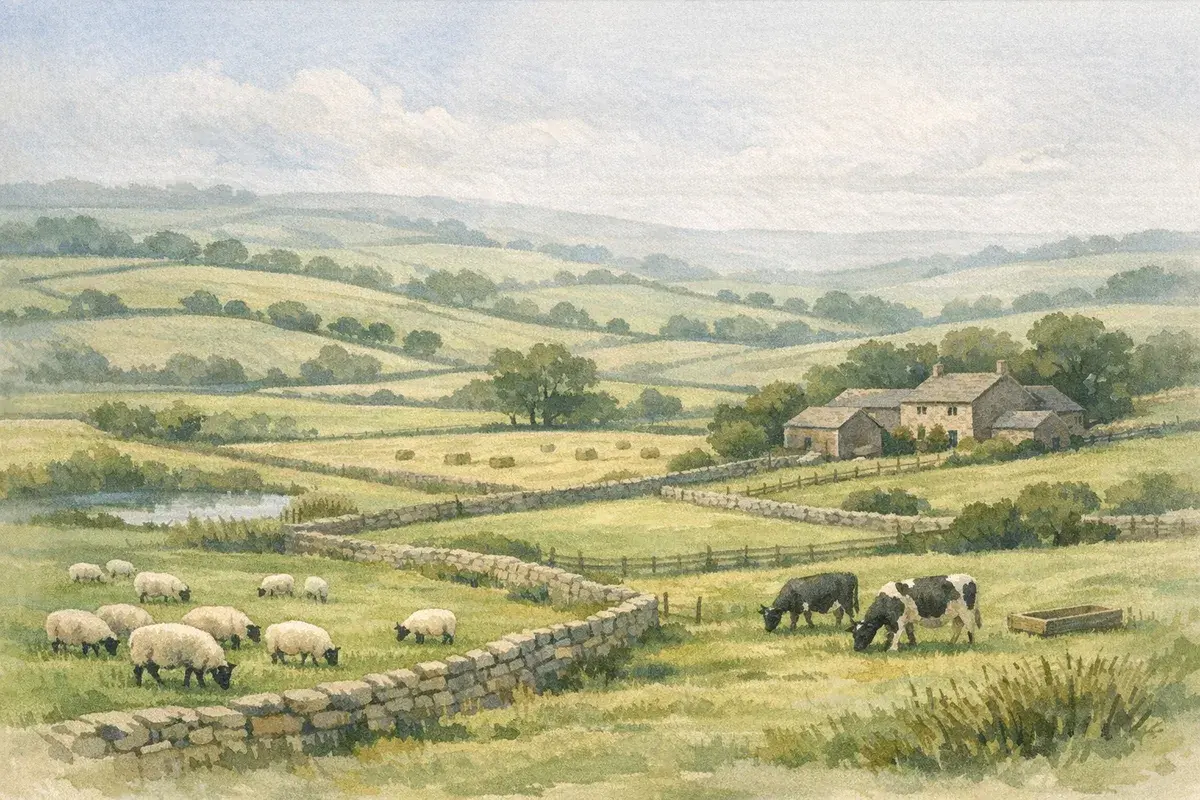
Pasture looks simple from the gate: grass in, animals out. But if you've ever watched covers disappear in a cold April, battled poaching in a wet corner, or wondered why you're feeding silage with "plenty of grass" standing, you'll know pasture land management is rarely straightforward.
In the UK, your grass growth is shaped by tight weather windows, variable soils, and a ruleset that's increasingly focused on water quality and outcomes. The upside? Small, consistent improvements, better pH, cleaner grazing residuals, a water trough in the right place, compound quickly. Done well, you'll grow more usable grass, carry more stock (or carry the same stock with less bought-in feed), and build soils that handle drought and deluges with less drama.
This guide is written for real-world UK farms and rural holdings: practical steps, sensible numbers, and the "watch-outs" we see most often through agents, advisers, and landowners using AgLand to assess grassland potential when buying, renting, or restructuring grazing blocks.
Set Clear Goals And Benchmark What You’ve Got
Pasture land management gets expensive when you're "improving" without a clear target. The quickest wins usually come from measuring what's already happening, and then making one or two changes you can actually stick with.
Stocking Rate, Output Targets, And Seasonal Priorities
Start with the output you're aiming for and work backwards:
- Beef systems: Are you chasing higher daily liveweight gain at grass, finishing earlier, or simply keeping cows in condition without pricey concentrates?
- Dairy systems: Is the goal more litres from forage, a longer grazing season, or reducing nitrogen use without losing yield?
- Sheep systems: Are you trying to lift scanning %, reduce lamb finishing time, or keep worm burden manageable while maintaining sward quality?
- Mixed or smallholdings/equestrian: Are you prioritising reliable keep, reduced poaching, or haymaking quality?
Then sanity-check your stocking rate against reality. A useful way to think is not "how many animals per acre" in the abstract, but:
- How many grazing days did this block actually provide last year?
- When did you start feeding, and why?
- Where did performance dip, mid-summer slump, late autumn, early spring?
UK grass growth isn't even. Most farms still see a big spring push, a variable summer (drought risk in the east: sporadic growth elsewhere), and a tail-off in autumn. So your seasonal priorities matter:
- Spring: protect regrowth and avoid grazing too tight when soils are cold.
- Summer: keep quality by controlling heading and managing residuals.
- Autumn: build cover for closing, extend grazing sensibly, avoid wrecking structure.
- Winter: decide early what's being sacrificed (if anything) and protect the rest.
If you're buying or renting land, this is also where you judge carrying capacity honestly: access, water, shape of fields, wet holes, and distance from yards often limit output more than "soil type" ever does.
Field Records That Actually Help: Covers, Grazing Days, And Inputs
You don't need a fancy system, just records that answer three questions: how much grass you have, how fast it's growing, and how efficiently you're using it.
A simple, workable set of records:
- Grass covers (weekly or fortnightly in season):
- Plate meter if you have one: if not, consistent visual scoring is better than nothing.
- Record at field level so you spot patterns (one field always lags: another always gets hammered).
- Grazing days and rest days:
- Note entry and exit dates for each field.
- You'll quickly see if fields are getting adequate recovery, or being re-grazed too soon.
- Residuals (post-grazing height):
- Whether you measure in cm or "boot height", be consistent.
- Residuals are a direct signal of utilisation and future regrowth.
- Inputs per field:
- Nitrogen rate and timing, slurry/FYM/digestate applications, lime, seed, sprays.
- A quick note on problems:
- Poaching, rush flare-up, docks after a wet summer, scorching in drought.
Over time, these records do something powerful: they stop you blaming "a bad year" for issues that are actually repeatable management bottlenecks.
Practical tip: pick three benchmark fields (good, average, poor). Measure those faithfully for a season. You'll learn more than sporadic whole-farm recording you can't keep up with.
Soil Health First: pH, Nutrients, And Structure
In UK grassland, soil is the cheapest place to win. If pH is wrong, fertiliser efficiency drops, clover sulks, and you're paying for nutrients the plant can't access. If structure is poor, you'll lose growth days to waterlogging and compaction even in an "average" rainfall year.
Soil Sampling In Practice: Where, When, And How Often
A few practical rules make soil sampling genuinely useful:
- Sample by management unit, not just by map. If one half of a field is heavy and wet and the other is freer draining, consider separate samples.
- Avoid unusual conditions: don't sample straight after slurry, lime, or fertiliser applications.
- Depth matters: typical grassland sampling is 0–10cm for pH, P, K, Mg, and organic matter measures where offered.
- Frequency: on actively managed grazing/silage ground, many UK advisers aim for every 3–5 years, sooner if you're correcting known issues.
Where to sample? Walk a "W" pattern and take enough cores to represent the field. Avoid gateways, troughs, dung patches, muck heaps, and headlands that don't represent the average.
And don't treat the lab report as a school grade. It's a decision tool: what's the limiting factor, and what's the cheapest fix?
Correcting pH And Indices: Lime, P And K, And Nutrient Planning
If there's one number to take seriously in pasture land management, it's pH.
- Low pH reduces availability of P and can depress clover performance.
- Correct pH improves the return on every pound you spend on fertiliser or manures.
For many UK mineral soils, grass and clover performance commonly improves as you move towards the mid-6s (exact targets depend on soil type, your lab and adviser will guide you). Peaty soils and some upland situations can differ, so avoid blanket targets.
On P and K, think in terms of:
- Silage ground is hungry for K. Cutting and carting removes a lot, then you wonder why swards look tired.
- Grazing recycles nutrients unevenly. Dung and urine return is real, but distribution is lumpy (camping areas, troughs, shady corners).
A sensible nutrient plan for grassland usually looks like:
- Correct pH first (lime programme).
- Use soil indices to decide whether you're building P/K or just maintaining.
- Match applications to offtake: cutting ground differs from grazing.
If you're pushing clover, keep an eye on sulphur too, many UK areas now see responses on grassland, particularly on lighter soils.
Compaction And Drainage: Fixing Poaching, Pans, And Wet Holes
You can't "fertilise your way out" of compaction.
Common UK causes:
- Grazing heavy stock on marginal days (especially in late autumn and early spring).
- Repeated trafficking for silage when conditions are borderline.
- Old drainage that's collapsed or never worked properly.
Start with diagnosis:
- Spade test: can you see a tight layer? Is rooting shallow? Does water sit in a pan?
- Field walk after rain: where does water stand and for how long?
Then choose the fix:
- Management fixes first: back-fence, reduce time on wet paddocks, sacrifice a chosen area, use on/off grazing, move troughs.
- Mechanical aeration/subsoiling: only works if you're addressing a genuine layer and doing it at the right soil moisture. Done wrong, it's an expensive way to smear the problem deeper.
- Drainage repairs: sometimes the most profitable "grass improvement" is simply restoring outfalls, clearing grips, and replacing failed runs.
If poaching is chronic, don't just blame weather. Ask whether water access, tracks, gateways, and paddock size are forcing animals to churn the same routes repeatedly.
Grazing Management That Grows More Grass
Grass growth responds to how you graze it. Not in a mystical way, mechanically. Leaves capture energy: roots recover: the plant needs time. The trick is matching grazing pressure and rest periods to UK growth curves.
Rotational Vs Set-Stocking: Choosing The Right System For Your Farm
Set-stocking can work, especially where labour is tight or land is fragmented. But it often leads to two classic outcomes:
- Selective grazing: animals keep taking the best leaves from the same plants.
- Patches of rank grass that go to seed and lose quality.
Rotational grazing (including paddock grazing) tends to improve utilisation and regrowth, because you control:
- Pre-grazing cover (enough leaf to fuel growth)
- Grazing intensity (how tight you leave it)
- Rest period (time to rebuild leaf area)
You don't have to go "all-in" with dozens of paddocks. Many UK farms do well with a modest step:
- Split big fields with temporary electric.
- Aim for a rotation that fits your stock and your week.
- Start with your most productive block (close to water and handling).
A good litmus test: if you often say "there's grass everywhere but nothing to graze", you're likely under-utilising and letting quality drift.
Residuals, Rest Periods, And When To Shut Up For Silage/Hay
Residuals are where discipline pays.
- Graze too tight and you slow regrowth, weaken tillers, and open the door to weeds.
- Leave it too high and you waste feed and encourage stemmy regrowth.
The "right" residual depends on stock class, sward type, and season, but the principle is constant: leave enough leaf for fast recovery.
Rest periods aren't fixed either. In the UK they should flex with growth:
- In a rapid spring flush, rest can be shorter.
- In a dry spell or cool shoulder season, rest must lengthen.
Knowing when to shut up for silage/hay is another big lever. If a paddock is getting ahead of you, forcing stock to "tidy it" often backfires, quality drops and the rotation slows. Cutting surplus (even a light cut) can reset the system and maintain grazing quality.
One practical approach:
- Keep grazing the best covers.
- Identify surplus early.
- Close it, cut it, and bring it back into the rotation as aftermath.
Infrastructure That Pays: Fencing, Water, Tracks, And Handling
Infrastructure is unglamorous, but it's what turns a grazing plan into something you can actually execute.
The upgrades that usually pay back quickest:
- Reliable water in the right place: fewer camping areas, better utilisation, less trampling around a single trough.
- More subdivisions (even temporary): control over allocation and rest.
- Gateways and tracks: reduce poaching and make it possible to graze on marginal days without wrecking the field.
- Handling/collection points: if gathering is a nightmare, you'll avoid moving stock, and the system collapses.
If you're assessing a new grazing block (purchase or rent), look beyond acreage. Ask:
- Can you get water to multiple paddocks affordably?
- Are there pinch points that will poach every winter?
- Is there safe access for moving stock and machinery?
We've seen "average" land outperform "good" land simply because the layout made grazing easy and consistent.
Sward Improvement: Renovation, Reseeding, And Weeds
Sward improvement is where people either make a step-change… or burn cash. The key is choosing the lightest-touch option that delivers the result you need, and then nailing establishment.
Overseeding Vs Full Reseed: Decision Triggers And Cost Reality
Overseeding can be brilliant when:
- The base sward is still decent but has thinned.
- You mainly want to introduce clover.
- You can create enough soil contact (grazed tight, scratched, or stitched) and manage competition.
It's less likely to work when:
- The field is dominated by weeds or rush.
- There's severe compaction, waterlogging, or chronic poaching.
- You've got old, unproductive species and very low ryegrass content.
Full reseeding makes sense when you're resetting a field for the next 5–10+ years of performance. But cost isn't just seed and cultivation, include:
- Lost grazing during establishment
- Spray and fertiliser needs
- Risk of failure if weather turns
Decision triggers we often see on UK farms:
- Low yield even though adequate nutrients
- Poor spring response
- High weed burden
- Sward open and mossy after winter
If you're unsure, do a simple sward assessment: percentage ryegrass, weed coverage, bare ground, and whether the field consistently underperforms neighbouring land.
Species And Mixtures For UK Conditions: Ryegrass, Clover, And Herbal Leys
There's no "best" mixture, only best for your site and system.
- Perennial ryegrass: still the backbone of productive UK grazing and cutting leys. Choose varieties suited to grazing or cutting based on use.
- White clover: valuable for nitrogen fixation and quality. It can reduce bought-in N needs, but it demands good pH and sensible grazing management.
- Red clover: often used in cutting leys: excellent yield potential, but different management and persistence compared to white clover.
- Herbal leys (e.g., plantain, chicory and others): can help with resilience and rooting, and may fit certain farm goals. Establishment and management matter, these aren't "set and forget" mixes.
UK reality check: herbal leys can be a strong tool, but they're not a magic fix for compaction, low fertility, or poor grazing control. If you're struggling to manage ryegrass well, fix management first.
Weed, Rush, And Bracken Control: Integrated Options And Compliance
Weeds are usually a symptom before they're a problem.
Common drivers:
- Overgrazing that opens the sward
- Under-utilisation that allows docks and thistles to seed
- Compaction/wetness that favours rush
An integrated approach typically includes:
- Grazing management: tighter control of residuals and rest, and cutting topping at the right time.
- Soil correction: pH and fertility to favour grass/clover.
- Mechanical options: topping, weed wiping where appropriate, improving drainage for rush pressure.
- Targeted herbicide use: where justified and legal, using the right product and timing.
On bracken, control is long-term and site-specific, often requiring repeated action and careful consideration of environmental constraints.
Compliance matters. Always follow product labels, stewardship requirements, buffer zones, and any scheme conditions on the land. If in doubt, speak to a qualified agronomist, getting it wrong can be costly in more ways than one.
Fertiliser, Manures, And Nutrient Use Efficiency
The UK is moving towards "produce more with less loss". That's not just policy, it's good business. Nutrient use efficiency is how you keep output while reducing waste, risk, and scrutiny.
Timing And Rates: Getting More From Nitrogen Without Waste
Nitrogen (N) is often the biggest spend and the biggest opportunity.
To get more from every kg of N applied:
- Time it to growth. Applying when soils are cold, saturated, or growth is stalled increases loss risk.
- Split applications. Smaller, well-timed doses usually outperform a big hit.
- Use clover intelligently. Where white clover is thriving, you can often reduce bagged N without losing quality, though it takes management (and patience).
Weather is the hidden variable. A dry forecast can turn N into a poor investment: a mild, moist spell can make it sing. You won't get it perfect, but you can avoid the obvious traps.
Slurry, FYM, And Digestate: Storage, Spreading, And Best Practice
Organic manures are valuable, if you treat them like a nutrient product, not a waste problem.
Best practice themes UK farms keep coming back to:
- Know what you're applying. Where possible, test slurry/digestate or use typical values with a sensible margin.
- Apply when the crop can use it. Spring applications to growing grass often give better return than late-season spreading on slowing growth.
- Use the right kit. Low-emission spreading (where practical) can improve nutrient capture and reduce ammonia loss.
- Protect water. Avoid spreading before heavy rain, on waterlogged ground, or near sensitive features.
Storage is part of the system. If you're forced to spread because you're full, you'll nearly always spread at the wrong time. Long-term, adequate storage creates freedom to wait for the right window.
Rules That Matter: NVZs, Farming Rules For Water, And Cross-Compliance Successors
Rules shift over time, and they differ across the UK nations, so you need to check what applies where you farm.
Key themes you can expect regulators (and schemes) to care about:
- Nitrate Vulnerable Zones (NVZs) where designated: limits, closed periods, and record-keeping.
- Farming Rules for Water (England) and equivalent requirements elsewhere: reducing diffuse pollution risk through sensible nutrient planning and soil protection.
- Scheme and inspection expectations that have evolved beyond the old cross-compliance era: evidence of good practice, records, and avoiding high-risk spreading.
If your pasture management relies heavily on manures, it's worth having a nutrient plan reviewed periodically by a qualified adviser, especially if you're expanding, changing systems, or taking on additional land.
Animal Performance And Pasture Utilisation
Pasture land management isn't just about growing grass, it's about converting it efficiently into milk, meat, or thriving animals. That's where grazing decisions, health planning, and simple infrastructure collide.
Grazing Groups, Lead-Follow, And Managing Different Stock Classes
Not all animals should be grazing the same covers.
A few practical strategies:
- Priority groups first. Growing lambs, finishing cattle, or high-yielding cows generally need the highest-quality swards.
- Lead-follow grazing: a "leader" group takes the best bite: a "follower" group cleans up. This can improve utilisation and control residuals, but it requires tight timing and good fencing/water.
- Match paddock size to demand. If allocation is too big, you'll get selective grazing: too small, and you'll graze too tight.
Also think about the week-to-week reality: if moving stock becomes a two-hour ordeal, you won't do it often enough. Design the system around what you (and your team) can repeat.
Parasites And Pasture: Worm Control, Rotation, And Grazing Hygiene
Parasite control is increasingly about strategy, not just dosing.
Grazing management influences parasite challenge:
- Rotation and rest: can reduce exposure, but only if the timing fits parasite lifecycles (which varies by species and conditions).
- Mixed grazing: cattle and sheep together or in sequence can help in some contexts, but it's not a universal fix.
- Avoid grazing "too low". Tight grazing can increase intake of larvae near the sward base.
Work with your vet or adviser on a plan that fits your system, including targeted treatments and monitoring. Blanket approaches are getting less reliable as resistance increases.
Minerals, Water Quality, And Shade/Shelter Considerations
Performance often stalls for mundane reasons:
- Water: volume, flow rate, and cleanliness. In hot spells, demand spikes: a slow trough can cap intake and grazing.
- Minerals: deficiencies (or imbalances) vary by region and soil type. Use testing and professional advice rather than guesswork.
- Shade and shelter: heat stress isn't just a southern problem anymore. Providing shade (natural or designed) and windbreaks can protect intake and reduce camping in gateways.
These aren't "nice-to-haves". If you're aiming for higher carrying capacity, animal comfort is part of the infrastructure plan.
Environment, Resilience, And UK Scheme Fit
UK grassland is being asked to do more: produce, protect water, support wildlife, and demonstrate outcomes. The most resilient pasture systems usually align with those goals anyway, healthy soil, continuous cover, and fewer bare, poached areas.
Biodiversity In Productive Grassland: Margins, Hedgerows, And Flowering Species
You don't have to choose between output and biodiversity.
Practical, low-regret options we see working:
- Manage field margins deliberately: reduce nutrient drift and give you cleaner boundaries for spraying/spreading decisions.
- Hedgerow maintenance: good hedges reduce wind stress, help stock comfort, and support beneficial insects and birds.
- Flowering species in leys: clovers and selected herbs can support pollinators while also contributing to forage quality and resilience.
If you're entering agreements or schemes, make sure the management requirements fit your farming calendar. The best option is the one you can deliver consistently.
Drought And Flood Resilience: Species Choice, Soil Cover, And Flexible Grazing
UK weather volatility is now a planning assumption.
To build resilience:
- Keep soils covered: good residuals and rest periods protect the plant and the soil surface.
- Improve rooting conditions: corrected pH and better structure support deeper roots.
- Choose mixtures with intent: deeper-rooting species can help in dry periods, but only if they're established well and managed appropriately.
- Stay flexible with grazing: have a plan for dry spells (longer rotations, protect regrowth) and wet spells (sacrifice areas, on/off grazing, use tracks).
The farms that cope best are rarely the ones with the fanciest seed mix. They're the ones with the most adaptable decision-making.
Carbon And Natural Capital: What You Can Measure And What To Be Wary Of
There's growing interest in carbon and natural capital across UK rural property, especially where grassland is part of a wider estate strategy.
A grounded approach:
- Measure what you can defend: soil organic matter trends, sward cover, fertiliser use, and grazing days are tangible.
- Be cautious with big claims. Carbon accounting methods vary, and results can be sensitive to assumptions.
- Don't undermine productivity. A grassland system that collapses under poor utilisation can be worse for both business and environment.
If you're considering carbon projects or biodiversity units tied to land value, involve the right professionals early, legal structure, long-term obligations, and valuation impacts matter as much as the biology.
Common Pasture Management Mistakes And How To Avoid Them
Most pasture problems aren't caused by a lack of knowledge. They're caused by good intentions meeting a busy week, a wet forecast, and infrastructure that makes the right decision awkward.
Overgrazing, Under-Utilisation, And Paper Gains That Don't Stick
The classic mistakes sit at opposite ends:
- Overgrazing: sward opens up, weeds move in, regrowth slows, and you end up feeding sooner.
- Under-utilisation: grass gets away, quality collapses, and you carry "more cover" but less usable energy.
The fix is rarely dramatic. It's consistency:
- Set a residual target you can repeat.
- Adjust rotation length with growth.
- Use surplus cutting to keep quality in front of stock.
"Paper gains" are improvements that look good in a plan but don't survive a season, usually because they depend on perfect weather or unrealistic labour.
Poor Reseed Establishment, Inputs Mis-Timed, And Infrastructure Bottlenecks
Reseeds fail for predictable reasons:
- Seedbed too rough or too dry.
- Competition not controlled (old sward comes back stronger than the new seedling).
- Grazing not managed post-emergence, either left too long or grazed too hard.
Inputs get mis-timed when you're forced by circumstance:
- Slurry applied because storage is full.
- Nitrogen applied ahead of a dry spell.
- Lime forgotten until after you've spent heavily on fertiliser.
And then there are infrastructure bottlenecks:
- One trough for a big field.
- One gateway that becomes a swamp every winter.
- No track, so you stop grazing when it turns wet.
If you're spending money, spend it where it unlocks better decisions week after week.
When To Bring In Help: Agronomists, Grazing Advisers, And Land Agents
There's no prize for doing it all alone, especially when the stakes are high.
Consider bringing in help when:
- You're investing in reseeding or drainage and want it right first time.
- You're changing system (set-stock to rotational: adding clover: expanding stock numbers).
- Performance and covers don't match your inputs.
Who helps with what?
- Agronomists/soil advisers: sampling strategy, nutrient planning, weed control choices.
- Grazing advisers: rotation design, paddock layout, practical targets for residuals and rest.
- Land agents: when you're buying, renting, or restructuring land, helping you evaluate grazing blocks, access, infrastructure potential, and the true "workability" that determines carrying capacity.
Through AgLand, we regularly see buyers and tenants focus on acreage and miss the practical constraints (water, access, wet corners, field shapes) that decide whether pasture management improvements will actually stick. Those same constraints decide which alternative uses a field can carry, from hay and equestrian livery through to stewardship agreements, which is what our guide to the options open to pasture land works through.
Conclusion
Better pasture land management in the UK isn't about chasing the newest idea. It's about getting the fundamentals right, pH and structure, controlled grazing pressure, and infrastructure that makes good decisions easy on a grim Tuesday in November.
If you want a simple action plan to start this season:
- Benchmark three fields (good/average/poor) for covers, residuals, and grazing days.
- Correct the obvious soil limiters (especially pH) before spending heavily elsewhere.
- Tighten grazing control with a modest step towards rotation and clear residual targets.
- Spend on the bottleneck, water, fencing, tracks, gateways, so the plan survives real life.
And if you're assessing land for purchase or rent, view grass as a system: soil, access, water, layout, and compliance context. That's how you judge true carrying capacity, not just "acres on the particulars".
Disclaimer: AgLand.co.uk is a UK agricultural land and rural property matching service, where buyers register what they are looking for and owners advertise directly to the buyers who match, and a rural resource hub. Nothing in this text is intended as legal, financial, or investment advice. You should do your own due diligence and seek guidance from appropriately qualified professionals (for example, a land agent, agronomist, vet, accountant, or solicitor) before making decisions.