
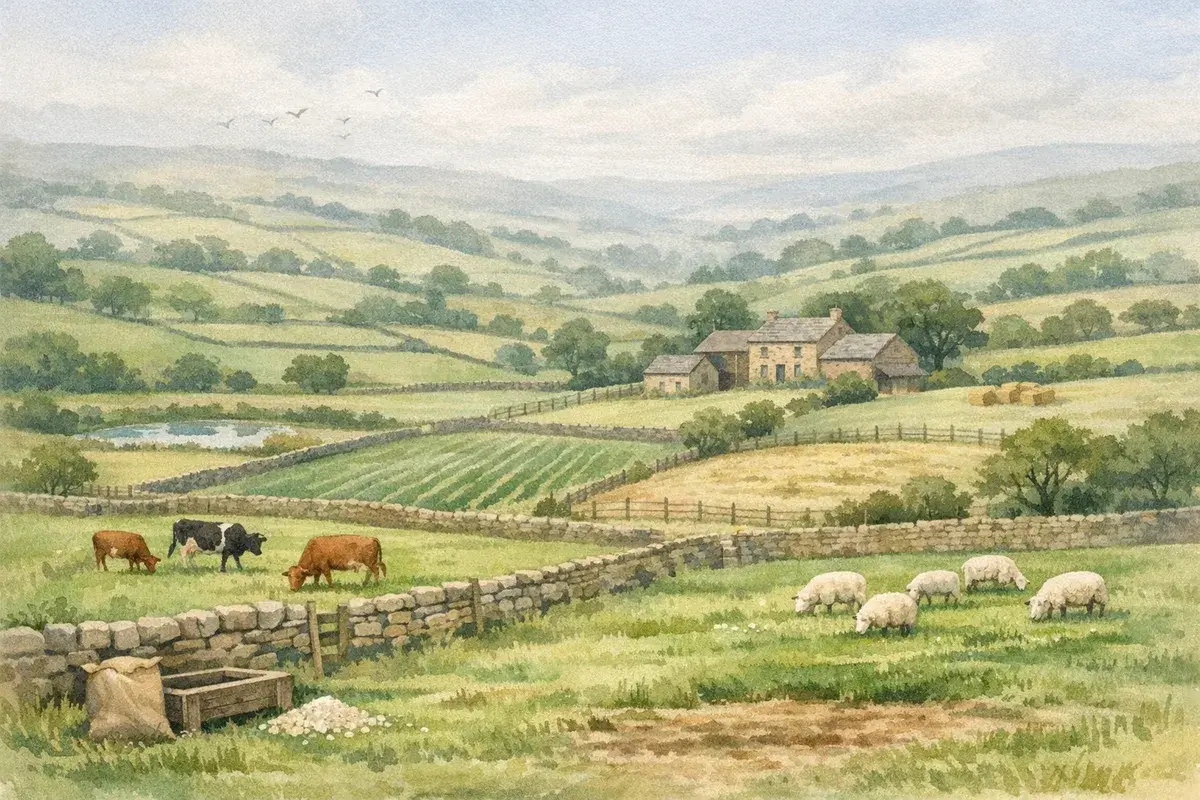
If your pasture feels "fine" but not firing, you're not alone. On a lot of UK farms the limiting factor isn't genetics, parlour kit, or even bought-in feed, it's the grass platform quietly under-delivering. And because grass growth is messy (weather, soils, stocking pressure, drainage…), it's easy to accept mediocre performance as normal.
Pasture improvement techniques don't have to mean a full reseed and a five-figure bill. Often, the quickest wins come from getting the basics right: knowing what's actually in the sward, correcting pH, fixing drainage pinch points, and tightening up grazing so plants get recovery time. Then, only then, does it make sense to spend serious money on seed, fertiliser, and infrastructure.
Below is a practical, UK-focused approach you can use whether you're running cattle, sheep, dairying, or managing horse ground. It's written the way we'd talk it through with land agents and grazing specialists we work with: baseline first, foundations next, then rebuild and optimise.
Start With A Baseline: What You’ve Got And What You Need
Most pasture "improvement" goes wrong for one simple reason: you change something before you've worked out what's limiting growth.
A baseline doesn't need to be complicated. You're trying to answer three questions:
- What's in the field right now? (species, density, weeds)
- What condition is the soil in? (pH, nutrients, structure, drainage)
- What are you trying to achieve? (more grazing days, better liveweight gain, cleaner horse pasture, more silage, etc.)
If you want a broader framework for ongoing decision-making, our practical pasture management guide is a useful companion, especially for benchmarking covers and tightening up utilisation.
Sward Assessment: Composition, Density, And Weed Burden
Walk the field properly. Not from the gate, and not at 40mph.
What you're looking for:
- Density: can you see soil between plants? Thin patches are where weeds establish and where production leaks away.
- Species mix: a pasture dominated by bent, Yorkshire fog, or rough meadow grasses can look green but won't drive performance like a productive ryegrass/clover sward.
- Clover presence: even small amounts of white clover can lift quality and reduce bagged nitrogen dependence.
- Weed pressure: docks, thistles, nettles, and rushes are usually symptoms as much as problems, compaction, wetness, low fertility, or poor grazing control.
A quick "10-step check" works well: stop at 10 points per field, note species, clover %, bare ground, and weeds. Consistency matters more than perfection.
Soil Testing In Practice: pH, P, K, Mg, And Organic Matter
In the UK, soil testing is still the cheapest decision tool you've got.
- Frequency: every 3–5 years is common, but if you're pushing output (or fixing problems), consider more often.
- Sampling: take a representative W-pattern across the field: avoid dung pats, gateways, and feed areas.
- Depth: typically 0–7.5cm for grassland (follow your lab's guidance).
Key metrics and why they matter:
- pH: if it's off, everything else underperforms, nutrients, clover, response to nitrogen.
- P and K: they drive root strength, tillering, and persistence. Silage fields are especially hungry for K.
- Mg: important for animal health and plant function: low Mg can be relevant where grass tetany risk is a concern.
- Organic matter & biology (if measured): useful for tracking soil resilience, especially on lighter land or where you're trying to reduce compaction and improve infiltration.
Set Clear Objectives: Grazing Days, Liveweight Gain, Silage, Or Horse Pasture
Be specific, because your objective dictates the right technique.
Examples:
- More grazing days: focus on drainage, soil structure, and rotational grazing discipline.
- Higher liveweight gain / milk from forage: prioritise sward quality (ryegrass/clover), leafier regrowth, and utilisation.
- More silage: nutrient planning (especially K), clean fields, and a reseed strategy that matches cutting frequency.
- Horse pasture: often about sward safety and cleanliness, ragwort control, avoiding poaching, managing parasite burden, and maintaining a dense sward that doesn't turn into weed mats.
Write your objective down per field. It sounds basic, but it stops you "improving" a field into something that doesn't fit how you actually farm it.
Fix The Foundations: Soil pH, Nutrients, Drainage, And Compaction
Here's the uncomfortable truth: you can buy the best seed mix in the world and still end up disappointed if the soil's working against you.
The foundations are pH, nutrients, drainage, and structure. Get these right and your pasture improvement techniques start compounding rather than stalling.
Correcting pH With Lime And Timing It Around Fertiliser And Reseeds
Grassland often drifts acidic over time, particularly where nitrogen has been used regularly.
Practical points that matter:
- Aim pH: many productive grass/clover systems do best around pH 6.0–6.5 (soil type dependent). Clover typically suffers first as pH drops.
- Lime type: ground limestone is the usual choice: quicker-acting products can help when timing is tight.
- Timing: avoid applying lime right alongside certain fertilisers (especially urea/ammonium forms) because you can increase nitrogen losses. Your adviser/lab can guide safe intervals.
- Before reseeding: correcting pH ahead of establishment is one of the best-value moves you can make.
If you're planning a reseed, treat lime like part of the seedbed cost, not an optional add-on.
Targeted P And K Strategy For Grass And Clover Performance
If your P and K indices are low, you'll often see it in persistence and recovery: poorer tillering, weaker roots, and swards that don't bounce back after grazing.
Key ideas:
- Don't guess: build a plan from soil results and offtake (silage removes a lot of K).
- Prioritise fields: put nutrients where response is highest, productive leys, high utilisation paddocks, and silage ground you rely on.
- Clover angle: a clover-containing sward still needs the right P, K, and sulphur to perform.
For the nuts and bolts (including typical UK considerations), see our guide to getting pasture fertiliser planning right.
Drainage, Poaching Control, And Tackling Compaction With Subsoiling Or Aeration
In much of the UK, water is the hidden yield thief, not because rain is bad, but because poor infiltration and blocked outfalls turn rain into stagnation.
Start with observation:
- Do you have standing water after normal rainfall?
- Are there rushes or soft patches that stock avoid?
- Do gateways and trough areas turn into mud every winter?
Then choose interventions:
- Surface water management: grips, cleaning ditches (where permitted), and sorting out outfalls.
- Field drainage: broken or silted systems can sometimes be repaired: sometimes you're looking at a bigger job.
- Compaction relief: subsoiling can help where you've got a defined pan and suitable conditions: aeration can be useful for shallow compaction and improving infiltration, but it's not magic on waterlogged clay.
If wet ground is a consistent issue for you, our resources on pasture land drainage and managing wet pasture go deeper into what to tackle first and what tends to waste money.
A rule of thumb: don't subsoil wet soil. You'll smear it, and you can make structure worse. Pick the right window, or don't do it.
Rebuild The Sward: Oversowing, Reseeding, And Species Choice
Once the soil is capable of supporting a better sward, you can make decisions about renovation. This is where budgets can disappear fast, so be clear on what you're trying to fix.
Oversowing Vs Full Reseed: When Each Makes Sense
Oversowing (stitching in seed) can be brilliant when:
- the existing sward is reasonably dense,
- weeds are limited,
- you mainly want to increase clover or lift productivity without taking the field out of use for long.
But oversowing struggles when there's a lot of open ground, weed dominance, or underlying soil issues.
Full reseeding makes sense when:
- the sward is thin and unproductive,
- perennial weeds are widespread,
- you need a known species mix for a specific system (e.g., high-output grazing or multi-cut silage),
- you're changing land use or field role.
If you're weighing the pros/cons and the practicalities, our dedicated piece on reseeding permanent pasture covers timing, methods, and common pitfalls in UK conditions.
Seed Mix Selection: Perennial Ryegrass, Timothy, Fescues, And White Clover
Seed choice should match soil, use, and management, not just the label.
Common UK-friendly options:
- Perennial ryegrass: the workhorse for grazing and silage on good ground: responds well to nutrients and good management.
- Timothy: useful on heavier or wetter ground: can suit certain livestock and upland-ish conditions.
- Fescues (tall and meadow): often more tolerant of droughty or lower-fertility situations: can add resilience.
- White clover: boosts protein and can reduce bagged N needs, but it demands light, pH, and sensible grazing.
Ask yourself:
- Is this mainly grazed, mainly cut, or a mix?
- How hard can you graze it (and will you actually do it)?
- What's your soil like in July/August, baking, or holding moisture?
Also, consider whether the field should stay as permanent pasture for your system, or whether a temporary ley gives you better control and output. Our explainer on permanent pasture versus short-term leys helps you think through that decision without the usual noise.
Establishment Essentials: Spray-Off, Seedbed, Drilling, Rolling, And First Grazing
Good establishment is mostly about doing the boring bits well.
- Spray-off: where appropriate, killing the old sward cleanly gives the new ley a fair start.
- Seedbed: aim for firm and fine: grass seed needs good seed-to-soil contact.
- Drilling: place seed at the right depth (too deep is a classic mistake).
- Rolling: it isn't optional on many soils: it improves contact and moisture retention.
- First grazing: light, quick grazing can encourage tillering once plants are established, think "nip the top," not "hammer it."
And don't ignore pests. Leatherjackets and frit fly can ruin an establishment quietly, so if a field has history, factor that into timing and monitoring.
One more human reality: if you know you won't have the time to manage a new ley properly in its first season, delay it. A reseed doesn't fail because seed is bad, it fails because weather turns, grazing gets missed, and weeds get a foothold.
Grazing Management That Grows Grass: The Fastest ‘Improvement’ Most Farms Miss
You can't out-fertilise poor grazing. And you can't reseed your way out of set-stocking if the plants never get recovery.
Grazing management is the pasture improvement technique that pays back quickest because it changes how the plant behaves: deeper roots, faster regrowth, better utilisation, and fewer weeds.
Rotational Grazing Basics: Residuals, Rest Periods, And Recovery
Rotational grazing isn't a fad: it's simply controlling three things:
- Pre-grazing cover (what you go in with)
- Residual (what you leave behind)
- Rest period (how long you let it recover)
In practice:
- Graze too hard and you remove the plant's engine (leaf area), slowing regrowth.
- Graze too lax and quality drops, you get stemmy patches, and utilisation falls.
- Rest too short and you're always chasing regrowth.
- Rest too long and you lose digestibility and invite rejection.
A simple way to think about it: you're managing the pasture like a solar panel. Leave enough leaf to capture sunlight and regrow quickly.
If you want a more detailed, UK-grounded walkthrough, our guide to pasture rotation grazing breaks down practical residuals, rotation length, and how to adjust through the season.
Stocking Rate, Infrastructure, And Water: Making A System Work On UK Fields
Good grazing is often limited by unglamorous stuff:
- Fencing: you can't control utilisation without control. Temporary fencing is usually the cheapest route to a big change.
- Water: if stock have to walk too far, they overgraze near troughs and undergraze the back end. More access points often improve utilisation immediately.
- Access and lanes: wet gateways and poached corners are productivity drains and animal health risks.
And then there's stocking rate. You don't need to be "high stocking" to benefit from rotation, but you do need to match demand to growth, or have a plan for surplus (bale it, cut it, or graze followers).
Managing Wet Weather: Turnout, Stand-Off Areas, And Minimising Sward Damage
UK winters and shoulder seasons test every system. The goal isn't to pretend it won't rain, it's to stop rain turning into field damage that costs you all spring.
Practical tools:
- Flexible turnout: avoid forcing stock onto fields when they'll poach them in 24 hours.
- On/off grazing: a few hours can give intake without wrecking the surface.
- Stand-off / sacrifice areas: not ideal, but sometimes the least-worst option to protect your best paddocks.
- Back-fencing: keeps animals off regrowth and reduces trampling.
If you're repeatedly losing early growth because fields are cut up, that's usually a sign to revisit drainage, grazing pressure, and infrastructure, not just "put more seed in."
Fertiliser, Slurry, And Clover: Getting More From Nutrients With Fewer Wasted Inputs
Nutrients should be the accelerator, not the steering wheel. Once soil pH, structure, and grazing are reasonable, fertiliser and organic manures start delivering predictable responses.
Nitrogen Planning Around Growth Curves, Closed Periods, And Risk Of Losses
In the UK, nitrogen decisions sit inside three realities:
- Grass growth curves: response is highest when the plant can use it (temperature, moisture, daylight).
- Run-off and volatilisation risk: applying ahead of heavy rain or on dry, breezy days can waste money and increase pollution risk.
- Rules and timing: NVZ rules and closed periods (where they apply) affect planning: even outside NVZs, good practice still matters.
Practical approach:
- Apply N when you can reasonably expect uptake.
- Split applications rather than chasing one big hit.
- Adjust to clover presence, more clover generally means you can lean on bagged N less.
Using Slurry And FYM Well: Testing, Application Methods, And Timing
Slurry and FYM are resources, not waste products, if you treat them like nutrients with variability.
What tends to separate "good" from "messy" use:
- Test the nutrient content: even occasional testing helps you avoid under- or over-applying.
- Application method: low-emission methods generally place nutrients where plants can use them (and reduce losses).
- Timing: target cool, damp conditions and actively growing swards: avoid waterlogged ground.
Also, be realistic about traffic. Repeated tanker runs on heavy land can compact the very soil you're trying to improve.
Integrating Clover And Managing N To Keep It In The Sward
Clover is often talked about like a switch you flick. In reality, it's a balancing act.
To encourage clover persistence:
- Keep pH in the right range.
- Make sure P and K aren't limiting.
- Avoid blanket high N that lets ryegrass bully clover out.
- Graze in a way that lets light reach the clover (overlong covers can shade it).
Done well, clover doesn't just add protein, it can stabilise summer performance and reduce your exposure to fertiliser price swings. But if your soils are acidic or your grazing is inconsistent, clover will sulk and disappear, and you'll be back to buying N.
Weeds, Pests, And Diseases: Control Without Setting The Sward Back
Weed control isn't just about what you spray, it's about why the weed is there.
A dense, well-managed sward is your best herbicide. But you still need a plan, because certain weeds (ragwort, for example) are non-negotiable from an animal health perspective.
Practical Weed Control: Ragwort, Docks, Thistles, Nettles, And Rushes
A quick UK-specific reality check:
- Ragwort: toxic to horses and cattle (especially when dried in hay/haylage). Control is a safety job, not a cosmetic one.
- Docks: thrive where fertility is high but utilisation is poor: they love gaps and overgrazed patches.
- Thistles: often a sign of under-grazing or uneven grazing.
- Nettles: usually point to high nutrient hotspots (around yards, gateways, dunging areas).
- Rushes: typically scream wetness/compaction/poor drainage.
The best results usually come from combining control methods and improving the underlying conditions that favour the weed.
Cultural Controls: Cutting, Topping, Grazing Pressure, And Soil Fixes
Cultural control is unsexy, but it's often the cheapest route:
- Topping/cutting at the right time: weaken weeds before seed set.
- Grazing pressure and timing: correct residuals reduce selective grazing, which helps stop weed patches forming.
- Fix wet areas: rushes rarely disappear until the ground dries out and roots can breathe.
- Improve density: oversowing or reseeding where bare ground is the real problem.
If you're repeatedly fighting the same weeds each year, treat that as a diagnosis: something about soil condition or grazing is giving them an edge.
Targeted Chemical Options And Stewardship: When Spraying Is Justified
Sometimes spraying is the right tool, particularly when:
- there's a genuine animal health risk (e.g., ragwort),
- docks and thistles are widespread and reducing utilisation,
- you're protecting a new ley.
But be targeted:
- Choose products and timings that suit the weed and growth stage.
- Consider clover-safe options if clover is part of your system (or accept you may set clover back).
- Follow UK stewardship requirements carefully, buffer zones, water protection, and application records.
If you're not sure, this is a good moment to bring in a BASIS-qualified agronomist or a trusted adviser. Poorly timed spraying can cost you grass growth and clover for a season, which is a big price to pay for a "quick fix."
Measure Results And Decide Next Steps
Pasture improvement techniques only really count if you can see what changed, ideally in grass grown and animal output, not just "it looks greener". Measurement keeps you honest, and it stops you throwing money at the wrong fields.
Simple KPIs: Grass Covers, Utilisation, Silage Yield, And Livestock Output
You don't need a lab coat, just a few consistent metrics:
- Grass covers: even occasional plate metering (or consistent visual scoring) helps you time grazing and spot underperformance early.
- Utilisation: look at residuals and how much is being trampled or rejected.
- Silage yield and quality: tonnes/acre (or hectares) and analysis results tell you whether your fertility plan is working.
- Livestock performance: daily liveweight gain, milk from forage, or days to finish are the business-facing indicators.
Pick two or three metrics you'll actually track, and stick with them for a season.
Costing Improvements: Reseed Payback, Input Efficiency, And Risk Management
A reseed or renovation isn't "worth it" because it increased growth, it's worth it because it increased margin.
When you cost an improvement, include:
- Direct costs: seed, sprays, fertiliser, contractor, rolling, fencing, water.
- Opportunity costs: taking a field out of use, bought-in forage, reduced grazing days.
- Risk: weather can ruin establishment: build contingency (and don't bank the benefit before it's in the clamp or under stock).
A practical way to frame it is: How many extra grazing days or tonnes of silage do I need to cover the cost? If you can't answer that, pause and do the sums.
When To Bring In Specialists: Agronomists, Soil Advisors, Drainage, And Land Agents
There's a point where paying for expertise is cheaper than learning the hard way.
Consider bringing in specialist help when:
- Soils are complex: persistent poor performance even though inputs.
- Drainage is structural: you suspect collapsed drains, failing outfalls, or you're planning major capital work.
- You're changing system: e.g., stepping into rotational grazing, dairy expansion, or converting land use.
- You're buying/letting land: understanding soil type, drainage history, and the pasture's productive potential can influence what you pay and how you plan improvements.
On AgLand, we regularly see buyers and tenants underestimate the cost of "making grass ground work" on heavier UK soils, particularly where access, water, and wet-weather management haven't been set up. A quick pre-purchase/tenancy review with the right people (agent, surveyor, agronomist, drainage contractor) can save you a year of frustration.
Conclusion
The best pasture improvement techniques are rarely dramatic, they're cumulative. A pH correction that unlocks nutrient response, a drainage fix that gives you an extra fortnight of grazing, a rotation that stops you scalping regrowth, a reseed only where it'll genuinely pay back.
If you take one principle into the next season, make it this: treat grass like a crop with a plan, not a background green carpet. Measure a little, act deliberately, and keep the system simple enough that you'll still follow it when it's wet, busy, and nothing's going to schedule.
Whether you're improving your current holding or assessing land as a buyer or tenant, pasture performance is one of the clearest indicators of how a farm will actually run in UK conditions, on paper and in real life.
Disclaimer: AgLand.co.uk is a UK agricultural land and rural property matching service, where buyers register what they are looking for and owners advertise directly to the buyers who match, and a rural resource hub. Nothing in this text is intended as legal, financial, or investment advice. You should carry out your own due diligence and seek guidance from suitably qualified professionals (e.g., land agents, agronomists, soil advisers, surveyors, accountants, and solicitors) before making decisions.