
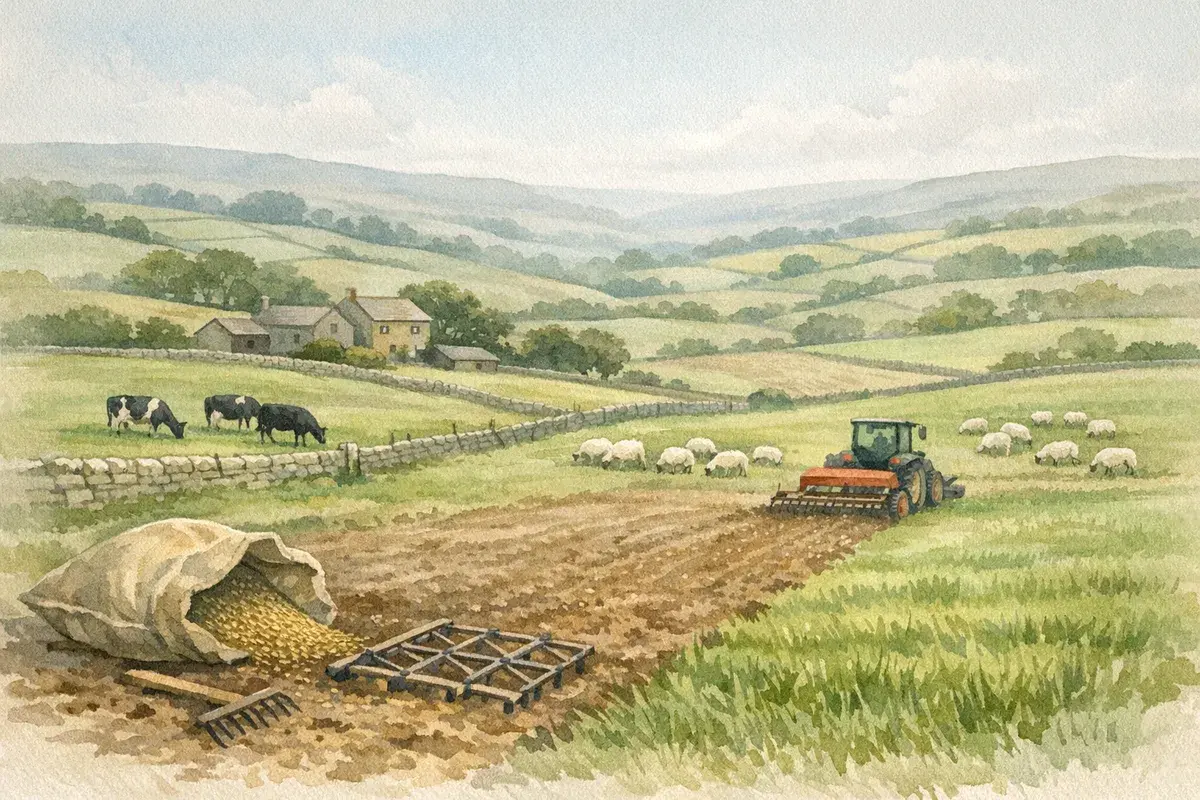
You can put a lot of money into livestock and machinery… then quietly lose margin every day to a tired sward. Permanent pasture has a habit of "looking green enough" right up to the point it isn't: milk from forage dips, lambs don't finish off grass, bales get lighter, and you start leaning on bought-in feed.
Reseeding permanent pasture can be one of the fastest ways to lift output per hectare, but it's also one of the easiest ways to waste money if you rush it, drill into the wrong conditions, or ignore what the soil is trying to tell you. This guide walks you through the UK realities: how to decide whether to reseed at all, what the rules and designations can mean in practice, how to choose a system, and how to protect establishment so you're setting the field up for years (not just a good first cut).
Deciding Whether Reseeding Is The Right Call
Reseeding permanent pasture is rarely a single decision. It's a chain: is the sward actually underperforming, can you fix the limiting factor, and will the new ley persist under your grazing and soil conditions?
A useful starting point is to treat reseeding as the final step in a pasture improvement plan, not the first. If you haven't tightened grazing, corrected pH, or addressed drainage, a shiny new mix can slip back into mediocrity surprisingly fast. If you want a wider toolkit before you commit to a full reseed, it's worth scanning through these pasture improvement techniques and picking the options that fit your system.
Productivity Signals: Yield, Sward Composition, And Weed Pressure
A permanent pasture can be "busy" without being productive. Look for signals that you're paying the cost of poor species composition:
- Reduced dry matter (DM) grown per hectare: you're grazing down too quickly, recovery is slow, and shoulders (April/May or September) feel tight every year.
- Sward dominated by low-value grasses (bent, fog, Yorkshire fog in places, soft rush creeping in wetter corners) and a thinning of productive ryegrass where you'd expect it.
- Weed pressure: docks, creeping thistle, chickweed, nettle patches, buttercups in persistently wet/acid conditions. A few weeds aren't a crisis: a weed population that's increasing year-on-year usually points to a management or soil issue.
- Poor utilisation: stock graze "in islands", leaving stemmy clumps and dead matter. That's often a sign of low palatability species and/or a thatchy base.
If you're trying to quantify it, compare:
- Days at grass achieved versus what the farm needs
- Silage ME and protein versus historic results
- Bought-in feed trends (and whether they correlate with specific fields)
Soils First: Compaction, Drainage, pH, P, K, Mg, And Organic Matter
If you take one thing from UK grassland reseeding: soil fixes come first.
- Compaction: common on gateways, trough runs, heavy land in a wet back-end, and any field that's had repeated trafficking for silage. You'll often see water sitting, poor rooting, and patchy establishment in reseeds where compaction was ignored.
- Drainage: if the field is wet for long periods, you can reseed it ten times and still get rushes, poached crowns, and an open sward. Where drainage is the limiter, sort that before you spend on seed. Our guide to pasture land drainage is a good primer on what's realistic and what tends to pay.
- Soil pH: grass and clover performance drops off quickly as pH drifts down. A reseed into an acid soil is like renovating a house on rotten foundations.
- P, K, Mg: new seedlings need access to nutrients early: deficiencies show up as slow establishment and thin ground cover, which then becomes a weed invitation.
- Organic matter and structure: permanent pasture often has good organic matter, but structure can still be poor if it's been damaged over time. Dig holes. Look for rooting depth, smell, earthworms, and whether the soil breaks into crumbs or plates.
Practical note: many farmers only soil test when something has gone wrong. Flip that logic. Test to prevent expensive reseed disappointment.
Full Reseed Vs Overseeding Vs Grassland Renewal
You've basically got three routes:
- Overseeding (stitching in): best where you've still got a reasonable base sward (enough desirable grass, not too much thatch), but you're short on clover or density. It's lower cost and lower disruption, but it's not magic, if soil pH is wrong or the sward is too competitive, the new seed never gets a fair shot.
- Grassland renewal (partial cultivation / min-till): a middle ground when you need more reset than overseeding offers, but you want to protect soil structure and reduce erosion risk.
- Full reseed (spray off + cultivation + new ley): highest potential uplift and the cleanest "reset," but also highest cost and highest risk if weather turns, weeds flush, or soil structure is damaged.
If you're still not sure whether you're dealing with true "permanent pasture" in the regulatory sense or simply old grass, it helps to clarify the difference between permanent pasture vs temporary grass. That distinction matters for both management expectations and compliance.
Rules, Designations, And Compliance Before You Start
In the UK, the agronomy is only half the job. The other half is making sure you're not about to breach a designation, an agreement, or an environmental rule that applies to the parcel.
This is where a lot of reseeds go wrong, not because the farmer didn't know how to drill grass, but because the field had a constraint that wasn't properly checked.
Permanent Pasture And Environmental Sensitivities
Some permanent pasture is environmentally significant because of its species diversity, carbon storage, or habitat value. Even when a reseed is technically possible, you may be expected (or required) to protect key features, think:
- diverse swards and unimproved grassland areas
- wet grassland supporting waders
- buffer zones along watercourses
- veteran trees, hedgebanks, and species-rich margins
If a field is part of a scheme agreement (or has options that rely on the existing habitat), a full spray-off and reseed can be a straight conflict with your obligations.
SSSI, SAC, SPA, AONB, Scheduled Monuments, And Local Constraints
Before you do anything that changes the sward substantially, check for:
- SSSI (Site of Special Scientific Interest)
- SAC/SPA (Special Area of Conservation / Special Protection Area)
- AONB / National Park sensitivities (not always a prohibition, but scrutiny can be higher)
- Scheduled Monuments and other historic environment constraints
The practical point: restrictions aren't always field-wide. You might have a corner, a strip, or a feature that triggers extra requirements.
If you're renting ground, don't assume "the landlord sorted all that". You need clarity in writing on what is and isn't permitted on that parcel.
Cross-Compliance, Scheme Agreements, And Record-Keeping
Even outside specific designations, your scheme conditions (and basic compliance expectations) mean you should be able to evidence what you did and why.
A sensible reseed file includes:
- soil test results (date, field ID)
- nutrient plan and application records (including slurry/FYM timing)
- spray records (product, rate, operator)
- seed labels and mix details
- establishment photos (they're surprisingly useful if something is challenged)
If you're in an agreement, read the option rules and keep correspondence. And if there's any doubt, ask before you act. The cost of a professional call is usually tiny compared with the cost of putting a field back the way it was.
Choosing A Reseed System: Plough, Min-Till, Or Direct Drill
Reseeding permanent pasture isn't one-size-fits-all. Your choice is really about how much "reset" you need versus how much soil risk you can tolerate.
Plough And Power Harrow: Best Reset, Highest Cost And Soil Risk
If you've got:
- severe weed burden
- a badly compacted top layer you're planning to correct properly
- a very open, unproductive sward
…ploughing can give the cleanest slate.
But it comes with trade-offs:
- Cost (fuel, labour, multiple passes)
- Soil structure risk if you work it too wet or over-cultivate
- Erosion and run-off risk on slopes or light land
- Organic matter disturbance (you're turning over a system that's often been building carbon for years)
If your field is known to "cap" or slump, power harrowing can create an over-fine seedbed that looks perfect, then bakes and cracks, leaving seedlings stressed.
Min-Till And Stitching-In: Balancing Establishment And Soil Protection
Min-till renewal and stitching-in sit in the sweet spot for many UK farms:
- less soil moved
- less moisture lost
- generally quicker back into production
It's especially attractive where you want to maintain soil biology and reduce the weather exposure of bare soil.
The catch is you must be honest about what you're trying to fix. Min-till won't erase a heavy dock population unless you've tackled docks properly. And it won't solve chronic wetness.
Direct Drilling Into Existing Sward: When It Works (And When It Won't)
Direct drilling can work brilliantly, but only under the right conditions:
Good candidates
- fields with decent structure and drainage
- a base sward that isn't too thatchy
- when you can create space for seedlings (tight grazing/mowing, then drilling)
Poor candidates
- compacted, wet ground
- thick thatch and trash
- heavy weed pressure
Direct drill isn't "low effort", it's high requirement on grazing management and timing.
One practical lens: if you're already struggling with persistently wet areas, read up on managing wet pasture land before you decide to drill into a field that can't carry stock or kit reliably. You can't out-seed a waterlogging problem.
Timing, Weather Windows, And Grazing Management Around The Reseed
Timing makes or breaks reseeding permanent pasture in the UK because our biggest variable isn't heat, it's moisture at the wrong time.
Spring Vs Late Summer: UK Regional Pros And Cons
Spring reseeds (often March–May depending on region and altitude):
- Pros: warming soils, long days, good establishment potential
- Cons: spring can turn dry quickly on lighter land: weed flushes (especially docks and chickweed) can be fierce: you can lose a big chunk of early grazing if you shut fields up
Late summer reseeds (typically August–early September when conditions allow):
- Pros: soils are warm, moisture often returns, weeds can be more manageable, and you can get grazing before winter if establishment is strong
- Cons: if autumn turns wet early, you may struggle to travel, roll, or graze without poaching: upland and northern areas can run out of growing season fast
There isn't a universal best window. The best window is the one where you can:
- travel without smearing the soil
- retain enough moisture for germination
- protect seedlings from being eaten or trampled into oblivion
Closing Up, Killing Off, And Managing Trash And Thatched Swards
If you're doing a full reseed, you typically need a proper kill-off to stop the old sward competing.
Your objectives before drilling are straightforward:
- reduce the mass (tight grazing or mowing)
- avoid a thick thatch layer that stops seed-to-soil contact
- plan for trash (dead material can interfere with drilling depth and create slug habitat)
Slugs are the classic "silent reseed killer" in mild, damp UK conditions. If you've got history, monitor and act early.
First Grazing Or First Cut: Setting The Reseed Up For Years, Not Months
A reseed is most vulnerable right after emergence. The first utilisation should be about building a dense base, not chasing yield.
Rules of thumb that tend to hold:
- First grazing: go in light and quick when plants are well anchored. Think "nip the tops" rather than "set stock for a week". The aim is to encourage tillering and reduce shading.
- First cut: if you're cutting, avoid letting it get too stemmy. A heavy, late first cut can pull plants and weaken the ley.
And don't forget the boring stuff that pays: grazing infrastructure. If you're serious about performance, the way you manage rest and residuals often matters as much as the seed mix. If you want a structured approach, our guide to pasture rotation grazing lays out a practical UK framework.
Seed Mix Design For Permanent Pasture Outcomes
Seed mix design is where reseeding permanent pasture goes from "new grass" to "a sward that fits your farm". The right mix depends on how you'll use it, what your soil can support, and how hard you'll push it.
Grazing, Cutting, Or Mixed Use: Matching Species And Heading Dates
- Grazing-focused leys usually benefit from dense, leafy varieties that recover fast and tolerate frequent defoliation.
- Cutting leys often prioritise yield and a slightly different growth pattern.
- Mixed systems need balance: strong spring growth for first cut, plus regrowth and persistence for grazing.
Heading date matters more than many people admit. A mix with clashing heading dates can turn management into a compromise, some plants are perfect, others are already running to head.
Perennial Ryegrass, White Clover, Red Clover, And Herbal Options
- Perennial ryegrass is still the backbone for many UK productive pastures because it's responsive and high energy when managed well.
- White clover can lift quality and reduce reliance on bagged N (subject to your system and soil). But it's sensitive to low pH and poor P/K.
- Red clover suits cutting systems well but can be less persistent under tight grazing and heavy traffic.
- Herbal options (for example, deep-rooting species) can be useful where you're targeting drought resilience or soil structure benefits, but they're not a free pass, management needs to match.
A quick caution: if you're farming heavy land, or you've got high stocking density and winter traffic, don't build a mix that only thrives in ideal conditions. Persistence beats theory.
Persistence Factors: Ground Cover, Winter Hardiness, And Traffic Tolerance
Permanent pasture outcomes are really about staying power:
- Can the sward hold ground cover through winter?
- Will it tolerate poaching risk at pinch points?
- Does it recover after silage kit or multiple grazings?
This is why your soil work, drainage, and grazing control aren't "extras". They're what make a reseed last.
Step-By-Step Reseeding Workflow (From Soil Test To Establishment)
Here's a pragmatic workflow you can adapt to your own kit, contractors, and field constraints.
Soil Corrections: Lime, Nutrients, And Fixing Compaction
- Soil test (in good time): pH, P, K, Mg at minimum. If you've got persistent issues, consider extra tests (but start with the basics done properly).
- Correct pH: lime takes time to work, so plan ahead.
- Fix compaction: subsoiling/aeration only works when soil moisture is right. Do it wet and you can make it worse.
- Plan fertility: seedlings need available nutrients early. Your approach should be integrated with slurry/FYM and bagged fertiliser.
If you're building a budget and plan for nutrition, our overview of pasture fertiliser requirements helps you sense-check what's typical in UK grassland situations.
Spray-Off, Cultivation, Consolidation, And Drilling Depth
- Prepare the existing sward: graze or mow tight to reduce trash.
- Spray off where appropriate and permitted: this is about removing competition and reducing carry-over of poor species.
- Choose your cultivation approach (plough/min-till/direct drill) based on the field's limiting factors.
- Consolidate: seed-to-soil contact is everything. A fluffy seedbed is a classic way to get patchy emergence.
- Drilling depth: grass seed wants to be shallow. Too deep and it struggles: too shallow and it can dry out or be taken by birds.
Rolling, Post-Emergence Care, And Early Weed Control
- Roll (when conditions allow): improves contact and moisture retention.
- Monitor emergence: don't just glance from the gate. Walk it and check density and gaps.
- Early weed control: deal with weeds while they're small and before they seed.
- First utilisation: light, fast grazing or a timely first cut, then manage for persistence.
A good reseed is rarely "set and forget". It's weeks of small, correct decisions.
Costs, Payback, And Valuation Considerations For Landowners
If you're a landowner (or a tenant watching every margin), reseeding permanent pasture needs to justify itself in pounds, not just in "it looks better".
Typical UK Cost Components And Where Budgets Blow Out
Your cost stack usually includes:
- soil testing and analysis
- spray-off (where used)
- cultivation (or drilling contractor costs)
- seed (mix choice can swing this materially)
- rolling
- fertiliser and/or slurry logistics
- follow-up weed control
- opportunity cost of lost grazing/cutting during establishment
Where budgets blow out:
- weather delays leading to extra passes
- drilling into sub-optimal conditions, then having to patch or redo
- ignoring drainage/compaction, so the reseed fails in the same places as the old sward
Measuring Return: Extra Dry Matter, Stocking Rate, And Bought-In Feed
Payback is most convincing when you track a few simple metrics:
- extra tonnes of DM utilised per hectare (even a modest uplift can pay quickly when used well)
- stocking rate changes (or days at grass)
- silage quality improvements (ME/protein) and what that does to concentrates
- reduced bought-in forage in shoulder periods
Reseeding tends to pay fastest where grazing management is already strong, because you can actually capture the extra growth.
How Grassland Condition Can Affect Lettings, Sales, And Long-Term Value
If you're thinking beyond annual performance, grassland condition can influence:
- lettability: better fields attract better tenants and reduce disputes about "what condition was it in?"
- saleability: buyers and agents do notice clean, productive ground, good access, and well-managed infrastructure
- risk: persistent wet patches, rush infestations, and chronic poaching are red flags for ongoing cost
At AgLand we see how buyers and tenants interrogate land quality, especially when they're comparing blocks at similar guide prices. Strong grassland management records, sensible reseeding history, and evidence of soil care can help support confidence in the holding.
If you're looking at land with a view to re-laying grass as part of a wider change, it's also worth understanding the practical implications of converting arable to pasture, the establishment mindset and soil considerations overlap more than you'd think.
Conclusion
Reseeding permanent pasture is one of those jobs that feels simple until you price it, plan it, and try to land it inside a UK weather window. When it works, you can transform forage output and animal performance. When it fails, it's almost always because the basics were ignored: soil condition, drainage, pH, seed-to-soil contact, and the first few grazings.
If you're on the fence, start with a field walk and a soil test, then decide what you're truly trying to fix. Sometimes an overseed and a change in grazing discipline is the best return. Sometimes only a full reset will do, but it should be done with eyes open, and with the right professional input where designations, agreements, or historic features are in play.
Disclaimer: AgLand.co.uk is a UK agricultural land and rural property matching service, where buyers register what they are looking for and owners advertise directly to the buyers who match, and a rural resource hub. Nothing in this text is intended as legal, financial, or investment advice. You should carry out your own due diligence and seek independent advice from suitably qualified professionals (for example, your agronomist, land agent, rural surveyor, solicitor, accountant, and relevant regulators) before taking action.