
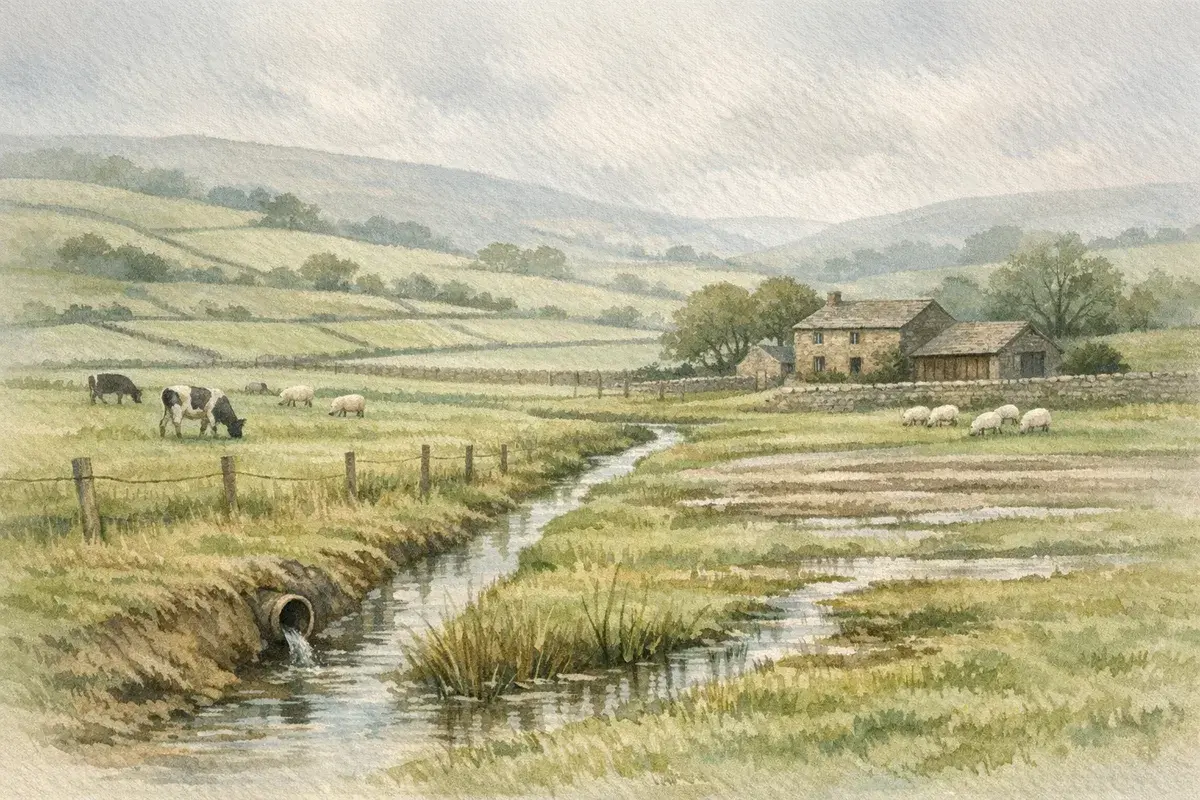
You can spot poor pasture drainage without a spade. The giveaway isn't just standing water in winter, it's the slow, expensive creep: gateways that turn into soup, cows that spend more time avoiding wet patches than grazing them, silage cuts that slip a week, then two, then suddenly the season's gone. And if you're buying or renting land, it's one of those "looks fine on a viewing day" issues that can quietly wreck budgets.
Pasture land drainage in the UK is rarely about a single silver bullet. It's usually a chain: water arriving from somewhere (rainfall, run-on, springs), soil that can't absorb or move it (texture, structure, compaction), and an exit route that's blocked, undersized, or never existed. This guide is designed to help you diagnose what's actually happening, choose a drainage approach that fits your ground and system, and deliver works that last, without walking into avoidable regulatory or neighbour headaches.
Done properly, drainage isn't "making land drier". It's making water predictable: where it goes, how fast it moves, and how you keep it moving year after year.
Why Pasture Drainage Matters (And When It Becomes A Costly Problem)
Pasture drainage sits in that awkward middle ground: it's not as visible as reseeding, and it doesn't feel as urgent as feed bills, until it suddenly is. When you're losing grazing days, damaging swards, and battling lameness, the costs aren't theoretical.
How Poor Drainage Hits Output, Welfare, And Soil Health
Poor drainage reduces performance in three main ways:
- Less usable grass: waterlogged areas grow less, and what does grow is often less accessible because stock avoid it or you're forced to stay off to prevent damage.
- More poaching, slower recovery: once the surface is damaged, air is squeezed out, roots struggle, and you get a feedback loop, wetter ground, weaker plants, more bare patches.
- Welfare and health knock-ons: prolonged wet conditions increase the risk of lameness (softened hooves, bacteria in muddy conditions) and can worsen parasite and liver fluke pressure in some localities.
There's also the machinery side: late fertiliser, delayed topping, lost silage quality, and extra wear on kit from pulling through heavy ground.
If your fields are consistently wet, it's worth stepping back and asking whether it's "normal UK winter wet" or a fixable constraint. A useful reality check is to compare how the field behaves against nearby land on similar soil and aspect. If you're the only one with standing water for weeks, it's telling you something.
Regulatory And Environmental Risks To Factor In Early
Drainage is not just an on-farm engineering decision: it can have environmental and compliance implications, particularly where works affect watercourses, protected habitats, peat soils, or historic features.
Key risks to consider early:
- Sediment and nutrient loss during works (and afterwards if the site is left bare) can impact ditches and streams.
- Downstream impacts: moving water off your land faster can increase peak flows elsewhere if not managed thoughtfully.
- Protected areas and designations can restrict what's permitted and how you must deliver it.
None of this means "don't drain". It means you'll save time and money by thinking about permissions, constraints, and good practice before a contractor turns up with a trencher.
If the problem is persistent wetness but you're still unsure whether drainage is the right lever, it can help to read up on day-to-day tactics for managing persistently wet grazing ground alongside longer-term drainage options.
Diagnosing The Cause: Water Sources, Soil Type, And Field Clues
Good drainage starts with a slightly unglamorous truth: if you misdiagnose the problem, you'll spend money very efficiently… on the wrong solution.
Before you price pipe drains, work through three questions:
- Where is the water coming from?
- Why is it staying there?
- Where could it go, if you gave it a route?
Surface Water Vs Groundwater Vs Springs
Not all "wet fields" are the same.
- Surface water (rainfall and run-on): Water sits because the surface can't infiltrate fast enough, or because water is flowing onto the field from higher land, tracks, yards, roads, or compacted headlands.
- Groundwater: The water table rises into the root zone. You'll often see a broad wetness across lower ground, with less obvious entry points.
- Springs and seepage lines: Water emerges at a consistent point or along a contour. Springs often keep running when rainfall stops, and you may see iron staining, lush rush growth, or a distinct wet band.
A quick clue: if the field dries quickly after a few dry days, you're often dealing with surface issues and compaction. If it stays wet long after, suspect groundwater, a perched water table, or blocked/failed drainage.
Soil Texture, Structure, And Compaction: What To Look For
UK pasture soils vary wildly across short distances, and texture drives what drainage can achieve.
- Heavy clays: naturally slow infiltration: they can benefit from mole draining (when conditions are right) and well-designed pipe systems that support moles.
- Silts and loams: can drain well when structure is good, but are prone to compaction and smearing.
- Peaty or organic soils: behave differently again, high water-holding capacity and often environmental constraints.
Structure matters as much as texture. You're looking for:
- Compacted layers (often from repeated grazing on wet ground, machinery, or feeding points)
- Smearing/pans in the topsoil that stop infiltration
- Rooting depth: shallow roots usually mean the soil environment is poor, waterlogging, acidity, compaction, or all three
If you want the most useful field test you can do in an hour: dig a few inspection holes (spade depth or more) in wet and "normal" areas. Look for grey/blue mottling (gleying), smell (anaerobic conditions), and whether water seeps in from the sides.
This also ties directly into overall pasture performance, soil pH, biology, and sward resilience. For the broader system view, you may find it helpful to anchor drainage decisions within a wider pasture management approach.
Mapping Wet Areas: Simple Checks Before You Call In A Contractor
You'll get better quotes, and better outcomes, if you can show a contractor what's happening.
Try these simple steps:
- Walk the field after heavy rain and again after a dry spell. Photograph the same points.
- Mark recurring wet spots on a map (even a printed aerial photo). Note gateways, troughs, tracks, and dips.
- Check ditches and outfalls: is water actually leaving the field? A perfectly installed system is useless if the outfall is submerged or blocked.
- Look uphill: water may be arriving from outside your boundary. Run-on from roads, yards, or neighbouring land can swamp a field that would otherwise cope.
If you're buying or renting, ask for drainage history. "We put drains in years ago" isn't the same as "here's where they are, when they were installed, and where they discharge."
Choosing The Right Drainage Approach For Pasture
The best drainage approach is the one that matches the cause. In practice, many UK pasture farms end up with a layered solution: sort surface routes first, relieve compaction where it's limiting infiltration, and only then commit to subsurface systems where the economics stack up.
Surface Solutions: Grip, Re-Profiling, And Managing Run-On
Surface work is sometimes dismissed as "old-fashioned", but it's often the most cost-effective starting point, particularly where water is ponding due to micro-topography or run-on.
Common options include:
- Grips (shallow field drains): can intercept surface water and move it to a ditch, but need careful placement and ongoing maintenance.
- Re-profiling / levelling local hollows: small depressions can hold water for days. Strategic regrading can remove the problem without deep works.
- Managing run-on: simple bunding, cut-off drains above the field, or improving yard/track drainage can prevent water arriving in the first place.
A practical note: if you don't control run-on, you may end up "draining your neighbour's hillside" at your expense.
In-Soil Solutions: Aeration, Subsoiling, And Mole Draining
These are about restoring soil function, getting water into the profile and moving it along existing pathways.
- Aeration: useful for shallow compaction and improving infiltration, especially on grazed swards. Timing matters: too wet and you smear: too dry and you do little.
- Subsoiling: targets deeper compaction but is easy to get wrong. You need the right moisture conditions and a clear idea of where the compaction layer actually is.
- Mole draining: a classic tool on heavy clay where moles can run and stay intact. Mole drains typically need an outlet via collector drains or a suitable permeable layer.
The catch is longevity: aeration can be short-lived if grazing pressure is high and the soil is trafficked wet again. That's why management changes often need to accompany the metal.
If you're adjusting stocking to protect recovering ground, it's worth thinking in terms of thresholds and timings rather than instinct. A structured view of stock levels on pasture can help you avoid undoing your own work.
Subsurface Pipe Systems: When Land Drains Make Sense
Pipe drainage is usually the biggest capital outlay, but it can be the most reliable long-term solution when:
- Wetness is broad and persistent, not just localised hollows.
- You have heavy soils or a perched water table that won't shift with surface works alone.
- You need dependable access for grazing rotations, silage windows, and machinery.
A well-designed system gives you control, but it's not "fit and forget". Outfalls, ditches, junctions, and rodding points still need attention.
One more reality check: if the field is fundamentally low-lying with limited fall to an outfall, drainage becomes as much about creating a viable discharge route as it is about pipes in the ground.
Design Basics For Subsurface Drainage (UK Pasture Context)
If you're investing in subsurface drainage, the design is where money is saved or wasted. Two systems can look identical from the surface in year one. Year five is where the truth comes out.
Outfalls, Falls, And Keeping A Free-Flowing Discharge
Everything depends on discharge. You're aiming for a free-flowing outfall that doesn't sit under water for long periods.
Focus points:
- Confirm the outfall location and condition before you start. If you can't find it, treat that as a red flag.
- Check ditch levels and maintenance: silted ditches raise the water level and reduce the effective fall of your drains.
- Protect outfalls from crushing and vermin. Simple guards can prevent blockages, but they must be maintained.
If the ditch is on someone else's land or the outfall crosses a boundary, deal with that early (permissions and responsibilities are where projects stall).
Drain Depths, Spacing, And Layouts: What Drives The Spec
Drain design is site-specific, but the key drivers are consistent:
- Soil type and permeability (how quickly water moves through the soil)
- Depth to any restrictive layer (like a compacted pan or naturally impermeable horizon)
- Available fall to the outfall
- Land use (grazing only, silage, heavy machinery use, wintering)
In UK pasture, you'll often see parallel lateral drains running to a collector, but the spacing and depth can vary significantly. Wider spacing might be fine in more permeable soils: tighter spacing is often needed in heavier ground.
A good designer or experienced contractor will talk you through trade-offs plainly: tighter spacing costs more upfront but can pay back in usability and resilience.
Materials And Build Quality: Pipes, Stone, Geotextiles, And Junctions
Materials aren't glamorous, but they're where failures start.
- Pipe choice: modern perforated plastic pipes are common: diameters should match expected flows.
- Backfill: clean stone or suitable aggregate supports flow and helps prevent fines washing into the pipe.
- Geotextiles: can be useful in some soils to prevent silt ingress, but must be specified correctly, wrong fabric can clog.
- Junctions and connections: weak joints, crushed pipes, or poor junctions create hidden choke points.
Ask what the contractor is proposing and why. If the answer is basically "this is what we always do", you're entitled to push for a design rationale, especially if you're spending serious money per acre.
Drainage shouldn't be designed in isolation from the rest of your grassland plan either. If reseeding is on the cards after works, plan timings and cultivations together rather than undoing good drainage with poor establishment choices. (More on this in the aftercare section.)
Permissions, Cross-Compliance, And Getting Advice In The Right Order
In the UK, the fastest way to turn a straightforward drainage job into a drawn-out mess is to assume it's purely "an agricultural improvement" and crack on.
You don't need to be paralysed by paperwork, but you do need to check constraints and speak to the right bodies in the right order.
Ordinary Watercourses, Main Rivers, And Who You Need To Speak To
The first question is: where does the water go?
- If works affect a main river, you'll typically be dealing with the Environment Agency in England (with equivalents in the devolved nations).
- For ordinary watercourses, the relevant Lead Local Flood Authority or Internal Drainage Board (IDB) may be involved, depending on location.
Even when permissions aren't required for every action, you should treat watercourse works as sensitive. Altering banks, culverting, changing discharge points, or clearing substantial sections can trigger consents or conditions.
Also check whether you're in an IDB district. IDBs can be practical and helpful, but they will expect you to follow their byelaws and maintain flows.
Protected Sites And Constraints: SSSI, Peat, AONB, And Historic Features
Designations can change what's appropriate and what's permitted.
- SSSIs: drainage can affect habitats and hydrology: you may need consent from the relevant statutory body.
- Peat and deep organic soils: drainage can have significant carbon and ecological impacts, and may be restricted or discouraged.
- AONBs / National Parks: not always a hard stop, but you'll need to consider landscape impacts and methods.
- Historic environment: field drains can cut through archaeology or historic features (old ridge and furrow, boundary banks). Desktop checks and local knowledge matter.
If you're unsure, don't guess. Get advice before you invest.
Tenancies, Wayleaves, And Neighbouring Land Considerations
If you're a tenant, drainage improvements can raise questions about:
- Landlord consent (often required)
- Who pays and who benefits
- Dilapidations / end-of-tenancy valuation
If the works involve crossing another party's land or discharging into their ditch, you may need a wayleave or written agreement. And if your drainage increases flow onto a neighbour, you'll want to be confident you're not creating a dispute.
One practical tip we've seen save time: write down the "chain of water" on a single page, your field, your ditch, the receiving ditch/watercourse, and who controls each section. It's amazing how often that's unclear until a machine is on site.
Installation, Timing, And Minimising Field Damage
Drainage installation is where good plans can be ruined by bad timing. UK weather doesn't care about your schedule, and neither does clay when it's on the wrong side of plastic.
Best Windows For Works And How Weather Can Derail Plans
The best window is usually when:
- soils are dry enough to carry machinery without smearing, but
- there's still enough moisture for effective mole draining (if you're doing it), and
- you can reinstate the surface and establish grass before winter pressure returns.
In practice, many farms aim for late spring to early autumn, but it's site-specific. A wet August can be worse than a dry April.
Build contingency into your plan. If the contractor is booked for one week and the ground is too wet, forcing the job through can lock in damage for years.
Contractor Method Statements: What Good Looks Like
A professional contractor should be able to set out, in plain language:
- the drainage layout and outfall details
- machine access routes and ground protection plans
- how they'll avoid smearing and compaction
- how they'll manage spoil, stone, and reinstatement
- how they'll protect existing services (water pipes, electric, telecoms)
If you're doing subsurface drains, ask how they'll record the system. A map with approximate lines isn't enough if you later need to repair a section or explain the investment to a buyer.
Avoiding Common Failures: Smearing, Blocked Outfalls, And Poor Backfill
Most failures are boring, and avoidable.
Common ones we see:
- Smearing of trench sides or the base in wet conditions, reducing infiltration into the drain.
- Blocked or drowned outfalls, sometimes because the ditch wasn't cleared first.
- Inadequate backfill (too little stone, wrong grade, contaminated aggregate).
- Crushed pipes from poor installation depth or trafficking before reinstatement.
If you want one simple quality check during works: keep an eye on the outfall. You should see consistent discharge when conditions are wet, and it should run cleanly rather than pumping out fines.
Once works are complete, don't rush straight back to full pressure grazing "because it looks dry". New drainage can make fields feel deceptively ready before the sward and structure have recovered.
Aftercare, Maintenance, And Long-Term Performance
A drainage system is an asset only if it keeps working. The good news is that maintenance isn't complicated, it's just easy to neglect because it's rarely urgent until it is.
Routine Checks: Ditches, Outfalls, Rodents, And Sediment
Build a simple routine:
- Outfalls: check after heavy rainfall and at least seasonally. Clear trash, check guards, and look for collapsed banks.
- Ditches: keep them functional. Silt build-up raises water levels and reduces the fall your drains rely on.
- Rodents: burrowing near outfalls and ditch lines can cause collapses and blockages.
- Sediment: if you're seeing dirty discharge, you may have a soil stability issue upstream (or an installation/backfill problem).
Small interventions, done early, avoid big repairs.
Reseeding And Grazing Management To Protect The Investment
Drainage works often leave you with disturbed ground and weakened sward. That's not failure: it's the start of the next phase.
If you're reseeding, align species choice and establishment with your grazing system and soil type. When done well, reseeding plus drainage can transform utilisation. When done badly (wrong timing, poor seedbed, grazing too early), you can end up with open ground that slumps back into wet patches.
If you're weighing whether to stitch in, overseed, or fully reseed, the practical considerations are covered in our guide to reseeding permanent pasture.
Then protect the field with management:
- back off grazing during wet spells
- use sacrifice areas or stand-off where appropriate
- move troughs and avoid repeated feeding in the same place
If you want to formalise this so it's not just "best intentions", a simple grazing plan can help you set rules for when to enter/exit, how long to rest, and how to handle wet weeks.
Monitoring Results: Infiltration, Poaching Reduction, And Carrying Days
You don't need fancy kit to judge whether pasture land drainage is paying back. Track a few outcomes:
- Carrying days: how many extra grazing days you gained on that field versus last year.
- Poaching: take photos from fixed points after wet periods.
- Infiltration: simple observation during rainfall, does water sit, flow, or disappear?
- Sward density: fewer bare patches, less rush encroachment, more consistent covers.
If results are mixed, don't assume "drainage doesn't work here". Go back to diagnosis: outfall levels, blocked lines, compaction reintroduced by management, or water arriving from outside the boundary are common culprits.
Costs, Returns, And Valuation Impacts For UK Rural Property
Drainage costs in the UK vary massively by soil, access, scale, and whether you're doing surface works, mole draining, or full subsurface systems. The mistake is to compare quotes on headline price alone.
Typical Cost Drivers And How To Compare Quotes Like-For-Like
When you're comparing quotes, make sure you're comparing the same job.
Key cost drivers include:
- Extent of wet area and whether you're draining patches or whole fields
- Outfall work (clearing, repairs, headwalls, fluming)
- Stone and materials availability and haulage distance
- Depth and spacing of drains (tighter spacing = more work and materials)
- Access and ground conditions (heavy kit, need for ground protection)
- Recording and mapping (worth paying for)
Ask for clarity on:
- drain spacing and depth assumptions
- pipe diameter and backfill specification
- reinstatement method
- what's excluded (ditch clearance is a common "surprise extra")
A thoughtful contractor will also ask you questions, about your grazing pressure, machinery traffic, and intended use, because design without context is guesswork.
Productivity, Access, And Risk Reduction: Building A Realistic Payback
Payback rarely comes from "more grass growth" alone. It's usually a combination:
- More days you can graze without damage
- Earlier turnout / later housing in some systems
- Better silage windows and improved utilisation
- Reduced lameness and vet costs in persistently wet gateways and gathering areas
- More reliable access for fertiliser, topping, fencing, and moving stock
If you're investing, estimate payback using your own figures: extra grazing days, reduced bought-in feed, fewer lost silage opportunities, and lower remedial costs (stone in gateways every year adds up quietly).
Also consider the "risk reduction" value. A field that can't be accessed when you need it is a business risk, not just an inconvenience.
What Buyers, Lenders, And Agents Look For In Drainage Records
If you're buying pasture, selling, or refinancing, drainage sits in the "prove it" category.
Buyers, lenders, and agents tend to value:
- Mapped drainage plans (where are the laterals, mains, and outfalls?)
- Dates and scope of works
- Photos and invoices
- Evidence of maintenance (ditch/outfall checks)
- Any permissions/consents where relevant
If you're looking at pasture as part of a wider acquisition, perhaps moving to grass, expanding an existing unit, or rebalancing an arable-heavy block, drainage should sit alongside your improvement budget and timeline. The same land can look very different once you've aligned drainage with soil correction and sward upgrades using proven pasture improvement methods.
And if you're evaluating land types, remember "pasture" isn't one thing. Permanent pasture can behave differently to short-term leys in terms of structure, rooting, and resilience. If you're weighing those trade-offs, this explainer on long-term pasture versus short-term grass is a useful reference point when you're assessing what you're actually buying.
Conclusion
Pasture land drainage is one of those investments where doing the basics well beats doing something clever. Diagnose the water source, fix the exit route, match the method to your soil, and protect the result with sensible grazing and maintenance. If you rush straight to pipes without understanding why the field is wet, or you install a good system and then hammer it in poor conditions, you'll spend money without getting the reliable grazing days you're really buying.
If you're buying, renting, or planning capital works, treat drainage like any other high-stakes rural decision: get it mapped, get it recorded, and bring in the right expertise early (contractors, drainage designers, agents, and where relevant, environmental and watercourse specialists). The payback isn't just drier ground: it's a more predictable system you can plan around.
Disclaimer: AgLand.co.uk is a UK agricultural land and rural property matching service, where buyers register what they are looking for and owners advertise directly to the buyers who match, and a rural resource hub. Nothing in this text is intended as legal, financial, or investment advice. You should carry out your own due diligence and take advice from relevant qualified professionals (for example, a chartered surveyor, land agent, drainage contractor, solicitor, accountant, or environmental consultant) before making decisions or undertaking works.