
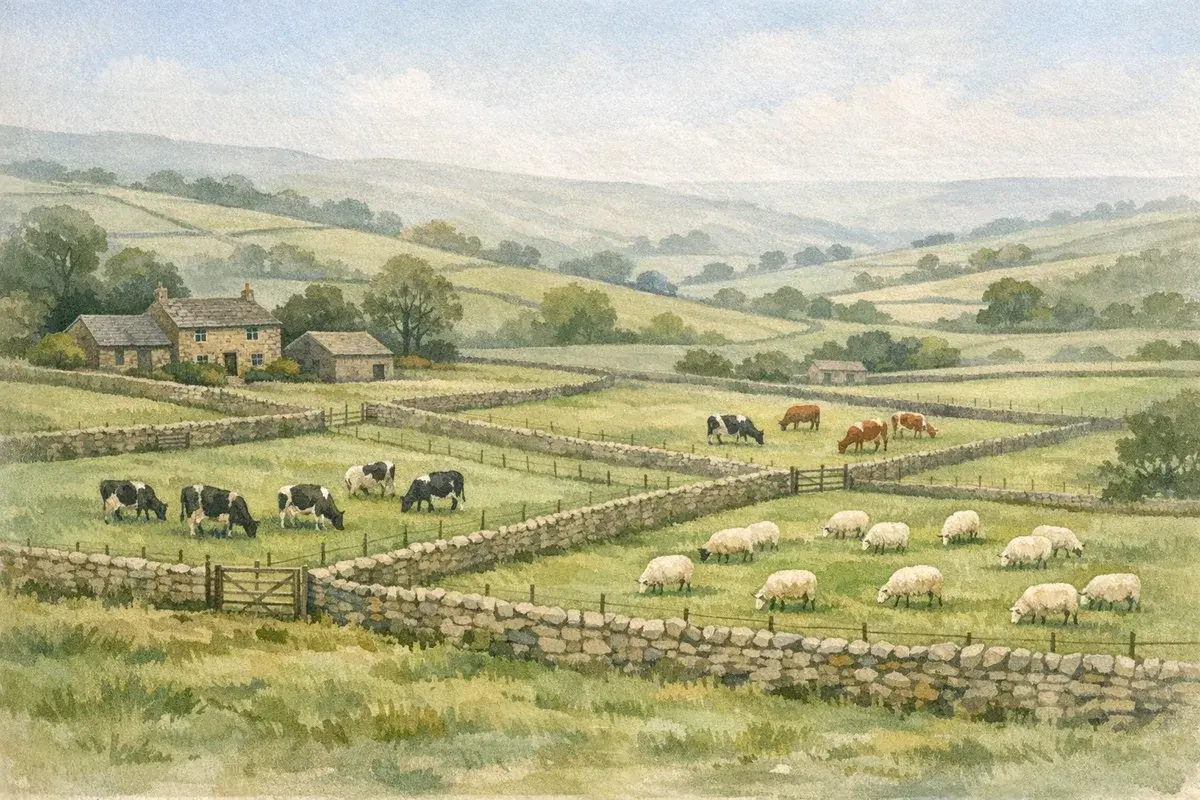
You don't need to be running a "textbook" grazing unit to make pasture rotation grazing pay. You do need a system that fits your farm: your soil type, your rainfall pattern, your stock class, and the reality of UK springs that arrive in a rush… then turn into a wet fortnight just as you've started believing in yourself.
Rotation grazing (done well) is less about copying a diagram of perfect paddocks and more about learning to control three things: time (rest and grazing days), area (how much ground you offer), and residual (what you leave behind). Get those right and you'll typically see better grass utilisation, cleaner swards, steadier performance from stock, and fewer "panic decisions" when growth stalls or gateways cut up.
This guide walks you through the practicalities: which rotation style suits which farms, how to size paddocks, how to match moves to grass growth, and what to measure so you're making decisions, not guesses.
What Pasture Rotation Grazing Really Means (And When It Works Best)
Pasture rotation grazing is simply planned grazing with planned rest.
Instead of letting stock roam a whole field for weeks (or months), you divide grazing into paddocks and control:
- Grazing duration (hours/days in a paddock)
- Rest period (days until that paddock is grazed again)
- Allocation (how much area you offer to match demand)
It works best when you've got at least three things in place:
- A defined grazing platform (land you can reliably access with stock).
- Some control over water and boundaries (permanent fencing helps, but isn't mandatory).
- A willingness to move stock on time, even when the weather's trying to negotiate.
On many UK units, the limiting factor isn't grass growth. It's access: wet soils, awkward field shapes, public rights of way, or a platform split by roads. Rotation can still work, you just design around constraints.
Rotational, Cell, And Strip Grazing Compared
You'll hear these terms used interchangeably, but they're not the same.
- Rotational grazing: Stock move through a series of paddocks on a set-ish cycle (for example, 18–30 days depending on season). Moves are often daily to every 3 days.
- Cell grazing: A more intensive form of rotational grazing with higher stocking density and typically shorter grazing bouts. The goal is tight utilisation and long rest periods.
- Strip grazing: Stock get a "strip" of fresh grass (often with temporary electric fence), usually moved daily or twice daily. Common for dairy, youngstock, and where you want strong control without permanent subdivisions.
In UK conditions, strip grazing is often the quickest win because it's easy to trial: a reel, posts, a decent energiser, and you can start learning immediately.
Set-Stocking Vs Rotation: The Real Trade-Offs
Set-stocking isn't "wrong". It's just a different compromise.
Set-stocking can be useful when:
- You need labour simplicity (lambing fields, extensive systems).
- You're grazing rough ground where subdivision is impractical.
- You're managing sward structure in a specific way (e.g., sheep keeping a tight sward).
Rotation grazing tends to win when:
- You want to increase grass grown and utilised, not just grazed.
- You're feeding cattle or dairy where residual discipline matters.
- You're trying to reduce poaching and regrow faster after grazing.
The real trade-off is this: set-stocking is often easier day-to-day, but rotation gives you more levers to pull when growth surges, when it stalls, and when weather forces a plan B.
The Benefits You Can Measure On UK Farms
The most convincing case for pasture rotation grazing is that it shows up in numbers you can track: days at grass, bought-in feed, average daily gain, milk from forage, and how often you're "repairing" swards.
If you want a broader benchmark view of what good grazing management looks like on UK farms, pH, covers, utilisation, and practical levers, see the grassland actions in the Environmental Land Management schemes and AgLand's guide to practical pasture land management (useful as a reference point alongside rotation planning).
Grass Utilisation, Liveweight Gain, And Milk From Forage
Rotation improves utilisation mainly by reducing selective grazing. Stock are less able to keep coming back to the same sweet spots while leaving stemmy clumps behind.
On a practical level, you'll often notice:
- More even residuals (fewer "lawns and tussocks").
- More consistent intakes, especially where you move daily.
- Better ability to hit performance targets because you're controlling allocation.
For finishing cattle, that can mean steadier liveweight gain through the season. For dairy, better control of pre-grazing cover and residual can lift milk from forage, particularly when spring growth is racing ahead and quality can slip quickly.
Soil Health, Reseeding Intervals, And Drought Resilience
Rotation grazing isn't magic, but it can be friendlier to soils than continuous grazing because you can:
- Rest plants long enough to rebuild leaf area and root reserves.
- Avoid repeated traffic on the same patches.
- Keep groundcover more consistent (less bare soil exposure).
Over time, many farms see improved sward persistence and fewer emergency fixes. That doesn't mean you'll never reseed, but you may lengthen the interval, especially if you avoid hammering residuals in late summer.
If you're deciding whether the land you're managing should remain long-term grass or be treated as a shorter rotation, it's worth understanding permanent pasture vs temporary grass because the management goals (and practical options) differ.
On drought resilience: in the UK, drought is often "short and sharp" rather than months-long, but it's becoming a more regular feature. A rested sward with decent root mass and groundcover typically bounces back faster after stress than a constantly nibbled one.
Worm Burden, Poaching Risk, And Animal Welfare Outcomes
Rotation can help with parasites, but only if you're realistic.
- Longer rest periods can reduce larval challenge on pasture, but the effective break depends on temperature and moisture (and it won't replace a proper parasite plan).
- Tight grazing can increase intake of larvae near the base of the sward. Residual discipline matters.
From an animal welfare angle, rotation often gives you cleaner lying areas and better access to fresh forage, provided you've planned for water, shelter, and sensible moves.
Poaching is the UK-specific headache. Rotation doesn't eliminate it, but it gives you options: smaller allocations, back-fencing, on/off grazing, and sacrifice areas (we'll get to those).
Designing A Grazing Platform And Paddock System
Before you start counting paddocks, get brutally clear about what your usable grazing area really is. Many systems fail because the "platform" exists only on paper.
If you want a structured way to bring all of this together, soil, infrastructure, grazing goals, timings, building a grazing land management plan can stop rotation becoming a collection of half-decisions.
Mapping Your Usable Grazing Area And Access Points
Take a farm map (or print an aerial image) and mark:
- Fields you can graze reliably (not just "in a dry year").
- The stock access route: where do cattle actually walk, and where does it cut up?
- Pinch points: gateways, bridges, underpasses, rights of way, waterlogged corners.
- Water locations and the distance to the farthest point.
A practical tip: if a field needs a 20-minute dog-and-stick routine to get stock in and out, it's probably not a "core platform paddock" for tight moves. Use it as silage ground or a flexible buffer.
Paddock Size, Shape, And Number: Getting The Maths Right
You don't need perfect rectangles. You need paddocks that are:
- Simple to fence
- Quick to move stock through
- Sized to match demand
A good starting point is to design around your most common move frequency (often 24 hours for dairy, 24–72 hours for cattle and sheep depending on system).
A workable approach:
- Decide your target rest period for the season (e.g., 18–25 days in spring, 25–40+ in summer depending on growth).
- Decide your grazing period per paddock (1–3 days is common).
- Paddock count ≈ Rest period ÷ Grazing period (e.g., 21-day rest / 3 days = ~7 paddocks: 21-day rest / 1 day = ~21 paddocks).
Then sense-check it with reality: fencing, water, and labour.
Paddock shape matters more than people admit. Long thin paddocks can work well for strip grazing and easy back-fencing. Awkward "L" shapes often lead to selective grazing and mess at one end.
Tracks, Gateways, And Water: Infrastructure That Prevents Damage
If you remember one thing about UK rotation grazing, make it this: infrastructure is profit protection.
- Gateways: Consider hardstanding, moving gateways, or two gates per paddock to spread traffic. A single muddy gate can undo a month's good grazing.
- Tracks: A simple stone track to the platform can pay back quickly in reduced poaching and time saved.
- Water: Aim for short walking distance and adequate flow. Nothing derails intake like stock queueing at a trickle.
If wet ground is your recurring constraint, don't just "hope for a dry spell". Read up on practical options for managing wet pasture land, because your grazing plan is only as good as your ability to keep cattle off the bits that will turn to soup.
Building A Rotation Plan That Matches Grass Growth
A rotation plan is basically a promise you make to the grass: "I'll give you enough rest to regrow, and I'll graze you at the right stage." The problem is that UK grass doesn't grow to your calendar.
So you plan for seasons, then adjust weekly.
Rest Periods By Season: Spring Speed, Summer Slump, Autumn Close-Up
A useful rule of thumb is to shorten rest as growth speeds up, and lengthen it when growth slows.
- Spring: Growth can rocket. If you stick to long rests, you'll end up grazing over-strong covers and quality will drop. Many farms push rest periods down (often around 14–21 days depending on growth and system) and keep moving.
- Summer: Expect variability. On light land, you might hit a slump: on heavier land, you might still grow well if moisture holds. Rest periods typically lengthen.
- Autumn: You're balancing late-season growth with setting up covers for winter. Moves might slow, and you may start closing paddocks for early spring grass.
If you find yourself saying, "We're on a 21-day rotation," but you're actually grazing paddocks whenever they look green enough… that's not a rotation. That's improvisation with extra fencing.
Pre-Grazing Covers, Residuals, And Post-Grazing Targets
You'll hear plenty of numbers thrown around, and they vary by region, soil and stock class. The point isn't to worship a figure, it's to be consistent.
A practical target framework:
- Pre-grazing: Graze at a leafy stage (not stemmy). If you're seeing seed heads early, you're probably letting covers get away from you.
- Residual: Leave enough leaf for quick recovery, but not so much that you're carrying trash forward.
- Post-grazing: The paddock should look evenly grazed, not scalped in patches with untouched clumps.
If residuals are too tight, regrowth slows and you'll chase your tail all season. If residuals are too high, quality drops and you'll be topping endlessly.
Buffer Feeding, Silage Ground, And When To Take Out A Cut
Rotation gets easier when you accept that not every paddock must be grazed.
- If growth gets ahead of demand in spring, take paddocks out for silage rather than forcing stock to clean them up.
- If growth crashes, use buffer feed to protect residuals and keep rest periods sensible.
The best systems treat silage ground as a pressure valve, on and off, rather than a fixed, sacred block.
If you're building grass into an existing arable-heavy setup, the broader land-use decision matters too. There's a helpful overview of the practical considerations when converting arable to pasture, especially relevant if you're creating a new grazing platform from scratch.
Stocking Rate, Stocking Density, And Move Frequency
These three get muddled, but they're different, and understanding the difference makes rotation grazing far less mysterious.
- Stocking rate: average animals per hectare over a period (season/year).
- Stocking density: animals per hectare at a moment in time (in a paddock).
- Move frequency: how often you shift them.
You can run a moderate stocking rate but high stocking density (small paddocks, short durations). Or a high stocking rate with poor utilisation if paddocks are too big and rests are wrong.
Calculating Demand: Kilograms Dry Matter Per Head Per Day
You don't need to become a nutritionist, but you do need a back-of-an-envelope demand figure.
As a starting point:
- Many cattle will eat roughly 2–3% of liveweight in dry matter (DM) per day, depending on class and performance.
- Sheep vary widely by size and stage (lactating ewes are a different beast to dry ewes).
So if your group is 30 cattle averaging 550 kg liveweight, and you assume 2.5% DM intake:
- 550 kg × 2.5% = 13.75 kg DM/head/day
- 30 head × 13.75 = 412.5 kg DM/day
Now you can start matching grass available to daily demand. Even if your numbers are imperfect, you're making explicit decisions rather than hoping the field lasts.
Move Timing: Once Daily, Twice Daily, Or Three-Day Paddocks
Move frequency is a tool, not a religion.
- Once daily: Often a sweet spot, good control, manageable labour, strong utilisation.
- Twice daily: More control and intakes for some systems (notably dairy), but labour and infrastructure have to be right.
- Two- or three-day paddocks: Common for beef and youngstock. Just watch selective grazing, if day one is the buffet, day three can become the salad you didn't want.
If you're seeing uneven grazing, either reduce the time in the paddock or tighten the allocation.
Flexible Stocking: Leader–Follower, Split Groups, And Priority Stock
Rotation gets powerful when you stop treating the herd/flock as one block.
Options you can use:
- Leader–follower: Priority stock (e.g., growing cattle) go first: lower-priority stock (e.g., dry cows) follow to tidy up.
- Split groups: Create a high-demand group and a low-demand group so you're not compromising both.
- Priority paddocks: Keep your best paddocks for your priority stock during tight growth periods.
This is where rotation becomes less about "moving fences" and more about managing feed quality like you would any other valuable input.
Grass Measurement And Record-Keeping That Drives Decisions
If rotation grazing is the engine, measurement is the dashboard. You don't need a research project, you need just enough information to answer two questions:
- How much grass have I got?
- How fast is it growing?
Plate Meter, Sward Stick, Or Visual Scoring: What's Fit For Purpose
- Plate meter: Great for consistency and speed once you're in the habit. It's a strong option on dairy and any unit serious about weekly monitoring.
- Sward stick: Cheap, quick, and surprisingly effective if you calibrate your eye and stay consistent.
- Visual scoring: Works if you're disciplined and have a reference point, but it's easier to drift into optimism, especially in May.
The tool matters less than the routine. A simple weekly walk tells you more than a perfect measurement you do twice a year.
Simple Grazing Wedge Planning For UK Conditions
A grazing wedge is just a way to line paddocks up from highest cover to lowest so you can:
- Graze the right paddock next
- Spot surpluses early (and take a cut)
- Spot deficits early (and buffer feed or slow the round)
In UK grass growth, the wedge also helps you avoid the classic spring mistake: letting half the platform get too strong because you didn't believe growth would keep coming.
If you're not measuring covers, you can still do a "low-tech wedge": rank paddocks 1–10 by eye, then graze in order while keeping rest periods honest.
A Minimal Data Routine You'll Actually Keep Doing
Here's a routine many farms can stick to without it becoming a second job:
- Once a week: Walk the platform (or the key paddocks), note covers/height, note grazing days ahead.
- At every move: Record paddock, date in/out, and a quick residual score (good/ok/too tight/too high).
- Once a month: Review: which paddocks underperform, which get poached, which are weedier, which recover fastest.
Those notes become gold when you're deciding where to spend money: fencing, reseeding, drainage, lime, or simply changing how you graze.
Common Mistakes And How To Fix Them Fast
Most rotation systems don't fail because the idea is wrong. They fail because two or three small issues stack up, then you decide rotational grazing "doesn't work here". Usually, it can work. It just needs a tweak.
Overgrazing Residuals, Too-Short Rests, And Slow Recovery
This is the quiet killer.
Signs you're overdoing it:
- Regrowth is slow even when moisture is decent.
- You're grazing the same paddocks too soon.
- You see bare soil and lots of weed seedling opportunity.
Fixes that work:
- Raise residuals slightly and protect the plant.
- Lengthen rest when growth slows (don't stick to a spring rotation in July).
- Use buffer feed to avoid forcing stock to "finish it off".
If swards are thin or tired, you might need more than grazing tweaks. AgLand's overview of pasture improvement techniques can help you choose between nutrient correction, over-seeding, and more structural changes.
Poached Paddocks, Wet Weather Plans, And Sacrifice Areas
In the UK, you need a wet-weather strategy before you need a fancy grazing app.
Common sense options:
- On/off grazing: Graze for a few hours, then house or stand off to protect soil.
- Back-fencing: Stop stock walking back over recently grazed ground.
- Sacrifice area: Choose the least damaging area to take the hit (close to handling and feed) rather than wrecking multiple paddocks.
- Move water and minerals: Don't create a mud bath around a trough or lick.
If the underlying issue is that water simply has nowhere to go, that becomes a land improvement question. (Sometimes it's as basic as sorting silted outlets.) For a deeper look at options and constraints, see AgLand's guide to pasture land drainage.
Nettles, Docks, Thistles, And Reseed Decisions Within A Rotation
Weeds are usually a symptom first and a problem second.
- Nettles often point to high fertility patches and under-grazed areas.
- Docks love open ground (poaching, overgrazing, thin swards).
- Thistles can follow stress and bare soil.
Within a rotation, you've got a few levers:
- Improve utilisation and residual consistency (less selective grazing).
- Avoid opening the sward with tight grazing in droughty periods.
- Target mechanical topping when it genuinely helps seed control.
And sometimes, yes, you reseed.
A practical rule: if you're spending money every year fighting weeds because the sward can't compete, it may be cheaper to reset the field. If you're weighing up that decision, AgLand's guide to reseeding permanent pasture is a useful UK-specific reference for timing, method, and the knock-on effects for management.
Conclusion
Pasture rotation grazing isn't about making your farm look like a diagram. It's about getting repeatable control over rest, allocation, and residual, so grass becomes a managed feed source rather than a background hope.
If you're starting from scratch, keep it simple: define the grazing platform, create a handful of workable paddocks, commit to timely moves, and measure just enough to spot surpluses and shortages early. Then iterate. The best UK grazing systems we see aren't perfect, they're responsive.
And if you're buying, renting, or restructuring land with grazing in mind, remember that rotation success is often decided by boring things: access, water, soil wetness, and how easily you can subdivide. Get those right and the "rotation" part becomes the easy bit.
Disclaimer: AgLand.co.uk is a UK agricultural land and rural property matching service, where buyers register what they are looking for and owners advertise directly to the buyers who match, and a rural resource hub. Nothing in this text is intended as legal, financial, or investment advice. You should carry out your own due diligence and seek appropriate advice from qualified professionals (for example, agricultural advisers, surveyors, accountants, vets, and solicitors) before making decisions.