
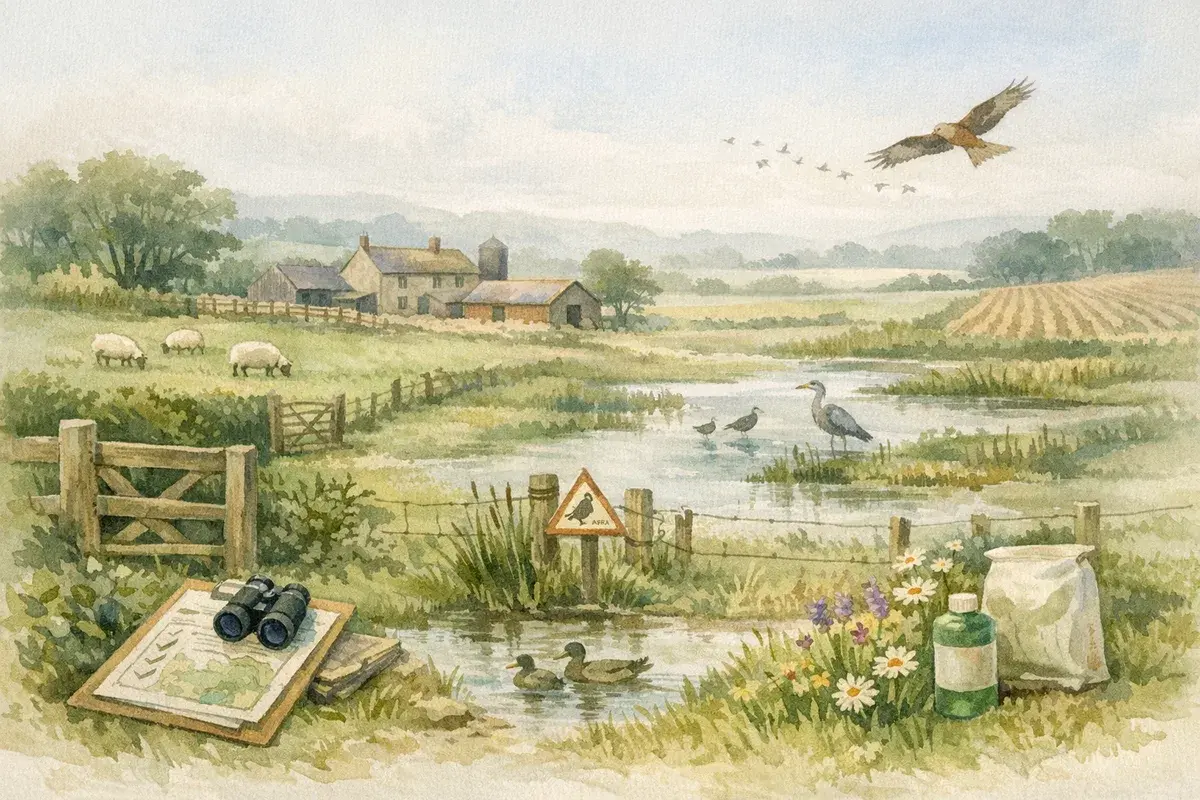
A special protection area can shape how a farm is managed, improved, sold, or developed. If land falls within or near one, the rules on habitats, birds, drainage, buildings, and planning can change fast.
This guide explains what a special protection area is, why it matters to farmers and landowners, and how it affects rural property activity across the UK. We'd argue it is one of those designations you should understand early, not after drawings have gone in or livestock plans have been set.
For many holdings, the immediate question is simple: can I still farm it as I do now? Often the answer is yes, but with conditions, safeguards, and more paperwork than expected. The detail matters, especially where grazing, water management, wind turbines, access tracks, or diversification proposals are in play.
What A Special Protection Area Means For Rural Land
A special protection area, often shortened to SPA, is a site protected for wild birds under the UK's nature conservation framework. It forms part of the wider network of protected land, and its purpose is to safeguard species that rely on the area for breeding, feeding, moulting, or wintering.
In practice, an SPA does not usually stop normal farming, but it can influence anything that might disturb birds or alter their habitat. That includes field drainage, burning, tree planting, scrub clearance, track creation, and in some cases changes to stocking density or timing of operations.
Why SPAs Matter To Owners And Agents
For landowners, the designation can affect both day-to-day management and long-term value. For agents, it adds a layer of due diligence because buyers will want to know whether restrictions, consents, or mitigation costs may apply.
It is also worth remembering that SPAs can overlap with other designations such as Sites of Special Scientific Interest, Ramsar wetlands, National Parks, or Areas of Outstanding Natural Beauty. That overlap can make a straightforward farm parcel feel far less straightforward.
- Breeding birds: The site may be protected because species nest there in spring and summer.
- Wintering birds: Some SPAs exist to support flocks that feed on estuaries, marshes, or arable stubbles.
- Supporting habitat: Fields outside the official boundary may still be important if birds use them regularly.
- Planning sensitivity: Development proposals often face extra scrutiny where bird life could be affected.
Across England, Scotland, Wales, and Northern Ireland, the broad principle is similar, even though the consenting route and terminology can differ. In East Anglia, for example, arable land near wetland SPAs often faces bird disturbance questions first, while in coastal Lancashire or Northumberland the focus may be on overwintering waders and geese.
How Planning And Farm Operations Are Affected
The biggest mistake is assuming an SPA only matters at the point of a major planning application. In reality, it can affect a wide range of farm decisions, from replacing a shed to re-routing a drainage ditch. If a proposal could affect the protected interest, the local authority may ask for evidence, assessments, or mitigation.
That does not mean every project is blocked. It means the project has to be justified properly, with clear information on likely impacts and how they are avoided or reduced. We'd argue much of the delay comes from incomplete submissions rather than from the designation itself.
Common Farm Activities That Can Trigger Questions
Simple maintenance often remains unaffected, but anything that changes disturbance levels or habitat quality can draw attention. Timing is critical too, because work in nesting season can be treated very differently from work carried out in winter.
- Grain stores and livestock buildings: Visual impact, noise, traffic, and habitat loss may be assessed.
- Drainage and ditch work: Water levels can be central to bird habitat, especially on wet grassland and estuary margins.
- Track and road construction: Access routes can fragment habitat or increase disturbance.
- Cover crops and stubbles: In some arable areas, winter feeding habitat is a key conservation issue.
- Renewable energy schemes: Turbines, solar arrays, and battery compounds often need bird impact evidence.
Agents should also factor SPAs into sale particulars and heads of terms. A buyer who wants to expand a dairy unit in Somerset, for instance, may see the designation as manageable if the buildings sit well away from sensitive land. A buyer in Norfolk or Essex, by contrast, may need a fuller look at bird foraging patterns if the holding lies close to coastal marsh or inland wetlands.
Permitted Development Is Not Always Straightforward
Some farm buildings and hardstanding can fall within permitted development rights, but an SPA position can still complicate matters. Where environmental impacts are possible, the local planning authority may require prior approval or additional screening before works start.
That is where early checks pay off. A sketch plan, Ordnance Survey boundary, and basic understanding of the site context can save weeks later. It also helps to show that the farm has thought about timing, drainage, lighting, and construction disturbance rather than treating them as afterthoughts.
Assessing Risk Before Buying, Letting, Or Developing Land
Whether you are buying a block of arable land, taking a farm tenancy, or considering a diversification project, an SPA should be part of the initial review. The issue is not just restriction for restriction's sake. It is whether the designation affects the land's usable value, management cost, or planning prospects.
That is particularly relevant in the current rural market, where buyers are more selective and planning certainty matters. As of March 2026, high-quality acres with clean access and fewer constraints are still attracting stronger interest than similar land with unresolved environmental questions. In more sensitive locations, advisers are placing more weight on policy risk than they did a few years ago.
| Risk Area | Typical Issue | Practical Impact | As Of March/2026 |
|---|---|---|---|
| Planning | Need for bird surveys or mitigation | Longer timescales and higher professional costs | Often material on marginal schemes |
| Operations | Timing limits for noisy work | Rescheduling of field or building works | Common near breeding grounds |
| Value | Perceived constraint by buyers | Discount or narrower buyer pool | Varies sharply by parcel and use |
| Management | Habitat-friendly farming requirements | Potential income from stewardship or agreements | Depends on location and scheme fit |
In market terms, the effect is not uniform. A grassland block on the edge of a South Yorkshire floodplain SPA may still command strong interest if it is productive and well set up. But a fragmented parcel with uncertain access, recurring disturbance risk, and possible mitigation costs will be priced more cautiously.
Due Diligence Checks Worth Completing Early
A sensible review usually starts with title documents, mapping, and a site visit. Then look at planning history, agricultural tenancies, drainage arrangements, and any existing environmental obligations.
- Boundary location: Confirm whether the land lies inside the SPA or only nearby.
- Reason for designation: Identify the bird species or habitat at issue.
- History of works: Check whether access, buildings, or drainage have already been approved.
- Operational plans: Match intended use against likely environmental sensitivity.
This is especially useful in county hotspots such as Norfolk, Lincolnshire, Somerset, Lancashire, Kent, and the Solway area, where bird designations can influence both farming operations and rural development opportunities. If you are buying at auction, the timetable is even tighter, so the costs of any extra assessment should be built in before bidding.
Management Options, Mitigation, And Stewardship Income
Not every special protection area creates a burden without return. In some cases, land management can be aligned with conservation goals and paid for through stewardship, environmental land management, or bespoke agreements. The trick is matching the right parcel to the right outcome.
For example, wet grassland managed for waders may still provide grazing use, but with altered timings and water levels. Arable margins, stubble retention, or low-disturbance approaches can also support bird populations while keeping the farm productive enough to stack up economically.
Ways Farmers Commonly Respond
Some holdings adapt in minor ways. Others need a more structural change, particularly where the SPA is central to the landscape and bird activity is strong for much of the year.
- Adjust grazing dates: Lower disturbance during nesting or winter feeding periods.
- Manage water levels: Keep wet features where birds depend on them.
- Retain winter feed: Use stubbles or cover where beneficial and appropriate.
- Create buffer zones: Reduce pressure near sensitive areas.
- Change mowing patterns: Avoid nest loss and disturbance.
There can be a commercial upside if the farm is well suited to the habitat. Stewardship payments, habitat creation funding, or targeted agreements may offset some lost flexibility. We'd still caution that money alone should not be the only test, because the best agreement is the one that fits the farm system without constant friction.
In parts of upland Scotland or the Welsh coast, land managers may find that conservation objectives are already closely tied to the way the farm is run. Elsewhere, such as intensive arable ground in Cambridgeshire or Essex, adaptation may need a bigger rethink, particularly if the land is also in a groundwater-sensitive or flood-prone location.
What Agents And Sellers Should Tell Buyers
Clear disclosure avoids both wasted time and unhappy callbacks later. If a site sits within or near a special protection area, the marketing should be accurate, measured, and backed by the right documents where possible.
Sensibly handled, the designation does not kill a sale. Poorly explained, it can. Buyers tend to accept constraints if they understand them early, but they react badly to surprises after survey, finance, or legal work is underway.
Key Points To Include In Sale Particulars
Sale details should state the SPA position plainly and avoid vague language. If the land has been managed under an agreement or with a bird-focused regime, say so, because that history may interest the right buyer.
- Location context: State whether the boundary is inside, adjacent to, or distant from the SPA.
- Known constraints: Mention any visible planning or management limitations.
- Agreements in place: Identify stewardship or grazing agreements if relevant.
- Potential upside: Note productive habitat management or income opportunities where appropriate.
For estate agents, the commercial art is balance. Do not oversell the land as development-ready if the SPA position makes that unlikely. Equally, do not underplay productive capacity just because the site has an environmental label attached. The better you frame the facts, the better the buyer profile you attract.
That matters across regional markets. In Devon and Cornwall, amenity buyers may value landscape and conservation character differently from commercial operators. In the East Midlands or the North East, a livestock or arable buyer may focus more on operational freedom, drainage, and access than on conservation branding, so the message should reflect the likely audience.
Conclusion
A special protection area is not simply a planning label. It is a working constraint, a habitat responsibility, and sometimes a commercial opportunity, depending on how the land is managed and what the buyer wants to do with it.
For farmers, landowners, and agents, the key is early clarity. Know where the designation sits, what species it protects, and how it interacts with practical farming plans, because that is where value is protected or lost.
Disclaimer: AgLand.co.uk is a UK agricultural land and rural property matching service, where buyers register what they are looking for and owners advertise directly to the buyers who match, and a rural resource hub. Nothing in this text is intended as legal, financial, or investment advice. You should carry out your own due diligence and seek guidance from appropriately qualified professionals (for example, solicitors, land agents, surveyors, and financial advisors) for your specific circumstances.