
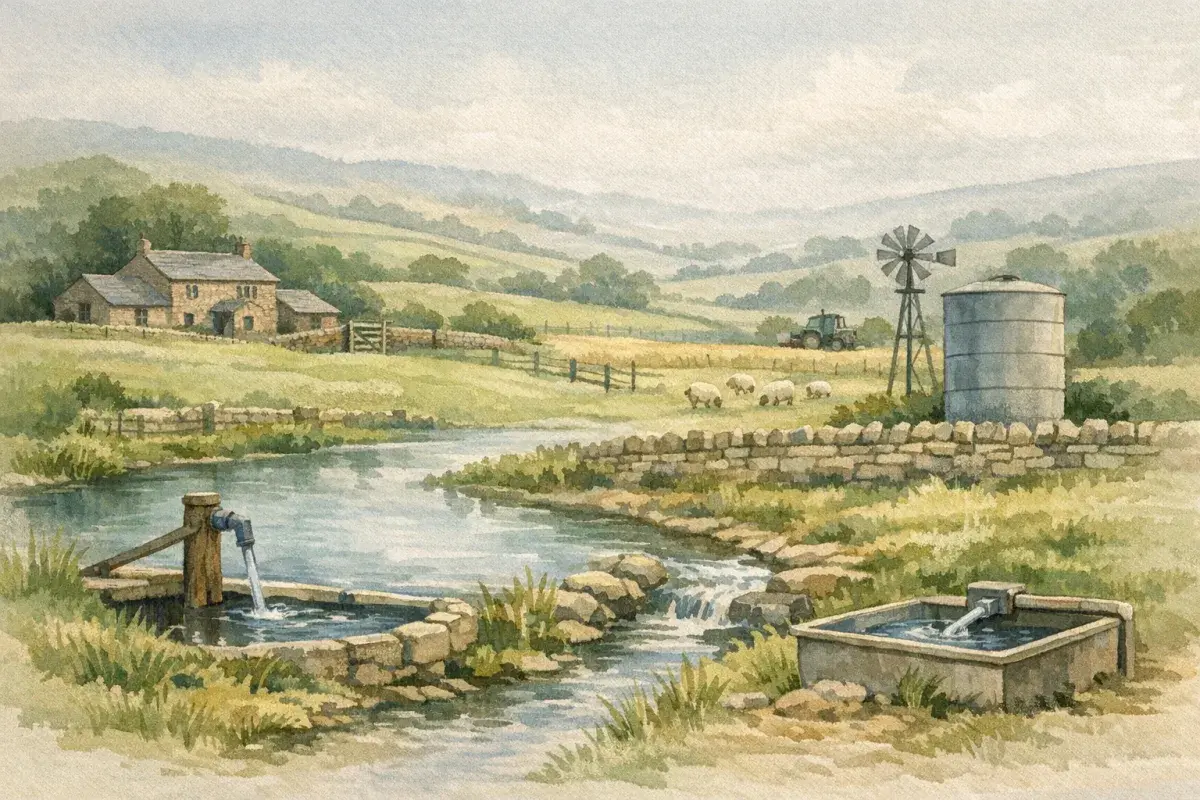
Water on a farm looks simple until you're the one answering awkward questions: "Where does it come from?", "Are you allowed to take that much?", "Who's responsible if the supply fails, or contaminates someone's drinking water?" And if you're buying or letting rural property, the stakes jump again: a perfectly good block of land can be quietly hobbled by an unreliable borehole, a non‑transferable abstraction licence, or a shared pipe nobody can prove they have the right to use.
UK agricultural water supply regulations aren't one neat rulebook. They're a patchwork of abstraction licensing, private water supply duties, pollution controls, and infrastructure standards, plus a layer of property rights that can make or break a deal. This guide cuts through the practical bits you actually need to run a compliant, resilient farm water system (or to assess one before you commit).
What Counts As An “Agricultural Water Supply” And Why It Matters
An "agricultural water supply" isn't a single legal term with one definition across the UK. In practice, it's the whole chain that gets water from source to use: where you take it from, how you store it, how you move it around the holding, how you treat it (if at all), and what you do with it afterwards.
Why it matters: each step can trigger different duties, licences, registrations, testing regimes, pollution controls, and (in property deals) checks on rights and liabilities. Two farms can use the same volume of water, but face totally different compliance depending on whether it's mains, a borehole, a river abstraction, or harvested rainwater.
Common Farm Water Sources: Mains, Private Supplies, Abstraction, And Harvesting
Most UK farms end up with a mix of sources:
- Mains water (from the local water undertaker): generally simplest for compliance, but often costly at volume and vulnerable to supply limitations in dry periods.
- Private water supplies: typically boreholes, wells, springs, or surface water feeds supplying a farmhouse, cottages, staff accommodation, or a cluster of buildings.
- Abstraction from rivers, streams, canals, lakes, reservoirs, or groundwater: highly regulated once you get beyond limited exemptions. "Abstraction" includes pumping, siphoning, gravity feeds, and taking water into storage for later use.
- Rainwater harvesting from roofs and yards: useful for washdown or irrigation top‑ups, but not a free pass, storage and runoff management still need thought.
The practical point: the more you rely on non‑mains sources, the more you need to be clear on volumes, quality, and legal permissions.
Typical Uses: Livestock, Irrigation, Washing Down, And Processing
Common agricultural uses sit on a spectrum from low‑risk to high‑risk:
- Livestock drinking water: quality matters: reliability matters more than many people expect.
- Irrigation (field veg, soft fruit, potatoes, salads, horticulture): often volume‑intensive and seasonal, exactly the profile regulators scrutinise.
- Washing down yards and parlours: big volumes, and a strong link to pollution prevention because dirty water has to go somewhere.
- On‑farm processing and retail (dairy, farm shops, packing sheds, holiday lets): this is where "farm water" can tip into drinking water duties or food hygiene expectations.
A useful mindset is to treat water like any other critical input: you wouldn't run a feed system on a handshake agreement and a guess at quantities. Water deserves the same discipline.
How Water Is Regulated In The UK: Who Oversees What
Regulation is devolved. The concepts are similar UK‑wide, control abstraction, protect the environment, safeguard public health, but the details and enforcement bodies differ by nation. If you operate across borders (or buy land near them), don't assume the rules and forms mirror each other.
Regulators And Roles: Environment Agency, SEPA, NRW, NIEA, And Local Authorities
In broad terms:
- England: the Environment Agency (EA) leads on abstraction licensing and environmental permitting/enforcement for water pollution controls.
- Scotland: SEPA regulates water activities under the Environmental Authorisations (Scotland) Regulations 2018 (EASR), which replaced CAR on 1 November 2025.
- Wales: Natural Resources Wales (NRW) covers abstraction and environmental regulation.
- Northern Ireland: the Northern Ireland Environment Agency (NIEA) handles water environment regulation.
- Local authorities play a key role in private water supplies (risk assessment, sampling, and enforcement around drinking water standards). In Northern Ireland, the Drinking Water Inspectorate does this.
On top of that, you may also interact with Internal Drainage Boards (in parts of England), water undertakers (for mains connections and backflow requirements), and planning authorities (where storage infrastructure or change of use is relevant).
Key Legal Building Blocks: Abstraction, Pollution Controls, And Drinking Water Standards
Most farm water compliance boils down to three overlapping pillars:
- Taking water (abstraction)
- Licensing thresholds, licence conditions (volume, season, source), and constraints such as hands‑off flows (you must stop or reduce abstraction when flows drop).
- Protecting water (pollution controls)
- Rules covering slurry/manure storage, fertiliser and pesticide use, yard runoff, silage effluent, and incident response. These aren't "nice to have" guidelines, breaches can become criminal matters.
- Supplying safe water (private supply duties)
- If water is supplied for people to drink (including tenants, employees, holiday guests, or the public via a business), you can be pulled into risk assessments, testing, and remedial works.
If you want a plain‑English run‑through of what you can take, store, and discharge, and what to check before you commit to a holding, AgLand's guide to what to check around water rights on agricultural land is a handy companion reference for deal‑time questions.
The takeaway: compliance isn't just "Do I have a borehole?" It's "Do I have permission to take it, controls to avoid pollution, and evidence that the water is safe for the way it's being used?"
Abstraction Rules For Farms: Licences, Exemptions, And Hands-Off Flows
Abstraction is where many farms get caught out, not because you're trying to game the system, but because historic arrangements (old pumps, old pipes, inherited practices) don't always line up with modern licensing and drought pressure.
When You Need An Abstraction Licence And What "Abstraction" Includes
At its simplest, you generally need authorisation when you take water from a natural source (surface water or groundwater) above certain thresholds, or for certain activities. What counts as abstraction can include:
- Pumping from a river or stream
- Taking water from a lake, pond connected to a watercourse, or canal
- Boreholes and wells (groundwater)
- Diverting flows into ditches, lagoons, or storage reservoirs
Exemptions and thresholds exist, but they're not a strategy. If your business depends on the water, treat "We think we're exempt" as a risk until it's verified.
And remember: the rules you fall under can differ by nation (and the wording and process certainly does). If you're expanding irrigation, adding a new enterprise (like horticulture), or increasing livestock numbers, you're often changing your abstraction profile in the exact way regulators look at.
Applying For A Licence: Evidence, Volumes, Seasonality, And Sustainability Tests
Licensing isn't just a form. Expect to justify:
- How much you want to take (daily/hourly rates and annual totals)
- When you want to take it (seasonality matters, summer abstraction is typically more constrained)
- Where you'll take it from (catchment sensitivity, nearby abstractions, protected sites)
- Why it's reasonably required (crop plans, stocking, business case)
- What mitigations you'll adopt (storage to shift abstraction to wetter months, efficient irrigation tech)
A good application reads like a competent farm plan: measured, evidenced, and realistic. Over‑asking can backfire: under‑asking can choke growth.
Compliance In Practice: Metering, Records, Drought Restrictions, And Transfers
This is where farms either stay comfortably compliant, or end up stressed when a dry spring hits.
- Metering and logs: if your licence requires metering, treat it as non‑negotiable. Keep records in a way you can actually retrieve during an inspection.
- Hands‑off flows / hands‑off levels: these conditions can require you to reduce or stop abstraction when a river drops below a set flow, or groundwater levels fall. Plan for this early, storage and demand management are what keep businesses afloat.
- Drought restrictions: regulators can impose extra constraints in drought conditions. If irrigation is mission‑critical, you need a drought plan, not just hope.
- Transfers and variation: changing point of abstraction, volumes, or purpose can require formal variation. Don't assume you can "move the pump" because it's still your land.
Costs are part of the compliance picture too. If you're budgeting for irrigation or livestock expansion, it's worth understanding the structure and logic of water abstraction charges for farming so you're not surprised later.
The practical reality we see: strong abstraction compliance isn't paperwork for its own sake. It's business continuity, especially as dry summers become less unusual.
Private Water Supplies On Farms: Quality, Testing, And Legal Duties
Private supplies are common on UK rural holdings, and they can be brilliant. But once your private supply serves people (not just stock or irrigation), the legal temperature rises quickly.
When Farm Water Becomes "Drinking Water" (People, Tenants, Holiday Lets, Staff)
Your private supply can become subject to drinking water expectations when it supplies:
- Your household (farmhouse)
- Tenants (let cottages, residential lets)
- Employees (tied housing or staff facilities)
- Holiday accommodation (short‑term lets, glamping)
- The public via a business (farm shop, café, events)
Local authorities are typically involved in risk assessment and sampling where private supplies serve others. Even where the minimum legal duties don't bite as hard for a single domestic supply, you still have a duty of care, and in a transaction, buyers' solicitors and lenders increasingly expect evidence the supply is understood and managed.
Risk Assessments, Sampling Frequencies, And Typical Remedial Actions
A sensible approach is to treat private supply management as a cycle, not a one‑off test:
- Risk assessment: identify hazards from source to tap, livestock access to springs, surface runoff into collection chambers, damaged covers, cross‑connections, chemical storage nearby.
- Sampling and lab testing: frequencies vary depending on the type of supply and who it serves, but the point is consistent evidence over time.
- Maintenance and remedial works: common fixes include improving source protection, repairing chambers, replacing old pipework, adding filtration, UV disinfection, or chlorination (and then maintaining and monitoring it properly).
A "pass once" result isn't enough if your system is vulnerable. We've seen supplies that test fine in winter and fail after heavy rain or during dry weather when source dynamics change.
Selling Or Letting Rural Property With A Private Supply: Disclosures And Due Diligence
If you're selling, letting, or buying, private water supply questions should be asked early, before surveys and legal costs spiral:
- Where is the source and is it on the title?
- Are there rights to access and maintain the source and pipework?
- Are there historic test results and any remedial history?
- Is the supply shared, and if so, who pays for what?
From a buyer's perspective, treat a private supply like a material feature, not a footnote. If you're in acquisition mode, AgLand's piece on water rights due diligence when buying farmland is particularly useful for framing the solicitor and surveyor questions that protect you later.
One candid note: if a property has holiday lets, staff accommodation, or a public‑facing business and the "water file" is basically empty, you should assume time and cost will follow. That's not a reason to walk away automatically, but it is a reason to price and plan properly.
Pollution Prevention And Diffuse Pollution Rules Linked To Water Supply
Water supply regulation isn't just about taking water, it's also about what your activities might put back into the environment. Pollution incidents can shut down abstraction, trigger enforcement, and create expensive clean‑ups. More subtly, diffuse pollution can bring ongoing scrutiny and restrictions.
Nitrate Vulnerable Zones, Farming Rules For Water, And Slurry/Manure Storage Impacts
Across the UK, controls exist to reduce agricultural pollution, including nutrients and organic manures entering watercourses; in England these are set out in the rules for farmers and land managers to prevent water pollution.
What this means for your water supply in practice:
- Nutrient management affects abstraction resilience: catchments under pressure can see tighter regulation and a harder line on new licences or variations.
- Slurry and manure storage is often a focal point in inspections. Storage capacity, location, integrity, and runoff controls matter.
- Field and yard pathways: the way water moves across the farm, especially during heavy rainfall, can be the difference between a compliant operation and a reportable incident.
Even if you're not in a designated area, the expectation is broadly the same: you plan, store, and apply nutrients in a way that prevents pollution.
Pesticides, Sheep Dip, Fuel, And Yard Run-Off: Practical Compliance Controls
This is the "small things that become big things" category. Common risk points include:
- Sheep dip and pesticide handling: mixing areas, bunding, and disposal routes. One bad practice can contaminate a watercourse fast.
- Fuel tanks and adblue/chemicals: secondary containment (bunds), secure valves, and sensible siting away from drains and ditches.
- Yard runoff: clean and dirty water separation, maintained gullies, and ensuring dirty water goes to appropriate storage/treatment.
A useful operational habit: walk the yard in heavy rain once a year. You'll learn more in 20 minutes than from a dozen diagrams.
What Happens If You Pollute: Investigations, Enforcement, And Clean-Up Liabilities
If there's a suspected pollution incident, expect some combination of:
- Site attendance and sampling by the relevant regulator
- Requests for records (slurry movements, tank checks, maintenance logs)
- Enforcement action ranging from advice/requirements to formal notices, penalties, or prosecution
- Clean‑up costs and potential claims, especially where third‑party land or protected waters are affected
And yes, liability can reach beyond the immediate "oops moment". If you buy a property with legacy issues, or you inherit a system that's quietly non‑compliant, you may be the one dealing with the consequences. That's why water due diligence is not optional in rural property deals: it's asset protection.
Infrastructure, On-Farm Storage, And Treatment: Permits, Standards, And Safety
When water becomes scarce or unreliable, farms naturally look at infrastructure: bigger tanks, storage lagoons, lined reservoirs, treatment systems, private distribution networks. All sensible, provided you match the build to the right approvals and safety standards.
Reservoirs, Lagoons, And Tanks: When Registration, Inspection, Or Planning Triggers Apply
Storage sits at the intersection of planning, environmental regulation, and engineering safety.
Depending on what you're building, factors can include:
- Planning permission: not every tank needs it, but location, scale, landscape designations, and associated works can trigger an application.
- Reservoir safety: larger raised reservoirs can fall under specific safety regimes with inspection and supervision requirements (thresholds and definitions matter, and they've changed over time).
- Environmental controls: storage connected to abstraction can be part of your licensing strategy (store in wetter periods, use in drier ones), but you must evidence that it's sustainable and won't harm the water environment.
If you're considering a sizeable storage build, it's worth getting input early from an engineer and a water/environment specialist, before you commit to a design that's hard to approve.
Pipes, Backflow Protection, And Cross-Connection Risks With Mains Water
Where farms have both mains and private networks, cross‑connection risk is real. Backflow can contaminate mains supplies and lead to serious enforcement.
Practical controls include:
- Correctly specified backflow prevention devices
- Clear separation and labelling of pipework
- Avoiding "temporary" hose connections that become permanent habits
- Formalising connections when enterprises expand (a dairy or packing shed has different expectations to a cattle trough)
If you've ever inherited a farm with pipework that looks like it evolved through a century of improvisation… you'll know why this matters.
Treatment Systems: Filtration, UV, Chlorination, And Ongoing Monitoring
Treatment is not a one‑and‑done box on the wall. It's a system that needs fitting, commissioning, monitoring, and maintenance.
Common treatment options include:
- Sediment/particulate filtration: protects downstream equipment and improves clarity.
- UV disinfection: effective when water is clear enough (turbidity matters) and units are maintained properly.
- Chlorination: provides a residual disinfectant, but dosing, contact time, and by‑products need management.
The most common failure mode we see isn't "wrong technology", it's insufficient monitoring. Lamps aren't changed, filters clog, dosing drifts, and nobody notices until the water changes taste, a test fails, or guests complain.
A good rule: if the supply serves other households, tenants, or holiday lets, maintain a simple log that any competent person can pick up and understand.
Water Rights, Easements, And Contracts In Rural Property Deals
This is the part that catches out buyers and sellers alike: you can have plenty of water physically available, but not have the legal right to access it, move it, or rely on it for the intended use.
Wayleaves, Easements, And Rights To Take Water Across Third-Party Land
If a supply pipe crosses someone else's land, or the source sits beyond the title boundary, you need to know what actually exists in writing:
- Easements (permanent rights that bind successors)
- Wayleaves (often contractual permissions, sometimes terminable)
- Licences to enter land for maintenance
Handshake arrangements can work for years… until there's a sale, a family dispute, or a new neighbour who takes a different view.
If you're checking a holding on AgLand and water is a key driver (irrigation potential, dairy throughput, holiday lets), it's worth cross‑checking the property paperwork against the practical reality on the ground.
Shared Supplies And Private Networks: Maintenance Responsibilities And Cost Splits
Shared supplies can be excellent value, but only if responsibilities are clear:
- Who owns the pump, treatment, and storage?
- Who pays for electricity, repairs, and testing?
- What happens if one party increases demand (new dwelling, new enterprise)?
- What's the process when the system fails, who calls whom, and who authorises spend?
Put it in writing. Even a simple agreement beats vague assumptions, especially when lenders and insurers get involved.
Drainage can also be entangled with supply and runoff management. If you're dealing with ditches, outfalls, or shared watercourses, AgLand's overview of agricultural drainage rights and responsibilities can help you spot where rights and duties sit, particularly when boundaries and water flows don't match up neatly.
Red Flags In Transactions: Unlicensed Abstraction, Missing Records, And Informal Agreements
If you're buying, renting, or investing, treat these as "pause and verify" signs:
- Unclear abstraction status: "We've always done it this way" is not evidence.
- No metering/records where you'd expect them
- A private supply with no recent test history (especially where it serves tenants/guests)
- Pipes with no documented rights crossing third‑party land
- Infrastructure in poor repair: leaking tanks, unsafe electrics at pump houses, unsecured chambers
None of these automatically kills a deal. But they should change your process: specialist surveys, legal clarity, and a price that reflects the work needed.
The best deals we see are the ones where water is treated as an asset with documentation, because that's what it is.
A Practical Compliance Checklist For UK Farms And Rural Landowners
If you want one workable approach, it's this: map it, measure it, document it, stress‑test it. Regulators like evidence, lenders like certainty, and your future self likes not firefighting a supply failure in July.
Map Your Water System: Sources, Uses, Volumes, And Sensitive Receptors
Start with a simple, accurate map (a printed plan is fine):
- Every source (mains entry, borehole, spring, surface intake, rainwater capture)
- Storage points (tanks, reservoirs, lagoons)
- Main pipe routes and key valves
- Where water is used (stock, irrigation blocks, dairy, washdown, accommodation)
- Sensitive receptors nearby: watercourses, ponds, drains, neighbour boreholes, designated sites
Then add basic numbers:
- Typical daily use by enterprise
- Peak seasonal demand
- Minimum viable supply for animal welfare and business continuity
If you can't quantify it roughly, you can't manage it.
Document And Demonstrate: Licences, Tests, Service Logs, And Emergency Plans
Build a "water file" you'd be happy to hand to an inspector, or a buyer:
- Abstraction licences/authorisations and conditions (and any variation history)
- Meter readings and abstraction records (where required)
- Private supply risk assessments and lab results
- Treatment system manuals, service records, lamp/filter change dates
- Incident and maintenance logs (including photos before/after repairs)
- A simple emergency plan: alternative supply options, shut‑offs, who to call, contamination response
This isn't bureaucracy for its own sake. It's how you avoid being the farm that can't prove compliance even when you're doing the right thing.
When To Bring In Specialists: Land Agents, Hydrogeologists, Water Engineers, And Solicitors
Some issues are "DIY with discipline". Others need specialists quickly:
- Hydrogeologist / water consultant: yield testing, source protection, licensing strategy, drought resilience.
- Water engineer: storage design, pumping systems, treatment selection, distribution networks, backflow protection.
- Land agent: negotiation of rights, practical insight on local catchment pressures, deal structuring.
- Solicitor (rural property): easements/wayleaves, shared supply agreements, title issues, and transaction protections.
If you're buying a property where water underpins the business plan (irrigation, dairy expansion, visitor accommodation), paying for the right expertise early is nearly always cheaper than "sorting it out later".
Conclusion
Agricultural water supply regulations in the UK can feel like a moving target, especially as drought risk rises and catchments come under more pressure. But the farms that stay confident aren't necessarily the biggest or the most technical, they're the ones that treat water as a managed system: clear permissions, reliable infrastructure, clean separation of dirty water, and a paper trail that matches reality.
If you're planning a new enterprise, investing in irrigation, or buying/letting rural property, make water a first‑week question rather than a last‑minute one. It's one of the few factors that can quietly cap your productivity, your compliance position, and your property value all at once.
Disclaimer: AgLand.co.uk is a UK agricultural land and rural property matching service, where buyers register what they are looking for and owners advertise directly to the buyers who match, and a rural resource hub. Nothing in this text is intended as legal, financial, or investment advice. You should carry out your own due diligence and seek guidance from appropriately qualified professionals (for example, solicitors, land agents, surveyors, hydrogeologists, and water engineers) for your specific circumstances.