
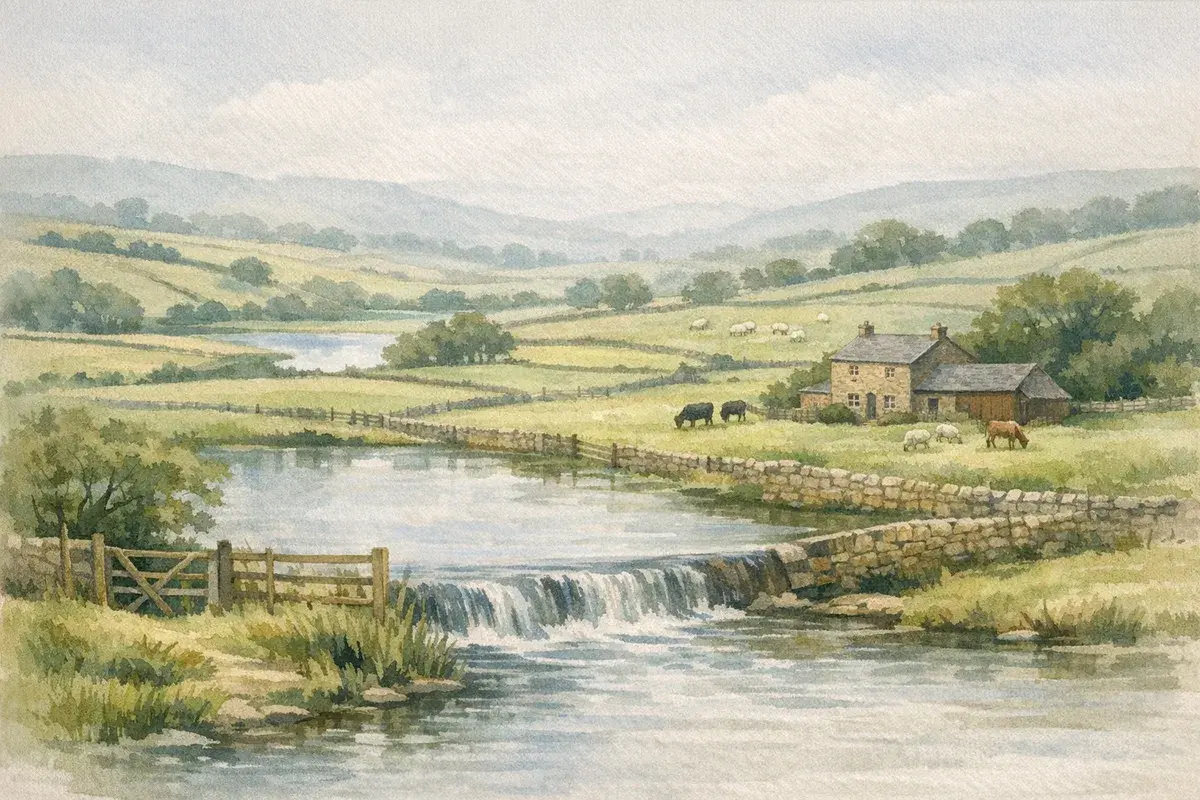
You can have the best soils in the county, a tidy block of ring-fenced acres, and the right buildings for your system, then discover the "water situation" turns the whole purchase into a headache. Maybe the irrigation licence can't be transferred. Maybe the borehole yield isn't what the seller thinks it is. Or maybe that innocent-looking ditch is actually a regulated watercourse with maintenance duties and consent requirements.
Water rights farmland purchase due diligence is one of those areas where buyers either get it very right, or pay for it for years. The stakes are bigger now too: tighter catchments, more scrutiny on abstraction, higher expectations around environmental compliance, and greater volatility in weather.
This guide walks you through what "water rights" really means in a UK rural property transaction, what to check before you exchange, and how to structure the deal so you're not inheriting unknown water risk.
Why Water Rights Can Make Or Break A Farmland Deal
Water is no longer a background assumption in UK farming, it's an input, a constraint, and often a differentiator in land value. When you're buying, you're not just acquiring acres: you're acquiring (or failing to acquire) the practical ability to irrigate, water stock, wash produce, run a dairy, or develop alternative rural uses.
How Water Rights Affect Value, Operations, And Future Options
A reliable, lawful water supply can underpin:
- Cropping choices and yields (especially higher-value irrigated crops and veg)
- Livestock throughput (consistent drinking water, yard washdown, biosecurity)
- Diversification (holiday lets, equestrian, small-scale processing, each can increase demand)
- Resilience (storage and licensed abstraction can be the difference between "difficult season" and "write-off")
From a valuation angle, two holdings that look similar on paper can diverge sharply if one has a functioning abstraction licence, legal access to infrastructure, and verified storage capacity, and the other relies on a neighbour's "gentleman's agreement" and a tired pump.
If you want a single starting point to frame the topic, our longer explainer on what you can legally abstract, store, or discharge before you buy maps the main regimes and the common pitfalls.
Common Deal-Stoppers And Costly Surprises We See In Practice
Across transactions and conversations with agents we work with, the recurring surprises tend to fall into a few buckets:
- The right exists, but not for your intended use. A licence might be for spray irrigation only, yet you're buying for a packhouse, livestock unit, or washing.
- The paperwork doesn't match reality. Abstraction point moved, meters missing, returns not filed, or historic use not evidenced.
- Infrastructure crosses third-party land without formal rights. Pipes, pumps, or access tracks exist, until the neighbour changes their mind.
- Catchment pressure changes the risk profile. In stressed catchments, your "secure" licence may be more exposed to hands-off flow restrictions or future variation.
- A watercourse brings obligations, not freedom. Owning a boundary stream doesn't mean you can dredge, impound, or alter it at will.
None of these are theoretical. They show up as delays, renegotiations, lender queries, and, in the worst cases, enforcement or expensive retrofit works after completion.
What “Water Rights” Actually Means In UK Farmland Transactions
"Water rights" is often used as shorthand, but in UK transactions it's really a bundle of separate legal concepts: property rights, regulatory permissions, contractual arrangements, and practical access to assets.
Surface Water, Groundwater, Springs, And Stored Water
You'll usually encounter one or more of the following:
- Surface water: rivers, streams, brooks, lakes, ponds, and field ditches (some are regulated watercourses).
- Groundwater: boreholes tapping aquifers, often the backbone of private supplies.
- Springs: can be reliable, but flows can be seasonal and vulnerable to upstream changes.
- Stored water: reservoirs, lined lagoons, tanks, storage can be strategically valuable, but comes with planning, engineering, and safety considerations.
A key point for a water rights farmland purchase: having water physically present is not the same as having the legal ability to use it for your intended purpose.
Abstraction, Impoundment, Discharge, And Flood Risk As Separate Regimes
Buyers sometimes lump everything into "do we have water?", but regulators don't.
- Abstraction is taking water from a source (surface or groundwater). It's commonly controlled via licensing, exemptions, thresholds, and conditions.
- Impoundment is obstructing or damming a watercourse (even modest structures can trigger consent requirements).
- Discharge (e.g., from yards, treated effluent, drainage outfalls) may require environmental permits/consents depending on what and where.
- Flood risk and drainage sit alongside: culverts, outfalls, maintenance, and works in or near watercourses can require consent even if you're not "taking" water.
If your purchase includes a new or existing reservoir, don't treat it as just an earthwork. Planning, design, and safety duties can be significant, our guide to planning and permissions for reservoirs on farmland is a useful deeper dive.
Deeds, Easements, Wayleaves, And Informal Arrangements
In conveyancing terms, look for how the holding is supplied and serviced:
- Easements/servitudes granting rights for pipes, access to abstraction points, or water conveyance across third-party land.
- Wayleaves or agreements with utilities and neighbours (sometimes time-limited or terminable).
- Covenants restricting works near water, maintenance responsibilities, or shared infrastructure obligations.
- Informal arrangements ("we've always taken water from that trough/pipe"), these are the ones that unravel under pressure.
You want rights that are clear, enforceable, and properly documented, and that match the physical reality on the ground.
The UK Regulatory Landscape Buyers Must Understand
Water regulation is UK-wide in principle, but it's administered differently across the nations, and local catchment conditions can change the practical risk. Treat this as a due diligence track in its own right, not an afterthought.
England: Environment Agency Licensing And Enforcement
In England, the Environment Agency (EA) oversees abstraction licensing (plus wider environmental regulation). As a buyer, the themes to watch are:
- Licence conditions and compliance history (metering, returns, hands-off flows)
- Catchment status (some areas are effectively "closed" to additional abstraction)
- Enforcement sensitivity where abstraction or works have drifted from what's permitted
If your plans involve high-demand water use (irrigation expansion, washing facilities, intensive livestock), you need to understand not just the current licence position, but how robust it is under scrutiny.
Wales: Natural Resources Wales Requirements
In Wales, Natural Resources Wales (NRW) carries similar responsibilities. In practice, buyers should be alive to:
- Local policy emphasis (including environmental protections and catchment impacts)
- Evidence of historic use when assessing risk around licence variation
- Consents for works affecting watercourses and flood risk assets
The headline is the same: don't assume yesterday's approach will be tolerated tomorrow, especially in more environmentally sensitive catchments.
Scotland And Northern Ireland: Key Differences To Flag Early
Scotland and Northern Ireland operate under different frameworks and regulators, and the terminology and processes vary. If the property is outside England/Wales:
- Flag it early with your solicitor and agent so the correct regulatory checks are built into the timetable.
- Confirm what permissions attach to the land vs the operator and what evidence of use is needed.
- Don't copy-paste assumptions from an English transaction (it wastes time and can miss key consents).
Because the rules differ, the right move is usually to line up a local specialist (legal and technical) as soon as the offer is accepted, not halfway through enquiries.
Abstraction Licences: The Detail That Matters In Due Diligence
If you're buying land where abstraction is part of the farming system, or could be, this is where you earn your keep. The value is rarely in the fact a licence exists. It's in what it allows, when, from where, and under what constraints.
Licence Type, Purpose, Volumes, Seasons, And Points Of Abstraction
Start with the basics, then go one level deeper:
- Source: groundwater vs surface water
- Purpose: irrigation, spray irrigation, trickle, livestock, processing, washdown etc.
- Volume: daily and annual limits (and any short-term peak restrictions)
- Seasonality: summer-only abstraction can be a problem if your system needs shoulder-season flexibility
- Point(s) of abstraction: exact grid references matter: moving a pump a few metres can become a compliance issue
Also check whether there are multiple licences for different uses (or different parcels) and whether any are dormant.
Where costs matter, particularly for water-hungry operations, read up on how charging works and what changes with usage and source. We've set out the practicalities in our guide to water abstraction charges for farming.
Transferability, Ownership, And What Happens On Change Of Occupier
One of the most common misconceptions: "The licence comes with the farm." Sometimes it effectively does, sometimes it doesn't, at least not smoothly.
You need to confirm:
- Who is named on the licence (seller, tenant, company, partnership)
- Whether a variation or formal transfer is required on change of occupier
- What happens if you're buying with vacant possession vs subject to a tenancy
If there's a tenant involved, clarify whether the abstraction is integral to the tenancy and how hand-back would work. Don't leave this until completion week.
Hands-Off Flows, Time-Limits, Metering, And Reporting Duties
Even a perfectly valid licence can be practically constrained.
- Hands-off flow (HOF) conditions can halt abstraction when river flows drop below a threshold. In dry summers, this can bite precisely when you need water most.
- Time limits: licences can be time-bound and up for renewal or review.
- Metering and telemetry: you may have obligations to meter, maintain equipment, and submit returns.
- Reporting: missing returns can create compliance risk and undermine evidence of use.
Budget for ongoing compliance, not just purchase price.
Catchment Pressures And The Risk Of Variation Or Revocation
Catchment pressure is one of the most "non-obvious" risks in a water rights farmland purchase.
In some catchments, regulators are under pressure to improve ecological status, manage drought risk, or re-balance historic allocations. That can translate into:
- tougher licence conditions at renewal,
- stronger enforcement of existing conditions,
- reduced reliability during dry periods (even without formal revocation).
You can't control the weather, and you can't fully control policy direction. What you can do is buy with eyes open: verify historic use, check compliance, and consider alternative supply and storage strategies if your enterprise depends on water.
Water Supply, Infrastructure, And Access Across The Holding
A surprising number of "water problems" aren't legal at all, they're engineering, access, and maintenance issues that were never properly documented.
Private Supplies: Boreholes, Springs, Reservoirs, And Treatment
Private supplies can be excellent, until they aren't.
What you should sanity-check:
- Yield and reliability: boreholes can drop in performance: springs can be seasonal.
- Power and redundancy: what happens if the pump fails in January? Is there backup?
- Water quality: livestock and especially any food/processing use may require treatment, testing, and ongoing monitoring.
- Storage integrity: tanks and reservoirs need inspection, maintenance, and sometimes upgrades.
Don't forget the regulatory side of private supplies either. If your plans touch on supplying water for domestic/holiday accommodation, farm shops, or staff housing, you'll want to understand the compliance landscape, see our overview of agricultural water supply rules and responsibilities.
Mains Supply Contracts, Capacity, And Reliability For High-Demand Uses
Mains water feels "safe" because it's someone else's problem, until you discover the connection is undersized, the pressure is weak, or the costs don't stack up for irrigation.
Check:
- Meter location and responsibility
- Contractual arrangements (including any shared supplies)
- Capacity constraints if you're intensifying use
- Resilience: what's the plan during outages?
For many holdings, mains supply is best treated as one part of a blended approach (mains + storage + licensed abstraction), not the whole answer.
Pipes, Pumps, Storage, And Servitudes Across Third-Party Land
This is where transactions quietly go wrong.
Walk the logic of water from source to end use:
- Where is the abstraction point?
- Where are the pipes and valves?
- Do they cross someone else's land?
- Do you have documented rights to keep, maintain, repair, and access them?
If the only access to a pump house is via a neighbour's track, you need that right in writing. If the pipeline crosses a strip that's been sold off historically, you need an easement, not a shrug.
And if the title plan looks messy, getting the land properly recorded can help reduce future arguments. In some cases, it's worth discussing voluntary first registration of farmland with your solicitor, especially where historic rights and plans are unclear.
Riparian Ownership, Ditches, Drains, And Shared Watercourses
Watercourses are classic "looks simple, isn't simple" territory. A stream along the boundary can be an asset (water, amenity, natural capital), but it can also bring constraints and duties.
What Owning Land Next To A Watercourse Does And Does Not Let You Do
If you own land adjoining a watercourse, you may have riparian ownership. In plain terms, it can involve rights to the natural flow, and responsibilities.
But it does not automatically allow you to:
- dam or divert flows,
- deepen or widen channels at will,
- remove vegetation or dredge without checking consents,
- abstract water in a way that breaches licensing rules.
If you want a focused explanation of where riparian rights begin and end for farmers, see our detailed piece on riparian rights in UK farming.
Maintenance Duties, Consents, And Responsibilities With Neighbours
Shared watercourses bring shared realities.
You should establish:
- who maintains which bank and bed,
- where the boundary actually runs (not always where you think),
- whether there's a history of disputes or flooding,
- whether any works have been done, and if they were authorised.
Even if a neighbour is "responsible in practice", lenders and insurers prefer clarity. It's worth asking directly during enquiries: when was it last maintained, and by whom? You'll often learn more from that answer than from a folder of old invoices.
Internal Drainage Boards, Ordinary Watercourses, And Main Rivers
Not all watercourses are treated the same.
- Some are main rivers (typically under more direct EA oversight in England).
- Others are ordinary watercourses where local authorities and, in many areas, Internal Drainage Boards (IDBs) play a role.
If the holding sits in an IDB district, that can affect:
- drainage rates/charges,
- consent requirements for works,
- expectations around maintenance and access.
Drainage is often where the legal and the physical collide. For a deeper look at who can do what, and when you need permissions, our guide to agricultural drainage rights is a good companion read.
Flood Risk, Land Drainage, And Natural Capital Constraints
Flood risk isn't just a house-buying issue. For farmland, it touches cropping reliability, access, infrastructure placement, insurance, and the viability of development or diversification.
Flood Zone Checks, Historic Flooding, And Insurability
Do the formal checks, but don't stop there:
- Flood map and surface water risk are a starting point.
- Ask for historic flooding evidence (photos, dates, impacts, insurance claims).
- Check whether key infrastructure (tracks, bridges, yards, power supplies) becomes unusable during flood events.
Insurability can become a practical constraint. Even if you're not insuring buildings, you may need cover for liability, business interruption, or equipment, and insurers will ask questions if the site has a record.
Culverts, Outfalls, SuDS, And Works Requiring Consent
Culverts and outfalls are the quiet workhorses of many holdings. They're also a source of enforcement risk if altered without the right permissions.
Watch for:
- collapsed or undersized culverts (and the temptation to "just sort it")
- outfalls that discharge into regulated watercourses
- SuDS features (swales, attenuation basins) tied to any modern development on the holding
If your plans involve changing drainage, creating new hardstanding, or building, you may trigger additional consents. And if you're relying on a river bank for access or operations, it's worth understanding the practical limits of access and usage, our overview on river access rights for farming unpacks what's commonly misunderstood.
Environmental Designations, Biodiversity Net Gain, And Water Framework Duties
Increasingly, "can we do this?" isn't only a planning question, it's an environmental constraints question.
You should check for:
- proximity to environmental designations (and what that means for works near water),
- opportunities and obligations tied to natural capital features,
- how catchment objectives may influence future abstraction/discharge controls.
And yes, these constraints can cut both ways. Well-managed wetland, riparian buffers, and storage can support environmental schemes and resilience, provided you're not inheriting an unmanaged liability.
A Buyer’s Water Due Diligence Checklist Before Exchange
This is the stage where you turn "we think it's fine" into evidence you can rely on. If water is material to the enterprise, treat the checks as non-negotiable.
Documents To Request: Licences, Maps, Monitoring Returns, And Consents
Ask for copies of (as applicable):
- abstraction and/or impoundment licences and any variations
- maps showing abstraction points, pipelines, reservoirs, and discharge locations
- meter records, telemetry information, and recent abstraction returns
- correspondence with regulators (including any warnings or enforcement)
- consents for works in/near watercourses (culverts, bank works, outfalls)
- private supply water quality tests and servicing records
- IDB correspondence/rates demands if in a drainage district
If the seller can't produce key items, don't accept "it'll be fine" as a substitute. Missing documentation is a risk signal.
Site Walkover: Locating Abstraction Points, Infrastructure, And Evidence Of Use
A good walkover often reveals what paperwork misses.
Take someone practical with you (and ideally someone who isn't emotionally invested in the deal yet) and look for:
- exact location of pumps, intakes, boreholes, kiosks, meters
- condition of pipework, valves, and storage
- signs of recent use (wear, maintenance, irrigation kit, power supplies)
- whether infrastructure sits on the title land or drifts onto neighbours
If you can't physically locate the abstraction point that's on the licence, pause. That's not a small issue.
Questions For The Seller, Tenant, Agent, And Neighbours
A few questions that tend to produce useful, unvarnished answers:
- "When did you last abstract, and how much?"
- "Have you ever been restricted by hands-off flow conditions?"
- "Has any neighbour objected to abstraction or drainage works?"
- "What breaks most often in the system, and what did it cost to fix?"
- "If the power goes off, what happens?"
If the holding is tenanted, add:
- "Who actually holds and operates the licence day to day?"
- "What happens to the kit and rights on hand-back?"
When To Bring In Specialists: Surveyors, Hydrogeologists, And Legal Advisers
You don't need a consultant for every purchase. But you do need one when water is business-critical or uncertain.
Bring in specialist support when:
- abstraction is central to the cropping plan or valuation,
- you're buying into a catchment known to be pressured,
- the borehole/spring yield is untested or disputed,
- there are multiple titles, awkward boundaries, or third-party land crossings,
- you're planning a reservoir, major drainage works, or intensification.
In practice, the best outcomes come from pairing your solicitor with a rural surveyor (and, where needed, a hydrogeologist) so legal rights and physical reality line up before exchange.
How To Structure The Deal To Manage Water Risk
If water is material, your contract should reflect that. The goal isn't to make the deal adversarial, it's to stop "unknowns" becoming your problem the day after completion.
Contract Clauses, Warranties, And Indemnities To Consider
Through your solicitor, consider whether you need:
- warranties that licences are valid, complied with, and accurately disclosed
- confirmation that infrastructure is located within the title (or that enforceable easements exist)
- disclosures around historic flooding, disputes, or regulator correspondence
- indemnities where a known issue exists but can be priced and managed
Be careful with vague wording. "To the seller's knowledge" has its place, but it can be too soft if the risk is fundamental to your business plan.
Price Adjustments, Retentions, And Conditionality On Licence Outcomes
Sometimes the right move is not "walk away", but "structure it properly". Options include:
- price adjustments where additional capex is clearly required (new pumps, treatment, storage lining)
- retentions held back until a transfer/variation is confirmed, meters are installed, or documentation is provided
- conditional contracts where the transaction depends on a specified regulatory outcome
This is especially relevant when the seller can't evidence recent licensed use, or where you need a regulator to confirm a change in details.
Tenancies, Licences, And Who Holds The Rights In Hand-Back Scenarios
If the holding is sold subject to an agricultural tenancy, clarify, before you exchange, how water rights and responsibilities sit:
- does the tenant hold the abstraction licence?
- who owns and maintains the pumps, pipes, and meters?
- what must be handed back at the end of the term?
- are there restrictions on the landlord installing new infrastructure?
We've seen perfectly sensible purchases become messy because the buyer assumed the water rights were "part of the land", when in practice the operational control sat with the tenant.
If you're buying with a view to future possession, build the water position into your long-term plan now, not later.
Conclusion
In a UK farmland purchase, water isn't a footnote. It's a mix of lawful permissions, reliable infrastructure, clear access rights, and ongoing compliance, and each part can fail in different ways.
If you take one pragmatic approach into your next viewing, make it this: follow the water from source to use, then follow the paperwork back to the regulator and the title. Where those two stories don't match, that's where you negotiate, investigate, or walk away.
Disclaimer: AgLand.co.uk is a UK agricultural land and rural property matching service, where buyers register what they are looking for and owners advertise directly to the buyers who match, and a rural resource hub. Nothing in this text is intended as legal, financial, or investment advice. You should carry out your own due diligence and seek advice from appropriately qualified professionals (for example, rural solicitors, surveyors, hydrogeologists, tax advisers, and planning/environmental consultants) before making decisions.