
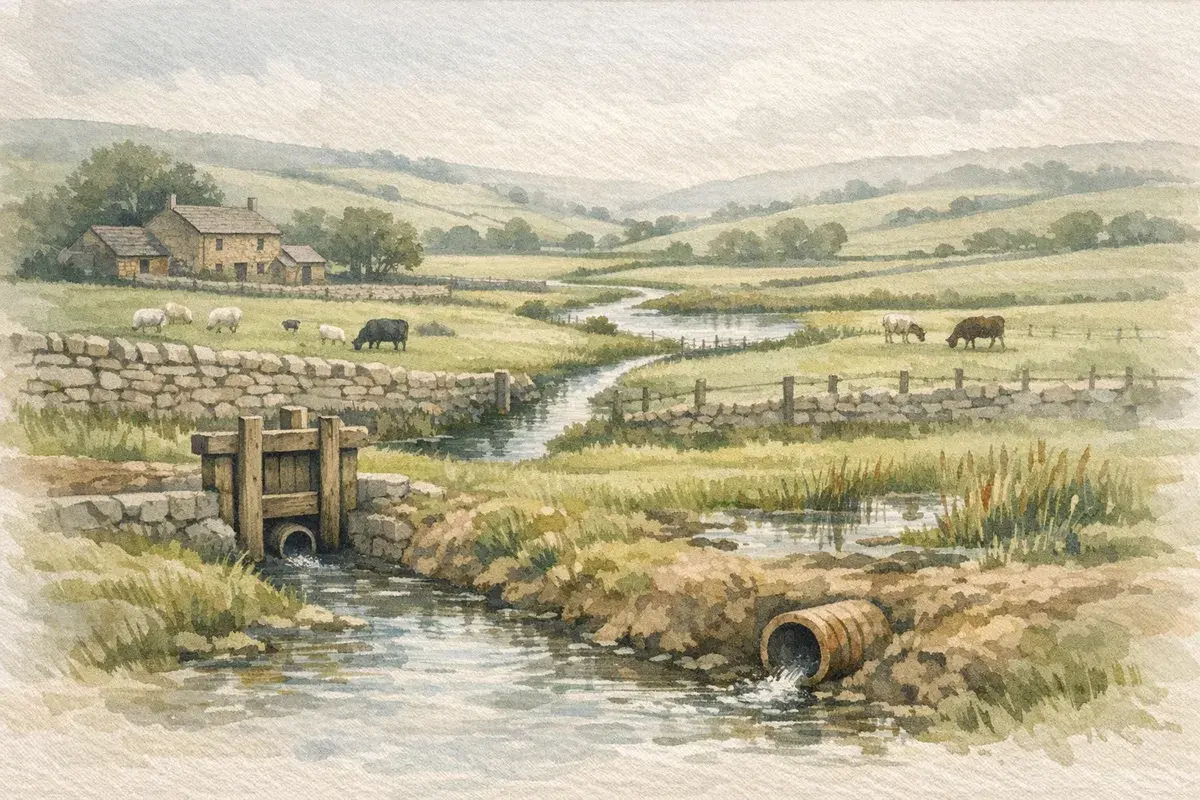
After a wet winter, you don't need a lecture on hydraulics, you need fields that carry stock, tracks that don't disappear, and a yard that isn't turning into a pond. But in the UK, "sorting the drainage" isn't just a practical job. It's a rights-and-responsibilities puzzle involving neighbours, watercourse law, regulators, and whatever the title deeds forgot to mention 40 years ago.
Agricultural drainage rights matter because the line between routine maintenance and unlawful interference can be surprisingly thin. One new outfall, one "helpful" culvert, one blocked ditch at the boundary, and you can find yourself facing an angry neighbour, an enforcement letter, or a claim in nuisance.
This guide cuts through the confusion: what rights you might have, what duties you can't ignore, when you'll need consent, and how to de-risk drainage when you're buying, selling, or leasing rural property in the UK.
Why Drainage Rights Matter In Rural Property Deals
Drainage is one of those topics that feels boring, right up until it isn't. In rural property, a small change in how water leaves your land can affect yields, access, tenancy relationships, and the value a buyer is willing to pay.
How Drainage Affects Value, Productivity, And Compliance
If you're farming, you already know the operational impacts: waterlogged ground delays drilling, increases compaction risk, knocks grass quality, and can push you into awkward grazing decisions. But buyers and lenders look at it through a different lens: risk and cost.
- Productivity and soil condition: Persistent wet patches can signal collapsed field drains, compacted headlands, blocked outfalls, or a ditch system that's effectively silted shut.
- Access and usability: A parcel that can't be accessed with machinery for weeks at a time is worth less in real terms, especially where cropping rotations matter.
- Flood history and insurability: Even if you're not in a headline flood zone, localised flooding from ditches and ordinary watercourses can still create insurance and finance friction.
- Regulatory exposure: Certain works, particularly near watercourses, can trigger consent requirements and environmental constraints.
When you're evaluating land, it helps to treat drainage like you'd treat access: you don't just want to see a track: you want to know you've got the right to use it and the responsibility to maintain it. The same logic applies to drains.
For a deeper jump into how land rights are created and recorded (and what can go wrong when they're vague), it's worth understanding the wider framework of rights over land such as easements.
Typical Flashpoints Between Neighbours And Land Users
Most drainage disputes aren't about grand engineering schemes. They're about day-to-day choices:
- "You've blocked the ditch." Often arises after vegetation clearance is neglected, a culvert collapses, or a boundary ditch becomes a no-man's-land.
- "You've changed the flow." A new outfall, a re-graded bank, or field drain connections can send water to a different point, faster.
- "That pipe runs through my land." Historic private drains frequently cross boundaries with no modern paperwork.
- Tenants vs landlords: Who pays for ditching, outfall repairs, or renewing land drains? The answer depends on the tenancy terms and what counts as repair vs improvement.
A useful rule of thumb: if your work could change the rate, volume, or route of water leaving your land, assume it needs checking before you touch it, not after someone's yard floods.
The Legal Building Blocks: Key Rights And Duties You’ll Encounter
Drainage rights in the UK sit across common law (like nuisance), property law (like easements), and statute (through flood and water management bodies). You don't need to memorise case law, but you do need to understand the concepts that keep coming up in real-world disputes.
Natural Drainage, Watercourses, And The Basics Of Nuisance
In plain terms, you usually can't unlawfully interfere with water in a way that causes damage to someone else.
- If water naturally flows from higher land to lower land, the lower landowner may have to tolerate natural run-off (within reason).
- But if you artificially collect, concentrate, or redirect water, say by piping, land forming, or a new outfall, you can increase your risk of a private nuisance claim if it causes flooding or damage downstream.
This is where disputes become technical quickly. Two fields can look "flat", but tiny level changes, blocked outfalls, and restrictive culverts can make one person's "normal winter wetness" another person's "you've flooded me."
Riparian Ownership And Ordinary Watercourses
If your land borders a watercourse, you may have riparian rights and duties. Riparian ownership is most commonly discussed in relation to rivers and streams, but it can also be relevant to ditches and ordinary watercourses depending on the facts.
Typical riparian duties include maintaining the bed and banks (where you own them), keeping the watercourse clear enough to allow flow, and not obstructing or polluting it.
Because the details matter, what counts as a watercourse, where the boundary sits, and what "maintenance" really means, it's worth reading up on the practical farming angle of riparian responsibilities in the UK.
Statutory Players: Internal Drainage Boards, Lead Local Flood Authorities, And The Environment Agency
Even if a ditch is on your land, you might not be free to do whatever you like with it.
In England (and with parallel bodies/arrangements elsewhere in the UK), common statutory players include:
- Internal Drainage Boards (IDBs): Operate in certain lowland areas with special drainage needs. They manage water levels and drainage infrastructure within their district and may regulate works on watercourses they supervise.
- Lead Local Flood Authorities (LLFAs): Usually your county council or unitary authority. They have roles relating to local flood risk management, including ordinary watercourses.
- Environment Agency (EA): Often involved where "main rivers" are concerned, and in wider flood risk regulation.
Scotland, Wales, and Northern Ireland have their own frameworks and bodies. The constant across the UK: the classification of the watercourse and the nature of the works drives what permissions you need and who you deal with.
When drainage intersects with abstraction, discharge, or water storage, it also overlaps with broader water regulation. If you're trying to join the dots on what you can use, store, or discharge, this guide to water rights on agricultural land is a helpful companion.
Know Your Water: Ditches, Drains, Culverts, And Outfalls
A lot of drainage trouble starts with a simple misunderstanding: people use "ditch", "drain", and "stream" interchangeably, but the law and regulators often don't.
Ordinary Watercourse Vs Main River: Why The Label Changes Everything
Whether something is an ordinary watercourse or a main river can change:
- who you need to speak to,
- what consent is required for works,
- the enforcement risk if you get it wrong.
A "main river" is typically designated and recorded by the relevant authority, and works in, over or near one can require a flood risk activity permit from the Environment Agency. Ordinary watercourses are, broadly, everything else (ditches, streams, cuts, and similar channels) that aren't designated as main rivers.
If you're planning works near any watercourse, don't rely on local slang ("that's just the ditch"). Confirm what it is in regulatory terms before you book a machine.
Field Drains And Private Pipework: Who Usually Owns And Maintains What
Field drainage is often a patchwork of eras:
- Old clay pipes laid in the mid-20th century
- Plastic land drains in later schemes
- Collector drains feeding into ditches or outfalls
- Private piped sections running under tracks, yards, or even neighbouring land
Ownership and maintenance usually follow the "serves/controls" principle, but it's not foolproof. A pipe crossing a boundary might be:
- yours (with a right over the neighbour's land),
- shared,
- or not documented at all.
The paperwork can be decisive. If you're unsure how to interpret the plan, colouring, or wording, you'll often find clues in the title deed documentation for agricultural land, especially around rights reserved, rights granted, and any mention of "drains, ditches, watercourses, and pipes."
Culverts, Headwalls, Grilles, And Trash Screens: Common Liability Hotspots
Culverts are where good intentions go to die.
A culvert can quietly become the restricting point in the whole system. Common issues include:
- Collapsed pipes or displaced joints
- Undersized diameters relative to modern rainfall intensity and upstream land use
- Blocked inlets due to vegetation, trash screens, or silt
- Poorly built headwalls that scour out banks or undermine crossings
If a culvert blocks and backs water up, the question quickly becomes: who is responsible for maintenance and who caused the obstruction? That's why photos, maintenance logs, and clear boundary responsibility matter (more on that later).
What You’re Allowed To Do (And When You Need Consent)
There's a difference between maintaining existing drainage and carrying out works that change a system. The first is often expected of you. The second is where consent, method statements, and neighbour agreements start to matter.
Routine Maintenance: Desilting, Vegetation Clearance, And Re-Profiling Banks
Routine maintenance typically includes:
- removing silt and debris to restore original capacity,
- cutting back excessive vegetation (without destabilising banks),
- repairing small slips and erosion,
- keeping inlets/outfalls clear.
But "routine" doesn't mean "do whatever you like." If your maintenance involves significant bank re-profiling, machinery in-channel, or spoil disposal that affects flow or habitats, it can tip into regulated works.
Practical tip: keep a simple record, date, location, what you did, contractor name, and photos before/after. It's boring admin… until you need it.
Works That Commonly Trigger Consent: Culverting, Outfall Changes, Weirs, And New Connections
Certain works are notorious for landing people in trouble:
- New culverts or extending an existing culvert
- Changing an outfall location or level
- Installing a weir, flap valve, penstock, or control structure
- Connecting new field drains into a ditch or watercourse
- Altering a crossing (pipes, bridges, hard fords)
Even where you're convinced it's an improvement, authorities may view it as a change in hydraulic behaviour. And neighbours may view it as you "sending your water onto them faster."
If your project touches water abstraction, discharge, or storage, you'll also want to sense-check it against the wider rules around farm water use, this guide on water rights when buying farmland is particularly relevant when the drainage plan is part of a larger irrigation or infrastructure strategy.
Timing, Method Statements, And Environmental Constraints (SSSIs, Protected Species, NVZs)
Drainage works don't happen in a vacuum. Constraints that often bite in the UK include:
- SSSIs and designated sites: You may need additional consents if works could affect protected habitats.
- Protected species and nesting birds: Timing vegetation clearance and ditch works can matter.
- NVZ rules and pollution risk: Spoil handling, runoff control, and avoiding sediment-laden discharges are part of doing the job properly.
This is where "get a digger in" becomes "get the right advice in." If you're in any doubt, speak to an experienced land agent, drainage engineer, or environmental consultant before works start, not after a complaint.
Easements, Wayleaves, And Drainage Across Boundaries
The moment a drain crosses a boundary, you're in the world of property rights. And in rural Britain, plenty of drains cross boundaries because the most sensible route for a pipe in 1968 didn't care about today's ownership pattern.
Express Rights In Deeds And Transfers: What To Look For
The best-case scenario is an express easement, a written right in the title allowing water to pass through a drain, ditch, or pipe over someone else's land.
When you review documents, look for wording along the lines of:
- rights "to drain and discharge water" through specified routes,
- rights "to enter for inspection, repair, and renewal,"
- rights reserved for one parcel over another.
You'll often find these buried in transfers, conveyances, or deed schedules. If you're not used to reading them, a specialist can save you time and costly misinterpretation, this is exactly the kind of detail an agricultural land solicitor will interrogate during a purchase.
Prescriptive Easements: When Long Use Can Become A Right
Sometimes there is no paperwork, but the drain has been used openly for decades. In certain circumstances, long, uninterrupted use can crystallise into a right (a prescriptive easement).
In practice, relying on prescription is risky because:
- you need evidence of long use (often 20 years is discussed as a benchmark in England and Wales, but facts matter),
- the use must be "as of right" (without force, secrecy, or permission),
- the route and nature of the right must be sufficiently certain.
If a neighbour disputes it, you may end up spending serious money proving what an old pipe has been doing quietly underground.
Positive Covenants, Shared Drains, And Apportioning Maintenance Costs
Even if you have a right to drain, who pays to maintain the system isn't always clear.
- Shared ditches and boundary watercourses can lead to arguments about desilting frequency and bank repairs.
- Some deeds include covenants about maintenance contributions, but enforcement can be complicated.
If you're trying to untangle what obligations are attached to the land (and whether they bind successors), it often comes back to registration and title detail. For background on how rights and burdens are recorded and mapped, see this practical guide to agricultural land registration.
Disputes And Enforcement: How Problems Escalate And How To De-Risk
Drainage disputes tend to escalate in a familiar pattern: a wet spell exposes a weakness: someone does works (or fails to): water ends up where it shouldn't: then the messages start. The earlier you treat it like a risk-managed issue rather than a shouting match, the better.
Blocking, Diverting, Or Speeding Up Flows: The Usual Allegations
Most claims revolve around three themes:
- Obstruction: A culvert inlet blocked by vegetation, a collapsed pipe, spoil pushed into a ditch, or an undersized screen.
- Diversion: A new channel, bund, or bank regrading that routes water away from its historic path.
- Acceleration: Field drains newly connected or improved, sending water off the land more quickly and increasing peak flows.
Even where you think you're "just improving drainage," you can inadvertently increase downstream risk. And legally, it's the impact that matters, not just your intention.
Evidence That Wins Cases: Levels, Photos, Rainfall Data, And Contractor Records
If a dispute is brewing, evidence is your best friend. The strongest files usually include:
- dated photos/videos of water levels at boundary points and outfalls,
- simple sketches showing flow paths,
- rainfall data and timing (to show whether an event was exceptional),
- contractor invoices and method notes,
- levels surveys where gradients are in question.
If you're buying or managing land, it's smart to include drainage in your broader due diligence. A structured approach to inspection, boundaries, access, services, and signs of drainage failure, aligns well with the checklist mindset in UK agricultural land surveys.
Practical Resolution Routes: Negotiation, Mediation, And When To Involve Authorities
Start practical, then escalate only as needed:
- Talk early, on-site. Many problems are fixable with one shared day of ditching and a sensible plan for future maintenance.
- Agree responsibilities in writing. Even a straightforward email confirming who maintains which section can prevent repeat arguments.
- Mediation. For entrenched disputes, a mediator can be cheaper than litigation and better for long-term neighbour relations.
- Authorities. If works require consent or there's alleged unlawful obstruction on a regulated watercourse, you may need to involve the relevant body.
The aim isn't to "win" a drainage argument, it's to keep your land functional without stepping into legal or regulatory traps.
Buying, Selling, Or Leasing Land: Due Diligence On Drainage Rights
If you're transacting on rural land, drainage is a due diligence item, not a footnote. You're not just buying soil, you're buying a working water system (and the relationships that go with it).
Desktop Checks: Title Plans, Historic Drainage Records, And IDB District Maps
Start before you visit the farm:
- Title plan and registers: Look for mentions of drains, ditches, watercourses, easements, and rights to enter for repair, which you can obtain from HM Land Registry's property information service.
- Historic paperwork: Old farm plans, drainage grant documents, or estate maps can reveal where pipes run.
- IDB/authority context: Check whether the land lies within an IDB district and whether any watercourses are supervised.
If you've never pulled apart a rural title before, do it with the right support. Drainage rights can be hidden in the same places as access rights and reserved service routes, your solicitor should be treating them as critical.
On-The-Ground Inspection: Outfalls, Ditch Condition, And Signs Of Backing-Up
On site, you're looking for function and warning signs:
- Outfalls: Are they visible, clear, and at a workable level? Are they submerged or silted?
- Ditches: Is there capacity, or are they choked with vegetation and silt?
- Culverts: Any obvious collapses, standing water upstream, or scouring downstream?
- Field indicators: Rushes, persistent wet hollows, tramline ponding, or crop colour variation.
Do this in more than one season if you can. Summer can make a failing system look fine.
Contract Clauses And Disclosures: Making Rights And Responsibilities Explicit
When you're buying, selling, or leasing, clarity prevents nasty surprises:
- Disclose known drainage issues and any disputes (buyers hate "mystery problems").
- Document shared responsibilities for boundary ditches and shared drains.
- Lease wording: Make sure repair obligations vs improvements are clearly allocated.
- Access for maintenance: If you need to cross someone else's land to maintain an outfall or ditch section, make sure the right exists and is practical.
If you get the drainage position clear at transaction stage, you're far less likely to be arguing about it in the middle of February, in the rain, when everyone's already stressed.
Conclusion
Agricultural drainage rights in the UK are rarely a single neat rule you can apply everywhere. They're a mix of what water naturally does, what your deeds say (or don't say), what you and your neighbours have historically relied on, and what regulators require when you change a system.
If you take one practical mindset into your next project or property deal, make it this: treat drainage like infrastructure, not like housekeeping. Map it, evidence it, maintain it, and don't "upgrade" anything that affects flows until you've checked who owns what and whether consent is needed.
Disclaimer: AgLand.co.uk is a UK agricultural land and rural property matching service, where buyers register what they are looking for and owners advertise directly to the buyers who match, and a rural resource hub. Nothing in this text is intended as legal, financial, or investment advice. You should carry out your own due diligence and seek advice from appropriately qualified professionals (for example, solicitors, surveyors, land agents, drainage engineers, and relevant regulators) before taking action or relying on any information above.