
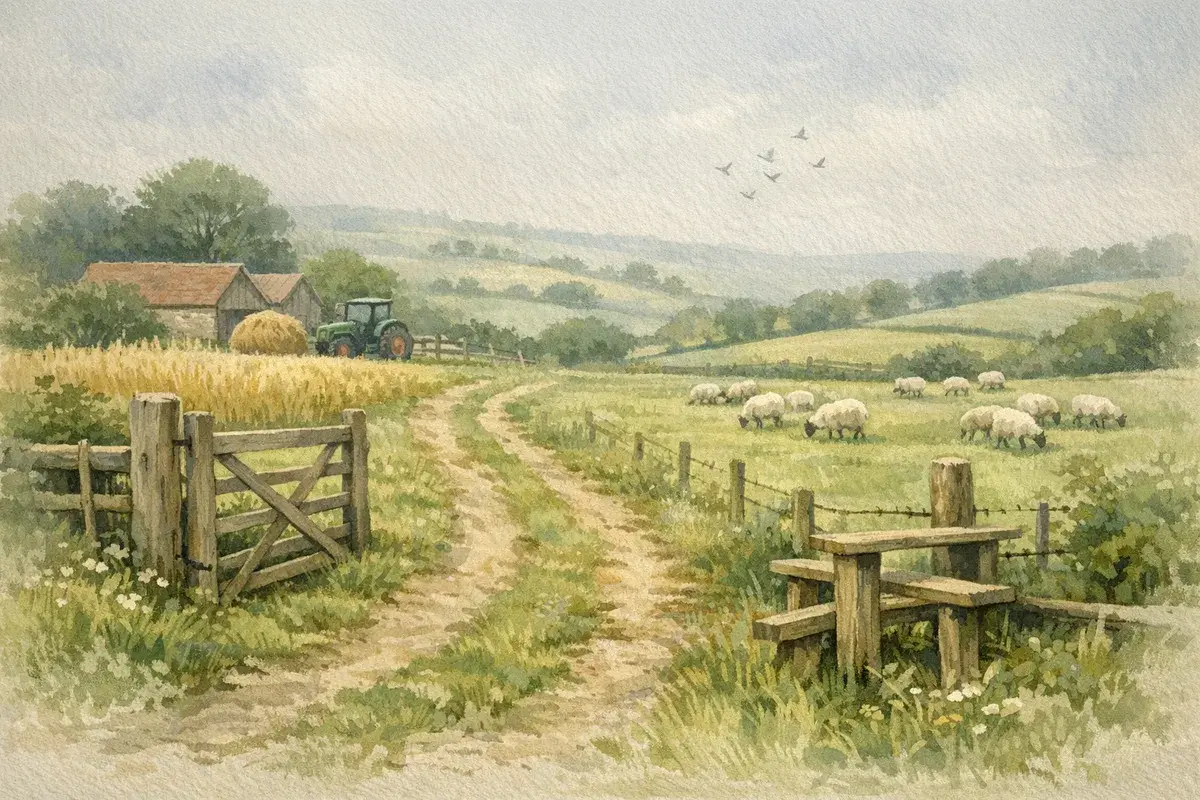
Agricultural rights of way can make or break how a farm functions, especially where access crosses third-party land, public tracks, or historic routes. This guide explains what they are, how they arise, and what landowners, farmers, and agents should check before a transaction or dispute becomes expensive.
If you're buying, selling, letting, or restructuring farmland, rights of way are not a minor detail. They can affect biosecurity, machinery movement, grazing patterns, value, and even whether a block of land is really practical for modern farming.
Get them wrong and you could inherit a problem that keeps coming back, usually when the weather is bad and the contractor is waiting at the gate. Get them right, and they become a manageable part of the holding rather than a daily headache.
What Agricultural Rights Of Way Actually Mean
In plain terms, a right of way is a legal right for someone to pass over land. In agriculture, that usually means a farmer, tenant, neighbour, utility operator, or the public can use a track, lane, ford, bridleway, or field edge to reach land, buildings, or services.
The key point is that the landowner does not always control who can pass, when they can pass, or what they can use the route for. Some rights are private, some are public, and some are tied to specific pieces of land rather than specific people.
Private Access And Farm Tracks
Most farm businesses rely on private access. That might be a recorded easement, which is a legal right benefiting one parcel of land over another, or a right granted in a historic deed. It can also be implied through long use, although that is where arguments often begin.
On mixed estates in counties like Lincolnshire, Norfolk, and North Yorkshire, private farm tracks often serve multiple purposes at once. They may carry livestock trailers, grain lorries, contractors, and occasionally the local utility company too.
Public Rights Of Way Across Farmed Land
Public rights of way include footpaths, bridleways, restricted byways, and byways open to all traffic. In agricultural areas, footpaths are by far the most common, but bridleways and byways can create bigger operational issues because they allow horses, cycles, and in some cases vehicles.
A farmer cannot simply close a public route because it is inconvenient. What matters is the legal status of the route, not whether it is well used, a nuisance in harvest, or currently overgrown.
- Footpath: public access on foot only.
- Bridleway: access on foot, horseback, and bicycle.
- Restricted byway: access on foot, horseback, bicycle, and non-motorised vehicles.
- Byway open to all traffic: can allow motor vehicles, subject to traffic law and conditions.
How Rights Of Way Are Created, Recorded, And Proved
Not every right is written neatly in one place. Some are recorded in title documents or Land Registry plans, some appear in old conveyances, and some arise through long use or dedication. That is why a conveyancing file can look tidy while the reality on the ground is anything but.
For buyers and agents, the practical question is simple: can the route be proved, and can it be relied on? If a vehicle needs to cross the route every day for dairy collections or potato lifting, uncertainty is a real commercial risk.
Documentary Evidence And Historic Use
Solicitors usually check the title register and title plan held by HM Land Registry, plus deeds, historical conveyances, and estate records. On older rural property, the critical evidence may sit in paper archives rather than the modern register, especially where boundaries have shifted over time after enclosure, sale, or amalgamation.
Historic use matters too. Continuous use over years may support a claim that a right exists, although each case turns on the facts. We'd argue this is where local knowledge is invaluable, particularly in counties with patchwork holdings such as Wiltshire, Devon, and Shropshire.
Common Triggers For Disputes
Disputes usually flare up when land changes hands, access is improved, or a neighbour starts using a route more intensively than before. A quiet farm lane used by one occupier can become a flashpoint if a new owner decides to run commercial traffic over it.
Another common issue is ambiguous wording. A deed might grant passage for agricultural purposes only, but what counts as agricultural purposes in practice? Is a feed merchant covered? What about an anaerobic digestion plant feedstock team? Those details matter.
| Issue | Typical Risk | Who Checks It | As Of Date |
|---|---|---|---|
| Unclear deed wording | Dispute over permitted use | Solicitor and land agent | As of June/2026 |
| Historic track use | Claim or challenge over existence of right | Solicitor and barrister | As of June/2026 |
| Public route on farm | Operational delay and liability | Landowner and rights of way officer | As of June/2026 |
| Intensified vehicle traffic | Surface damage and enforcement issues | Land agent and surveyor | As of June/2026 |
Practical Impacts On Farm Businesses And Land Values
Right of way issues are not abstract. They affect how efficiently land can be worked, how safe it is to move machinery, and how attractive the holding looks to a purchaser or lender. A strong access arrangement can add real confidence; a bad one can shave value, or at least make a buyer nervous.
In the South West, where narrow lanes and shared accesses are common, a single weak point can affect a whole block of land. In parts of the East Midlands, the issue may be less about width and more about heavy vehicle damage, soft verges, and seasonal bottlenecks at harvest.
Operational Costs And Biosecurity
A poor access route can mean more turnaround time, more track maintenance, and more risk of crop damage on the margins. If livestock units are involved, biosecurity becomes another layer, because shared access increases the chance of mud, contamination, and contact with outside traffic.
That is not just a management inconvenience. It can influence milk collection schedules, muckaway costs, and even whether a poultry or pig unit can meet its on-farm hygiene standards.
Value Implications For Sales And Rentals
Valuation depends on certainty. A farm with clear, wide, recorded access will usually be easier to market than one reliant on a shaky informal route through a neighbour's yard.
Agents should be especially alert where access serves multiple tenancies, separate titles, or lots marketed individually. Splitting land without checking the access matrix can create stranded parcels, which buyers will price accordingly.
- Direct access certainty: supports lender confidence and smoother saleability.
- Shared private track: may require maintenance agreements or contribution clauses.
- Public route crossing fields: can affect privacy, management, and risk profile.
- Seasonal access only: may suit some uses but reduce wider market appeal.
Managing Agricultural Rights Of Way In Practice
Good management usually beats confrontation. Most problems can be reduced by keeping routes tidy, defining responsibilities clearly, and dealing with issues early before tempers rise and tyres sink into the verge.
If a route is used by multiple parties, a written maintenance agreement is worth serious consideration. Who repairs the surface after wet weather? Who cuts back hedges? Who pays if a contractor causes damage? Those are not side questions, they are the whole game.
Maintenance, Gates, And Surface Damage
Gates, locks, and barriers need careful handling. A landowner cannot usually obstruct a right of way by adding a gate unless the gate is lawful under the Highways Act 1980 and does not materially interfere with passage. Even where a gate is allowed, it must be sensible for the users concerned.
Surface upkeep matters just as much. On clay ground in Somerset or Staffordshire, a track may need regular grading and drainage work to remain usable. If heavy machinery is expected, the route should be built for it, not improvised after the damage is done.
When A Dispute Needs Action
Sometimes a polite conversation is enough. Sometimes it is not. If a neighbour blocks access, widens their use beyond what is permitted, or claims a right that does not appear to exist, the sooner the facts are checked the better.
Early evidence gathering is vital. Photographs, historic maps, witness statements, title documents, and old estate correspondence can all help, particularly where the route has been used informally for decades.
- Maintain records: keep deeds, plans, and maintenance notes together.
- Inspect regularly: look for erosion, overgrowth, and illegal obstruction.
- Clarify responsibilities: write down who does what and when.
- Act quickly: delay can weaken your position and increase cost.
Due Diligence For Buyers, Sellers, And Estate Agents
For buyers, rights of way should be part of pre-contract due diligence, not a box ticked at the end. For sellers, disclosure is the safer route, because awkward access issues have a habit of resurfacing after completion, often with interest.
Estate agents should treat access as a core selling point and a core risk. A property with a sound access package can justify stronger buyer confidence, while a full explanation of restrictions can stop wasted viewings and renegotiation later.
Checklist Points For Rural Transactions
Before a sale or purchase, check whether access is private, public, shared, or informal. Then confirm the route on plan, walk it if possible, and compare the physical route with the legal documents.
It is also wise to ask whether the route serves neighbouring land, tenants, utility companies, or separate titles. One route can mask three different legal positions, which is exactly the sort of thing that creates problems after exchange. Access is not the only service question worth settling before exchange either, because whether a holding runs on metered mains, a private borehole or a licensed abstraction changes the running cost sharply, as a breakdown of what sits on a farm water bill shows.
| Transaction Stage | Key Access Checks | Typical Professional Help | As Of Date |
|---|---|---|---|
| Pre-Marketing | Title review, route status, obvious defects | Agent and solicitor | As of June/2026 |
| Offer Accepted | Evidence of rights, maintenance obligations, disputes | Solicitor and surveyor | As of June/2026 |
| Before Completion | Plan accuracy, easement wording, indemnity issues | Solicitor | As of June/2026 |
| Post-Completion | Practical use, repairs, neighbour liaison | Land agent and owner | As of June/2026 |
Regional context helps too. In Northumberland and Cumbria, upland access can involve long tracks, winter weather, and scattered holdings. In Kent and Essex, smaller blocks and higher traffic intensity can make every access decision more commercially sensitive.
Conclusion
Agricultural rights of way sit at the crossroads of law, land use, and day-to-day farm management. If you understand what exists, what is recorded, and what is actually happening on the ground, you're far better placed to avoid disputes and protect value.
That's the main takeaway: access is not just a legal technicality, it is part of a farm's working infrastructure. Deal with it early, document it properly, and you'll save time, money, and a fair bit of frustration.
Disclaimer: AgLand.co.uk is a UK agricultural land and rural property matching service, where buyers register what they are looking for and owners advertise directly to the buyers who match, and a rural resource hub. Nothing in this text is intended as legal, financial, or investment advice. You should carry out your own due diligence and seek guidance from appropriately qualified professionals (for example, solicitors, land agents, surveyors, and financial advisors) for your specific circumstances.