
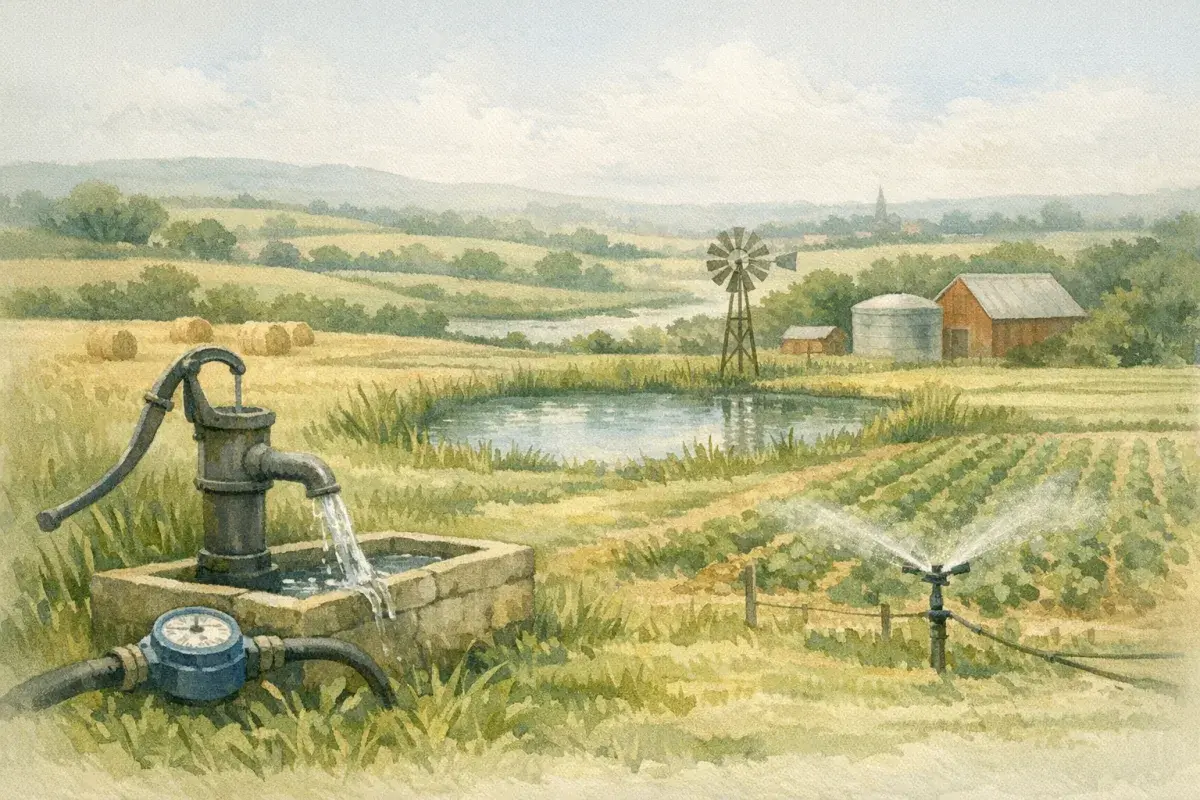
Agricultural water rates UK can look simple on a bill, but the real cost depends on supply type, use, meter setup, drainage, and where your farm sits in the country.
If youre comparing acreage, livestock units, or irrigation demand, the first question isnt just what are the rates, but what exactly is being charged. Treatment costs, standing charges, surface water drainage, and trade effluent can all play a part, and thats before you get into regional differences between, say, Devon, Lincolnshire, or Aberdeenshire.
For many farms, water is no longer a background utility. Its a cost line that can swing with weather, stocking levels, and cropping plans, which makes it worth understanding properly rather than treating it as routine overhead. Wed argue thats especially true now, with irrigation pressure, drought risk, and rising utility attention on rural users.
How Agricultural Water Rates Work
Agricultural water rates in the UK usually depend on whether you are connected to mains water, using a private supply, abstracting water from a river or borehole, or paying for a mix of services. In practice, the bill may include the water itself, sewage or drainage where applicable, and fixed charges for meter provision or pipe maintenance.
For a working farm, that means two neighbouring holdings can pay very different amounts even if both are similar in size. A dairy unit in Somerset on metered mains water will face a different structure from an arable farm in Lincolnshire using a borehole for spray irrigation, and that difference matters when you are budgeting over a full crop cycle.
Mains Water Versus Private Supply
Mains supply is generally the easiest to understand, but not always the cheapest. You usually pay on a meter or, in older arrangements, on a rateable basis that may include a standing charge, and some farms still find themselves on legacy billing systems that do not reflect current use very well.
Private supply changes the picture. If you own a borehole, spring, or reservoir, your direct water bill may be lower, but you will carry testing, pump electricity, treatment, and maintenance costs yourself. That can be a bargain for some holdings and a headache for others, especially where water quality varies through the year.
- Metered supply: Charges follow actual use, which is usually fairer for variable farm demand.
- Standing charge: A fixed fee that can apply even in quiet months.
- Private abstraction: Lower utility bills, but higher self-managed risk and maintenance.
- Drainage charge: May apply if surface water from roofs or yards enters the public system.
Abstraction And Agricultural Use
If you abstract water for irrigation, livestock, or washdown, the water can be free at the point of take, but not free in the wider sense. Licensing is the key issue, especially on rivers, streams, and some groundwater sources, and the catchments in East Anglia, Kent, and parts of the South West can be tightly controlled in dry periods.
Wed say this is one area where farmers should keep records carefully. Licence conditions, seasonal limits, and hands-on meter readings can all affect compliance with the conditions the Environment Agency attaches to a licence, and a missed reading or overlooked limit can create a cost problem long after the growing season has ended.
Current Market Costs And Regional Differences
There is no single agricultural water rate UK figure that suits every farm, because water companies, abstraction arrangements, and local drainage rules vary. Even so, broad patterns are useful, especially when you are comparing holdings for sale or assessing a rent review.
As of June/2026, many rural businesses on metered mains supply will see effective water and wastewater charges that can range from modest single-digit pence per cubic metre for pure water to materially higher blended costs once standing charges are included. In practical farm budgeting, the important point is that total annual cost often depends more on usage profile than headline price.
| Area | Typical Rural Supply Pattern | Cost Pressure Point | Date Reference |
|---|---|---|---|
| East Anglia | Irrigation-heavy, metered or abstracted water | Summer demand and drought restrictions | As of June/2026 |
| South West | Mixed mains and private supplies | Standing charges and drainage on yarded units | As of June/2026 |
| Lincolnshire | Large-scale arable irrigation | Licence limits and pump energy costs | As of June/2026 |
| Wales and Borders | Variable mains access and rural private supply use | Asset condition and winter pipe losses | As of June/2026 |
Regional variation also shows up in utility competition and infrastructure quality. Farms close to market towns in counties such as Norfolk or Herefordshire may have better mains access than more remote fell, moor, or upland units, while some Scottish holdings rely heavily on private systems that need winter-proofing.
In our view, the best comparison is not just price per cubic metre. It is total cost per hectare or per livestock unit, because that gives a truer view of how water affects enterprise margins.
Why The Same Farm Can Pay More Next Year
Water costs do not only rise because providers raise tariffs. A new shed, an extra wash bay, a wet winter that pushes more yard drainage into the public system, or a switch to irrigated vegetables can all change the bill quite sharply.
This is why agricultural buyers should ask for at least three years of actual water data during due diligence. If the holding has mixed use, such as a contractors yard alongside a livestock enterprise, you need to know what belongs to the farm and what belongs to any commercial leaseholder.
What Drives Agricultural Water Charges
The main cost drivers are fairly familiar once you strip away the jargon. Volume matters, but so do infrastructure, contract type, water quality treatment, and how much of your site sheds water into public drains.
For livestock farms, the biggest line often comes from washdown, parlour use, and trough losses. For arable growers, irrigation timing can be the budget breaker, especially in eastern counties where summer pressure is high and every dry week can mean another diesel-powered pumping run.
Usage, Metering, And Standing Charges
Metering should, in theory, make costs fairer because you pay for what you use. In reality, a poor meter location, a sticking meter, or an old fixed-charge arrangement can distort the picture, which is why bill checks matter more than many owners realise.
Standing charges are easy to overlook because they look small on paper. Across a year, though, they can add up for holdings with multiple supply points, and that is especially relevant for separated farmsteads, tenanted blocks, or diversified estates with several buildings. Those are also the holdings with most to gain from reviewing the retailer, since in England the retailer handles billing while the wholesaler still owns the pipes - who is eligible to switch and where the savings actually sit walks through the process.
Drainage And Surface Water
Surface water drainage charges can surprise farms that have expanded yards, hard standings, or roofed livestock buildings. If rainwater from roofs, yards, or access roads enters the public system, you may be charged even if your clean water use is relatively modest.
That issue can hit poultry units, equine businesses, and farm retail sites particularly hard. If youre buying or letting a property in counties like Cheshire, Gloucestershire, or Kent, it is worth checking the drainage layout as carefully as the water supply itself.
- Hard standings: Can increase surface water disposal charges.
- Roof drainage: May be charged if linked to the mains drainage network.
- Multiple meters: Often create hidden fixed costs.
- Private treatment: Can reduce bills but adds maintenance responsibility.
How To Budget For Farm Water Costs
Budgeting starts with separating essential use from avoidable waste. Once you know how much goes to stock watering, parlour washdown, crop irrigation, and office or domestic use, you can see which part of the bill is actually under your control.
Wed suggest using a simple annual benchmark based on enterprise type. A dairy unit with high washwater demand should expect a different profile from a beef-and-sheep holding with low yard use, and neither should be judged against a vegetable enterprise with intensive irrigation.
Practical Budget Checks
Start with last years bills, then adjust for any changes in herd size, cropped area, or building use. If you have added a new borehole pump, switched to more irrigation, or installed a calf housing block with additional washdown, the old number will probably understate the coming year.
It also helps to note seasonality. Irrigation-heavy businesses in Cambridgeshire or Suffolk may see very sharp summer spikes, while livestock farms might face steadier monthly use but higher winter drainage or yard-cleaning impacts.
- Usage trend: Compare monthly bills, not just annual totals.
- Enterprise split: Separate livestock, irrigation, and domestic demand.
- Leak checks: Inspect troughs, pipes, and taps regularly.
- Pump energy: Include electricity or diesel for private supplies.
Due Diligence For Buyers And Landlords
If you are buying land or a farm, ask whether any part of the estate is on metered mains, private supply, or abstraction licence. The answer affects operating cost, compliance obligations, and potentially the resale value of the holding. The same stage is the moment to check how the land is actually reached, because a route's recorded legal status decides far more than how heavily it is used, as our guide to rights of way across farmland explains.
For landlords, water usage can be a lease issue as much as an operating cost. A tenant dairy unit in Cheshire, for example, may need clear responsibility for the metre, repairs, and leakage reporting, or disputes can surface quickly once the first big quarterly bill arrives.
Reducing Water Costs Without Cutting Corners
Lowering water costs should be about efficiency, not false economy. A well-maintained system usually saves more than a cheap fix ever will, and that matters on farms where a burst pipe or failed pump can put stock and crops at risk.
There are several low-regret measures worth considering. Fixing leaks, installing water-efficient troughs, improving yard drainage, and matching irrigation timing to soil moisture all help, and they often pay back faster than expected.
Efficiency Measures That Work
On livestock units, float valves, pressure regulators, and better trough placement can reduce losses without affecting welfare. On arable farms, soil moisture monitoring and sensible irrigation scheduling can cut unnecessary applications, especially where sandy soils dry quickly but not every field needs the same treatment.
Private supply users should also think about pump servicing and water quality testing. A cheap repair that protects pump life or prevents contamination is usually a smarter spend than waiting for a full breakdown in mid-season.
- Leak detection: Catch small losses before they become expensive.
- Smart scheduling: Irrigate when the crop really needs it.
- Infrastructure upkeep: Maintain pipes, pumps, and valves properly.
- Water reuse: Where appropriate, recycle clean yard water responsibly.
Conclusion
Agricultural water rates UK are best understood as a mix of supply cost, drainage, infrastructure, and usage rather than a single neat tariff. Once you break the bill down by enterprise and region, the picture becomes much clearer, and the right comparisons are easier to make.
For farmers, landowners, and agents, the key is to look beyond the headline figure and focus on total operating cost, especially where irrigation, livestock housing, or private supply systems are involved. That is the only reliable way to judge whether a holding is efficient, expensive, or somewhere in between.
Disclaimer: AgLand.co.uk is a UK agricultural land and rural property matching service, where buyers register what they are looking for and owners advertise directly to the buyers who match, and a rural resource hub. Nothing in this text is intended as legal, financial, or investment advice. You should carry out your own due diligence and seek guidance from appropriately qualified professionals (for example, solicitors, land agents, surveyors, and financial advisors) for your specific circumstances.