
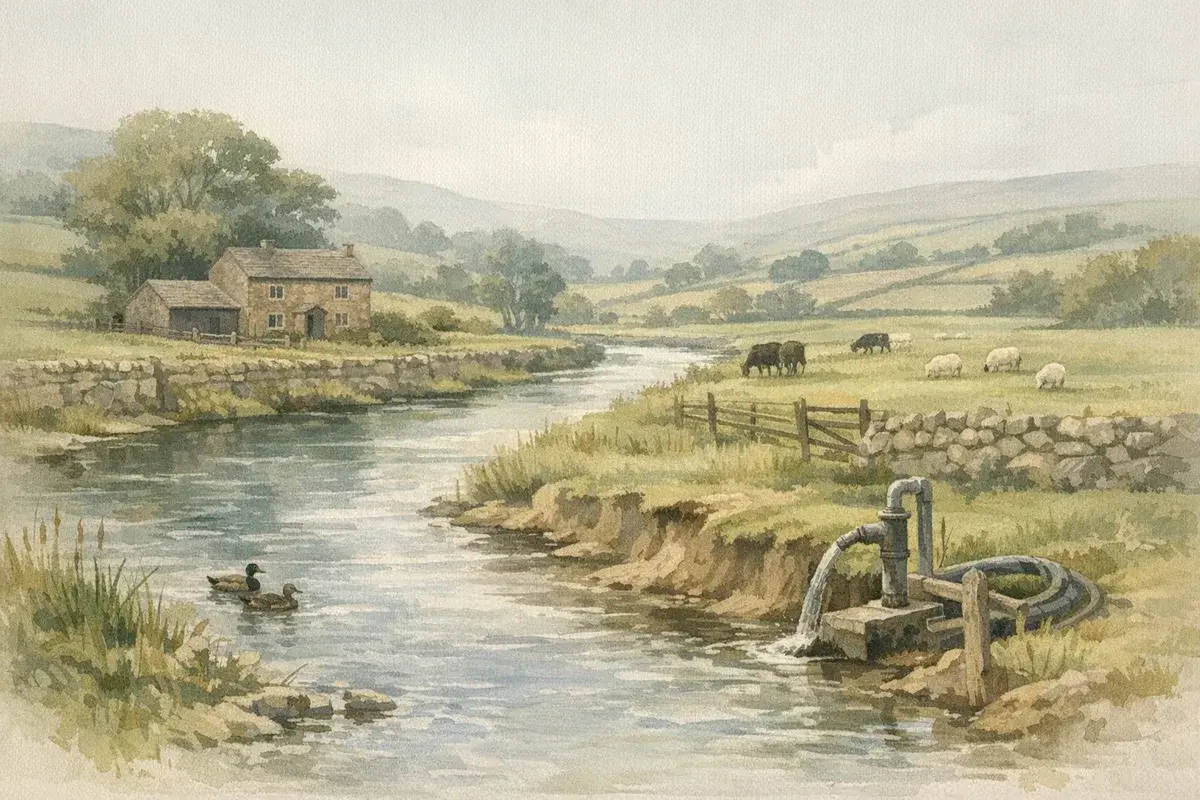
If you farm next to a stream, ditch, dyke, brook, or river, you're not just managing a field edge, you're managing a set of legal rights and duties that can affect drainage, cropping plans, livestock access, flood risk, and even the resale value of the holding.
Riparian rights in UK farming are often talked about like an "automatic entitlement" to do what you like with water. In reality, they're more like a framework: you may have certain reasonable uses, but you also inherit responsibilities to neighbours downstream (and upstream), plus a layer of regulator consents that can bite when you least expect it, typically after a flood, a pollution incident, or a sale.
This guide cuts through the practical questions we see most: what you can do without permission, when you need a licence or consent, how boundaries really work on watercourses, and how to protect yourself before you buy, let, or invest in riparian farmland.
What Riparian Rights Mean For Farmland Owners And Occupiers
Riparian rights are the rights (and linked duties) that attach to land that borders a natural watercourse. In England and Wales, they arise primarily from common law principles: in Scotland the terminology and underlying legal structure differs, but the day-to-day realities, don't cause harm, don't obstruct flow, don't pollute, get permissions for controlled works, often feel similar on the ground.
For UK farming, the key point is this: riparian rights are not a free pass to abstract, divert, dam, culvert, dredge, or "tidy up" but you want. They're qualified by the rights of other riparian owners and by modern environmental and flood-risk regulation.
Who Counts As A Riparian Owner?
You're typically a riparian owner if your land touches a natural watercourse. That can mean:
- The water forms the boundary between you and a neighbour.
- The water runs through your land.
- Your title includes the bed of the watercourse (in whole or in part).
A common misconception is that you need to "own the river" to be riparian. You don't. If your land adjoins it, you'll usually have riparian status, and the duties that come with it.
Rights Versus Responsibilities: The Core Principle
The core principle is reasonable use without causing harm.
In practice, that means you can generally:
- Make ordinary domestic/agricultural use of water (within limits).
- Protect your land from erosion (subject to consents).
- Access the watercourse from your bank.
But you must also:
- Allow water to flow naturally (not backing it up onto neighbours).
- Keep your section clear where you're responsible (without making flood risk worse).
- Prevent pollution from farming operations.
If you want the broader context of how "water rights" interact with abstraction, storage, and discharges on agricultural land, it's worth reading AgLand's deeper guide on what you can use water for, and what needs checking before you buy.
Freehold, Tenancy, And Contract Farming: Who Holds The Water Rights?
This is where farmers get caught out because the person doing the work isn't always the person with the legal right (or the legal exposure).
- Freehold owner-occupier: you'll usually hold the riparian rights and responsibilities.
- Tenant farmer: responsibilities are often split between what your tenancy says and what the law expects of the landholder/occupier. Some maintenance may be landlord's, some yours, don't assume.
- Contract farming arrangements: the landowner typically retains the legal interest in the land (and often the regulatory duties), while the contractor carries operational risk. But if an incident happens (say, silt runoff into the brook), regulators may look at who caused it as well as who controlled the land.
If you're taking on a tenancy with watercourse edges, it's worth being explicit in writing about maintenance standards, access for works, and who pays when a culvert collapses. "We'll sort it if it becomes a problem" is not a plan.
Typical Rights Farmers Rely On (And Their Limits)
Most farms with a watercourse use it in ways that feel completely normal, watering stock, running a pump in dry spells, maintaining crossings. The trouble is that what's "normal" operationally can still be regulated, and the threshold between routine use and a permissioned activity isn't always intuitive.
Taking Water For Livestock, Irrigation, And Spraying
A small volume of water taken for ordinary agricultural purposes may be permissible, but the moment you're taking more than de minimis volumes (or doing it routinely), you're into abstraction territory.
Irrigation and spraying are where abstraction issues tend to surface because:
- volumes are higher,
- low flows in summer make impacts more obvious, and
- neighbours (and anglers) notice quickly.
Pragmatically: if you're relying on a stream to make a cropping plan work, treat it like a business-critical asset and check your regulatory position before you commit seed to soil.
Watering Points, Pumps, And Abstraction: When You Need A Licence
Abstraction licensing is one of the most common "surprise liabilities" for buyers and tenants. The presence of an old pump house or pipe doesn't automatically mean the use is authorised today.
You should assume you may need an abstraction licence (or to comply with an existing one) if you're:
- pumping from a river/stream, or
- taking water from groundwater/field drains feeding storage, or
- filling irrigation reservoirs from a watercourse.
Volumes, location, and purpose matter, and rules can vary by catchment status and local constraints. If you want a farmland-specific run-through of what to check (including pitfalls around historic permissions and how they transfer), AgLand's guide on agricultural water use and the permissions that often apply is a good companion.
Using Watercourses For Access, Crossings, And Stock Movement
Watercourses are often part of farm logistics: a ford, a bridge to reach an in-hand block, or a stock crossing to split grazing.
Typical riparian "use" is about access from your bank. But building or modifying a crossing is another thing entirely. The moment you introduce a structure, culvert, hardstanding, in-stream ramping, you can change:
- flood conveyance,
- fish passage,
- bank stability,
- sediment movement.
Which is why permissions and design standards start to matter (we'll cover regulators and consents later).
Fishing, Sporting, And Ancillary Income Streams
If your holding includes fishing rights (or the potential to let them), riparian ownership can be commercially relevant. We've seen small stretches of water add meaningful value where:
- access is safe and managed,
- there's clear title to the sporting rights, and
- there's no conflict with existing public rights of way.
Equally, it can be a headache where rights are split, leased out historically, or where anglers assume access that isn't actually granted. The rule of thumb: treat fishing and sporting as property rights that need title clarity, not as a casual add-on.
The Legal Duties That Come With A Watercourse
Riparian duties are where the "quiet stream at the bottom of the field" becomes a compliance issue. Your duties aren't just moral or neighbourly, they can have legal and financial consequences if flood risk increases or pollution occurs.
Maintaining Banks, Beds, And Vegetation Without Creating Flood Risk
You're generally expected to maintain your banks and the bed in a way that doesn't increase flood risk and doesn't damage habitats unlawfully.
That creates a practical balancing act:
- Leave too much vegetation and you risk debris accumulation and localised flooding.
- Over-clear or heavily re-profile banks and you risk erosion, siltation downstream, and regulatory action.
In the real world, the "right" approach is usually targeted maintenance: selective cutting, stabilisation where needed, and proper timing (especially around nesting seasons and fisheries sensitivities).
Keeping The Channel Clear: Debris, Trees, Silt, And Beaver Impacts
Blockages are the classic dispute trigger. A fallen tree can act like a dam: silt can raise the bed level: and where beavers are present (in a limited number of places, with local management frameworks), dams can materially alter flow.
If you're clearing debris, be careful: doing the right thing (reducing blockage risk) in the wrong way (unconsented works on a regulated watercourse) is still a problem.
On farmland, channel management is often tied to wider drainage. If your ditches, grips, or outfalls link into a watercourse, it's worth understanding the overlap with farm drainage rights and responsibilities, because what you do in the field edge can have knock-on impacts downstream.
Pollution Prevention For Yard Runoff, Slurry, Silage, And Pesticides
Pollution is where regulators move quickly, and where reputational damage travels even faster than enforcement.
Common risk points we see on farms near water include:
- dirty yard runoff entering a ditch or stream via cracked concrete or "temporary" channels,
- slurry store overflow (or agitation incidents) reaching a land drain,
- silage effluent getting into field drains,
- pesticide/fertiliser handling areas too close to a watercourse.
It's rarely the dramatic "one big mistake" people imagine. More often it's a chain of small, accepted shortcuts, until a heavy rain event turns them into a reportable incident.
Protecting Neighbours' Rights: Flow, Quality, And Nuisance
You must not materially reduce, divert, or pollute the flow such that it harms other riparian owners.
In practical neighbour terms, that means if you:
- put in a culvert that reduces capacity,
- regrade a bank that sends silt downstream,
- run water onto the neighbour's land via an altered outfall,
…you may be creating a private dispute and inviting regulator scrutiny.
If you're already dealing with questions of who can access the bank, who can cross the water, and what "reasonable use" means day-to-day, AgLand's explainer on river access issues in a farming context can help you frame those conversations before they turn into rows.
Regulators, Consents, And The Rules You Meet In Practice
If riparian law is the underlying principle, regulators and consents are how it shows up in your life, usually when you're trying to get something done quickly.
One of the most expensive mistakes is assuming that because something has "always been there", you can repair, replace, or upgrade it without permissions.
Environment Agency, Lead Local Flood Authorities, And Internal Drainage Boards
In England, the Environment Agency (EA) is typically involved where main rivers are concerned and for broader environmental regulation. Lead Local Flood Authorities (LLFAs) (usually county councils/unitary authorities) have roles around ordinary watercourses and local flood risk strategy. Internal Drainage Boards (IDBs) may apply in specific drainage districts and can have their own byelaws and consent requirements.
In Wales, Natural Resources Wales (NRW) performs many of the equivalent functions. Scotland and Northern Ireland have their own bodies and frameworks. The point for you is simple: work out which regime you're in before you start works.
Ordinary Watercourses Versus Main Rivers: Why It Changes What You Need
This distinction matters because it affects:
- who you apply to,
- what permission is required,
- how strict design and environmental constraints may be.
A ditch that looks minor can still be hydraulically important. Conversely, a stream you've always called "the river" may be classed differently in mapping. Don't rely on local names, check the designation.
Works Near Water: Culverts, Outfalls, Weirs, Dredging, And Bank Protection
These are the activities most likely to trigger the need for consent:
- culverting (new or extended)
- outfalls from field drains or yards
- weirs and flow controls
- dredging/desilting and re-profiling
- bank protection (rock armour, piling, regrading)
Even "like-for-like" repairs can require approval depending on location and risk. We've also seen problems where a farmer improves a crossing for modern kit, wider, heavier, with more hardcore, and inadvertently constricts the channel or weakens the bank.
The safest pattern is:
- document the existing situation (photos, rough dimensions, location):
- speak to the relevant authority early:
- design for flow capacity and environmental constraints: and
- keep records of permissions and correspondence.
Cross-Compliance, SFI And ELM: How Schemes Interact With Water Management
Farm schemes can change what "good practice" looks like on a watercourse edge.
- Buffer strips, reduced inputs near water, and soil management measures can support compliance and reduce pollution risk.
- But scheme options can also constrain how and when you carry out maintenance (for example, restrictions around disturbance or habitat value).
If you're managing land under SFI or ELM-related options, align your watercourse maintenance plan with those commitments, and make sure contractors understand the rules. A well-meaning digger operator can undo months of careful compliance in an afternoon if the brief is vague.
Boundaries, Ownership, And Title: Avoiding Expensive Surprises
Riparian rights and watercourse liabilities are eventually property questions. And property questions live (or die) on title plans, deeds, historic agreements, and what's actually on the ground.
If you're buying, refinancing, selling part, or reorganising a holding, watercourse boundaries are where costs creep in: extra legal time, survey time, and the occasional nasty surprise.
Where The Boundary Sits: Centreline, Bank Top, And Deeds That Say Otherwise
People love a simple rule like "you own to the middle". Sometimes that's broadly true where the watercourse forms the boundary, but it's not a universal truth.
The boundary could be:
- the centreline of the channel,
- the near bank,
- the top of bank,
- or something specifically described in deeds.
Add in historic realignments (straightening, dredging, erosion), and the line on the plan may not match the wet reality. If you're unsure, don't guess, get the title checked properly. AgLand's practical guide to agricultural land registration and what title plans do (and don't) tell you is especially useful if you're dealing with older unregistered parcels or fuzzy boundaries.
Ditches, Drains, And Field Edge Grips: Who Owns And Who Maintains?
Ditches are where riparian rights collide with agricultural drainage.
- Some ditches are ordinary watercourses.
- Some are private drains.
- Some are part of a wider drainage district network.
Ownership and responsibility can depend on whether the ditch is wholly within your land, on the boundary, or serving multiple holdings. Maintenance expectations can also be shaped by local drainage bodies.
If your cropping depends on effective outfall and ditch performance, don't treat it as "just a bit of ditching." Understand the legal position and the practical obligations. The overlap is covered in more depth in AgLand's piece on how drainage rights work on farmland.
Bridges, Culverts, And Private Crossings: Liability And Repair
A private bridge or culvert can be a sleeper liability.
If it fails, you might face:
- repair costs (often higher than expected once you factor in access, traffic management, ecology constraints),
- neighbour claims if flooding results,
- regulator involvement if the watercourse is obstructed.
Also watch for "temporary" structures that have become permanent by default, old pipes, pallets, makeshift hardcore ramps. They can be functionally useful and legally risky at the same time.
Easements, Wayleaves, And Third-Party Rights Along Water
Watercourses often carry third-party rights you only discover when you try to change something:
- an easement for a neighbour's drainage outfall,
- rights of access for maintenance,
- utility wayleaves near the bank,
- historic sporting leases.
These matter hugely when you're selling part, granting a new tenancy, or trying to improve access. If you're carving off a paddock or strip by the river, take a careful look at how rights will be reserved, granted, or extinguished. (This is also where overage and development value discussions sometimes creep in, depending on location.)
Disputes And Enforcement: The Scenarios We See Most Often
Riparian disputes are rarely about abstract legal theory. They're about timing (usually after a storm), money (who pays), and stress (who's to blame). The earlier you understand the typical flashpoints, the easier it is to keep relationships workable.
Flooding And Blockages: Proving Cause And Agreeing A Remedy
The classic scenario: someone says, "Your tree/your silt/your culvert caused my field to flood."
The hard bit is causation. Flooding can be multi-factorial, rainfall intensity, catchment saturation, land management, blocked screens, downstream pinch points.
If you're trying to resolve it without it turning into a formal dispute:
- agree a joint site visit (with photos and dates),
- map the likely flow path during peak events,
- document proposed works and responsibilities,
- consider an independent drainage engineer where stakes are high.
A practical note: if you rush into dredging because tempers are high, you can create regulatory issues. "Doing something" isn't the same as doing something permissible.
Abstraction, Low Flows, And Neighbour Objections
Low flows bring everyone's priorities into sharp focus: livestock water, irrigation, environmental protection, fisheries, amenity.
If you're abstracting (or planning to), expect questions like:
- Is there a licence, and what are its conditions?
- Are hands-off flow restrictions being met?
- Is the abstraction impacting downstream users?
Neighbour objections often land when a new buyer arrives and starts using an old pump harder than the previous owner did. From a risk standpoint, this is why buyers should treat existing infrastructure as a clue, not proof, of lawful use.
Pollution Incidents: Investigation, Penalties, And Insurance Considerations
When a pollution incident happens, the immediate priorities are containment and reporting. After that, expect investigation and potential enforcement.
Insurance can help, but it's not a magic wand. Policies vary, exclusions bite, and poor record-keeping makes everything harder.
If you're operating near water, it's worth reviewing:
- where your highest-risk liquids are stored and handled,
- what happens to yard runoff during a storm,
- whether staff and contractors know who to call and where to deploy spill kits.
And yes, keep incident records even when you "sorted it quickly." Those notes can save you later.
Public Access, Rights Of Way, And Angling Conflicts
Water attracts people. In rural areas that can mean:
- public footpaths running along the bank,
- informal access that's become "customary" (but not necessarily lawful),
- anglers assuming they can cross your land to reach the river.
Your job is to separate public rights of way (legal and mapped) from "people have always done it". If you want a practical framing for common access friction points, crossings, bank-side routes, and what's reasonable, AgLand's article on river access rights for farms is a useful starting point.
When these issues escalate, get professional advice early. The cost of a clear letter and a managed solution is usually less than the cost of a neighbour dispute that drags on through a season.
Buying, Letting, Or Investing In Riparian Farmland: A Due Diligence Checklist
If you're buying riparian farmland, your aim is simple: know what you're getting, know what you're responsible for, and know what you're allowed to do with it. Water adds value when it's understood and managed: it subtracts value when it's a hidden liability.
If you want the full purchase process (access, title, planning, rights, tax and practical inspections), it helps to follow a structured method like AgLand's step-by-step approach to buying agricultural land. Below is the riparian-specific overlay.
Documents To Review: Title, Plans, Drainage Records, And Historic Consents
Ask for (and actually read):
- Title register and title plan (and any deed plans that show the water boundary).
- Historic drainage and flood correspondence (even informal emails can reveal patterns).
- Abstraction licences / discharge consents / permits (where applicable).
- Records of works: culvert installs, bank works, dredging, outfall changes.
- Sporting leases (fishing rights, access permissions).
A red flag isn't "there were works." It's "there were works and nobody can find the paperwork."
Site Walkover: Erosion, Structures, Invasives, Outfalls, And Flood Evidence
Do the walkover like you mean it, after rain if you can.
Look for:
- active bank erosion (fresh slumps, undercutting),
- silt fans and deposition zones,
- collapsed or undersized culverts (standing water upstream is a clue),
- unseen outfalls (pipes emerging from banks: field drains discharging),
- invasive species (management obligations can be time-consuming),
- flood markers on fences/trees and debris lines.
If the watercourse is hidden by scrub, that's not "nice shelter." It might be "nobody's looked at it for five years."
Questions To Put To Agents, Vendors, And Neighbours
Be direct. Ask:
- Who maintains this stretch, and how often?
- Has the land flooded in the last 10 years? Where, and how badly?
- Are there any disputes about blockages, outfalls, crossings, or access?
- Is any water abstraction taking place now? If yes, under what authority?
- Are there any IDB rates or local drainage levies?
Also: talk to neighbours (politely). You'll learn more in ten minutes at a gate than in some glossy sales particulars.
When To Bring In Specialists: Land Agents, Surveyors, Drainage Engineers, And Legal Advice
Bring specialists in when:
- the farm relies on abstraction/storage for cropping output,
- there are significant structures (weirs, culverts, multiple crossings),
- the holding has a flood history,
- the boundary line is unclear or contested,
- you're buying as an investment and need a clean risk picture.
A good rural surveyor or land agent will help you see the "value and risk" side: a drainage engineer will help with capacity and failure points: a solicitor will keep rights, liabilities, and covenants from becoming your problem by default.
And if you're still searching, use a platform that lets you filter and compare rural property properly. AgLand's guide to finding and assessing agricultural land for sale across the UK is designed to help you spot rights-and-risk issues early, not after you've emotionally committed.
Practical Next Steps For Farmers Managing Watercourses Day To Day
Once you accept that watercourse management is part law, part agronomy, part neighbour relations, the day-to-day becomes much easier. You're aiming for a routine that keeps the channel functioning, protects water quality, and gives you a paper trail if anyone questions what you've done.
Set Up A Maintenance And Inspection Routine That Stands Up To Scrutiny
A workable routine (adjust for your farm):
- Monthly visual checks in high-risk seasons (autumn leaf fall, winter storms).
- Post-storm inspections of known pinch points: culverts, trash screens, bends, bridges.
- Seasonal vegetation management with a light touch, selective, not scorched earth.
- Annual review of crossings, outfalls, and bank stability.
If you've got multiple ditches feeding into a main watercourse, build ditch management into your broader drainage plan. It's easier to justify consistent, preventative work than emergency intervention.
Record-Keeping For Works, Incidents, And Permissions
Keep a simple log. Nothing fancy:
- date, location, what you observed,
- what you did (or what a contractor did),
- photos before/after,
- any permissions/consents and reference numbers,
- any conversations with neighbours or regulators.
This is your shield when memories get selective.
Building A Relationship With Regulators And Local Drainage Bodies
You don't need to be best mates with every authority. You do need to be credible.
- Make contact before you're in a panic.
- Ask what they need from you to make a decision quickly.
- Be honest about constraints (access, timings, machinery).
Where an IDB or local drainage body is involved, understanding their maintenance schedule and standards can prevent duplicated effort, or you paying to fix something they would have handled anyway.
One last practical tip we've seen work: if you're planning capital works (crossing upgrades, bank stabilisation), schedule pre-application conversations in winter for spring/summer delivery. Trying to secure consents in the middle of a drought or immediately after flooding is when delays and objections pile up.
Conclusion
Riparian rights in UK farming are best thought of as a package deal: you get reasonable use and practical benefits, but you also inherit obligations to keep flow moving, prevent pollution, and avoid causing harm. The farmers who stay out of trouble aren't the ones with the quietest streams, they're the ones who treat water as an asset that needs governance, not just management.
If you're buying, letting, or restructuring land with a watercourse, do the unglamorous checks early: title, boundaries, historic consents, and the condition of crossings and outfalls. If you're already farming it, build a repeatable inspection routine and keep records. When something does go wrong (and eventually, something will), that combination, evidence plus a sensible maintenance history, usually makes the difference between a solvable issue and a spiralling dispute.
Disclaimer: AgLand.co.uk is a UK agricultural land and rural property matching service, where buyers register what they are looking for and owners advertise directly to the buyers who match, and a rural resource hub. Nothing in this text is intended as legal, financial, or investment advice. You should carry out your own due diligence and seek guidance from appropriately qualified professionals (for example, solicitors, surveyors, land agents, drainage engineers, and tax advisers) before taking action.