
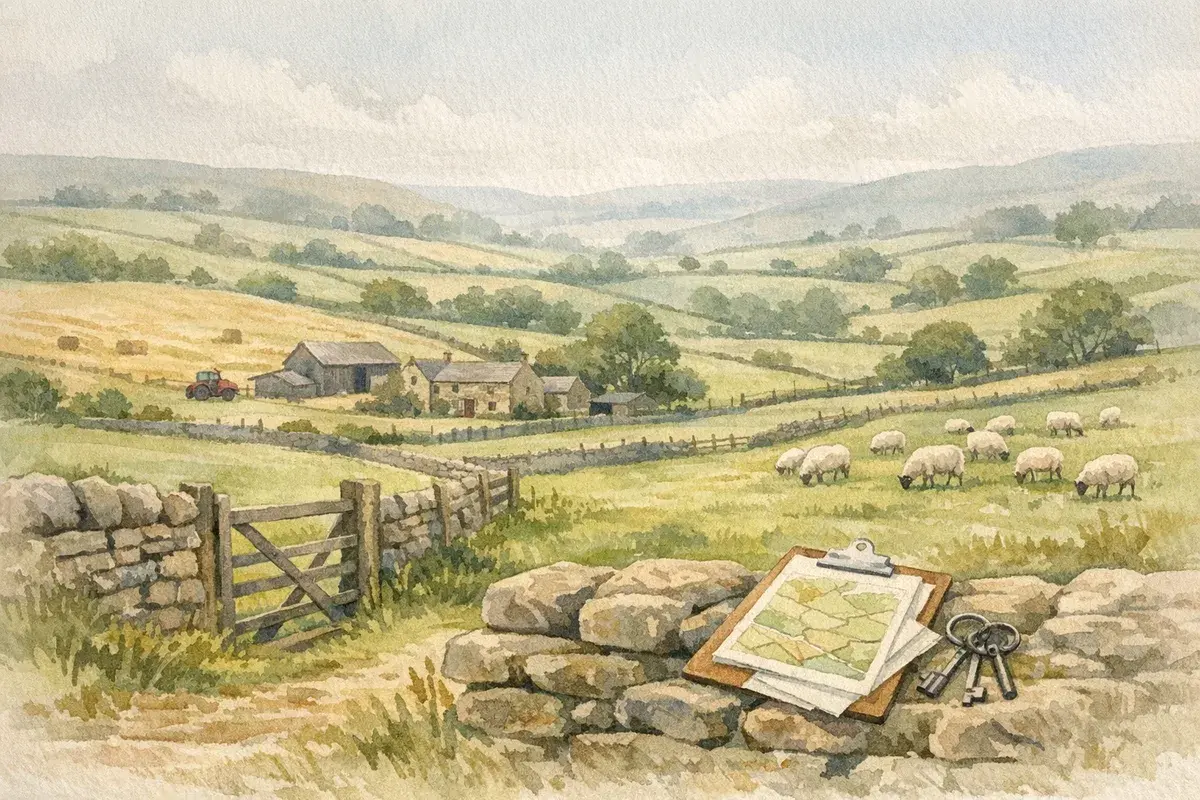
If you've ever tried to pin down exactly what you "own" on a farm map, where the boundary really sits in a hedge line, whether that stony track is yours to use, or who's responsible for a leaking water main, you'll already understand why agricultural land registration matters.
In the UK, land registration isn't just an admin exercise. It's the backbone for sales and purchases, farm business tenancies, bank lending, grant applications, and, increasingly, future development and diversification decisions. But rural titles often carry quirks: historic conveyances, vague plans, long‑standing informal access, sporting rights carved off decades ago, or a neighbour who's fenced "a bit" inside your field for as long as anyone can remember.
This guide cuts through the practical reality of agricultural land registration, what it means, what you'll need, where things commonly go wrong, and when it's worth paying for specialist help so you don't end up re‑doing the job (or fighting over it) later.
What Agricultural Land Registration Means (And Why It Matters)
At its simplest, agricultural land registration means recording your ownership (and certain rights and burdens affecting the land) on the official register held by HM Land Registry (for England and Wales). Scotland and Northern Ireland have their own systems, but the big idea is similar: a state-backed register that tells you who owns what, and what affects it.
In practice, registration is about more than the owner's name. For rural property, it's often the first time a farm's legal "paper reality" is forced to line up with what's on the ground.
Registered Vs Unregistered Land: The Practical Differences
If your land is registered, there's a title number and a title plan. The register will show:
- who owns it
- mortgages/charges (if any)
- restrictions (for example, needing consent before a sale)
- easements/rights that benefit the land (like a right of way)
- burdens that affect it (like someone else's right of way across it)
If your land is unregistered, ownership is proved by a bundle of historic deeds and conveyances, often going back decades. That can work perfectly well… until you need to sell, mortgage, split, or sort out a boundary disagreement. Then the practical downsides show up fast:
- Slower transactions: buyers' solicitors have to review a thick deeds pack.
- More uncertainty: old plans can be vague, and "sold as edged red" may not match modern mapping.
- Higher risk: missing deeds or unclear rights can spook lenders and buyers.
Common Triggers For First Registration
Many first registrations happen because you're forced into it by an event. Typical triggers include:
- Selling the land (even part of a field) where first registration is required on transfer.
- Granting a registrable lease (the exact thresholds vary by jurisdiction: take legal advice).
- Taking a new mortgage/charge over the land.
- Assenting land through inheritance/estate administration.
- Splitting titles for a family arrangement, partnership change, or business restructure.
Registration also comes up when you're gearing up for a transaction. If you're preparing to sell, getting the title registered and "cleaned up" first can reduce price chipping and delays, especially if you're following a structured approach like the one in this guide to selling agricultural land without nasty surprises.
The Benefits And Trade-Offs Of Registering
Benefits you feel on day one:
- Clearer evidence of ownership (and easier to share with banks, valuers, and solicitors).
- Easier to transfer or split land later.
- Better protection against certain types of fraud (especially if you add title monitoring and restrictions).
- A chance to spot problems early: missing rights, unclear access, mismatched occupation.
Trade-offs (the bits people don't always tell you):
- Time and professional cost if the deeds are messy or the plan is unclear.
- Requisitions (questions raised by the Land Registry) can drag things out if evidence is thin.
- You may have to confront uncomfortable facts, like a neighbour's long-standing encroachment, or a right of way you assumed didn't exist.
Done properly, registration is a de-risking exercise. Done lazily, it can "freeze in" errors that come back to bite you when you're trying to sell, finance, or diversify.
What You Need Before You Start: Title Evidence, Plans, And Key Documents
If you want a smooth registration, you win it in the prep. Most delays come from two places: (1) patchy title evidence and (2) plans that don't meet the Land Registry's requirements or don't reflect the reality on the ground.
Essential Title Documents And How Far Back To Go
For unregistered land, you're typically pulling together an "epitome of title" (a chain of ownership). The key is showing good root of title and a continuous chain to you.
Practically, gather:
- conveyances/transfers (and any plans attached)
- mortgages/charges and evidence of discharge
- statutory declarations or statements of truth (for long use of a track, for example)
- grants/reservations of easements (rights of way, drainage, water)
- deeds granting or reserving sporting/mineral rights
- copies of relevant probate/assent documents if the land came through an estate
How far back? It depends on your particular title and what evidence exists, which is exactly why rural conveyancing can't be treated like a box-ticking exercise. If you're buying rather than registering land you already own, it's worth understanding the wider due diligence picture too, this guide on how to buy agricultural land sits nicely alongside the registration steps in this text.
Land Registry-Compliant Plans: Boundaries, Access, And Scale
Plans are where agricultural registrations often wobble.
A Land Registry‑compliant plan should usually:
- be drawn to a stated scale (commonly 1:1250, 1:2500, or 1:5000 depending on the area)
- show north point and enough detail to identify the land on the Ordnance Survey base
- clearly edge the land in red (and use other colours for rights where appropriate)
- be consistent with the description in the deeds (acreage differences should be explained)
For farms, the challenge is that deed plans might show "the field" without accounting for:
- track realignments over time
- ditches moved for drainage
- hedges grubbed out and replanted
- new gateways, concrete aprons, or widened entrances
If you're splitting a holding into lots, don't underestimate how much time good mapping saves. A crisp plan now prevents a decade of "is that gate in or out?" arguments later.
Third-Party Rights To Identify Early: Easements, Wayleaves, And Rights Of Way
Before you apply, list every way someone else might have a legal right over your land, or you over theirs. In rural settings, the usual suspects are:
- private rights of way (for cottages, farms, or landlocked paddocks)
- public rights of way (footpaths, bridleways, restricted byways, byways open to all traffic)
- wayleaves and easements for electricity lines, telecoms, water mains, and drains
- drainage rights and water abstractions (where applicable)
Two practical tips we've seen pay off:
- Walk the boundaries and key routes with a printout of the plan in hand. Mark gates, culverts, stiles, and service boxes.
- Cross-check what you "know" locally against documents. Rural memory is useful, but it's not evidence.
If you're assessing a parcel's long-term usefulness, remember that rights and constraints often matter as much as soil and access. It's part of why land capability and constraints, such as in agricultural land classification, should sit beside title work in your decision-making.
Step-By-Step: First Registration Of Agricultural Land
First registration is a legal application, but it's also a project: collect evidence, clarify boundaries, anticipate queries, and keep momentum.
Choosing The Right Application Route And Forms
How you apply depends on the transaction and jurisdiction (England/Wales processes differ from Scotland and Northern Ireland). In England and Wales, first registration is typically made to HM Land Registry using the appropriate forms and supporting evidence.
In real life, your route is usually driven by why you're registering:
- sale/transfer of whole or part
- assent after death
- mortgage
- voluntary first registration (where you're doing it proactively)
If you're doing this alongside a sale or purchase, align your registration strategy with the wider deal structure. For example, if you're sourcing land, start with a tight shortlist of suitable opportunities, then work backwards into title due diligence, our approach to finding agricultural land to buy is built around that reality.
Fees, Timelines, And How To Avoid Requisitions
Fees vary depending on the value of the land and the application type. Your solicitor will confirm the current fee scale and whether any reductions apply (for example, voluntary first registration can sometimes be incentivised).
Timelines can be quick for clean titles and slower for complex rural land. What slows things down isn't just Land Registry workload, it's requisitions.
A requisition is basically: "We can't complete this until you answer these questions or provide these documents." Common triggers include:
- plans that don't match the deeds or don't fit mapping standards
- missing discharges for historic mortgages
- inconsistent names (especially across generations, partnerships, or trust arrangements)
- rights referenced in deeds but not properly evidenced
How you reduce requisitions:
- submit a coherent, indexed bundle of evidence
- explain anomalies upfront (acreage differences, old field names, boundary shifts)
- use a plan that is clearly identifiable on OS mapping
- include statements of truth where long use supports a claimed right
What Happens If The Title Is Complex Or Evidence Is Missing
Agricultural titles get complex for boring, human reasons: paperwork lost, farms restructured, handshake agreements, and rights granted "for all purposes" in 1963 with a plan that looks like it was drawn on a cornflakes box.
If evidence is missing, outcomes might include:
- requests for additional evidence (statutory declarations, statements of truth)
- possessory title (a weaker class of title initially, potentially upgraded later)
- title exclusions or notes where something can't be fully proved
This is the point where you decide whether to press on or pause and tidy things properly. If your end game is a sale, refinance, or development, it's usually cheaper to resolve it now than during a pressured transaction window.
And if you're assembling land as part of a growth plan, buying blocks, letting grazing, taking on licences, having a clear and marketable title is part of the "infrastructure" of the business, not a separate legal chore.
Boundaries And Rural Rights: Where Agricultural Registrations Get Tricky
This is where agricultural land registration stops being theoretical.
Most rural disputes aren't about who owns "the farm". They're about one gateway, one corner of a field, one track, one pipe, one ditch. Registration can help, but only if you treat boundaries and rights as first-class issues.
General Boundaries, Determined Boundaries, And Boundary Agreements
In much of the UK land registration system, title plans show general boundaries, they indicate the boundary's general position, not its exact line to the centimetre.
If you need precision (because you're selling plots, building, or you've got a live dispute), you may look at:
- determined boundaries (a more exact boundary position recorded with supporting evidence)
- boundary agreements with a neighbour (recording what you've both agreed, reducing future ambiguity)
Pragmatically: if the hedge has wandered over 40 years, or fencing has been "improved" bit by bit, sorting it out while relationships are calm is far easier than doing it when there's money on the table.
Access And Services: Tracks, Pipes, Cables, Ditches, And Water Rights
Rural access is rarely simple. A property may rely on:
- a farm track crossing third-party land
- a shared driveway to cottages
- a right to pass with livestock and machinery
- drainage outfalls into neighbouring ditches
- water supply pipes that were laid decades ago without formal paperwork
For registration, you're aiming to make sure:
- any rights you need (to reach a highway, to get water to buildings, to drain) are properly documented
- any rights you've granted are accurately reflected (so you're not accidentally giving away more than you intended)
One very real "gotcha": the physical route of a track may have shifted, but the legal right might still refer to the historic route. That mismatch can delay sales and complicate insurance.
Grazing, Sporting, Mineral, And Timber Rights: How They Show Up On Title
In rural Britain, it's common for rights to be split out:
- sporting rights retained by a former owner
- mineral rights reserved (sometimes with rights of entry)
- timber rights or restrictions on felling
- grazing rights (or common rights, depending on the land)
These can appear as reservations, rights, or restrictive covenants on the title. They matter because they affect value and what you can do day-to-day.
If you're an investor or expanding business, don't treat these as "historic trivia". A mineral reservation with wide rights can make a lender twitchy. Sporting rights can complicate management. And grazing rights can impact your stocking plans.
We've seen deals where everything looked fine until someone asked a basic operational question: "Can I actually stop that shoot crossing the land?" The answer, frustratingly, lives in the title.
How Registration Interacts With Leases, Tenancies, And Farm Business Arrangements
Registration isn't just about freehold ownership. If you let land, license grazing, or run joint operations, your agreements and the way you document occupation can affect how cleanly you can register, sell, or finance.
Farm Business Tenancies, Agricultural Holdings Act Tenancies, And Licences
Different arrangements create different legal realities.
- Farm Business Tenancies (FBTs) (Agricultural Tenancies Act 1995) are the modern norm for many lettings.
- Agricultural Holdings Act (AHA) tenancies can carry strong security of tenure and can materially affect value and marketability.
- Licences (like short grazing licences) may or may not create exclusive possession depending on how they're structured and operated in practice.
Where registration bites: a buyer and lender will want certainty about who is in occupation, on what terms, and whether any registrable interests exist.
If you're selling let land, the deal structure and the paperwork quality can make the difference between a straightforward sale and months of negotiation. (It's one reason we push owners to prepare early, not the week before marketing, see our wider guidance on getting a farm sale process right.)
Contract Farming, Share Farming, And Grazing Agreements: What To Record
Not every farming arrangement is a tenancy, but your paperwork still needs to reflect what's happening.
For registration and due diligence, keep a clean record of:
- who has day-to-day control of operations
- who bears risk and receives income
- who occupies which buildings and yards
- who maintains boundaries, tracks, and fixed equipment
Why it matters: if occupation on the ground doesn't match the documents, you invite awkward questions during registration or a sale, especially if someone argues they have rights by long use or implied agreement.
Buying Or Letting Land Mid-Term: Consents, Notices, And Priority
If you buy land that's already subject to a tenancy or long agreement, you step into a legal landscape you didn't create.
Practical priorities to manage:
- notice requirements (for termination, rent review, or variations)
- consents needed for assignment, subletting, or improvements
- priority and protection (ensuring the right interests are registered/protected so later dealings don't cut across them)
If you're buying, this is where your "land registration" work merges with your wider acquisition process. You're not just checking who owns the land, you're checking what travels with it.
And if you're actively building a portfolio, you'll save time by aligning your search and due diligence. Start with specialist listings and filters that reflect rural reality (access, buildings, lot size, location), then drill into title. That is exactly the order AgLand is built around: buyers register their requirements once and hear when something matches, so professional due diligence is spent on a short list rather than on everything that comes up.
After Registration: Keeping The Title Accurate Over Time
Registration isn't "set and forget". Farms evolve: you split fields, add tracks, put up buildings, grant rights, refinance, and restructure businesses. If you don't keep the register aligned with reality, you slowly rebuild the same mess registration was meant to solve.
Registering Transfers, New Leases, Charges, And Easements
Any time you:
- transfer part (a paddock sale, house plot, or yard split)
- grant a new lease that needs registration
- refinance and add a charge
- grant an easement (services, access, rights to maintain)
…you should treat registration as part of the workflow, not an afterthought.
For landowners, one of the best disciplines is a simple "title file" routine: keep executed documents, plans, correspondence, and completion statements indexed and stored securely. When the next transaction comes, you'll be grateful.
Updating Plans After Splits, Amalgamations, Or Track Realignments
The big rural headache is physical change:
- a track is widened to take modern kit
- a boundary ditch is re-cut
- parcels are swapped with a neighbour to square off awkward corners
- two titles are effectively run as one farm
All sensible operational decisions, but if the title plan and legal rights aren't updated, you create future friction. The worst time to discover your "main access" isn't properly documented is when you're trying to sell a lot with a six-week timetable.
Title Monitoring, Restrictions, And Protecting Against Fraud
Rural property isn't immune to fraud, and the values involved can be significant.
Practical safeguards include:
- keeping Land Registry contact details up to date
- considering restrictions where appropriate (for example, to require solicitor certification on a disposition)
- monitoring the title for unexpected applications or changes
Also consider the human, offline side: make sure family members and business partners know where deeds and key documents are held, and who your go-to professionals are.
If you're actively buying or letting land, it's worth maintaining a consistent way to track properties you're interested in, what the title position is, and what documents you're waiting on. Most people start with a notebook and end up with chaos. A more structured approach, starting from how you source and shortlist land, can save you time: our guide on how to find agricultural land for sale in the UK is a helpful companion piece.
Common Pitfalls And How To De-Risk Your Registration
Most registration pain is avoidable. The pattern we see is consistent: people underestimate rural complexity, rush the plan, and only ask the hard questions when a buyer's solicitor forces the issue.
Mismatched Occupation Vs Title: "Adverse Possession" And Encroachments
If you've occupied land beyond your legal boundary, or someone has occupied yours, long-term, you may be looking at an adverse possession issue (sometimes informally called "squatters' rights", though that label isn't very precise).
Real-world examples:
- a neighbour's fence line runs inside your field for 15+ years
- you've always maintained and used a track that technically sits outside your title
- a yard corner has been effectively "given over" to someone else's access
De-risking steps:
- walk boundaries and compare to the plan and register
- speak to neighbours early (calm conversations beat legal letters)
- document use and maintenance history
- get professional advice before you "fix" fences in a way that inflames a dispute
Overage, Clawback, And Development Value Provisions
Overage (also called clawback) is common where land has potential beyond agriculture, think edge-of-village paddocks, yards with conversion potential, or land near infrastructure.
If overage exists, it can:
- appear as a restriction or obligation impacting a future sale
- require notices to previous owners on triggering events
- affect value and lender appetite
If you're selling, overage can protect you. If you're buying, overage can be a future cost you need to price and plan for. Either way, it should be crystal-clear in the paperwork and correctly protected on the register.
Environmental And Statutory Constraints That Can Surprise Buyers
Registration doesn't automatically "solve" constraints, but the due diligence around registration often flushes them out.
Constraints that commonly intersect with rural title and future use include:
- public rights of way and access obligations
- designations and consents affecting operations and development (varies across the UK)
- drainage board matters and watercourse responsibilities
- restrictions/covenants limiting use (for example, limits on building, external storage, or business activity)
If you're buying, don't treat constraints as a footnote. They can affect diversification, lender requirements, insurance, and resale.
And if you're trying to assess land value, remember that "best land" isn't just the nicest looking field, it's land that fits your business plan and is legally usable the way you assume. That's why capability tools like understanding agricultural land grades belong in the same folder as title documents.
When To Bring In A Land Agent, Solicitor, Or Surveyor (And What To Ask Them)
You can do some early legwork yourself, collect deeds, walk boundaries, list known rights, but most agricultural land registrations benefit from specialist input. Not because you can't handle paperwork, but because rural land hides expensive edge cases.
Which Specialist Does What: Legal, Mapping, And Valuation Roles
You'll often see three roles (sometimes blended):
- Solicitor (rural property specialist): leads the application, checks title evidence, deals with requisitions, drafts/negotiates easements and transfer terms.
- Chartered surveyor / land surveyor: produces compliant plans, measured surveys, and can support determined boundary work.
- Land agent: brings market context (value impact of rights/constraints), negotiates with neighbours, supports strategic decisions on lotting, access, and farm business practicalities.
On bigger estates and business restructures, you may also involve tax advisers and planning consultants, but make sure someone is "owning" the coordination.
A Checklist Of Questions Before You Instruct Professionals
Ask these before you sign engagement letters:
- How much rural first registration work do you do each year? You want someone who sees farm titles weekly, not occasionally.
- What are the likely pinch points on my land? (access, services, rights, missing deeds, boundaries)
- Who will produce the plan, and will it be Land Registry-compliant? Don't assume a basic farm map is enough.
- How will you handle requisitions and timescales? Ask how you'll be kept updated.
- What evidence do you need from me, and what can you obtain independently?
- If we discover an issue (encroachment/rights dispute), what's the strategy? Fix now, insure, or renegotiate?
- How will this affect a sale, refinance, or tenancy plan over the next 3–5 years? Registration should serve your wider objectives.
Whichever side you're on. Buyers tell AgLand what they're looking for and hear the moment something fits. Owners advertise straight to the buyers who already match, for one flat fee and no commission. Register as a buyer or check your matches.
Conclusion
Agricultural land registration is one of those jobs that feels procedural, until it isn't. The moment you're selling a block, refinancing, granting a new tenancy, or trying to prove access for a diversification project, the title stops being a document and becomes an operating system for your farm or rural business.
If you take one thing from this guide, make it this: treat first registration as an opportunity to make the legal record match the working reality on the ground. Get the plan right, identify rights early, don't ignore awkward boundary history, and bring in the right specialists when the facts are complicated.
If you're buying, selling, or restructuring land, keep your search and due diligence disciplined. Start with the right opportunities, then go deep on title, calmly, methodically, and with professionals who understand rural property.
Disclaimer: AgLand.co.uk is a UK agricultural land and rural property matching service, where buyers register what they are looking for and owners advertise directly to the buyers who match, and a rural resource hub. Nothing in this text is intended as legal, financial, or investment advice. You should carry out your own due diligence and take advice from suitably qualified professionals (for example, a solicitor, chartered surveyor, land agent, accountant, or tax adviser) before making decisions or taking action.