
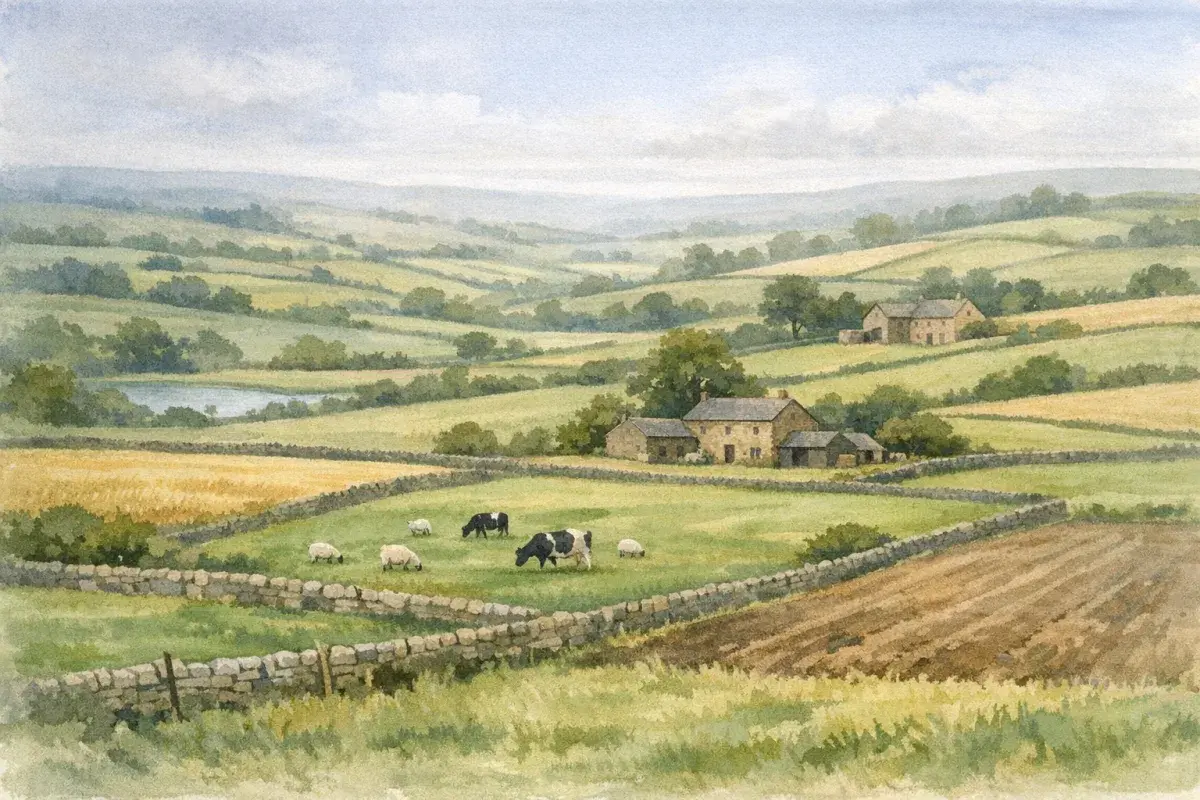
You can walk the same boundary twice and come away with two completely different opinions about a field. One person sees "good, honest land" and another sees "too wet in the spring, too baked in the summer". Agricultural land classification is the UK's attempt to make that conversation more objective, so planners, valuers, lenders, land managers and buyers are talking about the same underlying capability, not just gut feel.
But here's the catch: ALC isn't a single, all-purpose label that answers every question about value, planning or productivity. Used properly, it's a powerful decision tool. Used casually (or copied blindly from an old map), it can send you down the wrong path, especially when you're buying, letting, developing, or arguing a planning case. This guide cuts through what the system actually measures, where the data comes from, and how you can use it confidently in real UK rural property decisions.
What Agricultural Land Classification Is (And What It Is Not)
Agricultural land classification (ALC) is a capability-based grading system used across the UK (with some differences in data availability and mapping) to describe how well land can support agricultural production, based largely on physical factors like climate, soils, slope and wetness.
Think of ALC as answering one core question:
- "How limited is this land for growing crops and grass, and what type of farming does it naturally suit?"
It's not a statement of what you currently do with the land (sheep, arable, hobby equestrian, solar), and it's not a guarantee of yields. It's also not a "value grade", although the market often reacts to it.
Why The ALC Exists And Who Uses It
ALC exists because land is a finite resource, and, particularly in planning, decision-makers need a consistent way to identify the most productive and versatile farmland.
In practice, you'll see ALC referenced by:
- Local Planning Authorities (LPAs) when weighing development proposals
- Land agents and valuers when benchmarking quality and marketability
- Lenders assessing risk and long-term security
- Farmers and farm managers thinking about rotations, drainage spend, or diversification
- Surveyors and consultants preparing site appraisals and planning statements
If you're active in the market, you'll also see ALC crop up indirectly, through pricing guidance, "productive block" language in particulars, or lender questions during due diligence. Where it's relevant, it's worth understanding the underlying logic rather than relying on a single line on a brochure.
ALC Vs Planning Policy, Land Use Classes, And Tenure
ALC is often confused with other "classification" systems that sit beside it.
Key distinctions:
- ALC vs planning policy: ALC feeds into planning decisions, but it doesn't decide them on its own. Policy tests (need, alternatives, landscape, heritage, highways, ecology, flood risk, etc.) still apply.
- ALC vs land use classes: Planning "use classes" and concepts like agriculture, equestrian, B8 storage, or sui generis relate to how land/buildings are used, not what the land is physically capable of.
- ALC vs tenure: Owner-occupied, FBT, AHA, common grazing rights, tenure affects your control and income profile, but it doesn't change the land's physical limitations.
Bottom line: ALC is a capability lens, not a full legal or commercial diagnosis. It's one of the first filters you should apply, not the last word.
How The UK Agricultural Land Classification System Works
The ALC system groups land into five grades, with Grade 3 split into 3a and 3b. The grades reflect the severity of limitations on agricultural use.
The system is widely referenced in England and Wales planning contexts, and the concept of land capability also features in Scotland (although you'll encounter different mapping products and terminology depending on the dataset you're using).
The ALC Grades Explained (1 To 5) And What They Typically Support
A practical way to think about the grades is: as you move from 1 to 5, limitations increase and flexibility decreases.
- Grade 1 – Excellent quality agricultural land
Very few limitations. Typically capable of a wide range of arable and horticultural crops.
- Grade 2 – Very good quality agricultural land
Minor limitations (often climate or soil workability) that slightly reduce flexibility.
- Grade 3 – Good to moderate quality agricultural land
This is where nuance matters:
- Grade 3a is higher quality "good" land with moderate limitations.
- Grade 3b is lower quality "moderate" land with more significant constraints.
- Grade 4 – Poor quality agricultural land
Severe limitations. Often suited to grass production and limited arable in favourable years/locations.
- Grade 5 – Very poor quality agricultural land
Very severe limitations. Generally restricted to rough grazing.
Two important reality checks:
- Management can shift outcomes (drainage, lime, organic matter, cultivation approach), but it won't always shift the underlying limitation the grade is capturing.
- ALC doesn't replace local knowledge. One field might be a joy to travel: the next is a machinery graveyard in a wet spring, yet mapping may show them similarly.
"Best And Most Versatile" (BMV) Land: The Policy Trigger You Need To Know
"Best and Most Versatile" (BMV) land is the label planners use for the higher-quality end of the scale:
- ALC Grade 1
- ALC Grade 2
- ALC Grade 3a
BMV matters because many planning policies expect development to:
- avoid BMV land where possible, and
- justify the loss where avoidance isn't realistic.
If you're considering any non-agricultural use, especially large footprint proposals, ALC can become a policy trigger early. It's one reason you'll see agents, planning consultants, and LPAs ask whether land is 3a or 3b rather than just "Grade 3". That split often decides whether you're in a routine debate… or a much more forensic one.
What Determines ALC Grade On The Ground
ALC isn't a vibe, it's derived from measurable factors. And while the detail is technical, the logic is straightforward: the land is graded by the most limiting factor affecting agricultural use.
Climate, Site Factors, And Microclimate Effects
Climate is a bigger driver than many people expect. Temperature and rainfall patterns influence:
- length of growing season
- risk of late frosts
- trafficability and harvest windows
- ability to establish crops reliably
Then site-specific factors can nudge things further:
- altitude and exposure (windy ridges are rarely kind to spring operations)
- aspect (south-facing slopes can help in marginal areas)
- shelter belts/woodland edges (can reduce exposure but also shade and root competition)
Microclimate is why two farms a few miles apart, same soil series on paper, can farm very differently in practice.
Soils, Drainage, And Wetness Limitations
Soil properties are usually where the story becomes real.
ALC considers things like:
- texture and structure (how workable it is: compaction risk)
- depth (shallow soils limit rooting and water storage)
- stoniness (cultivation difficulty, wear on kit)
- natural drainage and wetness class (how long water sits in the profile)
If you've ever had a field that looks fine in August but dictates your whole spring workload, you've met the wetness limitation. Even with drains, there are sites where the underlying geology, outlets, or soil profile keep the ceiling lower than you'd like.
Slope, Droughtiness, Flood Risk, And Other Physical Constraints
Other constraints commonly driving lower grades include:
- slope: limits machinery use, increases erosion risk, affects safe operations
- droughtiness: soils that can't hold water well (often light/sandy profiles) can burn off fast in dry spells
- flood risk: not just total inundation, frequency and seasonality matter, as well as how quickly land returns to workable condition
- soil erosion susceptibility: can be a major practical constraint where cultivation exposes soil
One useful way to apply this as a buyer or land manager is to ask: "What's the limiting factor here, and can I realistically change it?" Some constraints are improvable (structure, organic matter, some drainage improvements). Others, altitude, exposure, slope, are essentially fixed.
Where To Find ALC Data And How To Interpret It Safely
You can often find ALC information quickly. The trick is knowing whether what you've found is good enough for your purpose.
Natural England Maps And Regional Equivalents: What's Available And What Isn't
In England and Wales, ALC mapping is most commonly encountered via Natural England datasets and legacy mapping. In Scotland, you may find capability-style mapping and soil information through national datasets, but availability and presentation differ.
From a property perspective, you'll usually meet ALC in three places:
- planning reports and agricultural land assessments
- land sale particulars and valuation notes
- constraint maps used in early-stage site selection
Whichever side you're on. Buyers tell AgLand what they're looking for and hear the moment something fits. Owners advertise straight to the buyers who already match, for one flat fee and no commission. Register as a buyer or check your matches.
Limitations Of Mapping: Scale, Age Of Surveys, And Field-By-Field Variability
Here's where people get caught out.
Most readily available ALC mapping is:
- broad-scale (not field-by-field precise)
- based on older survey work in many areas
- not always updated after major improvements (drainage schemes, soil movement, long-term management)
So the map is best treated as a screening tool, good for early filtering, risky for high-stakes decisions.
Common misreads we see:
- assuming a boundary line on a map is exact (it rarely is)
- treating "Grade 3" as automatically BMV (it isn't, 3a vs 3b matters)
- ignoring within-field variability (ridges, hollows, headlands, past compaction, peat lenses)
If you're buying a block with mixed land, it's entirely possible for a single title to include multiple grades, with the "headline" grade masking the operational reality.
When You Need A Site-Specific Survey And What "Detailed ALC" Involves
If ALC could influence a planning outcome, a valuation argument, or the viability of your intended use, you may need a site-specific (detailed) ALC survey.
A detailed ALC assessment typically involves:
- desk study of soils, geology, climate and historic mapping
- field inspection and soil pits/augers
- assessment of wetness, droughtiness, texture, structure, depth and stoniness
- mapping of land quality boundaries across the site
- a written report suitable for planning submission (where relevant)
This isn't a "nice to have" for certain projects. It's often the difference between a credible case and an objection that sticks.
And while ALC is about capability, don't forget the administrative basics when land changes hands. Clean title, mapped boundaries and correct records matter just as much. If you're unsure what's involved, the practical steps in our guide to sorting out agricultural land registration can save you time (and awkward surprises) later.
How ALC Influences Planning, Development, And Change Of Use
ALC is most "visible" when you hit planning. It's one of the quickest ways for an LPA (and consultees) to understand whether a proposal might permanently remove higher-quality farmland from production.
The Planning Balance: Avoiding BMV Where Possible And Demonstrating Need
If your site includes BMV land, you should assume the planning conversation will include:
- can you use lower-quality land instead?
- can you reduce the footprint?
- is the use temporary and reversible?
- what's the overriding need/benefit?
This doesn't mean development is impossible on BMV. It means you'll need a more robust justification and often better evidence.
Equally, if the land is genuinely lower grade (e.g., 3b/4/5), that can strengthen the argument that the proposal minimises loss of productive land, particularly for larger schemes.
Planning is complicated fast, so if your next step is a proposal of any kind, it's worth reading up on the UK process and typical pitfalls in our guide to planning permission on agricultural land.
Common Development Scenarios: Solar, Housing, Farm Diversification, And Minerals
Different development types interact with ALC in different ways.
- Solar PV: Often promoted as temporary and reversible, but you'll still need to address land quality and soil handling. Layout design, access tracks, and substation areas can create permanent impacts. If you're weighing viability, constraints and what planners typically expect, see our overview on installing solar panels on farmland.
- Housing and enabling development: ALC can be one element in the planning balance, but it rarely carries the whole case. Settlement boundaries, highways, services, landscape character and local plan allocations are usually more decisive.
- Farm diversification (yards, storage, workshops, holiday lets): Here, the ALC question is often about whether the proposal consumes productive land unnecessarily, and whether there are existing buildings or poorer-quality corners that do the job.
- Minerals and waste: These schemes can affect soils dramatically. ALC is frequently used to set expectations on soil stripping, storage, restoration and aftercare.
Conditions, Mitigation, And Soil Management Expectations During Construction
Even where development is approved, ALC can shape conditions, especially around soils.
Typical expectations include:
- a soil management plan (stripping, storage, handling in suitable weather)
- protection of topsoil and subsoil horizons (no mixing, no contamination)
- traffic management to avoid compaction
- restoration standards and monitoring where land is returned to agriculture
If you're a landowner, it's worth treating soil as a headline asset in negotiations, because once it's damaged, it's slow and expensive to rebuild. We've seen the best outcomes where the landowner pushes early for competent contractors, seasonal timing, and clear reinstatement obligations written into agreements (not left as hopeful intentions).
How To Use ALC In Buying, Selling, Letting, And Valuation
Outside planning, ALC is a practical way to sense-check whether the land fits your objectives, and whether you're paying (or charging) the right money for the right reasons.
What ALC Signals For Yield Potential, Rotations, And Long-Term Resilience
ALC can help you predict how flexible your farming system can be.
In broad terms:
- Higher grades usually mean more reliable establishment, wider crop options, and better chances of hitting quality specs.
- Mid grades (especially Grade 3) can still be excellent commercial land, but the limitation matters. Wetness-driven Grade 3 land behaves very differently from droughty Grade 3 land.
- Lower grades lean towards grass, grazing and low-input systems, and can suit livestock-focused enterprises well, particularly where soils and slope make arable a constant battle.
Resilience is the modern twist. With more volatile weather, the "limitation" that defines a grade can become more costly:
- Wetness limitations can compress working windows.
- Droughtiness can expose you to establishment failures and yield variability.
So when you're viewing land, don't just ask "what grade is it?" Ask "what's the limiting factor, and what will that cost me over ten years?"
Impacts On Pricing, Rent, Finance, And Lender Due Diligence
Market pricing often reflects land capability, but it's never the only driver. Local demand, block size, access, sporting potential, development hope value, stewardship income, and house/buildings can dominate.
Still, ALC can influence:
- sale price expectations (especially for arable-demand areas)
- rents and tenant appetite
- lending terms and valuation comfort
- how you present land to the market (e.g., emphasising versatility vs livestock suitability)
If you're sense-checking whether an asking price "fits" the local market for that quality of land, use current benchmarks rather than hearsay down the pub. Our regularly updated view of agricultural land prices across the UK is a helpful starting point for that conversation.
And if you're buying with an investor mindset, whether that's long-term capital, farming returns, diversification angles, or natural capital opportunities, ALC is one of the core variables you should capture early. The wider framework in our guide to agricultural land as an investment shows how capability, income and risk tend to interact.
Combining ALC With Other Due Diligence: Water, Access, Rights, And Restrictions
ALC is important, but it won't tell you everything that can make or break a deal.
Alongside ALC, your due diligence should typically include:
- Water: mains availability, private supplies, abstraction positions (where relevant), trough and pipework condition
- Access: legal access, width, visibility splays, weight limits, third-party control of tracks
- Rights and restrictions: public rights of way, easements, wayleaves, sporting rights, covenants
- Environmental constraints: designations, habitats, protected species risk, peat/organic soils sensitivity
- Services and utilities: overhead lines, buried apparatus, grid capacity if you have diversification ambitions
- Boundary certainty: fences, hedges, ditches, responsibility and disputes
If you want a practical, step-by-step way to keep all of that organised, our checklist-style guide on how to buy agricultural land is designed to help you avoid the classic "we'll sort it later" traps.
A final market-insider note: when we speak to agents we work with, the smoothest transactions are the ones where the seller anticipates the buyer's questions, ALC included, and has the documents and context ready. It's not just good practice: it tends to protect your price.
Conclusion
Agricultural land classification is at its best when you treat it like a compass, not a stopwatch. It points you toward what the land is naturally capable of, what will be hard work forever, and what will be easy, until the weather turns.
If you're buying or letting, use ALC to frame the right questions about soil type, drainage, rotations and resilience. If you're planning a development or diversification project, take BMV seriously and get the evidence right early, because "it looked like Grade 3 on a map" won't carry much weight when it matters.
And remember: the most expensive mistakes in rural property rarely come from one big error. They come from stacking small assumptions. ALC helps you remove a few of those assumptions, provided you interpret it carefully, and back it up with proper site knowledge and professional advice when the stakes are high.
Disclaimer: AgLand.co.uk is a UK agricultural land and rural property matching service, where buyers register what they are looking for and owners advertise directly to the buyers who match, and a rural resource hub. Nothing in this text is intended as legal, financial, tax, planning, or investment advice. You should carry out your own due diligence and take advice from appropriately qualified professionals (for example, a chartered surveyor, land agent, solicitor, accountant, or planning consultant) before making decisions.