
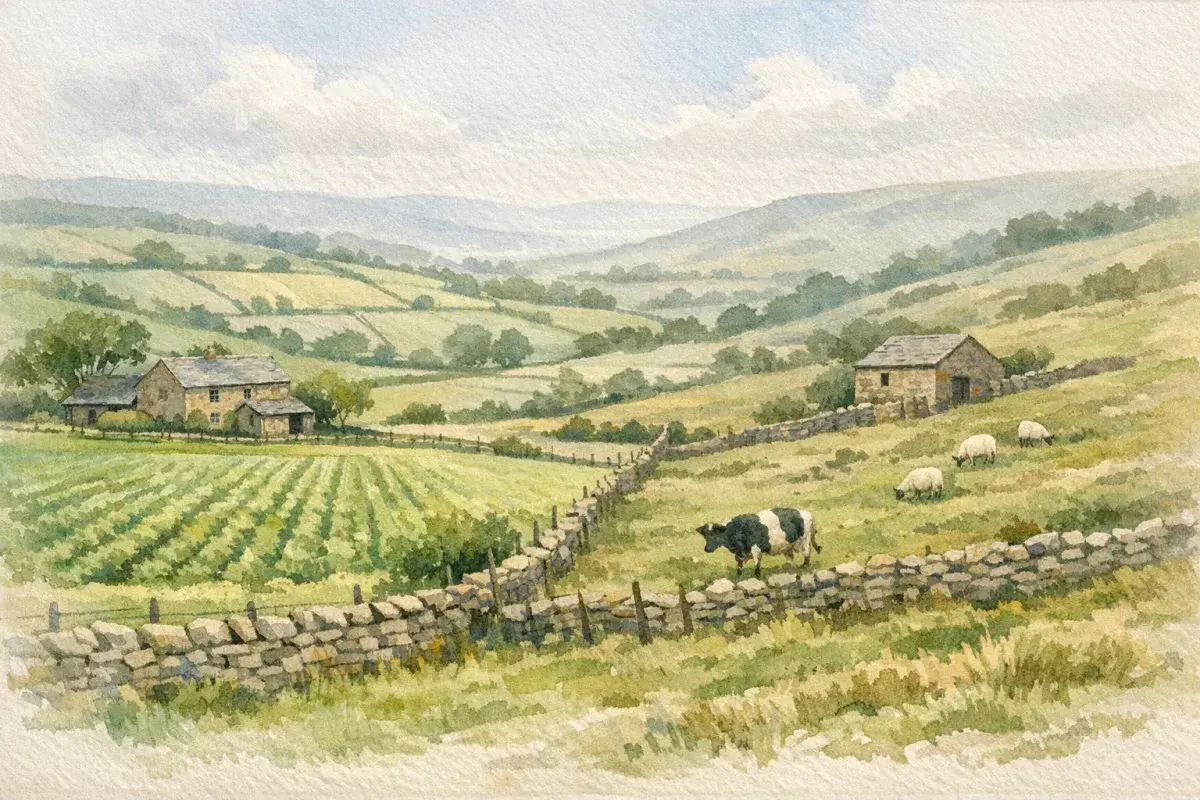
You can stand in two neighbouring fields that look identical, same hedgelines, same slope, same colour of soil after rain, and yet one might be treated as significantly more "capable" land than the other.
That's the practical heart of the difference between Grade 2 and Grade 3 land in the UK. It isn't a beauty contest. It's an evidence-led view of how reliably a site can grow crops (and which ones), how often weather will interrupt field operations, and how much the land's natural limitations will bite in an average year.
If you're buying, renting, valuing, or trying to change the use of a rural holding, the Grade 2 vs Grade 3 question can ripple into everything from rotation choices to the strength of a planning case. This guide keeps it UK-specific, grounded, and decision-focused, especially where Grade 3a becomes a flashpoint.
How The UK Grades Agricultural Land: ALC And What “Grade” Really Measures
In the UK, when people talk about "Grade 2 land" or "Grade 3 land", they're usually referring to the Agricultural Land Classification (ALC) system used in England and Wales. Scotland and Northern Ireland have their own land capability frameworks, but the "Grade 1–5" shorthand you'll hear in sales particulars and planning debates is overwhelmingly ALC-led.
If you want the full backdrop, including where "maps mislead" and why two reports can disagree, our deeper explainer on how the ALC system is used in practice is worth reading once you've got the basics below.
Agricultural Land Classification (ALC) In Plain English
ALC grades land from 1 (best) to 5 (poorest) based on the physical characteristics that affect agricultural use. The key idea is versatility and consistency:
- Higher grades can grow a wider range of crops, more reliably, with fewer "lost" days to wetness/drought/soil workability.
- Lower grades are more restricted, maybe by climate (upland exposure), soil wetness, stoniness, droughtiness, steepness, or shallow depth.
A crucial nuance: ALC is about the inherent capability of the land, not how well it's currently farmed. Great management can improve performance, but it doesn't rewrite the underlying limitations that ALC is trying to capture.
The Main Factors Behind A Grade: Climate, Site, Soil, And Limitations
ALC grading is built around a fairly down-to-earth question: what stops you using this land well, and how often does it stop you?
Surveyors and consultants typically consider:
- Climate (temperature, rainfall, exposure, length of growing season). In marginal areas, climate alone can cap the grade.
- Site (slope, aspect, altitude, risk of flooding, and how machinery can operate safely and on time).
- Soil (texture, depth, structure, stoniness, organic matter, and critically how water behaves in the profile).
- Limitations that flow from the above:
- Wetness limiting trafficability and root development
- Droughtiness limiting yield consistency
- Workability (how often the soil is "fit")
- Erosion risk on lighter or sloping soils
If you're trying to orient yourself quickly, it can help to read the wider land grading system UK overview and terminology in this plain-English guide, especially if you're comparing agent descriptions across regions.
Grade 2 Land Explained: Characteristics, Capabilities, And Typical Uses
Grade 2 is commonly described as very good quality agricultural land. In practice, it tends to mean you've got land that's productive and flexible, but not quite as "bulletproof" as Grade 1.
Grade 2 often performs like the sort of land you'd happily build a serious arable or high-output mixed system around, provided you respect the limitations that keep it from Grade 1.
What Grade 2 Usually Supports (Cropping Range And Yields)
On many Grade 2 blocks, you can typically support:
- A broad range of cereals (winter wheat, barley, oats)
- Oilseed rape where regionally appropriate and agronomically sensible
- Field beans/peas depending on soil type and structure
- Potatoes, sugar beet, vegetables in some areas, though whether that's realistic often comes down to local climate, access to irrigation, and the specific soil series (not just the grade label)
The hallmark is choice. In an average year, Grade 2 is more likely to let you:
- drill on time,
- travel with fewer ruts and compaction events,
- harvest with fewer weather-driven compromises.
That doesn't automatically mean the "best returns" (cropping decisions are market-led), but it tends to mean you've got options, and options matter when input prices or policy support shifts.
Common Constraints Still Seen On Grade 2 (Workability, Droughtiness, Wetness)
So why isn't it Grade 1?
Grade 2 often carries one or more meaningful constraints, such as:
- Soil wetness: heavier profiles that hold water and shorten the workable window in spring or autumn. You can still farm it well, but timing gets tighter.
- Workability issues: soils that are structurally sensitive, easy to damage if you push on when it's marginal.
- Droughtiness: lighter land that can burn off in a dry June/July, trimming yield potential without irrigation or moisture-conserving establishment.
- Localised stoniness or variable depth: not enough to downgrade the whole block further, but enough to cap its "very best" status.
One of the most common real-world misunderstandings is assuming Grade 2 equals "problem-free". It's more like: high-performing land that still asks you to be disciplined, about drainage maintenance, controlled traffic where relevant, organic matter strategy, and not forcing operations when the land says "not today".
Grade 3 Land Explained: Why It’s Split Into 3a And 3b
Grade 3 is where things get interesting, because it covers a broad band of land quality, and the UK planning system treats part of it very differently.
In ALC terms, Grade 3 is split into:
- Grade 3a: good quality agricultural land
- Grade 3b: moderate quality agricultural land
That single letter can materially change how a site is discussed in planning, and how it's perceived by buyers and lenders.
Grade 3a Versus 3b: Practical Differences On The Ground
Think of Grade 3a as land that can still deliver a fairly wide arable rotation most years, while Grade 3b is more often pushed towards grass, forage, or simpler arable options because its limitations bite more frequently.
Typical reasons land lands in 3a rather than 2 might include:
- slightly shorter workable windows due to wetness risk,
- more variable soil depth across the block,
- a bit more climatic exposure,
- droughtiness that's more yield-limiting in a "normal" dry spell.
For 3b, the constraints are usually more decisive:
- heavier wetness and trafficability limits (you lose more days),
- shallower soils or stronger stoniness,
- greater slope/erosion risk,
- more pronounced climatic limitation.
From a farming point of view, the difference often shows up in how confident you feel committing to higher-cost crops. If you've been caught with late drilling three autumns out of five, you start designing a system around reality.
Typical Farming Systems On Grade 3 (Arable, Mixed, And Grassland)
Grade 3 land can be highly productive, especially in strong farming regions with good infrastructure and know-how, but it's commonly used in ways that reflect risk and seasonality.
You'll often see:
- Arable on the stronger parts (particularly 3a) with rotations built to cope with delayed establishment
- Mixed systems where livestock and forage crops provide flexibility when conditions don't suit fieldwork
- Permanent pasture or long leys on 3b where soil wetness or topography makes repeated cultivations a false economy
Plenty of excellent businesses run on Grade 3. The point is that the land itself is more likely to dictate the plan, rather than you dictating the plan to the land.
And when someone says "it's Grade 3", your next question should be: 3a or 3b, and what evidence backs that up?
Grade 2 Vs Grade 3: Side-By-Side Differences That Affect Decisions
If you're deciding what to pay, what to plant, or how to justify a change of use, you're rarely debating grade in the abstract. You're really debating risk, reliability, and flexibility.
Here's where Grade 2 and Grade 3 typically separate in day-to-day decisions.
Cropping Flexibility, Timeliness, And Risk In Different Seasons
A practical way to view it:
- Grade 2 usually gives you a wider choice of crops and establishment methods with fewer "gambling" moments.
- Grade 3 (especially 3b) asks you to plan around disruption, late harvests, wet autumns, spring catch-up, and the knock-on effects that can have on rotation and blackgrass/control strategies.
In the UK, the last few seasons have hammered home how expensive poor timeliness can be:
- A wet autumn can mean delayed drilling, higher seed rates, more spring cropping, and yield penalties.
- A dry late spring can expose droughty soils quickly, turning what looked like a decent crop into a variable one across the field.
Grade 2 isn't immune. But it's more likely to give you workable windows that align with modern machinery and contracting availability.
Inputs And Infrastructure: Drainage, Irrigation, Tracks, And Storage
This is where a lot of buyers get caught: land grade is only half the story: the enabling infrastructure can tilt the economics either way.
Consider how Grade 2 vs Grade 3 can shift spending priorities:
- Drainage: Grade 3 land with wetness limitations may justify a more aggressive drainage and outfall strategy, if it's feasible and cost-effective. But if you're buying in an area with limited outfall rights or sensitive watercourses, you need to be realistic.
- Irrigation: On droughty soils, access to water (and abstraction licensing constraints) can be worth more than an incremental change in ALC grade.
- Access and tracks: If you can't get on and off fields without damage, your workable window effectively shrinks.
- Grain storage and handling: Higher-output systems need reliable logistics. Sometimes a Grade 3 block next to your existing yard is operationally "better" than a remote Grade 2 block that forces you into inefficient haulage.
So yes, grade matters. But when you're weighing a purchase or tenancy, you're really asking: what does this land demand from me in capex, time, and risk budget?
How Grade 2 And Grade 3 Influence Planning, Development, And Change Of Use
In UK planning, agricultural land quality becomes most visible when land is proposed for development or a non-agricultural use, because policy often pushes decision-makers to avoid unnecessary loss of the best land.
This is where the Grade 2 vs Grade 3 conversation can become more than a farming debate.
Best And Most Versatile (BMV) Land And Why Grade 3a Is A Planning Flashpoint
In England and Wales, Best and Most Versatile (BMV) agricultural land generally means Grades 1, 2 and 3a.
That matters because planning policy (including the NPPF in England, and equivalent policy approaches in Wales) typically expects BMV land to be protected where possible, especially from significant development that would take it out of agricultural use.
So the big pressure point is often:
- If a site is Grade 3a, it's treated as BMV.
- If it's Grade 3b, it's not BMV.
In other words, 3a vs 3b can influence:
- whether an alternative site should be preferred,
- how strong the justification must be,
- what mitigation/compensation arguments get explored.
Grade 2 land, being BMV, tends to face even more scrutiny in that context.
What Councils And Consultants Typically Look For In ALC Evidence
Local Planning Authorities don't just take "Grade 3" at face value, particularly if the proposal is contentious.
Common expectations include:
- Clarity on data sources: Is it based on old published mapping, a desk study, or a site-specific ALC survey?
- Appropriate methodology: ALC work is technical: councils often expect it to follow recognised guidance and be proportionate to the decision at hand.
- Seasonal context: Some aspects (like soil wetness class) can be misread if fieldwork happens at the wrong time.
- Transparent soil descriptions: Pits, auger borings, texture, depth, stoniness, mottling, permeability, written up in a way that another professional can interrogate.
If you're trying to anticipate these issues early, either to protect the agricultural value of your holding or to reduce planning risk, start by getting comfortable with how ALC is determined and checked. A practical next step is to review how to verify an agricultural land grade so you know what's credible evidence and what's just a map screenshot in a PDF.
One more reality check: ALC grade is influential, but it's rarely the only planning consideration. Ecology designations, heritage constraints, access safety, flood risk, landscape policy, and local plan allocations often carry equal or greater weight.
Buying Or Renting: How To Verify The Grade And Avoid Costly Assumptions
If you're buying or renting land, the most expensive mistake is assuming the grade from a listing line, a neighbour's comment, or a broad-brush map layer.
ALC is a helpful framework, but it's also easy to misuse if you don't understand where the numbers came from.
Where The Data Comes From (ALC Maps, Farm Records, And Desk Studies)
You'll typically encounter a few different "levels" of information:
- Published ALC maps: useful for context, but often too coarse to reflect within-field variation, especially on mixed geology.
- Farm records: yield maps, cropping history, drainage plans, and input records can reveal the practical limitations ALC is trying to capture.
- Desk studies: consultants might blend mapping, geology, soilscapes, rainfall datasets, and local knowledge to estimate likely grade before fieldwork.
The strongest approach is triangulation. If a map suggests Grade 2 but your yield history shows chronic drought stress, you don't ignore the yield history, you investigate.
Whichever side you're on. Buyers tell AgLand what they're looking for and hear the moment something fits. Owners advertise straight to the buyers who already match, for one flat fee and no commission. Register as a buyer or check your matches.
When You Need A Site Survey: Sampling, Pits, And Seasonal Timing
A site-specific ALC survey isn't always necessary, but you should consider it when:
- the 3a vs 3b line could change planning sensitivity or valuation,
- the holding is borderline and you're making a high-stakes decision,
- there's obvious variability (soil changes across the parcel, wet corners, shallow ridges),
- you're banking on a particular cropping plan that needs reliable workability.
What "good" looks like in practice:
- Enough observation points: a couple of token holes won't represent a 50-acre field with three soil types.
- Proper logging: texture, depth, structure, drainage indicators, restrictive layers.
- Timing that makes sense: assessing wetness limitations in the middle of a dry spell is tricky: equally, judging structure when it's saturated can be misleading.
If you're renting, it's also worth aligning expectations in writing: who maintains drainage? what's the policy on subsoiling? can you reseed? what about environmental schemes? Grade isn't the only risk, ambiguity is.
What Grade Means For Price, Finance, And Long-Term Strategy
Land grade influences value because it influences earning power and risk, but it doesn't set a universal price tag. In the real UK market, two Grade 3 blocks can sell at very different £/acre depending on where they are and what they unlock.
If you want a reference point on the top end of the market, it can be useful to look at how premium land behaves. For context, see AgLand's analysis of what tends to drive the strongest values for top-grade arable, not because you're buying Grade 1, but because it clarifies what buyers pay extra for (and what they don't).
Valuation Drivers Beyond ALC: Location, Blocks, Access, And Entitlements
In practice, valuers and buyers often weight these factors alongside grade:
- Location and local demand: proximity to established farming businesses, strong contracting networks, and competitive tenant demand can buoy prices.
- Block size and shape: one clean block often outvalues fragmented parcels, even if the fragmented land is slightly better on paper.
- Access: road frontage, visibility, gateways, and whether HGV/tractor movements are realistic.
- Services and buildings: water, power, sheds, yards, sometimes a "worse" grade with the right infrastructure outperforms.
- Tenure and terms: vacant possession vs tenanted, length of term, rent review clauses.
- Scheme compatibility: environmental opportunities and constraints can change the net picture (but they don't magically erase soil limitations).
And don't ignore the bigger land-use price conversation. The gap between agricultural values and any form of residential/hope value can distort expectations, so it's worth reading a grounded comparison of how agricultural values differ from residential pricing dynamics if you're modelling long-term scenarios.
Risk, Resilience, And Futureproofing Under Weather And Policy Change
Where Grade 2 generally "wins" is resilience: in many regions it offers a better probability of hitting target drilling dates, carrying higher-value crops, and achieving consistent output.
Where Grade 3 can still shine is in strategic fit:
- It may integrate better with livestock, grazing, forage, or regenerative approaches where soil cover and flexibility matter more than absolute cropping range.
- It can be a smarter buy if it adjoins your existing unit and reduces overheads.
- It may offer environmental upside, provided you're realistic about what the land can actually deliver.
Weather volatility is now a core business variable. A grade label can hint at vulnerability (wetness vs droughtiness), but your futureproofing comes from decisions like:
- building organic matter and soil structure,
- maintaining drainage and gateways,
- adapting rotations and establishment,
- investing in the right kit (or partnering with the right contractors),
- using data to understand variability rather than averaging it away.
One quiet truth we see again and again: the best operators don't buy "Grade 2" or "Grade 3", they buy a specific set of limitations they know how to manage.
Conclusion
The difference between Grade 2 and Grade 3 land in the UK comes down to reliability and versatility. Grade 2 is typically the safer bet for wide cropping choice and consistent timeliness: Grade 3 is broader, more variable, and often more honest about the constraints you'll be managing, especially where it falls into 3b.
If you take one practical step after reading this, make it this: don't rely on a single label. Treat grade as a starting point, then validate it against soil evidence, field performance, and the operational realities of your system. That's how you avoid paying Grade 2 money for Grade 3 risk, or missing a smart Grade 3 opportunity because someone used "moderate" as a throwaway line.
Disclaimer: AgLand.co.uk is a UK agricultural land and rural property matching service, where buyers register what they are looking for and owners advertise directly to the buyers who match, and a rural resource hub. Nothing in this text is intended as legal, financial, tax, or investment advice. You should do your own due diligence and seek guidance from appropriately qualified professionals (for example, a chartered surveyor, agricultural valuer, planning consultant, solicitor, or tax adviser) before making decisions.