
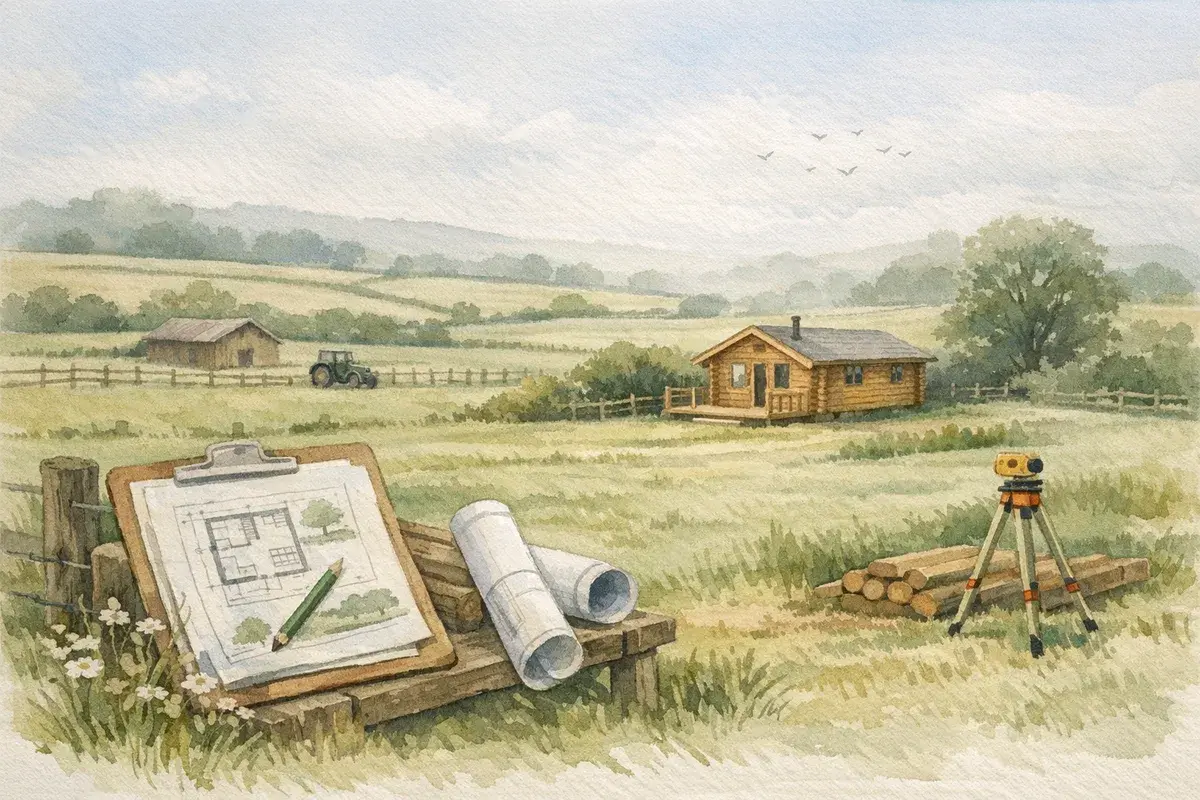
If you're wondering about planning permission for log cabin on agricultural land, the short answer is: usually yes, unless a very specific exemption applies. The detail matters, though, because use class, siting, design, and intended occupation can all change the outcome.
A log cabin on farmland is rarely treated as a simple garden structure. In most cases, planners look at whether it's for agricultural use, a temporary rural worker's dwelling, tourist accommodation, or a residential home in disguise. That distinction is everything.
We'd argue the safest approach is to assume permission is needed until proven otherwise. Why? Because enforcement on rural land can be swift, costly, and awkward to unwind, especially where a cabin has already been installed. In counties with strong landscape protections such as the Lake District, parts of North Yorkshire, Exmoor, and many areas in Devon or Shropshire, the bar can be even higher.
When Planning Permission Is Needed For A Log Cabin
On agricultural land, a log cabin is generally classed as operational development, which means it needs planning permission unless it clearly falls within permitted development rights. Those rights are limited, and they do not automatically apply just because the land is in agricultural use.
The main test is what the cabin will be used for. A storage shelter for tools may be viewed differently from living accommodation, a holiday let, or an office. If there is sleeping, cooking, bathing, and year-round occupation, planners will almost certainly treat it as a dwelling rather than a temporary structure.
Common Triggers For Permission
These are the situations where permission is usually required:
- Residential use: any cabin intended as a home, annexe, or permanent living space.
- Tourist use: holiday lets, glamping cabins, or short-stay accommodation.
- Visible siting: larger cabins in open countryside, especially in AONBs (Areas of Outstanding Natural Beauty) or National Parks.
- New services: where water, foul drainage, power, or access tracks are needed.
- Change of use: where the land use shifts from farming to mixed or non-agricultural occupation.
There is also the practical matter of size. A small timber building might look modest, but if it is fixed to the ground and used for accommodation, size alone won't rescue it. The local planning authority will look at function, permanence, and impact on the rural scene.
Permitted Development Rights On Agricultural Holdings
Agricultural holdings can benefit from some permitted development rights, but they're far narrower than many owners expect. For example, certain farm buildings, tracks, and small extensions may fall within agricultural rules, but a cabin used as a dwelling usually won't.
Even where a structure is technically temporary, planners may still consider it development if it stays in place long enough or has a clear residential purpose. A good rule of thumb? If you'd be unhappy explaining it in writing to a planning officer, get advice first.
Agricultural Use, Ancillary Use, And Rural Living
The phrase ancillary use crops up a lot, and it's worth understanding. An ancillary building supports the main approved use of a site. If a farmhouse already has lawful residential use, a cabin in the garden might be ancillary. On open agricultural land, though, the argument is much weaker.
For landowners and farmers, the biggest issue is proving the cabin is genuinely tied to farming. A lambing shed with a small welfare room is not the same as a shepherd's holiday lodge. Likewise, an office for farm administration may be easier to justify than a self-contained studio with a separate postcode vibe (yes, planners notice these things).
Rural Workers' Dwellings
In some cases, a new dwelling on agricultural land can be justified if there is a proven essential need for a rural worker to live on site. This is often assessed under strict occupancy tests, including the viability of the farm business, the functional need for someone to be present at unsociable hours, and whether the need could be met elsewhere.
These applications are heavily evidence-led. Livestock units, ring-fenced dairy operations, and remote hill farms are more likely to have a case than low-intensity arable land with easy road access. Even then, the dwelling is usually expected to be modest and closely linked to the business.
Temporary Versus Permanent Structures
Some owners hope a cabin can be treated as a temporary structure to sidestep full permission. That can work in very limited cases, but only if the structure is truly temporary, the period is limited, and the planning authority accepts the need.
Temporary use is not a magic label. A cabin on pads, skids, or a chassis may still count as development if it is used like a permanent building. As ever, use beats appearance.
How To Approaching The Planning Process
Before spending money on a log cabin, it is sensible to establish the planning status of the site. Start with the local development plan, any restrictive designations, and whether the land has an agricultural occupancy condition or other covenant-like constraint on an existing holding.
Pre-application discussions can be worthwhile. They do not guarantee approval, but they can expose red flags early, such as flood risk, visibility splays, landscape sensitivity, or highways concerns about access from narrow lanes. In rural counties like Cumbria, Herefordshire, and parts of Norfolk, access and landscape impact are frequent sticking points.
Documents You’ll Usually Need
A strong submission normally includes:
- Site plan: showing the cabin, access, boundaries, and nearby buildings.
- Design statement: explaining scale, materials, and why the cabin fits the landscape.
- Justification: especially if arguing agricultural need or rural worker occupancy.
- Drainage details: foul drainage and surface water management.
- Transport access: visibility, parking, and any track improvements.
If the cabin is intended for holiday use, the planning case changes again. Councils will often look for evidence that the business is viable, that the design is in keeping with the countryside, and that it will not create an isolated residential unit outside policy.
| Use Case | Typical Planning Position | Key Risk | As Of |
|---|---|---|---|
| Tool store or agricultural shelter | May be allowed if genuinely agricultural | Misuse as accommodation | June 2026 |
| Holiday cabin or glamping pod | Usually requires permission | Noise, traffic, landscape impact | June 2026 |
| Rural worker's dwelling | Possible with strong evidence | Occupancy restrictions and refusal | June 2026 |
| Permanent home on farmland | Normally needs full permission | Policy conflict and enforcement | June 2026 |
As of June 2026, the planning climate remains cautious on countryside residential development, especially where proposals could be seen as speculative. That's true across much of England, and even more so in protected landscapes and Green Belt-adjacent locations.
Regional Differences Across England, Scotland, Wales, And Northern Ireland
Rules are not identical across the UK, and local policy matters a great deal. In England, most decisions sit with the local planning authority, but national policy strongly discourages unnecessary new homes in open countryside. That makes a cabin on agricultural land a harder sell in many districts.
In Wales, landscapes with statutory protection, including National Parks and AONBs, are tightly controlled, and rural tourism proposals can face robust scrutiny. Scotland has different planning terminology and stronger local variation, while many rural authorities will focus on landscape effect, flood risk, and road access. Northern Ireland also has its own planning framework, with sensitive handling of countryside dwellings and tourism units.
County-Level Practical Realities
Some counties are routinely tougher than others because of designation density and land values. For example, parts of Devon, Cornwall, Kent, Sussex, Northumberland, and Wiltshire combine strong demand with varying degrees of rural protection, so a cabin that looks acceptable on paper may still struggle in committee.
By contrast, a well-justified agricultural building on a working farm in a less sensitive part of Lincolnshire or East Yorkshire may find the process more straightforward, provided access, drainage, and use are properly evidenced. The location doesn't guarantee success, but it absolutely shapes the discussion.
One final point: politicians and planning committees often respond differently to tourism, diversification, and housing need. A cabin pitched as farm diversification may be viewed more favourably than one that looks like a back-door house build. The branding matters, but only if the facts support it.
Costs, Timescales, And Common Pitfalls
Planning itself is only part of the cost. You may also need ecology surveys, drainage tests, design work, access drawings, and agent or consultant fees. For a modest rural cabin scheme, professional costs can mount quickly, especially where a resubmission or appeal becomes necessary.
As of June 2026, local planning fee levels and consultant charges vary widely, so it's wise to budget conservatively. A simple application may move in months, but complicated rural proposals can take much longer if revisions, neighbour objections, or committee referral come into play.
Typical Pitfalls To Avoid
These issues cause avoidable refusals:
- Poor justification: assuming a cabin can be built because the land is agricultural.
- Wrong use description: understating residential or tourist occupation.
- Weak siting: placing the cabin in a highly visible field edge position.
- Missing drainage details: especially where no mains sewer exists.
- Unclear access: ignoring visibility, turning space, or emergency vehicle access.
There is also the problem of buying or installing first and asking later. That is risky. If the local authority decides the cabin is unauthorised development, you could face enforcement action, retrospective application costs, and in some cases removal.
If you're buying agricultural property with cabin potential, ask about planning history, any prior refusals, and whether the land has ever carried holiday or residential use. Many estates and farm parcels are sold with optimism baked in, but optimism is not consent.
Conclusion
The key point is simple: planning permission for log cabin on agricultural land is usually required unless the proposal is clearly tied to an exempt agricultural purpose and meets the planning rules in your area. The finer points, from occupancy and siting to drainage and landscape impact, will often decide the outcome.
For farmers, landowners, and rural investors, the safest route is to check the policy position early and build a proper case before any money is spent on construction. In the countryside, good paperwork is often worth as much as good timber.
Disclaimer: AgLand.co.uk is a UK agricultural land and rural property matching service, where buyers register what they are looking for and owners advertise directly to the buyers who match, and a rural resource hub. Nothing in this text is intended as legal, financial, or investment advice. You should carry out your own due diligence and seek guidance from appropriately qualified professionals (for example, solicitors, land agents, surveyors, and financial advisors) for your specific circumstances.