
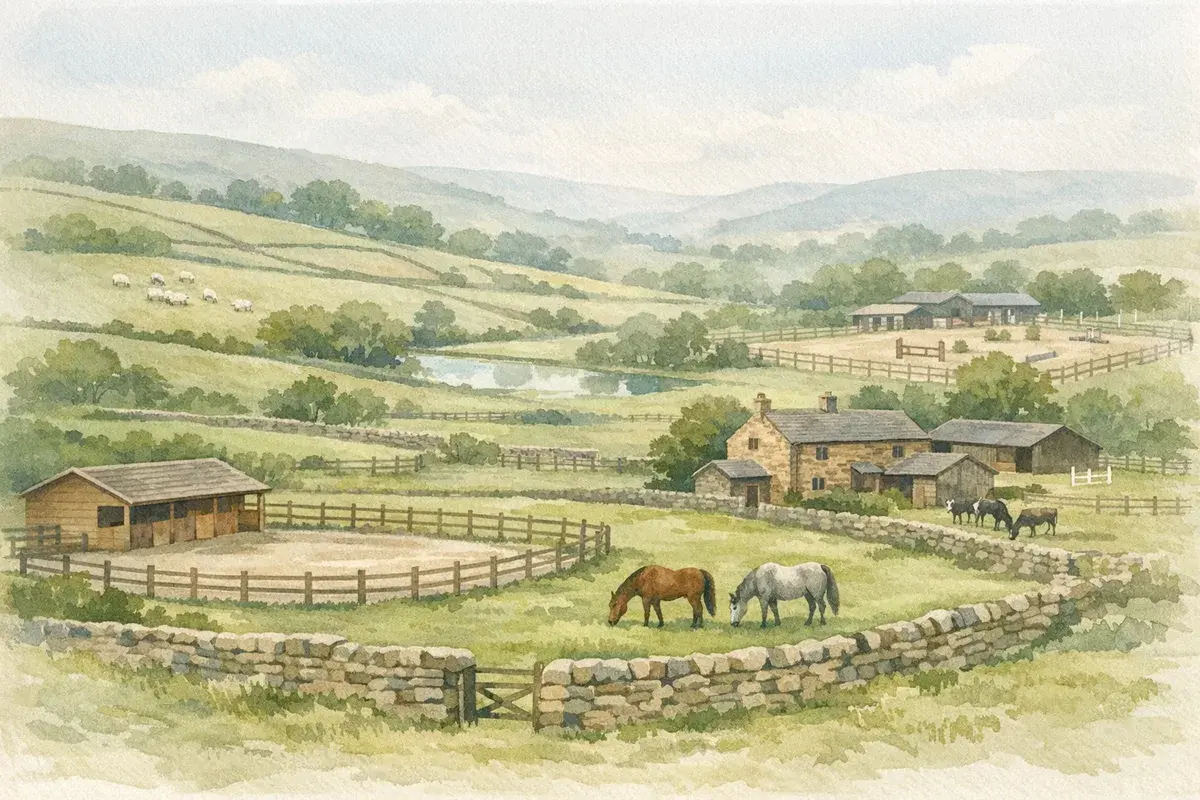
You've found it: a neat block of land, decent access, maybe even a handful of stables, and the listing says "planning permission in place". Great. But in the UK, equestrian land with planning permission is one of those phrases that can mean anything from "lawfully used for private grazing" to "fully consented commercial yard with an arena, lighting, parking, drainage strategy, and conditions already discharged".
The difference matters because planning status affects everything: what you can build, how you can run the site, whether lenders and insurers will engage, and what happens if a neighbour complains. And unlike buying a standard house, you're often dealing with multiple "moving parts" at once, use class, access, drainage, biodiversity, rights of way, and (quietly) enforcement risk.
This guide is written for UK buyers who want to act confidently: what equestrian land means in planning terms, which permissions are common, what conditions trip people up, and how to verify what's actually been approved before you spend serious money.
What “Equestrian Land” Means In UK Planning (And Why It Matters)
In everyday conversation, "equestrian land" often just means "land where horses live". Planning isn't quite so relaxed.
In the UK, the planning system cares about use. And with horses, the use can flip from agricultural to equestrian surprisingly quickly, sometimes without the owner realising they've crossed a line.
Agricultural Vs Equestrian Use Class: The Practical Difference
Broadly:
- Agricultural use usually covers grazing that's part of farming, or grazing that is genuinely agricultural in character (including grazing livestock).
- Equestrian use is generally treated as a recreational/leisure activity (and hence not "agriculture" for planning), particularly where the land supports riding, schooling, exercising, jumps, an arena, or stable-yard infrastructure.
Why you should care: if a parcel is being marketed as equestrian but is only lawful for agricultural grazing, you may need a change of use before you can add a manege, run a livery, or even use it in a way the council deems equestrian.
If you want a deeper grounding in how councils draw that line, it's worth reading AgLand's guide to planning rules on agricultural land (particularly the parts about when "agricultural" stops being a safe label).
Private Leisure Horses, Livery, Riding Schools, And Training Yards
Not all horse-related land is equal in planning terms:
- Private leisure horses (a couple of your own horses, basic grazing, minimal structures) is often the least contentious, until you add an arena, floodlights, or regular horsebox traffic.
- DIY/assisted/full livery tends to bring commercial intensity: staff/clients, deliveries, muck collection, and parking requirements.
- Riding schools and training yards raise additional issues: hours of operation, noise, lighting, highway safety, welfare facilities, and (often) a stronger need for formal consents.
The key concept is intensity. Councils aren't usually counting your horses for fun, they're assessing impacts: traffic, amenity, drainage, and landscape character.
Material Change Of Use: When Grazing Becomes Equestrian
People get caught out here. A field with horses in it isn't automatically equestrian in planning terms, but add the "supporting activity" and it can become a material change of use.
Common triggers include:
- Installing stables, feed stores, wash-down areas, or a defined yard
- Creating an arena/manege, jumps, schooling areas, or a track system
- Laying hardstanding for turnout, parking, or winter use
- Increasing traffic: instructors, liveries, farriers, vets, clients
If your plan is to buy a plot and keep it simple, start by understanding what makes land function well for horses on the ground, not just on paper. AgLand's practical notes on grazing land for horses are a good "reality check" alongside the planning side.
Common Types Of Planning Permission On Equestrian Land
When sellers say "planning permission", it's your job to find out what kind, and what it actually covers.
In UK equestrian deals, permissions usually fall into a few familiar buckets. Some are straightforward: some look fine until you notice the boundary plan only covers half the paddocks, or the arena is approved without lighting, or the access was never built to the spec shown.
Change Of Use To Equestrian And Ancillary Development
A typical consent might be:
- Change of use of land from agricultural to equestrian, often described as "grazing of horses and keeping of horses for private use", sometimes with "incidental schooling".
- Permission for ancillary structures: stables, tack/feed rooms, hay storage, maybe a WC or small welfare block.
The wording matters. "Private use" is very different from "commercial livery". If your business plan includes liveries, lessons, clinics, or hiring the arena out, you need permission that supports those activities (or a strategy for applying).
If you're specifically in the early stages of buying land for horses, AgLand's guide on buying land for horses in the UK is helpful for matching your intended use to what's typically acceptable in rural policy.
Stables, Manege/Arena, Field Shelters, And Hardstanding
These are the usual "wish list" items, and also where councils get precise.
- Stables: location, design/materials, drainage, manure storage, proximity to neighbours.
- Manege/arena: levels, surface build-up, drainage outfall, lighting (often a separate battle), and visual impact.
- Field shelters: sometimes tolerated: sometimes treated as development needing consent, depending on permanence and positioning.
- Hardstanding: frequently underestimated. Councils care about runoff, appearance, and whether hardstanding becomes a yard that intensifies use.
A common pattern we see: a site has consent for stables, but the arena was built later "because everyone does it". That's fine right up until a complaint triggers a planning investigation.
Access, Lighting, Drainage, And Parking: The Hidden Dealbreakers
Even when the horse facilities look modest, these issues can make or break the permission (and your ability to use it comfortably):
- Access design: width, surfacing, passing places, visibility splays, and whether horseboxes can turn without reversing onto a lane.
- Lighting: floodlights can be heavily conditioned or refused, especially near homes, dark skies areas, or sensitive landscapes.
- Drainage: arenas and hardstanding create runoff: councils may require attenuation, soakaways, or a specific discharge route.
- Parking and turning: if you can't keep vehicles on site, you can end up with conditions you can't practically comply with.
If you're coming from an agricultural angle (barns, tracks, yards), a lot of the logic overlaps. AgLand's guide to planning permission for farm buildings is useful for understanding how councils think about siting, access, and "functional need", even though equestrian is assessed on its own merits.
Planning Conditions, Legal Agreements, And Restrictions To Watch
Planning permission is rarely a blank cheque. Most equestrian consents come with conditions, and those conditions can be the difference between a workable yard and a site that's permanently "almost right".
Treat conditions like part of the property, not paperwork. You're buying the obligations too.
Occupancy Ties, Personal Permissions, And Time Limits
You'll most commonly encounter:
- Time limits: standard implementation deadlines (often 3 years). If the permission wasn't started lawfully in time, it may have lapsed.
- Personal permissions: occasionally, a consent is tied to a named person. These are unusual but not unheard of in rural cases.
- Occupancy ties: less common on equestrian-only land than on rural dwellings, but you might see restrictions linked to an on-site dwelling or staff accommodation.
If a site includes a house or a proposal for one, be cautious. Equestrian need is not automatically accepted as "essential rural worker" need. You'll want specialist advice early.
Use Restrictions: Numbers Of Horses, Commercial Limits, Event Bans
This is where dreams meet reality.
Common restrictions include:
- A cap on the number of horses kept on the land
- "Private use only" wording that effectively bans livery, lessons, or arena hire
- Limits on operating hours and deliveries
- Prohibitions on events, shows, clinics, or amplified sound
Ask yourself: if you can't do lessons, can your model still work? If you can't host clinics, is the arena still worth building? It's better to discover this on page two of a decision notice than after you've signed.
Biodiversity, Landscaping, Highways, And Noise Conditions
Modern consents increasingly lean on environmental and neighbour impacts:
- Landscaping: hedge planting, tree belts, maintenance periods, and replacement clauses
- Highways: visibility splays must be kept clear: gates may need to open inwards: sometimes there are limits on surfacing materials
- Noise and lighting: angles, timers, lux limits, and "no lighting outside X hours" conditions
- Biodiversity: habitat protection, timing of works, invasive species controls, and (in some cases) measurable net gain requirements
None of this is "just admin". If you can't comply, you can't safely use the permission, and that can spook lenders and insurers, even if enforcement never happens.
How To Verify Planning Before You Offer (A Due-Diligence Checklist)
If you take nothing else from this guide, take this: verify first, negotiate second, offer last.
On equestrian land with planning permission, the risk isn't only "no permission". It's "permission exists, but not for what you think, not for all the land, not built to the plans, or not lawful because conditions were never discharged".
Which Documents To Ask For: Decision Notices, Approved Plans, Discharge Of Conditions
Ask the seller/agent for a full planning pack, not a screenshot.
Your minimum list:
- The decision notice (the permission itself) and any appeal decisions
- The approved plans (site plan, elevations, drainage, access drawings)
- Evidence of discharge of conditions (formal council letters), especially for highways, drainage, and landscaping
- Any subsequent variations (Section 73 applications), amendments, or non-material changes
If something important is conditioned "before commencement" and wasn't discharged, you may be looking at a technical breach, even if the site has been operating quietly for years.
How To Search The Council Planning Portal And Map Site Boundaries
Don't rely on what's printed in a brochure. Do your own cross-check:
- Find the application on the local authority planning portal
- Download the location plan and block plan
- Compare the red-line boundary to the title plan and to what you've actually viewed on site
You'd be surprised how often the arena is approved on one parcel, but the turnout paddocks you assumed were included sit outside the boundary. That's not fatal, but it changes what's lawful.
Also check for refusals. A previous refusal for lighting, access, or a dwelling can tell you what the council is likely to push back on again.
Lawful Development Certificates, Breach Risk, And Enforcement History
If existing uses or structures aren't clearly covered by permission, ask whether there's a:
- Lawful Development Certificate (LDC) for existing use or operations
- Certificate of Lawfulness of Proposed Use/Development for something you plan to do without full consent (where applicable)
Then ask the blunt questions:
- Has the council ever contacted the site about enforcement?
- Are there complaints on record?
- Was anything built differently from the approved plans?
If the land has moved from agricultural grazing into equestrian activity over time, you may need to understand whether a formal change of use route was followed, or whether the current setup is running on assumption.
Practical tip: get your solicitor to request a thorough planning history and raise targeted enquiries. And if the site is commercially important, a planning consultant's "health check" is often money well spent compared with fixing problems later.
Location And Constraints That Commonly Make Or Break Consent
Two sites can look similar on a viewing day and behave completely differently once you hit planning. Constraints aren't just bureaucratic, many are physical realities that affect your build cost, your usable months of the year, and your ability to operate without headaches.
Green Belt, AONB, SSSI, Flood Zones, And Heritage Constraints
In England (and similarly across devolved administrations with their own policy frameworks), some designations add friction:
- Green Belt: there's a strong presumption against inappropriate development. Equestrian uses might be acceptable in principle, but built form (arenas, stables, hardstanding) can be heavily scrutinised.
- AONB / National Landscapes: visual impact and materials matter: lighting is harder.
- SSSI and protected habitats: you may need surveys and careful timing.
- Flood Zones: arena drainage, stable siting, and access routes can all be constrained.
- Listed buildings / conservation areas: design and setting issues can limit what's possible.
None of these make equestrian impossible. They do mean you should expect conditions, extra reports, and longer timelines.
Highway Visibility Splats, Access Widths, And Rights Of Way
Horse land lives or dies by access.
Look for:
- Visibility splays that are actually achievable (hedges you don't own can be a problem)
- Junction geometry that works for trailers and 7.5t vehicles
- A place to turn within the site so you don't reverse onto a road
- Public rights of way crossing the holding (bridleways and footpaths can be fine: they can also create conflict if poorly managed)
If you're planning a commercial use, livery, lessons, arena hire, assume highways will be a headline issue.
Water, Manure Management, And Drainage For Arenas And Yards
This is where "looks ideal in summer" can become "unusable by November".
Focus on:
- Water supply: mains? private? capacity? winter resilience?
- Soils and drainage: heavy clay can make turnout and access tracks a misery without investment
- Manure storage and collection: where does it go, how often, and can vehicles access year-round?
- Arena drainage outfall: where does water discharge and is it approved?
Even for private use, poor drainage quietly drives ongoing cost, stone, repairs, resurfacing, wasted grazing, vet bills. For commercial use, it also increases complaint risk if runoff affects neighbours or watercourses.
Cost, Value, And Funding Implications Of Planninged Equestrian Land
"Planninged" (as agents love to say) equestrian land isn't automatically better value, but it often is more financeable, more predictable, and easier to sell on.
The catch is that some buyers overpay for permissions that are narrow, heavily conditioned, or not properly discharged.
How Planning Status Affects Price Per Acre And Resale Liquidity
Planning status can shift value in three main ways:
- Reduced uncertainty: if the use and key structures are consented, you're not gambling on the council.
- Wider buyer pool: lenders and insurers are generally happier when permissions are clear, which helps resale.
- Operational readiness: if access, drainage, and parking are approved and built, you can get going faster.
But be wary of "planning in principle" thinking. A consent for private grazing plus a small stable block does not equal a consent for a commercial yard. That gap is where buyers get stung.
Build And Fit-Out Costs: Stables, Arenas, Fencing, And Services
Even with permission secured, equestrian fit-out can be capital-hungry.
Typical cost buckets you should price early:
- Groundworks (often the big one): levelling, drainage, aggregates, retaining edges
- Arena build: base layers, drainage runs, membrane, surface, kickboards, fencing
- Stables and storage: base, services, lighting, water, fire safety considerations
- Fencing and gates: safe post-and-rail or electric systems, plus horsebox-friendly gateways
- Tracks and hardstanding: for winter access and to protect grazing
- Utilities: water, power, and sometimes communications if you're running a business
A practical approach: treat the permission like a "spec sheet". If the approved drawings show a particular arena dimension, drainage route, or access construction, cost it as designed, because deviating may trigger a fresh application.
Lender And Insurer Requirements: Evidence, Compliance, And Risk
Many lenders and insurers will want:
- Evidence of lawful use (decision notices, LDCs if relevant)
- Confirmation that conditions are discharged, especially for access and drainage
- Details of flood risk and any mitigation
- For commercial yards, clarity on public liability, employee arrangements, and safety controls
If your paperwork is messy, you may still buy the land, but you'll likely do it on worse terms, with more hoops, or not at all. Clean planning status is part of the asset.
And if you're still in the "what can I do without a full application?" stage, AgLand's up-to-date explainer on what you can build on agricultural land without planning permission helps you separate genuine permitted development from pub-talk.
Tax And Reliefs: The Areas Where Equestrian Can Get Complicated
Equestrian is where rural property and tax can get… knotty. Not because horses are unusual, but because the line between agriculture, leisure, and business is important to how land is treated.
This section is UK-focused and deliberately high-level. You should take advice on your specific circumstances.
Business Rates Vs Council Tax, VAT, And Record-Keeping
Depending on what you buy and how you operate it:
- A commercial yard may fall into business rates territory (or a mix), whereas a dwelling is generally council tax.
- VAT can become relevant if you're providing taxable supplies (livery, schooling, arena hire) and your turnover and structure bring you into VAT registration.
- Record-keeping matters more than people expect. If you want to support a "this is a business" position, you'll need clean invoicing, contracts, and evidence of commercial intent.
Even if you're not aiming for a big operation, it's smart to decide early whether you're running a hobby, a sideline, or a genuine business, and then document accordingly.
Inheritance Tax And Agricultural Property Relief: What Changes With Horses
Many buyers assume "it's land, hence agricultural relief applies". Horses can complicate that assumption.
In broad terms:
- Agricultural Property Relief (APR) is tied to agricultural use/value.
- Land used for equestrian leisure may not qualify as agricultural in the same way as land farmed as part of an agricultural trade.
- Business Property Relief (BPR) may be relevant for some trading businesses, but it has its own tests and exclusions.
The point isn't to panic, it's to avoid buying with a tax story in your head that doesn't match the legal reality. If inheritance planning is part of your decision, speak to a rural-focused tax adviser early, before you change the use.
Capital Gains Tax, Rollover, And When Development Value Is Triggered
CGT planning can bite when:
- You change use and create development value
- You sell land with uplift from planning permission
- You restructure ownership (family transfers, partnerships, company structures)
Reliefs like rollover relief or hold-over relief can be available in certain scenarios, but they're not automatic and the conditions matter.
A sensible mindset: treat planning uplift as a value event that deserves tax advice at the same time you're getting planning advice. They're linked in practice, even if they sit in different professional silos.
Buying Strategy: How To Find The Right Plots And Avoid Expensive Mistakes
The best equestrian purchases tend to look "boring" on day one: the paperwork is clean, access is straightforward, the site drains, and the intended use matches local policy. The glamorous ones, big promises, vague consents, are where budgets go to die.
Here's how to stack the odds in your favour.
Defining Your "Must-Haves": Acreage, Access, Services, And Local Policy Fit
Before you book viewings, write your non-negotiables.
Examples that genuinely matter:
- Acreage that suits your horse numbers and grazing plan (and leaves room for rotation)
- All-weather access with safe visibility
- Space for parking/turning on site (especially if anyone other than you is coming and going)
- Water and power options that aren't heroic
- A realistic place to put an arena (levels, drainage, neighbour distance)
Then match those to policy reality. Some councils are more receptive to modest private setups: others will resist anything that looks like commercial intensification in open countryside.
Working With Specialist Land Agents, Surveyors, And Planning Consultants
Equestrian land isn't a "rightmove-and-hope" category. The risks are too specific.
Your typical professional team might include:
- A specialist land agent who understands rural comparables and planning nuance
- A chartered surveyor for boundaries, access rights, condition, and value
- A planning consultant for feasibility, application strategy, and condition negotiation
- A rural solicitor who doesn't treat planning as an afterthought
We've seen buyers save tens of thousands simply by having a consultant point out that the red-line boundary doesn't include the only viable access, or that a condition bans commercial use entirely.
Registering Your Requirement To Track Permissioned Opportunities
If you only rely on generic property searches, you'll often miss the better rural opportunities, or you'll find them late, after the local network has already kicked the tyres.
Whichever side you're on. Buyers tell AgLand what they're looking for and hear the moment something fits. Owners advertise straight to the buyers who already match, for one flat fee and no commission. Register as a buyer or check your matches.
For a broader view of how to assess yards and land parcels (beyond the planning decision notice), AgLand's guide to finding the right equestrian property for sale adds a practical checklist mindset, access, drainage, land quality and the small details that decide whether a place is a joy or a grind.
A final strategic tip: when a listing claims "permission in place", build your offer around evidence. If the seller can't produce decision notices, approved plans, and discharge letters quickly, price the risk accordingly, or be prepared to walk. There will always be another field: there won't always be another chance to undo a rushed purchase.
Conclusion
Equestrian land with planning permission is valuable because it reduces uncertainty, but only if the permission is the right one, for the right area of land, with conditions you can actually live with (and ideally already discharged). In practice, the smartest UK buyers treat planning as a verification exercise, not a marketing claim: they read the decision notice, map the red-line boundary, check conditions, and align the lawful use with what they intend to do day-to-day.
If you're disciplined up front, on access, drainage, intensity of use, and constraints like Green Belt or flood risk, you'll avoid the expensive mistakes that turn "dream yard" into a slow-moving planning dispute.
Disclaimer: AgLand.co.uk is a UK agricultural land and rural property matching service, where buyers register what they are looking for and owners advertise directly to the buyers who match, and a rural resource hub. Nothing in this text is intended as legal, financial, or investment advice. You should carry out your own due diligence and take independent professional advice (for example from a planning consultant, rural solicitor, surveyor, accountant, and/or tax adviser) before making offers, starting works, or changing land use.