
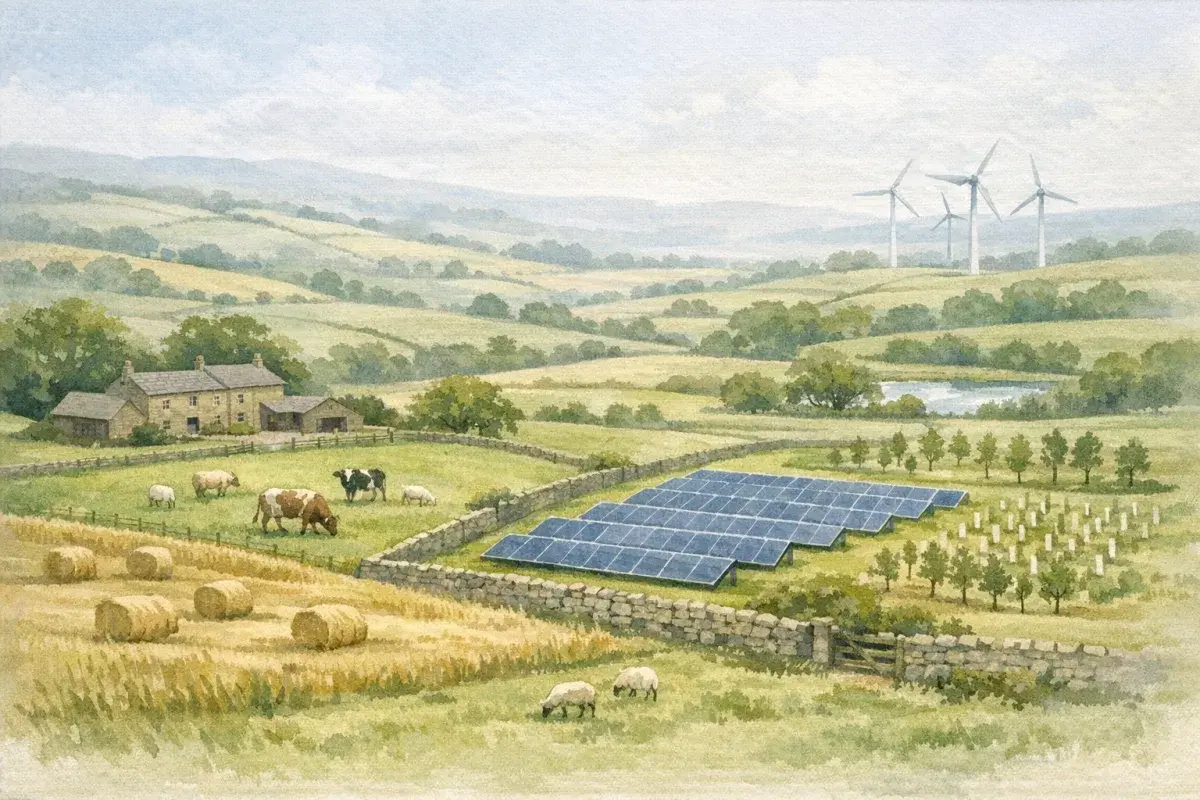
You can stand in the middle of a field and see three different futures: a new yard for your contracting business, a couple of holiday lodges, or a tidy paddock with stables. On paper, each looks like "just using your land differently". In planning terms, though, a change of use agricultural land can be anything from straightforward to a multi-year, high-cost gamble, depending on what you're changing to, what's already on site, and what constraints sit on the map.
This guide cuts through the jargon and the hopeful myths. You'll learn what actually counts as a change of use, the permission routes that exist (and where they commonly fail), the scenarios planners see most often on farms, and the non-planning consequences that catch people out, tax, tenure, valuation and enforcement. If you're trying to protect your core farming operation while unlocking value, this is the practical "what to do next" version.
What Counts As A Change Of Use (And What Doesn’t)
When people say "change of use agricultural land", they often mean one of three things:
- A planning-defined change of use of the land itself (e.g., agriculture to equestrian or leisure).
- A change of use of buildings (e.g., an agricultural barn to a workshop or dwelling).
- A shift in intensity, the use stays broadly similar, but the impacts tip it into "material change" territory.
That distinction matters because the planning system doesn't regulate "change" in a casual sense. It regulates development, and in England (and similarly across the UK nations with their own systems), development includes a material change of use.
Use Classes Vs Sui Generis Uses: Why The Label Matters
In planning, uses are grouped into Use Classes (in England, the Use Classes Order has been revised several times in recent years, including the creation of Class E). The headline point is simple: some moves within a class are easier than moves between classes, and some uses sit outside classes altogether.
Agricultural land is a bit of a special case. "Agriculture" (as defined in planning legislation) covers things like arable, grazing, horticulture, and certain livestock activities. But the moment you drift into uses that don't fall within that definition, especially where people, traffic, noise, or commercial operations become the dominant feature, you may be stepping into a different planning use.
Then there are sui generis uses, uses considered unique. Certain rural activities (depending on scale and nature) can land you in sui generis territory, which usually means fewer "easy swaps" and more scrutiny.
A practical way to think about it: planning officers aren't just labelling your idea: they're predicting its impacts. The "label" (use class / sui generis) is the shorthand they use to anchor those impacts.
Material Change Of Use: The Practical Tests Planners Apply
There isn't one single magic test, but in practice planners look at whether what you're doing would change the character of the use of the land/buildings in a way that matters.
Common triggers for "material change" on farmland include:
- Intensity: a few horses grazing may look agricultural-ish from a distance: a full livery yard with daily client visits, lighting, a ménage and constant vehicle movements won't.
- Physical works that signal a new use: hardstanding, new accesses, fencing for paddocks, signage, lighting, caravans/lodges, wash-down areas.
- Traffic and servicing: HGV deliveries, staff/visitor parking, turn radii, and hours of operation.
- Noise/odour/disturbance: workshops, events, dog activities, visitor attractions.
The awkward truth: you can sometimes "change the use" without constructing much. And you can sometimes build quite a lot without changing the lawful use. But if the activity has planning impacts, it's the activity that will be assessed.
If you're still getting your head around the broader planning baseline for rural land, it's worth reading our deeper guide to what you can (and can't) do on agricultural land under the UK planning system (and where permitted development stops helping).
Agricultural Use And Ancillary Activities: Staying On The Right Side Of The Line
Most farms run a mix of activities that are ancillary to agriculture: machinery storage, feed handling, lambing sheds, farm office admin, seasonal labour arrangements, even farm diversification planning.
"Ancillary" is where many people get unstuck. For an activity to stay on the agricultural side of the line, it usually needs to be:
- Subordinate to the primary agricultural use, and
- Genuinely required for (or closely linked to) the agricultural enterprise on the unit.
A classic flashpoint is storage:
- Storing your own grain and kit for the holding is typically agricultural.
- Storing third-party goods as a stand-alone business can quickly look like B8 storage/distribution (i.e., non-agricultural).
Same building, same doors, completely different planning risk.
If you're unsure, treat it like a red flag, not a grey area. A short pre-application discussion (or a planning consultant's view) is cheaper than an enforcement letter later.
The Main Permission Routes: From Low-Risk To High-Risk
There's no single route for a change of use agricultural land. You're choosing from a menu of planning tools, each with different risk levels, timeframes, and evidence requirements.
The best strategy is usually: start with the least risky lawful route that still achieves your objective, then step up only when you must.
Permitted Development Rights And Prior Approval: When They Help (And When They Don't)
Permitted development (PD) can be a gift in the right circumstances, especially for operational farm development. But PD is not a blank cheque, and it isn't consistent across every UK nation (rules differ in Scotland, Wales and Northern Ireland).
In England, agricultural PD commonly sits within the General Permitted Development Order (GPDO). Depending on the class and the site, you might be looking at:
- New agricultural buildings (with size, siting, and use limitations)
- Tracks
- Certain excavations/engineering operations
- Conversions in limited scenarios (but be careful: conversions and change of use often drift into full planning)
Even when a development is "permitted", you may need prior approval/prior notification for matters such as highways, design/external appearance, noise, contamination risk, or flood.
Where PD often doesn't help is when your goal is fundamentally non-agricultural, especially residential or high-traffic commercial uses.
If residential is your endgame (or you're being told "just do it under permitted development"), read this before you sink money into drawings: our guide to agricultural-to-residential permission realities lays out what typically needs full consent and why.
Full Planning Permission: Evidence You'll Usually Need
For many diversification projects, full planning permission is the main route. It's slower and more exposed to planning policy, but it can also be the cleanest way to secure a robust, financeable permission.
Evidence commonly needed includes:
- A clear planning statement tied to local plan policies
- Site location and block plans (and existing/proposed drawings)
- Transport/highways information (sometimes a full Transport Statement)
- Ecology (from preliminary checks to full surveys, depending on habitats/species)
- Flood risk (if relevant)
- Noise/lighting reports for sensitive uses
- Heritage assessment if there are listed buildings or nearby heritage assets
What planners are really asking is: Is this reasonably located here, and can impacts be managed? If you can't answer that convincingly, the application becomes a policy fight.
Lawful Development Certificates: Proving Existing Use Or Immunity
A Lawful Development Certificate (LDC) isn't "permission". It's a formal confirmation that:
- something is already lawful (because it doesn't need permission), or
- it has become lawful through time (immunity), or
- a particular use is lawful.
This route can be relevant if you've inherited a historic farm setup, say, a yard that's been used for a mixed commercial purpose for many years, and you need certainty for a sale, refinance, or a new planning application.
Two cautions:
- Evidence must be strong: sworn statements, dated invoices, historic imagery, business records.
- Time limits are not a DIY guessing game: the relevant immunity periods depend on the breach type and jurisdiction. Get proper advice before you start relying on "it's been there ages" as a strategy.
Used well, an LDC can de-risk the future. Used badly, it can poke the bear and trigger enforcement attention, especially where neighbour relationships are already strained.
Common Change-Of-Use Scenarios On Farms And Rural Estates
Rural change of use isn't abstract. It usually starts with a very practical problem: "We need another income stream," "The kids want to come back," "That yard is underused," or "We can't justify that building's upkeep anymore."
Here are the scenarios we see most often, and where the traps tend to be.
Agricultural To Residential: Dwellings, Curtilage, And The Reality Check
Residential is the big one, because it's where land value uplifts can be dramatic. It's also where policy resistance can be strongest.
A few reality checks:
- A dwelling is rarely ‘just a dwelling' in planning terms. You're also proposing curtilage, domestic paraphernalia, lighting, bins, boundary treatments, parking, and a long-term change in character.
- Access and services matter. Poor visibility or a substandard track can be the quiet application-killer.
- Location policy bites. Many councils tightly control isolated homes in the countryside unless you can justify a rural worker need or reuse policy.
If your ambition extends to a brand-new home on farmland, don't skip the assignments. Our article on building a home on agricultural land in the UK goes into the realities of policy tests, siting, and the evidence you'll need.
Agricultural To Equestrian: Paddocks, Stables, And ‘Horsiculture' Pitfalls
Equestrian is where people assume: "It's basically grazing." Sometimes it is. Often, it isn't.
Planning frequently distinguishes between:
- Grazing (which can still be agricultural if it's genuinely grazing livestock for farming), and
- Keeping horses for leisure (often treated as equestrian / recreational).
That's where "horsiculture" arguments appear, trying to position horse-keeping as agriculture. In practice, councils will look at how the land is actually used:
- Is it a private paddock with occasional grazing?
- Is it a training/livery operation with clients, staff, deliveries, lighting, arenas and significant vehicle movements?
Small physical changes can have big planning implications: ménages, hardstanding, jumps storage, wash-down areas and stable blocks can convert a quiet field into a "use with impacts".
If you want equestrian use, you'll usually do better with a clean, well-drawn proposal (layout, manure management, access/parking, lighting control) than trying to argue semantics.
Agricultural To Commercial: Storage, Workshops, Yard Uses, And HGV Movements
Commercial yard uses can be an excellent diversification route, particularly where there's an existing cluster of buildings, good access, and separation from neighbouring dwellings.
What commonly sinks these proposals isn't the building. It's the knock-on effects:
- HGV and van movements (frequency, hours, reversing alarms)
- Parking and turning (especially if staff and customers arrive separately)
- External storage and visual impact
- Noise (compressors, fabrication, plant)
If you're planning a workshop or storage use, assume highways and neighbour amenity will be central. Build your application around mitigation: defined hours, acoustic measures, internalised operations, landscaping, clear circulation plans.
And if you're evaluating whether a particular site has upside beyond pure agriculture, our guide to assessing a holding's development potential is a useful way to pressure-test what's realistic (before you spend on architects).
Agricultural To Leisure And Tourism: Glamping, Events, And Visitor Impacts
Leisure and tourism can work brilliantly, if you treat it like running a small rural business with planning constraints, not like "a few tents in a field".
Key planning pressure points:
- Seasonality and duration: the difference between occasional low-impact use and a semi-permanent operation.
- Toilets, waste and servicing: where it all goes, and how it's collected.
- Traffic peaks: events can generate short, intense surges that highways teams dislike.
- Noise and lighting: particularly near housing or sensitive landscapes.
Glamping proposals often succeed when they're:
- close to existing access and services,
- screened with thoughtful landscaping,
- limited in unit numbers,
- supported by a simple but credible management plan.
Events are trickier. Even if the land is large, the local road network might not be. If you're thinking weddings, festivals, or "experience days", get on top of transport management and neighbour impacts early, or expect objections.
Constraints That Can Make Or Break Your Application
Two sites can look identical on the ground and behave totally differently in planning.
Why? Constraints. Most are visible on a constraints map in minutes, yet they still catch people out because they only become "real" when a planner, ecologist, or highways officer points to them in a formal response.
Green Belt, AONB, National Parks, SSSI, Flood Risk, And Heritage Assets
In constrained areas, the question shifts from "Is this a good idea?" to "Is this the kind of development policy will allow here?"
Common UK constraints include:
- Green Belt: new buildings and changes that conflict with openness can be heavily resisted, unless you fit within specific policy categories.
- AONB / National Parks: expect heightened scrutiny on landscape character, design, lighting and cumulative impact.
- SSSI and protected habitats: ecology moves from a checkbox to a central issue. Timing matters, some surveys can only be done in certain seasons.
- Flood zones: the sequential approach and flood risk assessment requirements can shape siting and viability.
- Listed buildings and conservation areas: even if your proposal isn't "on" the listed structure, setting matters.
A mistake we've seen: applicants designing the scheme they want, then discovering policy means they needed a different scheme from day one, fewer units, different siting, different access, or a different business model.
Highways, Access, Visibility, And Parking Standards
Highways is often the deciding factor for rural change-of-use. You might have the perfect barn conversion concept, but if your access can't meet visibility requirements or the lane can't safely take the traffic you're proposing, you're pushing uphill.
What you should sanity-check early:
- Visibility splays at the access onto the public highway
- Passing places on single-track lanes (and whether they're deliverable)
- On-site turning so vehicles can enter/exit in forward gear where expected
- Parking numbers and layout for staff/customers/visitors
A quiet truth: highways teams are rarely swayed by "it'll be fine, it's rural". They want drawings, swept-path analysis if needed, and a realistic trip generation picture.
Noise, Lighting, Odour, Ecology, And Nutrient Neutrality Where Relevant
Change of use applications increasingly live or die on "secondary" technical issues.
- Noise: workshops, kennels, events, even busy equestrian yards. You'll likely need to show how you'll protect residential amenity.
- Lighting: floodlights, yard lighting, and glamping festoon lighting can draw objections fast, especially in dark-sky areas.
- Odour: waste storage, manure handling, composting, or certain commercial processes.
- Ecology: bats in barns, breeding birds, hedgerows, great crested newts, each can impose survey requirements and mitigation.
- Nutrient neutrality: only relevant in certain catchments and contexts, but if it applies, it can fundamentally change timelines and costs.
You don't need to become an expert in each topic. You do need to recognise when one of them is likely to be the "lead issue" and budget accordingly, money, time, and professional input.
Conditions, Planning Obligations, And Long-Term Strings Attached
Getting permission isn't always the finish line. Often it's the start of a long relationship with conditions, obligations, and monitoring.
If you're making a change of use agricultural land to something more valuable, assume the council will try to manage risk through:
- planning conditions (controls on what you can do and when), and/or
- planning obligations (usually legal agreements tied to land).
Agricultural Occupancy Conditions And Rural Worker Ties
Where a new dwelling (or even a converted one) is justified on rural worker grounds, you may face an agricultural occupancy condition (sometimes called an "agricultural tie" or rural worker tie).
This can be sensible policy, keeping essential housing linked to countryside enterprises. But it can also become a long-term constraint on value and saleability.
If you already have a tied dwelling and you're looking at changing the enterprise, refinancing, or sale planning, it's worth understanding the evidence thresholds and pitfalls involved in removing an agricultural occupancy condition (and why councils often resist without robust marketing and need evidence).
Section 106 Agreements, Overage Triggers, And Viability Arguments
For certain developments, councils may require a Section 106 agreement (England and Wales terminology: Scotland and Northern Ireland have broadly similar mechanisms but different legal frameworks).
A S106 can cover things like:
- limiting use or occupancy in a specific way
- highways works or travel plans
- ecological mitigation/management
- contributions (in some contexts)
Separate from planning obligations, land transactions may include overage/clawback: if you secure planning permission later, part of the uplift is payable to the seller (or a third party).
Two practical points:
- Overage triggers and definitions need careful drafting. "Planning permission" isn't always as straightforward as it sounds, reserved matters, variations, certificates, and phased consents can complicate.
- Viability arguments can help in some cases, but they're evidence-led and they invite scrutiny of your costs and assumptions.
If you're negotiating a deal on a farm with hope value, don't leave overage and planning obligations to the last week before exchange.
Enforcement Risk, Time Limits, And How Breaches Escalate
Enforcement is where "it's only temporary" and "nobody will mind" turns into real cost.
Typical escalation looks like:
- A complaint (often from a neighbour) or a council site visit.
- A planning contravention notice / information request.
- An enforcement notice requiring cessation or remediation.
- Potential prosecution for non-compliance.
The bigger risk isn't just being told to stop. It's being told to:
- remove hardstanding,
- reinstate land,
- undo building works,
- and still pay for a proper planning application afterwards.
If your plan relies on operating "under the radar", it's usually a sign the proposal needs redesigning, or the site isn't right for the use.
And if you're preparing for a disposal where historic uses might be questioned, building your file early helps. Our guide on selling agricultural land step by step covers the practical documents and checks that reduce nasty surprises mid-transaction.
Tax, Tenure, And Valuation: The Non-Planning Consequences
Planning is only one piece of the puzzle. A change of use agricultural land can ripple into tax reliefs, VAT positions, rates, and even whether your lender stays comfortable.
This is where you should slow down and get specialist advice early, because "great planning outcome" can still be a poor net outcome.
Agricultural Property Relief, Business Property Relief, And Capital Gains Implications
Reliefs like Agricultural Property Relief (APR) and Business Property Relief (BPR) can be hugely significant in estate planning. But changing how land and buildings are used can affect eligibility.
Examples of where the detail matters:
- If land shifts away from agriculture into a more investment-like use, APR positions may change.
- Diversification can be "trading" or "investment" depending on facts, which can influence BPR.
- A disposal following uplift can create Capital Gains Tax (CGT) issues, and the availability of reliefs depends on circumstances and structure.
This is not an area for rule-of-thumb decisions. You'll want your accountant/tax adviser to look at the whole picture: ownership, trading status, partnership/company structure, and future intentions.
If you're approaching farmland partly as an asset class (whether you're a farmer diversifying or an investor buying in), our UK-focused guide to agricultural land investment risks and due diligence is a solid framework for the questions you should be asking before you commit.
VAT, Rates, And The Trading Vs Investment Question
Change the use, and you may change your VAT and rates landscape:
- Some property income is exempt: some is taxable: and options to tax can come into play.
- Converting or building can bring VAT complexity around input tax recovery.
- Non-agricultural uses can bring business rates into play where none existed before.
The "trading vs investment" point isn't just academic. It can affect:
- how HMRC views the income
- the reliefs you may or may not get
- how a purchaser values the enterprise
If you're creating a diversified income stream, build the tax plan in parallel with the planning plan.
Tenancies, Grazing Licences, And Lender Consent: What Can Block You
Even if planning is achievable, legal occupation and finance can stop you.
Check early:
- Tenancy terms: A FBT, AHA tenancy, or even an informal arrangement can restrict non-agricultural use or building works.
- Grazing licences: Often short-term, but still relevant if you're trying to take land back mid-season.
- Lender consent: If there's a charge on the land, your lender may need to consent to development, leases, or a change of use.
- Restrictive covenants and easements: Private constraints can bite just as hard as planning.
Valuation also changes. Once a site has non-agricultural income, valuers may assess it on yield, covenant strength of tenants, and risk, rather than purely on acres and soil indices.
The smart move is to treat your proposal as a combined planning–legal–tax project from day one, not a planning application you "tidy up" later.
A Step-By-Step Approach To Getting A Change Of Use Right
If you want a change of use agricultural land to succeed, you need more than a good idea. You need a process that reduces avoidable risk.
Here's a step-by-step approach we've seen work across farms, estates, and rural smallholdings.
Due Diligence: Title, Covenants, Rights Of Way, Services, And Planning History
Before you draw anything, do a fast but disciplined due diligence sweep:
- Title and boundaries: Is the plan accurate? Any ransom strips? Any unregistered land issues?
- Restrictive covenants: Do they limit building, business use, caravans, or subdivision?
- Rights of way: Footpaths and bridleways through a tourism site can be manageable, but not if you ignore them.
- Services: Power capacity, water supply, drainage. "We'll sort it later" can become the most expensive sentence in the project.
- Planning history: Previous refusals, appeal decisions, enforcement cases. Planners have long memories, files do too.
If you're buying rather than already owning, broaden your baseline knowledge. Our practical primer on buying and managing agricultural land in England is a helpful checklist-driven read for spotting issues early (access, tenancies, environmental constraints, and planning risk).
Pre-App Advice, Design And Access, And Technical Reports That Speed Decisions
A strong pre-app submission can save months, if you treat it as more than a box-tick.
What tends to make pre-app useful:
- a clear description of the proposed use (hours, numbers, traffic, lighting)
- an honest constraints summary (don't hide the SSSI or flood risk)
- an initial access sketch with visibility assumptions
- a simple landscape approach (especially in sensitive areas)
Then, plan your technical reports around likely objections. For many rural change-of-use applications, these are the "time savers":
- ecology scoping early (to avoid missing survey windows)
- highways input early (to avoid redesigning access later)
- noise/lighting strategy (to head off amenity objections)
A good Design and Access/Planning Statement doesn't just describe the proposal. It answers the unspoken question: why this use, here, and why this layout?
Choosing The Right Professionals: Agent, Planner, Surveyor, And Tax Adviser
Rural change of use is multidisciplinary. The best outcomes usually happen when your team speaks to each other, early.
Who you may need:
- Agricultural agent/land agent: market reality, deal structure, overage, comparable evidence.
- Planning consultant: policy strategy, pre-app positioning, appeal thinking.
- Rural surveyor: valuation, site appraisal, development viability.
- Architect/technician: drawings that are actually buildable and match the planning narrative.
- Ecologist/highways engineer/noise consultant: as required by site/use.
- Accountant/tax adviser: APR/BPR/CGT/VAT implications.
- Solicitor: title, covenants, easements, leases, overage, lender consent.
Whichever side you're on. Buyers tell AgLand what they're looking for and hear the moment something fits. Owners advertise straight to the buyers who already match, for one flat fee and no commission. Register as a buyer or check your matches.
One last practical tip: keep a project file from day one, emails, drawings, photos, notes of meetings. When you're six months in, you'll be glad you did.
Conclusion
A change of use agricultural land can unlock genuine long-term resilience, extra income, better use of redundant buildings, even a route for the next generation to stay on the farm. But it's rarely "just planning". You're navigating policy, constraints mapping, highways reality, neighbour impacts, legal title, tax reliefs, and future saleability all at once.
Your best advantage is being systematic. Define the use precisely, pick the least risky permission route that fits, front-load the constraints work, and get the right professionals around the table before you start spending serious money. Do that, and you'll avoid most of the expensive dead ends we see.
Disclaimer: AgLand.co.uk is a UK agricultural land and rural property matching service, where buyers register what they are looking for and owners advertise directly to the buyers who match, and a rural resource hub. Nothing in this text is intended as legal, financial, or investment advice. You should carry out your own due diligence and take advice from appropriately qualified professionals (for example, a planning consultant, rural surveyor, solicitor, and tax adviser) before making decisions or committing to any transaction or development.