
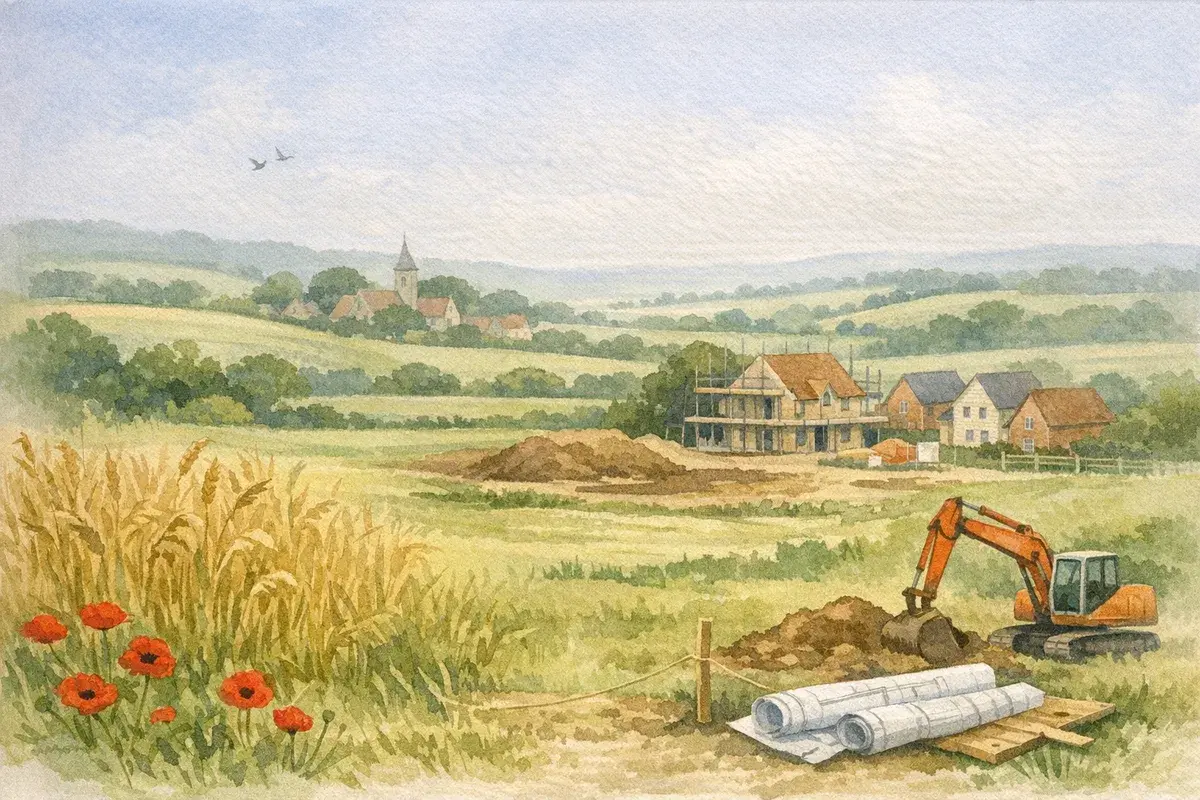
Can you build on arable land? Sometimes, yes, but only if planning policy, access, landscape impact, and the site's agricultural case all stack up. For most farms, the answer is still 'not easily', which is why understanding the rules matters before anyone spends serious money.
The short version is this: arable land sits in the same planning system as every other rural site, yet it often gets stronger protection because it is productive farmland. That can affect everything from a new farmhouse or shed to a barn conversion, holiday accommodation, or a one-off dwelling, and the details vary a lot by county, local plan, and Green Belt status.
If you're a farmer, landowner, or estate agent, the key question isn't just whether building might be allowed. It's what kind of development, where it sits in the field pattern, and how it fits rural planning policy in England, Scotland, Wales, or Northern Ireland (rules differ more than many people expect).
Can You Build On Arable Land In The UK?
Yes, you can sometimes build on arable land, but only with planning permission unless the proposal falls within permitted development rights. Arable land means land used to grow crops such as wheat, barley, oilseed rape, potatoes, or vegetables, and planning officers will usually treat it as working agricultural land rather than a blank canvas.
That distinction matters. A field near a village may look like a tempting development plot, but if it falls outside settlement boundaries, sits in open countryside, or changes the character of a high-grade farmed landscape, permission can be hard to secure. We'd argue that many hopeful schemes fail because the land's agricultural value was ignored at the outset.
What Counts As Development On Arable Ground?
Development can mean a new dwelling, agricultural building, access track, hardstanding, slurry store, polytunnel, irrigation reservoir, or a change of use. Some items need full planning consent, while others may qualify under agricultural permitted development rights if the use is genuinely agricultural and the site meets the stated limits.
For example, a grain store or machinery shed on a farm in Lincolnshire may be more achievable than a house on a similar parcel in Surrey. The purpose, scale, design, and location all shape the outcome, and local policy often weighs heavily against unnecessary loss of good-quality farmland.
- Full planning permission: usually needed for houses, major commercial uses, and many non-agricultural changes.
- Permitted development: may apply to certain farm buildings or temporary works, subject to prior approval.
- Change of use: often the hardest route where the new use is not agricultural.
- Land classification: higher-grade soils are more sensitive in planning terms.
Why Arable Land Gets Extra Scrutiny
Arable land is often among the most versatile and productive agricultural land, so local authorities are reluctant to see it taken out of food production without a strong reason. In areas with large blocks of Grade 1 or Grade 2 land, such as parts of East Anglia, the Fens, Yorkshire, and Hampshire, that sensitivity can be acute.
The same idea applies, in a different way, in counties with tight planning controls and strong landscape protections, such as the Cotswolds, Dorset, Kent, and Suffolk. If a site forms part of a wider agricultural enterprise, the planning case must usually show a real operational need, not simply an aspiration to unlock land value.
Planning Permission, Agricultural Permitted Development, And Exceptions
The main route to building on arable land is still planning permission from the local planning authority. That means checking the local plan, national policy, flood risk, access, ecology, highways, neighbour impact, and how the proposal affects the countryside setting.
There are exceptions, but they're narrower than many people hope. Agricultural permitted development rights can help with certain buildings, though the rules depend on the size of the structure, whether the land is part of an established agricultural unit, and whether prior approval is required. In practice, a lot turns on whether the scheme supports a genuine farming business.
Common Routes That May Work
Some proposals have a better chance than others. A new livestock shed, storage building, grain drier, or covered yard may be easier than a dwelling, and a conversion of an existing masonry barn can be more realistic than a fresh build on open arable ground.
There's also a difference between agricultural development and diversification. A farm shop, office, glamping pod, or equestrian use may be possible, but planning officers will test whether the enterprise is viable, whether traffic is acceptable, and whether the site remains in keeping with the countryside character.
- Agricultural building: often the strongest case if tied to a working holding.
- Barn conversion: may be possible where the structure is sound and rural character can be retained.
- Farm diversification: can be approved if it supports the rural economy without overdevelopment.
- Replacement dwelling: sometimes allowed where an existing agricultural house exists or a lawful dwelling has been demonstrated.
When Permission Gets Harder
Permission becomes much harder if the land lies in the Green Belt, An Area of Outstanding Natural Beauty, National Landscape designation, conservation area setting, or floodplain. The same applies where access relies on a narrow lane, visibility splays are poor, or the proposal would interrupt a working block of cropped land.
In counties like Oxfordshire, Surrey, Warwickshire, and parts of Wiltshire, strong landscape and settlement policies can block development even where the land is privately owned and technically available. Is it impossible? No. But the policy burden is usually higher, and the supporting evidence has to be much better.
| Scheme Type | Typical Planning Position | Usual Risk Level | Date Reference |
|---|---|---|---|
| Farm shed or grain store | May qualify under agricultural permitted development or full permission | Medium | As of June/2026 |
| New dwelling on open arable field | Usually resisted unless a very strong exceptional case exists | High | As of June/2026 |
| Barn conversion | Often viable if the building is suitable and the design is modest | Medium | As of June/2026 |
| Farm diversification use | Case-specific and policy-led, with transport and amenity concerns | Medium to High | As of June/2026 |
How Land Classification Shapes The Answer
Land classification is one of the most important factors in deciding whether you can build on arable land. In England and Wales, the Agricultural Land Classification grades land from 1 to 5, with Grade 1 and Grade 2 considered the best and most versatile, while Subgrade 3a also remains highly productive.
That doesn't ban development automatically, but it does make the planning argument more difficult. If the land is sorted as best and most versatile agricultural land, many authorities will expect a strong justification for taking it out of production, especially where there are lower-grade sites elsewhere.
Best And Most Versatile Land
Best and most versatile land, often shortened to BMV, usually means Grades 1, 2, and 3a. This land is prized because it can support a wide range of crops and tends to justify long-term agricultural investment, from drainage to irrigation and soil improvement.
For a landowner in Norfolk or Cambridgeshire, for instance, the presence of BMV land can make a proposed dwelling or commercial building much harder to defend than a scheme on a poorer parcel nearby. Planning authorities are expected to give weight to the loss of this land, particularly where the development is not essential to agriculture.
Where Local Evidence Can Help
Soil surveys, crop records, historic yields, drainage maps, and farm business plans can all support a planning case. If the proposal genuinely improves agricultural operations, the evidence should show it clearly rather than assuming the planning officer will connect the dots.
That said, evidence cuts both ways. If maps show the land is highly productive, well drained, and part of a coherent arable block, the authority may say it should remain in agricultural use. For land agents, that often means advising clients early on whether a sites prospects are realistic or simply optimistic.
- Grade 1 or 2 land: strongest agricultural status and highest planning sensitivity.
- Subgrade 3a: still BMV and often treated cautiously.
- Grades 3b to 5: generally less sensitive, though still not free for development.
- Soil evidence: can strengthen or weaken a planning case quickly.
How Different UK Regions Handle Arable Development
Planning rules are broadly similar across the UK, but the practical approach varies by nation and county. England relies heavily on the local plan and national policy, while Scotland, Wales, and Northern Ireland each use their own development frameworks and countryside protections.
Regional context matters a great deal. A scheme that has a fair chance in parts of Cheshire or Herefordshire might face a much tougher test in the South Downs, the Lake District fringe, or within commuting distance of London. County planning officers also differ in tone, which is why local knowledge pays.
England
In England, the main pressure points are the National Planning Policy Framework, Green Belt policy, landscape designations, flood risk, and the local plan. Agricultural land quality is a key material consideration, especially where the proposal would permanently remove productive cropland.
Counties with major arable blocks such as Lincolnshire, Cambridgeshire, Essex, Suffolk, and Norfolk often see careful scrutiny of any non-farm development. Even a relatively small scheme can attract objections if it fragments a working farm unit or creates precedent for more building.
Scotland, Wales, And Northern Ireland
In Scotland, rural development policy can be more flexible in some circumstances, but land management, landscape, and transport still matter enormously. In Wales, the emphasis on the countryside, farm diversification, and sustainable development can support some schemes, though not on every field.
Northern Ireland also takes a policy-led approach, with sensitivity around the countryside and the protection of productive farmland. Put simply, there isn't a single UK answer, so assuming one county's outcome applies everywhere is a mistake.
Practical Steps Before You Try To Build
Before anyone buys arable land hoping to build, the site needs a proper planning reality check. That should include the land classification, title restrictions, access rights, services, flood maps, ecology, contamination history, and whether any existing agricultural building could be reused instead.
It also helps to think commercially. A buyer in Devon might see a roadside field as a future house plot, but if the planning route is weak, the real value may still be in the soil, the cropping potential, or a long-term land investment rather than development gain.
What To Check First
Start with the basics: is the land inside or outside settlement boundaries, is it in a protected designation, and what does the local plan say about countryside development? Then look at whether the access is capable of serving the proposed use without creating highway danger or unacceptable traffic.
Next, test the agricultural narrative. If the building supports crop storage, livestock handling, or a genuine diversification business, the case may be workable. If the main argument is simply that the field is owned privately and seems available, the odds are usually poor.
- Planning status: check local plan designations and any prior applications nearby.
- Land quality: establish whether the site is BMV or lower-grade land.
- Access: confirm visibility, width, and whether rights of way exist.
- Utilities: assess water, power, foul drainage, and broadband early.
- Flood risk: low-lying arable land can introduce a major constraint.
Why Agent And Surveyor Input Matters
Land agents and rural surveyors can help separate realistic opportunities from expensive daydreams. They can also advise on whether a promotion agreement, option agreement, or overage clause might be appropriate if there's any hope of residential or commercial uplift.
From a market perspective, that structure matters. A parcel in the West Midlands with weak planning prospects may still be worth a lot as prime arable land, but a similar field in a peri-urban location could have very different optionality if the policies soften over time.
| County Example | Likely Planning Climate | Practical Takeaway | Date Reference |
|---|---|---|---|
| Lincolnshire | Strong arable base, detailed scrutiny of land loss | Good for farm buildings, harder for new homes | As of June/2026 |
| Surrey | High policy pressure, limited countryside tolerance | Expect strong resistance outside settlements | As of June/2026 |
| Norfolk | Productive farmland with transport and landscape considerations | Evidence-led applications matter most | As of June/2026 |
| Worcestershire | Mixed rural policy, case-by-case assessment | Farm context can be decisive | As of June/2026 |
Conclusion
So, can you build on arable land? Yes, but only where the planning case is strong, the use is justified, and the site constraints don't tip the balance against you. For many plots, the land's agricultural quality, local designation, and access will matter far more than the owner's intentions.
If you're assessing a field in Yorkshire, Somerset, Kent, or anywhere else in the UK, treat the question as a planning and land-value exercise, not a quick yes-or-no gamble. That's the sensible way to protect both the farmed land and the financial case.
Disclaimer: AgLand.co.uk is a UK agricultural land and rural property matching service, where buyers register what they are looking for and owners advertise directly to the buyers who match, and a rural resource hub. Nothing in this text is intended as legal, financial, or investment advice. You should carry out your own due diligence and seek guidance from appropriately qualified professionals (for example, solicitors, land agents, surveyors, and financial advisors) for your specific circumstances.