
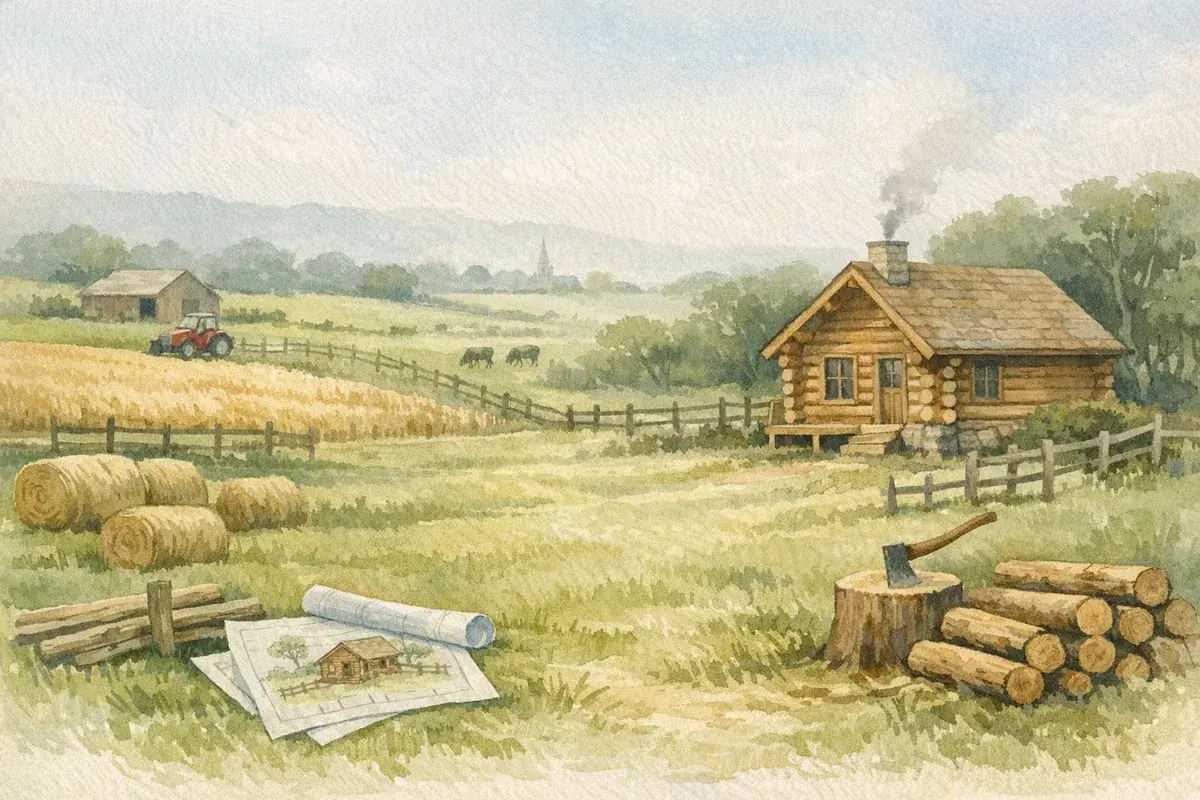
If you're asking can I build a log cabin on agricultural land, the short answer is: sometimes, but only with the right planning route and a clear lawful use. In most cases, a simple holiday-style cabin won't be allowed on farmland just because the land looks suitable.
The key issues are planning permission, whether the cabin counts as a dwelling, and how the land is currently used. A modest structure for agricultural purposes can be possible in some situations, yet a residential log cabin is treated very differently by local planning authorities.
That distinction matters more than many buyers realise. Claiming agricultural land is cheap and open with no planning headaches is risky, because the rules vary by county, site context, and the exact proposal. We'd argue the first question is not whether you can place a cabin on the land, but what the cabin is for, and whether the use can be justified.
Planning Permission On Agricultural Land
In England and Wales, agricultural land usually sits within a planning framework that protects the countryside from uncontrolled residential development. A log cabin may be treated as a building, a change of use, or both, depending on its size, permanence, and occupation pattern.
If the cabin is intended as a home, sleeping accommodation, or holiday let, it will usually need express planning permission. If it is for farm management, such as storing equipment, housing staff temporarily during lambing, or supporting a business use, the planning case can be stronger, but it still depends on evidence and scale.
What Counts As Agricultural Land
Ag land is land used for farming activities such as grazing, arable crops, orchards, horticulture, and livestock. A field on its own does not give you building rights, even if it has been farmed for decades.
Local authorities will look at the use class, access, ecology, road safety, drainage, and visual impact. In counties with tighter countryside policies, such as Surrey, Oxfordshire, and parts of Cornwall, small-scale proposals can still face robust scrutiny.
- Agricultural use: farming activity on the land, not a development right.
- Permitted development: limited rights that may apply to certain farm structures.
- Lawful use: a use the council accepts as legally established.
- Planning application: formal permission needed for most dwelling proposals.
Permitted Development Rights For Farm Buildings
Some farm buildings can be created or altered under permitted development rights, which are national rules that allow limited works without a full planning application. These rights do not normally extend to a new residential log cabin.
For example, a farm might put up a building for storage, livestock welfare, or machinery use under specific conditions. But once the intention shifts towards sleeping, self-contained living, or leisure accommodation, planning control tightens considerably.
Can A Log Cabin Be A Dwelling
This is usually the decisive point. A log cabin that is used as a dwelling on agricultural land is far more difficult to justify than a cabin used for agricultural operations or ancillary farm purposes.
Planning officers ask whether the building is capable of independent residential occupation. If it has a kitchen, bathroom, sleeping space, and year-round living services, it is likely to be treated as a home, even if it is built from timber and looks rustic.
Residential Use Versus Ancillary Use
Ancillary use means the cabin supports an existing lawful main use. Think of a farm office, a welfare unit, or a temporary site cabin for seasonal workers. That is different from creating a separate home in the middle of a field.
If the cabin would operate as a standalone dwelling, the council may require a full planning application and a strong planning justification. In some cases, this could include proving an agricultural need, though that route is narrow and evidence-heavy.
Temporary Accommodation And Rural Workers
Some farms need short-term accommodation for workers during peak periods. This can include dairy, poultry, fruit picking, or lambing units, where staff presence is genuinely needed on site.
Even then, the proposal must be proportionate. Councils often want to see why existing buildings cannot be used, whether the need is full-time or seasonal, and whether the accommodation can be removed later. In Devon, Herefordshire, and Rutland, where active farming and protected countryside often sit side by side, that evidence can make or break an application. Removability carries less weight than owners expect, because foundations, servicing and how long a unit actually stays in place all feed into whether it counts as development at all, a point our guide to putting a temporary structure on rural land sets out.
When Planning Permission Is More Likely
There are a few scenarios where a log cabin has a better chance of approval on agricultural land. None are automatic, but each can create a sensible case if backed by proper reports and a realistic design.
One route is where the cabin is genuinely tied to an active agricultural enterprise and is needed for that business to function. Another is where the land holds an established lawful development, such as a cluster of farm buildings, and the cabin is modest in scale and carefully sited.
| Scenario | Planning Prospects | Typical Issues | Date Reference |
|---|---|---|---|
| Farm office or welfare cabin | Moderate | Must stay ancillary to farming | As of June/2026 |
| Seasonal worker accommodation | Moderate to low | Need evidence of seasonal demand | As of June/2026 |
| Full residential log cabin | Low | Strong countryside and policy resistance | As of June/2026 |
| Replacement for an existing lawful dwelling | Variable | Depends on history, footprint, and condition | As of June/2026 |
Planning officers also consider nearby designations. A parcel in the Green Belt, National Landscape area, National Park, or near a heritage asset will face additional tests. In places like the Cotswolds, Kent Downs, or Northumberland National Park, the design and siting need to be especially careful.
Certificate Of Lawfulness And What It Can Do
If a cabin has already been used in a way that has become lawful through time, a certificate of lawfulness may be relevant. This does not grant permission from scratch, but it can confirm that an existing use has become immune from enforcement in certain circumstances.
That said, relying on historic use is a specialist exercise. You will need hard evidence such as utility records, photographs, tenancy documents, council correspondence, and sworn statements. Without that, the safer assumption is that the cabin needs fresh permission.
Costs, Risks, And Practical Realities
Even if the answer to can I build a log cabin on agricultural land is potentially yes, the commercial reality can be sobering. The land may be cheaper than residential land, but the planning risk, infrastructure costs, and professional fees can quickly narrow the gap.
As of June/2026, buyers are still seeing strong price differences between pure agricultural land and land with residential potential. Bare arable or pasture land often trades at a fraction of residential development land, yet the uplift from planning consent can be dramatic, which is exactly why councils examine these proposals closely.
Typical Cost Considerations
You'll usually need more than the cabin itself. Access tracks, drainage, electricity, potable water, wastewater treatment, ecology surveys, and design drawings all add cost, and they can be essential to a successful application.
For a farm-based scheme in an ordinary rural county, initial professional costs can run into several thousand pounds before a spade hits the ground. On more sensitive sites, especially where highways or ecology are contentious, the budget can climb much higher.
- Planning advice: helps test whether the idea is viable.
- Topographical survey: records levels, boundaries, and constraints.
- Ecology report: checks for bats, nesting birds, and habitats.
- Drainage design: vital where mains sewer access is absent.
- Highways input: needed if access or visibility is limited.
There is also enforcement risk. If you place a cabin without permission and move someone in, the council can investigate, require removal, or pursue formal action. That can be costly and stressful, particularly if finance or insurance was arranged on the assumption that the use was secure.
County-Level Differences Across Rural Britain
While planning law is national, local policy culture varies. Some rural authorities are pragmatic about farm diversification, while others are more protectionist, especially in areas with strong landscape designations or pressure from second-home demand.
Across Norfolk, Lincolnshire, and Northamptonshire, larger farm holdings may have more scope for functional agricultural buildings, but that does not mean a log cabin home will be acceptable. In Somerset, Dorset, and Cumbria, landscape and tourism pressures can make even small structures contentious if they look residential.
Scotland and Northern Ireland have their own systems and terminology, so the details differ again. If you're dealing with a site near the Scottish Borders, for instance, you need advice that reflects the local planning regime rather than assuming English rules apply.
There is a real difference between a cabin intended as part of a working farm and one pitched as lifestyle accommodation. Councils are increasingly alert to proposals that look like rural homes in disguise, so consistent documents and honest descriptions matter more than ever.
Conclusion
So, can I build a log cabin on agricultural land? Sometimes, yes, but only where the proposal fits planning policy, the use is properly justified, and the site can support it without undermining countryside protections. A farm-related building may be possible, while a stand-alone home usually faces a much tougher test.
The safest approach is to work out the intended use first, then test it against planning, access, drainage, and local policy. On agricultural land, the cabin's purpose is everything, and the way you evidence that purpose will usually decide the outcome.
Disclaimer: AgLand.co.uk is a UK agricultural land and rural property matching service, where buyers register what they are looking for and owners advertise directly to the buyers who match, and a rural resource hub. Nothing in this text is intended as legal, financial, or investment advice. You should carry out your own due diligence and seek guidance from appropriately qualified professionals (for example, solicitors, land agents, surveyors, and financial advisors) for your specific circumstances.